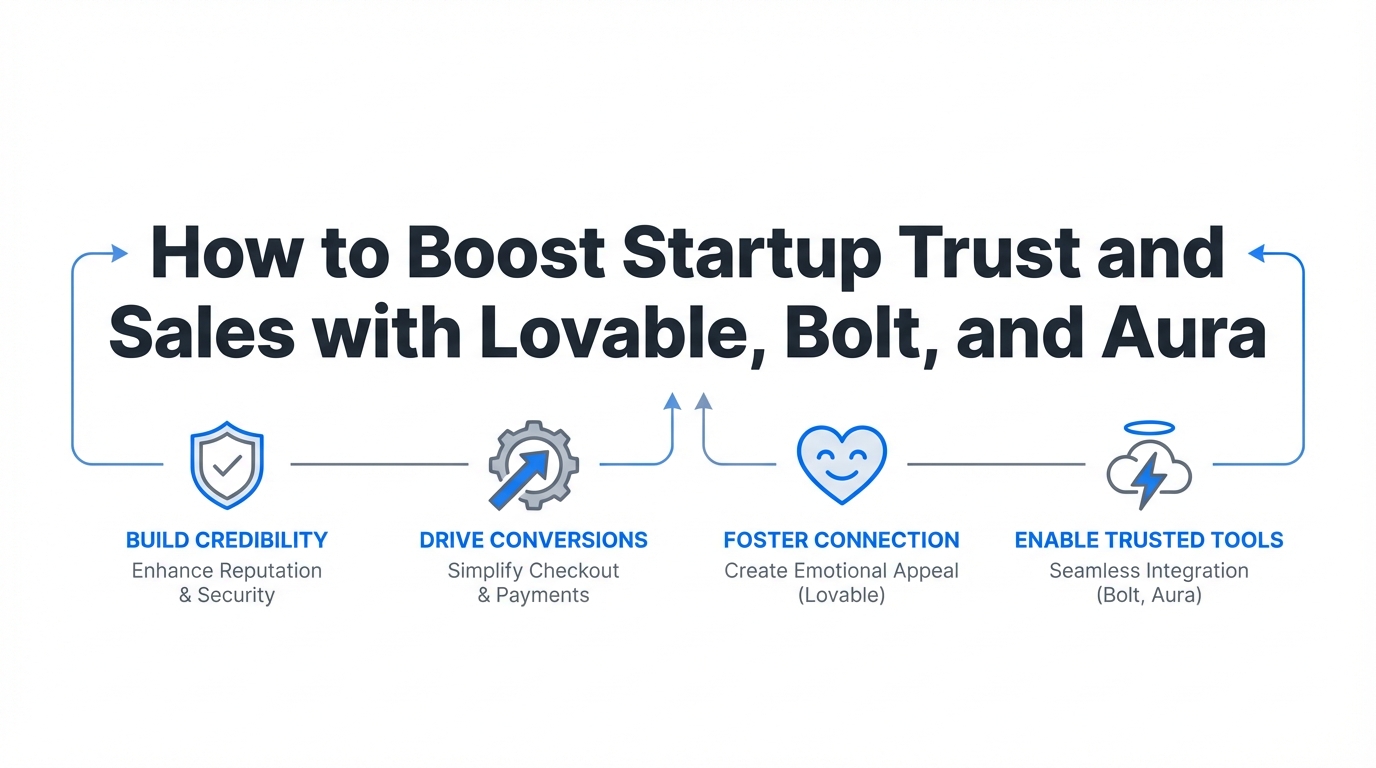
In the current era of "vibe coding," the barrier to shipping a functional product has never been lower. Tools like Bolt.new and V0.dev allow founders to generate entire applications from a single prompt. However, there is a looming problem: most AI-generated startups look exactly the same. They rely on the same generic ShadCN templates, the same sterile layouts, and the same lack of "soul." This visual sameness is a silent killer for startup conversion rate optimization. When a potential customer lands on your site and it looks like a thousand other generic SaaS tools, they don't just see a young company—they see a lack of care. And where there is no care, there is no trust.
To move past the generic and into the realm of premium brand building, founders must bridge the gap between developer-centric AI tools and high-end designer aesthetics. By leveraging new tools like Aura to enhance the output of platforms like Lovable.dev, you can create products that don't just function—they elicit the psychological trust signals required to charge premium prices. In this guide, we will break down the playbook for moving from "generic AI output" to "A16Z-backed aesthetic," allowing you to increase your pricing power and scale your user base without spending a dime on traditional advertising.
The Psychological Link Between High-End UI and Customer Trust
There is a reason why consumers are willing to pay a 40% premium for Apple products despite comparable hardware specs elsewhere. This is the "Apple Effect." In the digital world, your UI is your storefront. It is the only physical manifestation of your code that the user can see and touch. UI design for growth isn't just about pretty colors; it's about signaling to the user that the people behind the product care about the details. If you care about the kerning in your typography, the user subconsciously assumes you also care about the security of their data and the reliability of your backend.
"Marketing is all about what people feel when they see your design. It shouldn't feel generic—it should feel unique, even if you only spent two hours on it."
When you use standard templates from V0.dev, you are following a standard. While standards provide consistency, they rarely inspire premium brand building. Users are increasingly sophisticated; they can spot a "template" from a mile away. To break this, you need to introduce "taste." Taste is the human element that AI struggles to replicate without heavy guidance. It involves understanding visual hierarchy, deliberate spacing, and the subtle use of shadows and gradients that make a digital element feel tangible.
Why Generic ShadCN Templates are Killing Your Conversions
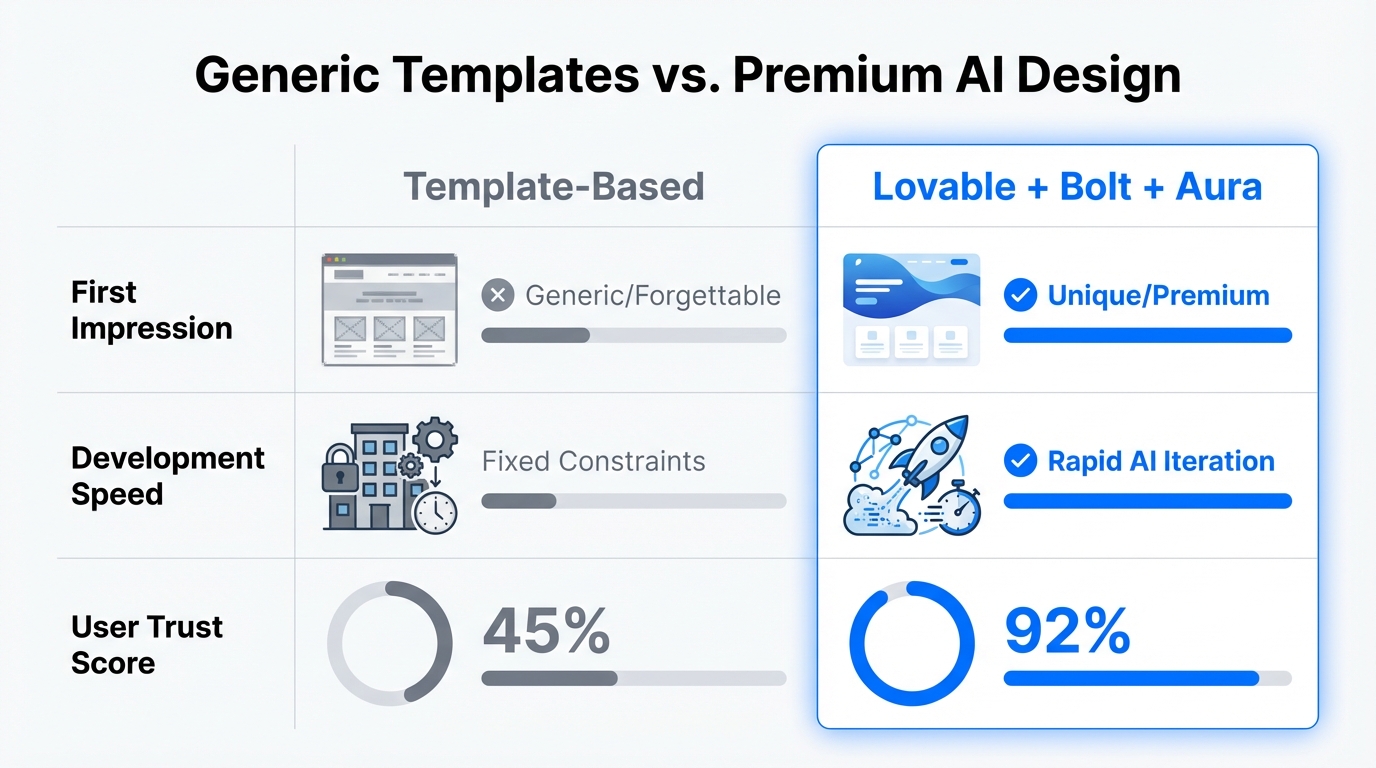
Most AI-powered development tools are deeply integrated with ShadCN/UI. While ShadCN is an incredible library for developers, its ubiquity has created a "sameness" across the internet. When every dashboard uses the same slate-gray borders and the same Inter font weight, your brand becomes invisible. This lack of differentiation is a major hurdle for SaaS trust signals. If your site looks like a template, your product feels like a commodity. Commodities are always in a race to the bottom on price.
The problem isn't the code; it's the lack of context given to the AI. Platforms like Lovable are more designer-oriented than their competitors, but they still require a specific vocabulary to reach their full potential. Without high-level design terminology, you are stuck in a cycle of "make it look clean" or "make it modern"—prompts that the AI interprets as the most generic possible version of those concepts. To fix your conversion rates, you must learn to direct the AI with specific design nuances like Bento layouts, claymorphism, and sequence animations.
How to Use Aura to Bridge the Gap Between Bolt and Designer Aesthetics
One tool that has recently surfaced to solve the generic AI problem is Aura. Aura acts as a prompt builder and design layer that sits on top of tools like Bolt. Instead of typing into a blank chat box, Aura allows you to visually select layout patterns, typography styles, and animation sequences. This "training wheels for design" approach ensures that the output code is packed with the context necessary to look like a high-end product.
| Feature | Generic AI Tool (v0/Bolt) | Aura + Lovable Approach |
|---|---|---|
| Layout | Standard grid/flexbox | Bento, 1/3 splits, custom framing |
| Typography | Default Inter/System sans | Manrope, Geist, Serif accents |
| Animations | Basic fade-in | Sequence, letter-by-letter, blur effects |
| Visual Detail | Flat colors, basic borders | Subtle gradients, depth-based shadows |
By using Aura’s prompt builder, you can inject thousands of lines of context into your prompt. This includes specific CSS variables for "glassmorphism" or specific React components from libraries like 21st.dev. Instead of reinventing the wheel, you are essentially curating the best of the open-source community and forcing the AI to implement it correctly. This method was used to build ideabrowser.com, a tool that received praise from billion-dollar company founders specifically for its design details, despite having no dedicated designer on the team.
The Step-by-Step Playbook for Creating 'A16Z-Backed' Looking Products
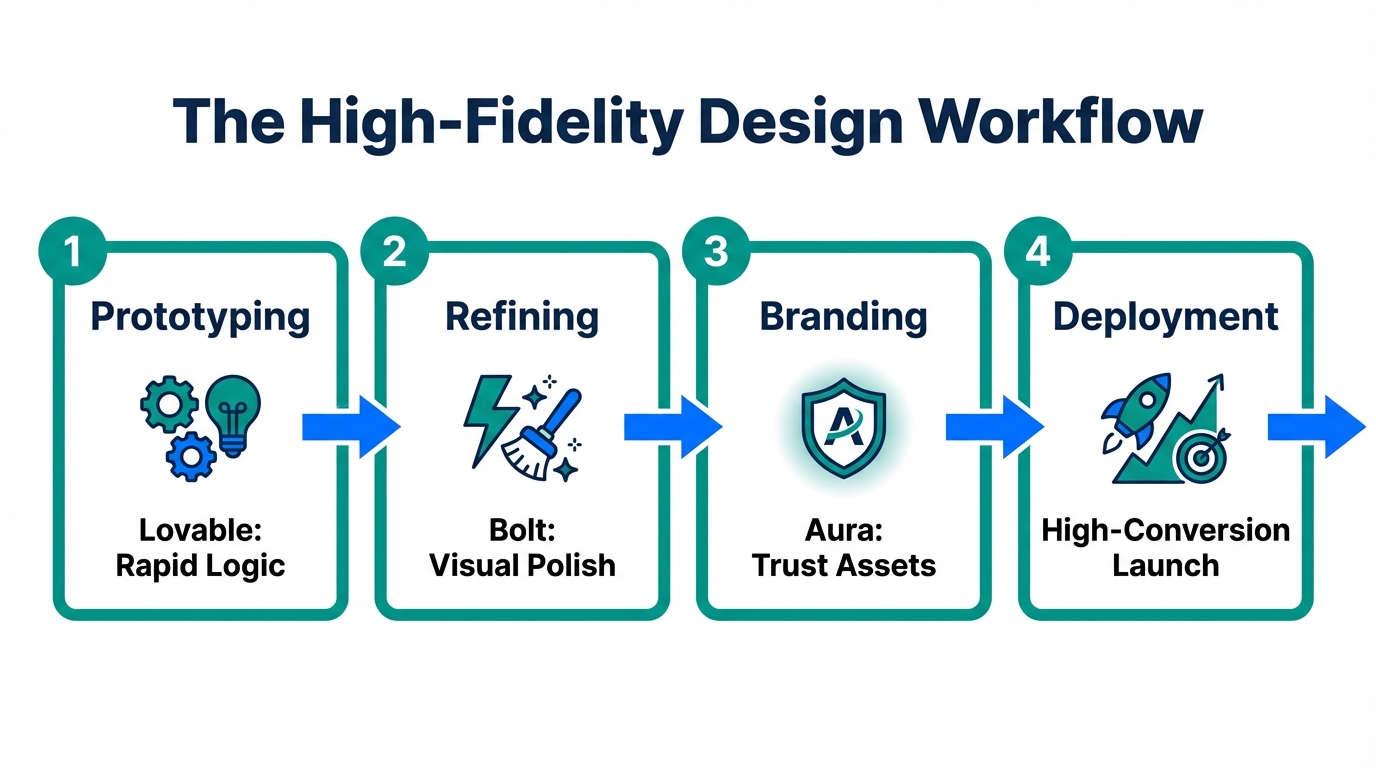
If you want to increase your pricing power, you need to follow a specific design-first prompting hierarchy. Here is the playbook for founders to achieve high-fidelity AI design for founders:
Step 1: Define Your Layout Vocabulary
Stop using the word "website." Instead, use specific layout terms. Are you building a Bento layout (inspired by Apple’s hardware pages)? Is it a Document-style layout with a sticky sidebar? Defining the framing—whether it's a browser mockup, a floating card, or a clay effect—immediately elevates the product above standard full-screen templates. Use Figma to find layout inspirations even if you don't know how to design there yourself.
Step 2: Master the 80/20 Rule of Typography
80% of all digital design is text. If you change nothing else but the font, your trust signals will skyrocket. Move away from standard fonts and experiment with Geist, Manrope, or specialized Serif fonts for headings. Use the prompt builder in Aura to specify different weights and letter-spacing (kerning) to create a sense of premium luxury. High-end brands often use slightly wider tracking for headers and tighter leading for body text.
Step 3: Inject "The Special Sauce" with Micro-Animations
Static sites feel dead. Premium sites feel alive. Use resources like CodePen or React Bits to find code for background particles, text gradients that shimmer on hover, or sequence animations where elements appear one by one. Copy this code and paste it directly into your Lovable or Bolt session with the instruction: "Implement this specific animation logic for my hero section."
"The last thing you want is to follow exactly what the big players are doing. You need to push the envelope to set yourself apart in a world of AI-driven sameness."
Leveraging High-Fidelity Design for UGC and Influencer Campaigns
Once you have a product that looks "A16Z-backed," your marketing becomes significantly easier. High-fidelity UI is inherently viral. It is much easier to convince a top-tier creator to showcase your app when it looks like a work of art. This is where UGC (User-Generated Content) strategies become a massive growth lever for mobile and web apps. When your design is stunning, creators naturally want to feature it in their "best new tools" videos because it makes their own content look better.
To scale this, platforms like Stormy AI streamline creator sourcing and outreach. Since high-end design appeals to specific aesthetic-focused niches on TikTok and Instagram, you can use the AI search engine in Stormy AI to find influencers who already post high-quality tech reviews. By providing them with a beautiful product, your conversion rates from their traffic will be 3-5x higher than if you were sending them to a generic ShadCN landing page.
Case Study: How Design-First Prompting Led to 500 Signups a Day
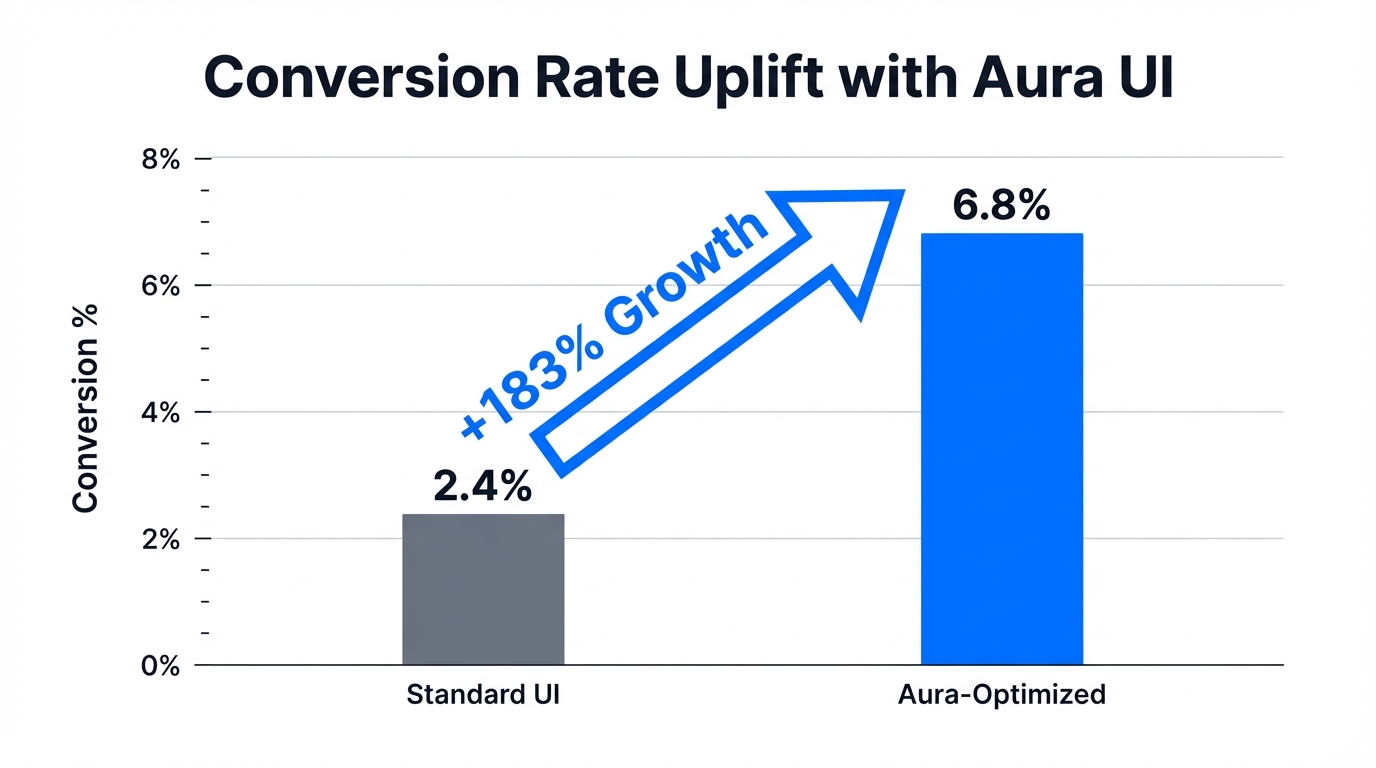
Aura isn't just a tool; it's a testament to the power of high-fidelity design. The founder, Colin David Kennedy, vibe-coded the platform in just a few weeks. However, the growth didn't come from heavy ad spend on Google Ads. Instead, it came from "design-first" marketing on Twitter and YouTube.
By sharing tips on typography prompting and showing off "gorgeous, stunning looking designs" that looked impossible to create with AI, Aura attracted over 50,000 views on YouTube and 9,000+ likes on social media. This visual proof led to a consistent 500 signups per day and a growing MRR of $3,000 within the first few weeks of the web launch. The key takeaway? The product marketed itself because the design was so far ahead of the "generic AI" curve.
Conclusion: Moving to a "Take My Money" UX
In the end, the goal of premium design is to move the customer from skepticism to the "take my money" phase as quickly as possible. When you combine the speed of Bolt with the aesthetic precision of Aura, you create a competitive moat that generic startups cannot cross. You are no longer just a "founder who prompts"; you are a digital architect with taste.
To start boosting your trust and sales today, stop accepting the first result your AI tool gives you. Push for better typography, experiment with unique layouts, and use micro-animations from libraries like Framer Motion to bring your product to life. When your UI communicates that you care, your customers will reciprocate with their wallets. And when you're ready to show that beautiful product to the world, use Stormy AI to find the creators who can turn your high-fidelity design into a viral sensation.