In 2026, the way customers find your products has fundamentally shifted. We have officially entered the era of Agentic Commerce, where the majority of product discovery doesn't happen on a Google search results page, but inside the neural networks of "Answer Engines" like Perplexity, ChatGPT, and Claude. These AI agents don't just recommend products; they are increasingly authorized to purchase them autonomously. For brands running on BigCommerce (now a core pillar of the Commerce.com ecosystem), the goal is no longer just ranking for keywords—it is about becoming "agent-readable."
Preparing your store for this transition requires a mix of technical protocol adoption and high-fidelity data enrichment. While your frontend might look beautiful to a human, an AI agent needs a structured manifest to understand shipping logic, real-time inventory, and complex compatibility. In this guide, we will walk through the exact steps to optimize your store for the BigCommerce Agentic Commerce Suite and how an AI ecommerce employee like Stormy AI handles the messy back-office logistics that these automated orders trigger.
The Shift: From Search Engines to Answer Engines in 2026
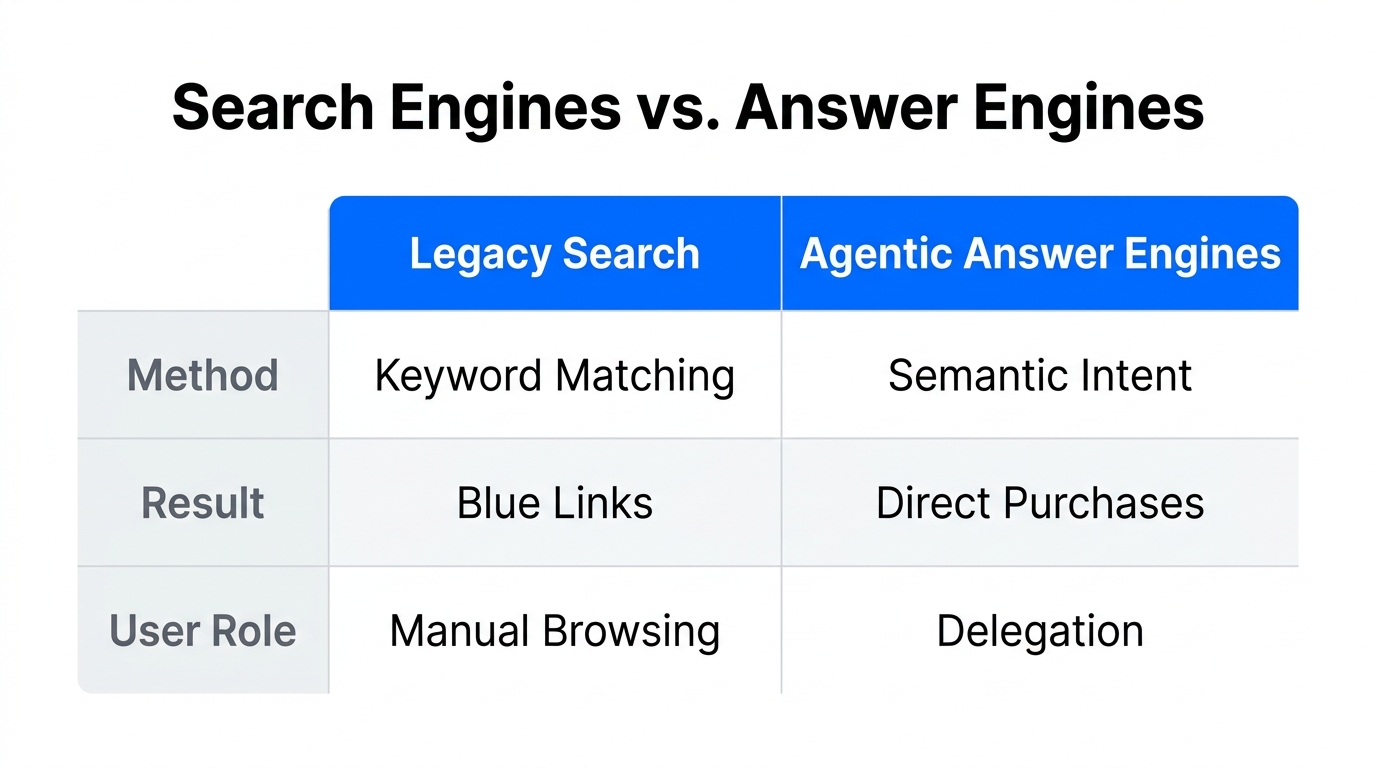
Traditional SEO is dying, replaced by Agentic Optimization. According to recent data, the global ecommerce platform market is set to hit $13.92 billion in 2026, driven largely by AI-integrated buying experiences. AI agents prioritize stores that provide structured, verifiable data over those with the best "copywriting."
To stay competitive, you must move beyond the legacy "Stencil" themes and embrace a headless architecture. Over 64% of enterprise merchants have already shifted to headless builds using the Catalyst framework, which provides the speed and API flexibility that AI agents require to parse your site without latency issues.
"When product discovery begins with a prompt, not a homepage, quality of data determines whether you get purchased." — Travis Hess, CEO of Commerce.com
Technical Setup: Deploying the Universal Commerce Protocol (UCP)
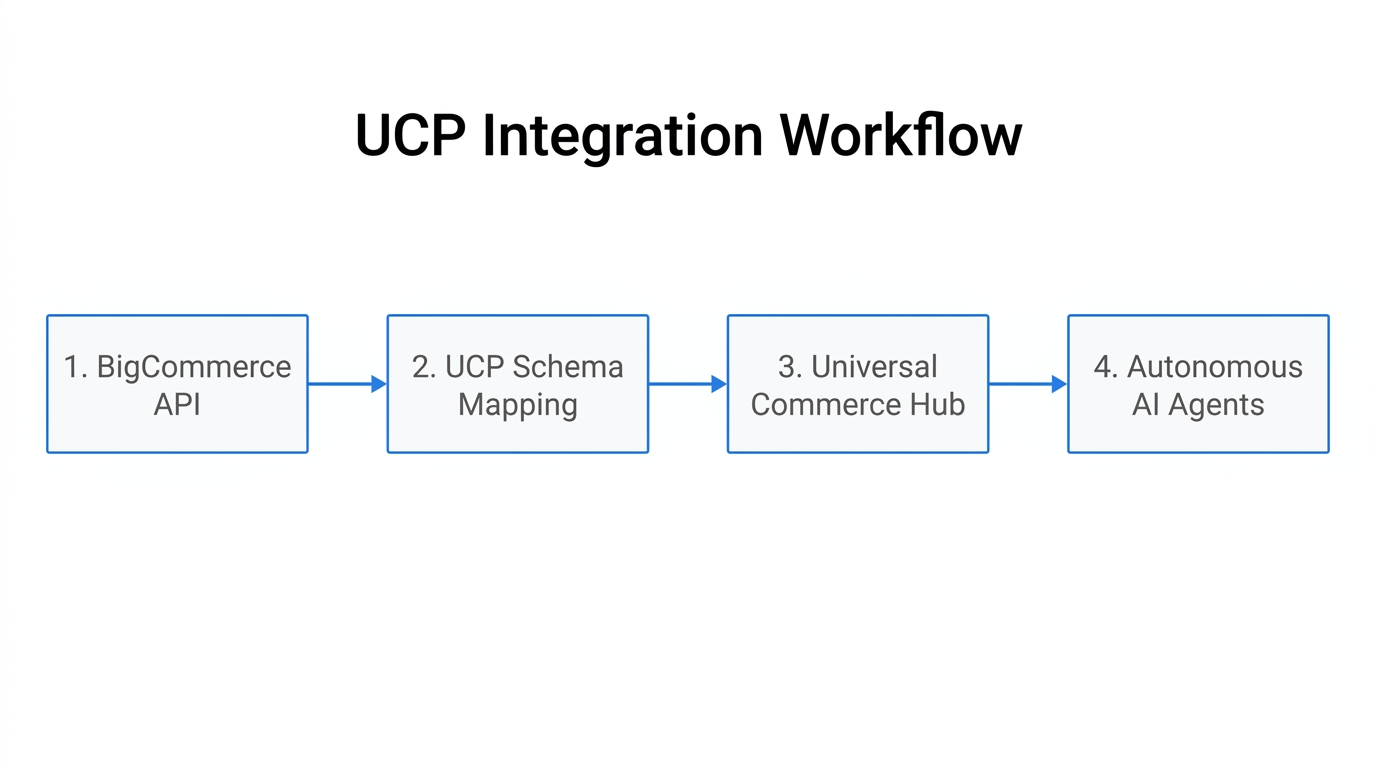
The Universal Commerce Protocol (UCP) is the open standard that allows AI agents to "crawl and buy." Think of it as a robots.txt file, but for transactions. By placing a ucp.json manifest in your store's root directory, you allow agents to see real-time pricing, tax logic, and checkout requirements without needing to scrape your HTML.
Step 1: Generate Your ucp.json Manifest
Your manifest must include your store's identity, supported payment gateways (like Stripe), and shipping constraints. You can use tools like UCPtools to validate your schema before deployment.
Step 2: Upload via WebDAV
To deploy the file, you need to access your BigCommerce server via WebDAV. Navigate to the /.well-known/ folder. if it doesn't exist, create it. Drop your ucp.json file here. This ensures that when an agent from OpenAI or Google hits your domain, it immediately finds the instructions it needs to complete a purchase.
Step 3: Handle the New 2026 Fee Structure
As of June 2026, BigCommerce has introduced a 2% Open Payment Provider Fee for non-approved gateways. To maximize margins on agentic orders, ensure you are using an approved embedded provider like BigCommerce Payments (Powered by Stripe). This keeps your transaction costs at 0% (excluding standard processing) and ensures the agent doesn't run into "unsupported gateway" errors during autonomous checkout.
Data Enrichment: Using Feedonomics for Long-Tail Attributes
AI agents are incredibly specific. A human might search for "heavy winter coat," but an agent will search for "mens parka with 800-fill down insulation, waterproof rating above 20,000mm, compatible with Size L mid-layers." If your product attributes don't contain these technical details, you are invisible to the agent.
This is where Feedonomics becomes your most powerful SEO tool. In late 2025, Feedonomics launched "Surface," an AI-driven data enrichment tool designed to standardize product data for Answer Engines.
- Material Density: Don't just say "cotton"; specify the GSM (grams per square meter).
- Specific Compatibility: List every model number or part your product works with.
- Sustainability Metrics: Agents in 2026 are often programmed with "ethical filters"—ensure your carbon footprint data is in the feed.
| Attribute Type | Standard Ecommerce | Agentic-Ready (2026) |
|---|---|---|
| Product Title | Blue Running Shoes | Men's Alpha-Grip Trail Runner - Cobalt |
| Description | Comfortable for long runs. | 8mm heel-to-toe drop, Vibram Megagrip outsole, recycled polyester mesh. |
| Compatibility | Fits most feet. | Compatible with custom orthotics; fits True-to-Size (D width). |
"The winner in 2026 isn't the brand with the biggest ad budget, but the brand with the most structured data. Feedonomics is the bridge to that reality."
Stormy AI: Your Internal 'Agent' for Back-Office Automation
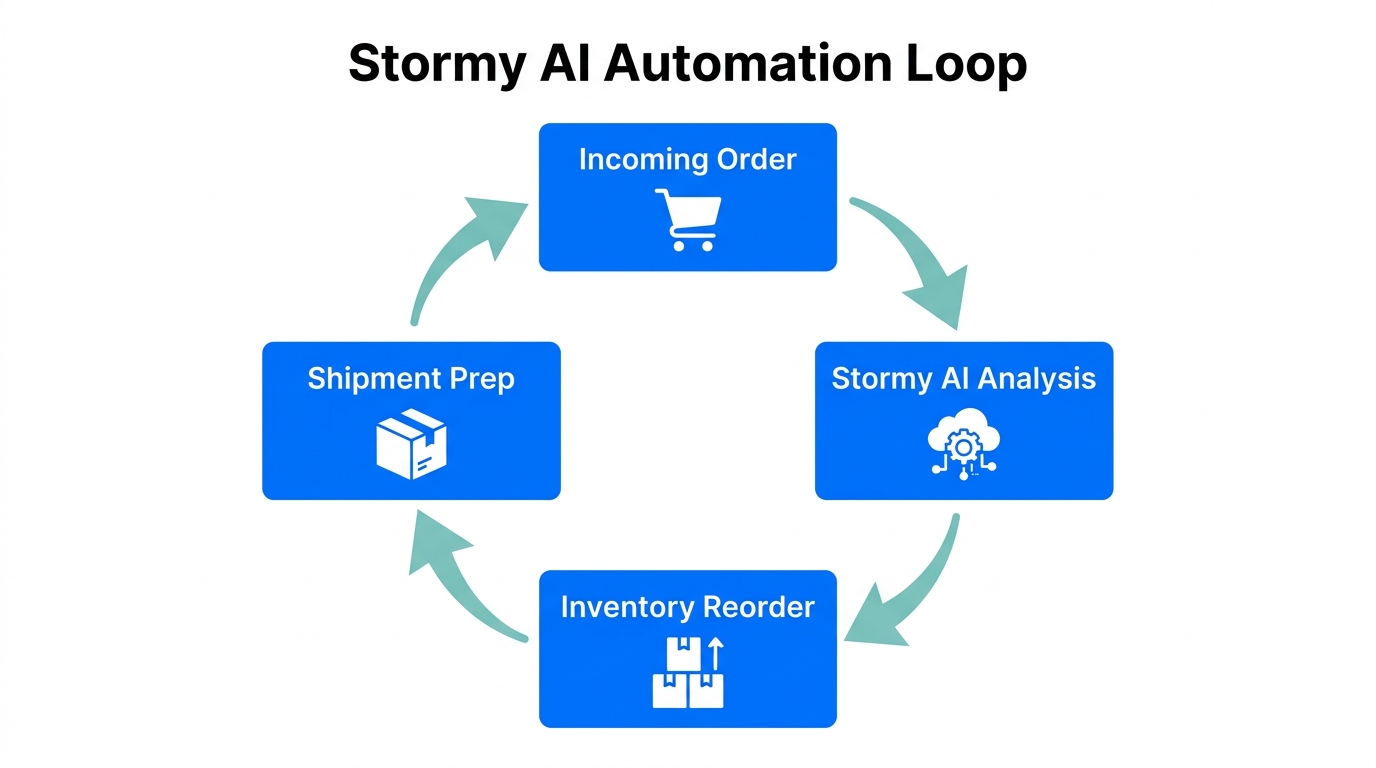
Setting up your store for external agents is only half the battle. When those agents start placing orders at 3:00 AM, who is managing the fallout? This is where Stormy AI steps in as your AI ecommerce employee. Stormy doesn't just sit on a dashboard; it acts as a teammate that runs the messy back office of your BigCommerce store.
For example, when an agentic order triggers a stockout, Stormy AI handles the supplier follow-up in the background. It wakes up, checks your inventory levels in BigCommerce, sees a row in your spreadsheet that is running low, and automatically emails your supplier to request a restock PO. If the supplier doesn't reply within 48 hours, Stormy escalates the task to you.
Stormy AI also bridges the gap between customer support and operations. If a customer (or their agent) asks about a shipping delay, Stormy can read the inbound thread in Gmail, check the fulfillment status in ShipStation, and draft a polite, brand-accurate reply for your approval. By automating these recurring checks, you can maintain a lean team even as your order volume scales through agentic channels.
Performance Benchmarks: ROI of the Agentic Commerce Suite
Is the investment in UCP and headless Catalyst worth it? The data from early 2026 adopters suggests a resounding yes. A study by Anchor Group found that BigCommerce B2B Edition users—who often deal with the highest data complexity—achieve a 391% three-year ROI with a 7-month payback period.
When you optimize for agents, you aren't just winning AI-driven sales; you are also improving the experience for humans. The Catalyst framework ensures Lighthouse scores of 90+, which directly correlates to lower bounce rates and higher organic rankings. Furthermore, by avoiding the "App Debt" common on platforms like Shopify, BigCommerce merchants are seeing 12-15% better long-term margins on high-volume stores (over $10M ARR).
"The 2026 ecommerce stack isn't a collection of plugins; it's a high-speed data engine operated by AI agents both inside and outside the company."
Conclusion: Your 2026 Playbook
Preparing for Agentic Commerce isn't a one-off task; it is a fundamental shift in how you maintain your store. To succeed in 2026, you must:
- Deploy the
ucp.jsonmanifest to your/.well-known/folder to invite AI agents to shop. - Enrich your feed with technical, long-tail attributes using Feedonomics to win the "Answer Engine" rankings.
- Hire an AI ecommerce employee like Stormy AI to manage the backend—from supplier follow-ups to automated performance reporting.
- Monitor your TCO by staying within the BigCommerce/Commerce.com approved payment ecosystem to avoid unnecessary fees.
The brands that will dominate the next decade are those that make it effortless for both humans and AI agents to buy. Start by cleaning your data today, and let Stormy AI handle the rest in the background.