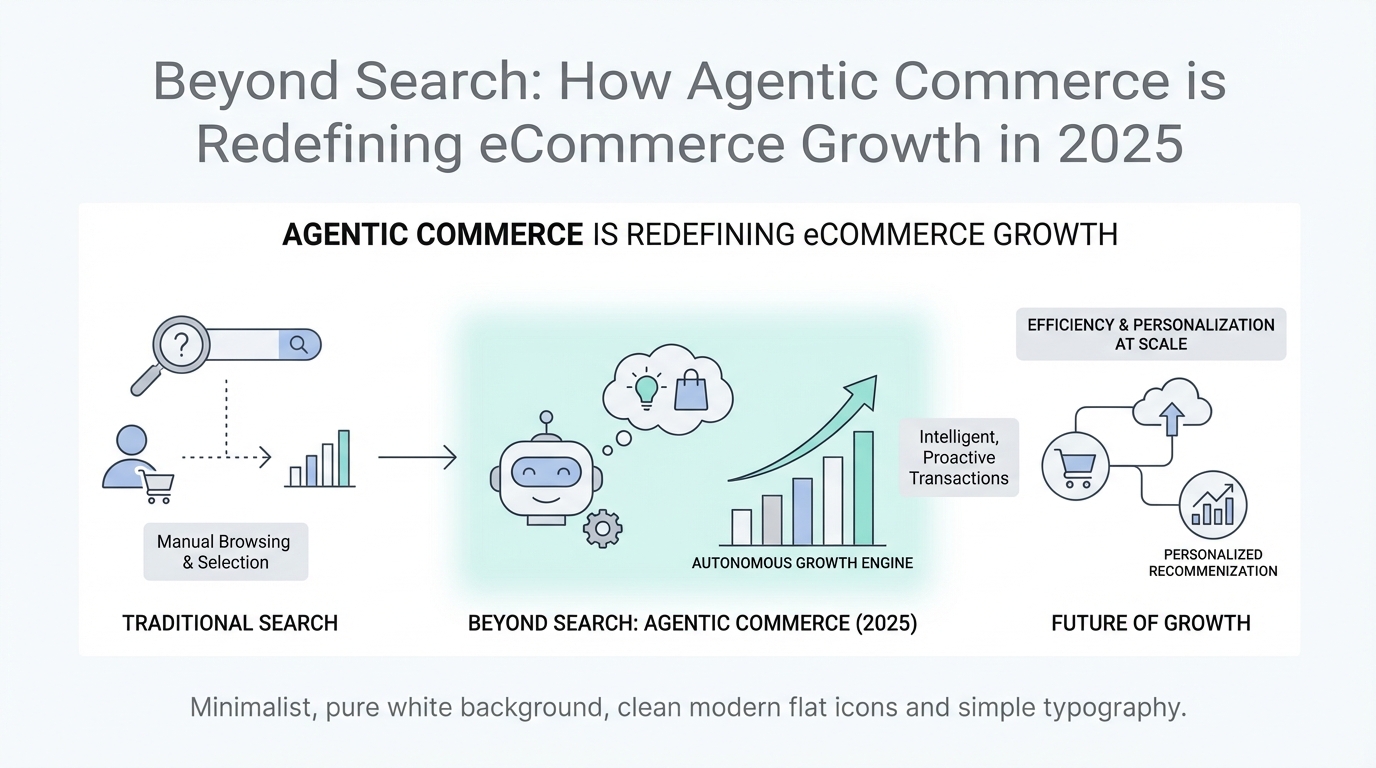
For the last two decades, the digital shopping experience has been defined by a single, repetitive loop: search, browse, compare, and purchase. Whether you were a consumer looking for a pair of sneakers or a B2B buyer sourcing thousands of components, the friction remained high. You had to know what to look for, where to find it, and how to vet the quality yourself. But in 2025, that paradigm is shattering. We are entering the era of agentic commerce—a fundamental shift where AI moves beyond generating text and images to executing complex business workflows autonomously. This isn't just an incremental improvement; it is a total redefinition of eCommerce market analysis and execution.
Defining Agentic AI: Execution Over Generation
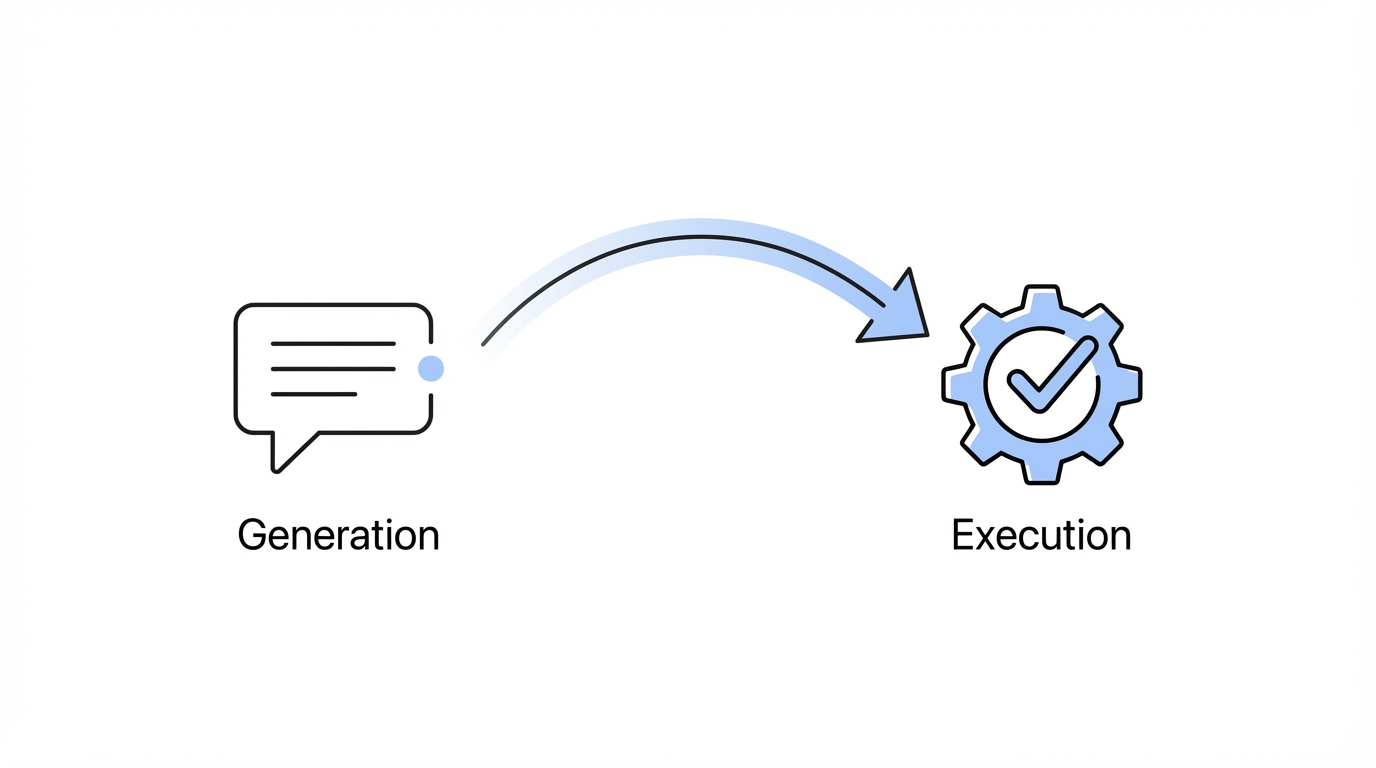
To understand the future of ecommerce 2025, we must first define the "agent." While 2023 and 2024 were the years of generative AI—where tools like ChatGPT could write a product description—2025 is the year of agentic AI. An agent doesn't just talk; it acts. In the context of commerce, an agent can identify a market trend, find a manufacturer, negotiate a contract, and arrange logistics without constant human oversight.
The pioneer of this movement is Alibaba’s Accio AI, the world’s first AI-powered B2B sourcing agent. Unlike a traditional search bar, Accio functions as a conversational sourcing assistant. It manages the entire procurement workflow, transforming weeks of manual research into a streamlined dialogue. This shift is critical because marketplaces accounted for 67% of global online sales in 2024, and those that fail to integrate autonomous execution will quickly fall behind.
"Agentic AI is moving beyond generative text to autonomous action. In 2026, the value isn't in search—it's in the execution of the entire supply chain."
The Rise of the Solo Entrepreneur and Creator Economy
One of the most profound creator economy trends is the emergence of the "Solo Entrepreneur." Currently, solo-run businesses make up approximately 40% of small businesses. These individuals don't have the resources to hire procurement teams or logistics managers. Agentic commerce tools act as a virtual back-office, allowing a single creator to launch a global brand from their laptop.
This trend is fueled by shifting discovery habits. Statistics show that 43% of Gen Z now start their product searches on TikTok rather than Google. When a product goes viral, the window of opportunity is narrow. Solo entrepreneurs need to bridge the gap between social media discovery and manufacturing instantly. Platforms like Accio integrate social trend data, allowing buyers to see what's trending on platforms like TikTok and immediately source similar products through Alibaba.com.
Furthermore, B2B buyers now expect B2C-style experiences. According to eMarketer, 81% of Millennials prioritize brand ethics and personalized procurement portals. Agentic tools allow for this hyper-personalization at scale, vetting suppliers not just for price, but for certifications and ethical standards automatically.
Expert Insights on Repeatable AI Rules
Industry leaders are already signaling that the era of "guessing" in ecommerce is over. Kuo Zhang, President of Alibaba Group, describes Accio as a tool that turns weeks of manual research into a "simple conversation." This accessibility democratizes global trade, allowing even the smallest players to access 1.5 million+ verified suppliers and over 1 billion product listings.
Logan Brown, Product Manager at Triple Whale, offers a deeper perspective on AI business automation. He notes that the future value of eCommerce isn't in human opinions but in "turning real-world experience into repeatable rules that AI can apply at scale." This means that once a successful sourcing and marketing workflow is established, the AI agent can repeat it across different niches with minimal intervention.
"The future of eCommerce isn't in human opinions; it's in turning real-world experience into repeatable rules that AI can apply at scale." — Logan Brown, Triple Whale
Bridging Discovery and Distribution with Stormy AI
While agentic commerce handles the "supply" side of the equation, the "demand" side still requires sophisticated creator partnerships. Once you've used an agent to source a product like "transparent wireless earbuds with dimmable LED cases," the next challenge is getting that product in front of the right audience. This is where modern influencer marketing tools become indispensable.
Platforms like Stormy AI streamline creator sourcing and outreach by helping brands find and manage UGC creators at scale. Just as Accio uses AI to find the perfect factory, Stormy AI uses natural-language prompts to find the perfect influencers. For example, a brand could search for "fitness creators in LA with 10K-100K followers" to launch a campaign for a new health gadget they just sourced via agentic AI.

By combining AI-powered sourcing with influencer discovery on Stormy AI, brands can create a closed-loop system: AI finds the product, AI finds the creators, and AI automates the outreach. This level of AI business automation allows companies to move at the speed of social media trends, reducing the time from "viral video" to "product in warehouse" by up to 90%.
Playbook: Winning with Agentic Commerce
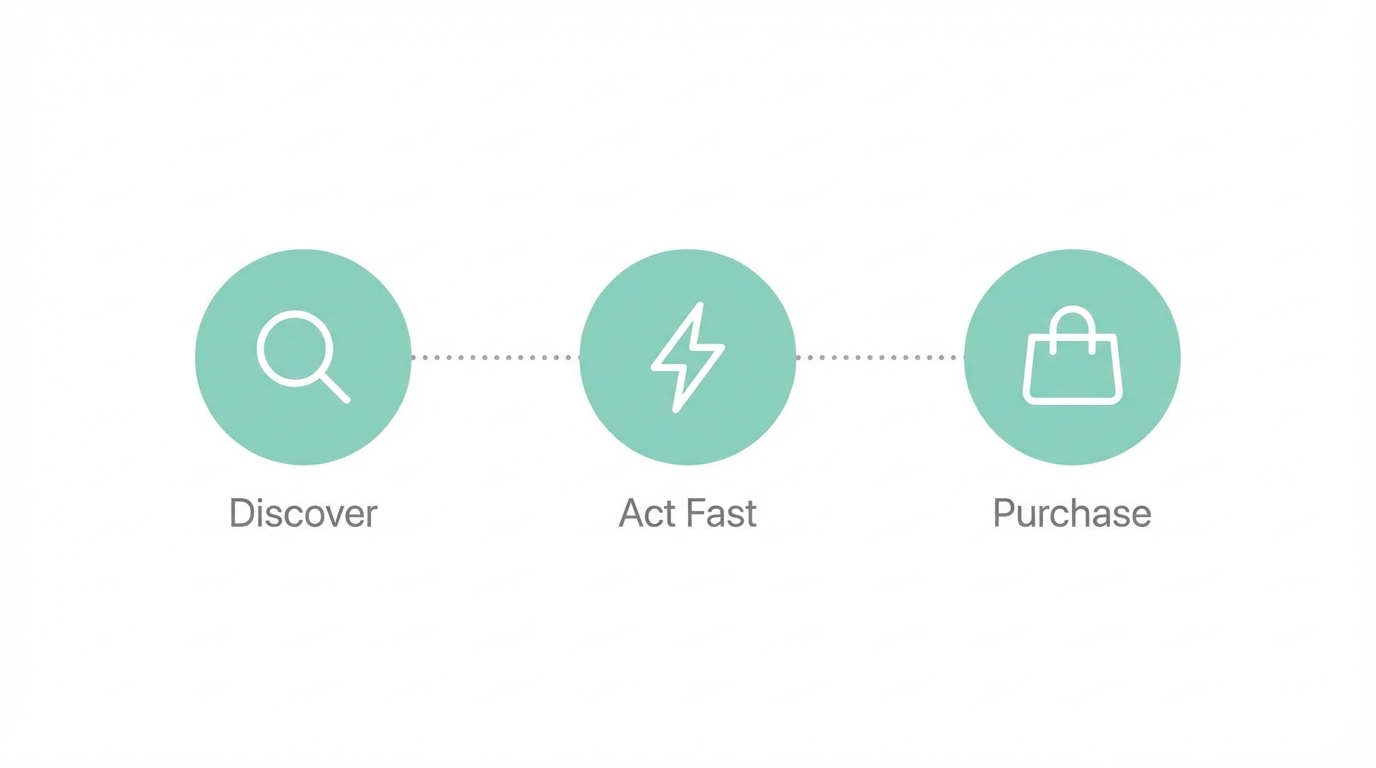
To succeed in the future of ecommerce 2025, sellers must move beyond basic search functions and adopt a proactive, agent-first strategy. Here is the playbook for leveraging agentic commerce effectively:
Step 1: The "Niche Score" Strategy
Before committing to a product, use agentic tools to validate the idea. Look for categories with a Niche Score of 75+. This indicates high consumer demand coupled with manageable competition levels. Avoid the mistake of entering saturated markets without a data-backed reason.
Step 2: Hot-Selling Product Redesign
Don't just sell what already exists. Feed an existing top-seller from Amazon into an agent like Accio and ask for "three design improvements based on negative user reviews." This creates a built-in competitive advantage by solving consumer pain points before the product even hits the shelf.
Step 3: Multi-Category Sourcing and Comparison
Use AI to view factory size, production capacity, and annual revenue side-by-side. Instead of manual spreadsheets, let the agent compare 10+ suppliers simultaneously. Focus on those that offer ISO 9001 certification and low MOQs (Minimum Order Quantities) to test the market quickly.
Step 4: Agentic Outreach and Negotiation
Instead of drafting individual emails, use AI-drafted inquiries to message multiple suppliers at once with specific technical requirements. Ensure you include requirements like "custom logo, sustainable packaging, and lead times under 15 days."
Real-World Impact and Efficiency Gains

The efficiency gains of agentic commerce are not theoretical. In consumer electronics, entrepreneurs have reported using AI to analyze 24+ websites, identify trending features (like LED charging cases), and match with verified suppliers in under 10 minutes. In the baby products niche, sellers have found Greenguard Gold certified manufacturers—a highly specific requirement—in just 4 hours, down from a traditional 15-day manual search.
This speed is essential because consumer expectations are at an all-time high. According to the FedEx E-commerce Trends report, over 80% of shoppers now view real-time tracking (68%) and free shipping (76%) as baseline features. By automating the backend supply chain, brands can free up capital and time to focus on meeting these frontend logistics demands.
Common Mistakes to Avoid in AI Automation
- Vague Prompts: Treating an AI agent like a basic search bar. Instead of searching for "t-shirts," use specific prompts like "Source 100% organic cotton oversized tees, 250 GSM, with sustainable dye certifications."
- Ignoring Unit Economics: AI might recommend a great product, but you must manually verify the Total Landed Cost (shipping + duties) to ensure profitability.
- Neglecting Post-Purchase Excellence: Sourcing is only half the battle. Ensure your logistics and tracking are as automated as your procurement.
The Bottom Line for 2025
The transition to agentic commerce is inevitable. As AI moves from a tool for "thinking" to a tool for "doing," the barrier to entry for global trade will continue to drop. For brands, this means faster product cycles and more competition. For solo entrepreneurs, it means a level playing field with legacy corporations. By leveraging platforms like Accio for sourcing and Stormy AI for creator-led growth, savvy businesses can build a fully automated commerce engine that identifies trends, sources products, and markets them with surgical precision. The future of commerce isn't about who has the biggest team—it's about who has the best agents.