Beyond Prompting: Using ChatGPT and Midjourney to Build Immersive Brand Worlds in 2026
In 2026, the best brands aren't just prompting; they are architecting. Learn the Monkey Island method and how to use ChatGPT and Midjourney to build immersive brand worlds.
In the early days of generative AI, success was measured by how well you could write a single prompt to get a decent-looking headshot or a generic blog post. But as we move through 2026, the goalposts have shifted. We are no longer in the era of 'prompt engineering'; we are in the era of Narrative Architecture. Today, non-technical founders are using ChatGPT and high-fidelity video tools like Runway Gen-3 to build entire brand universes that rival the production value of legacy media houses.
The barrier to technical execution has effectively collapsed. Whether you are a sommelier at a high-end restaurant or the founder of successful tech giants listed on the YC Top Companies list, the ability to manifest complex creative ideas is now limited only by the depth of your imagination, not your ability to use Adobe Photoshop or After Effects. This playbook breaks down how to move beyond basic outputs and start building immersive, cohesive brand worlds that convert.
The 'Monkey Island' Method: Architecting Brand Lore
Using a classic pirate game to illustrate a new approach to brand building.
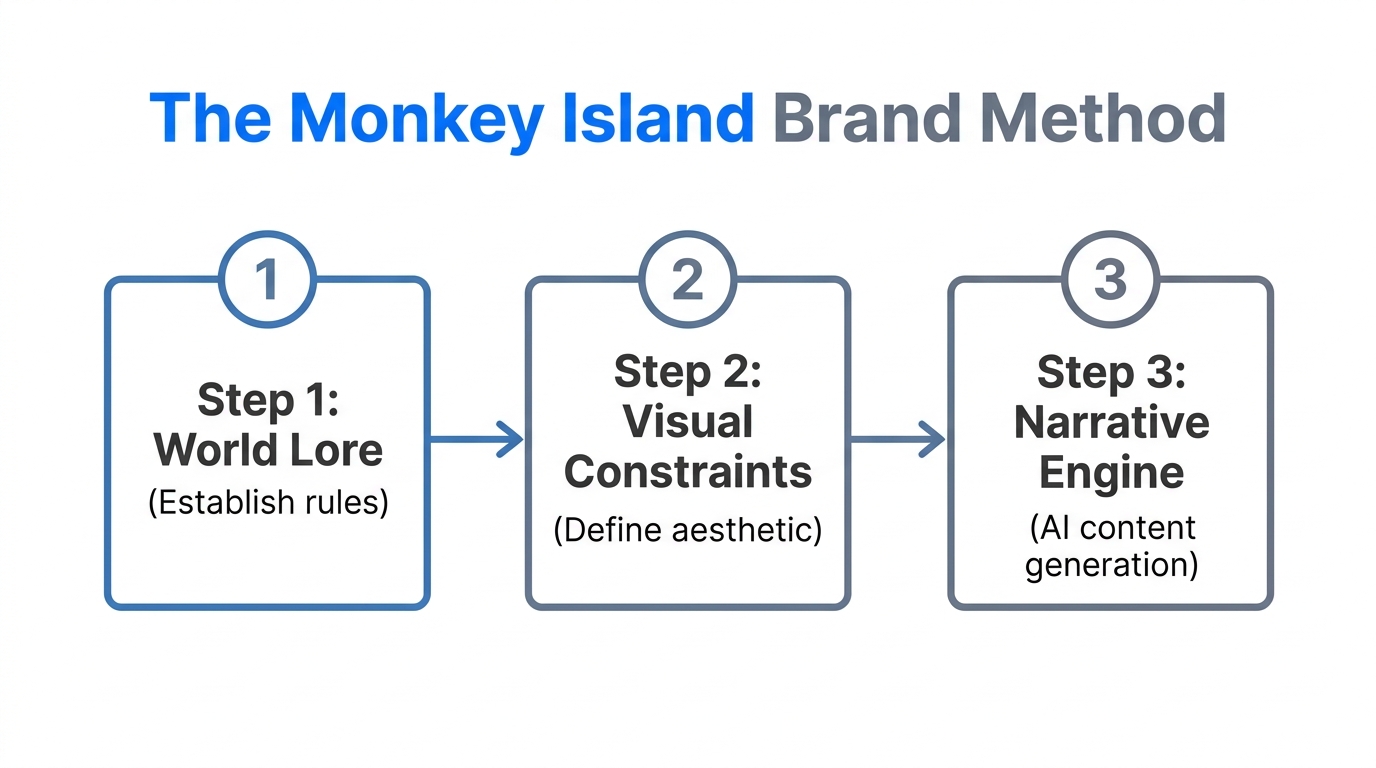
One of the most effective ways to build a brand in 2026 is what we call the 'Monkey Island' method. Named after the classic point-and-click adventure games, this approach involves using OpenAI's latest reasoning models to architect a world before you ever generate a single visual. Instead of asking for a 'logo' or a 'caption,' you ask the AI to build the logic of your brand's universe.
- Define the Rules: What are the physics of your brand world? If your brand were a game, what can and can't the characters do?
- Level Design: Build the different 'stages' of your customer journey as if they were levels in a story.
- NPC Dialogue: Use AI to write the distinct voices of your brand characters, ensuring they stay consistent across every TikTok Ads Manager campaign.
"AI doesn't replace creativity; it manifests ideas that were previously trapped by the friction of technical skill. It is the ultimate amplifier of the human imagination."
Pressure-Testing: Turning Marketing into Role-Play
How do you know if your brand story actually makes sense? In 2026, founders are pressure-testing their concepts by turning their brand guides into interactive Role-Playing Games (RPGs). By feeding your 2,000-word brand prompt into ChatGPT, you can 'jump into' your brand world and interact with it.
Imagine saying: 'I am a customer who is skeptical of our new product. Role-play our interaction in the setting of our brand universe.' This allows you to find flaws in your storytelling, identify logical inconsistencies in your brand lore, and refine your messaging before it ever touches a public-facing platform like Meta Ads Manager. It’s like having a focus group that runs at the speed of thought.
Maintaining Cohesion in 2026: The Holy Grail of AI Video
How AI now handles character and setting cohesion for high-quality video production.The biggest challenge in AI-generated marketing used to be 'flicker'—the loss of character and setting consistency between frames. In 2026, breakthroughs in diffusion models and 30fps high-fidelity video generation have solved this. We can now maintain Character Cohesion and Setting Cohesion across entire social campaigns.
| Feature | 2025 Standard | 2026 Standard (Stormy AI Era) |
|---|---|---|
| Frame Rate | 8-12 fps (choppy) | 30-60 fps (cinematic) |
| Character Consistency | Changes slightly every shot | Identical across 100+ shots |
| Tooling | Manual prompting | Agentic orchestration |
To achieve this, creators are using tools like Midjourney for master character sheets and then feeding those seeds into video models. This allows a solo founder to produce a high-end commercial that previously would have required a $50,000 production budget and a crew of ten. Once these assets are ready, platforms like Stormy AI can help you find the right influencers to 'host' these videos or react to them, bridging the gap between AI-generated worlds and human-led social proof.
The 'PhD Intern' and the Power of Tool-Calling
Understand the powerful analogy of treating AI as an intern with a PhD.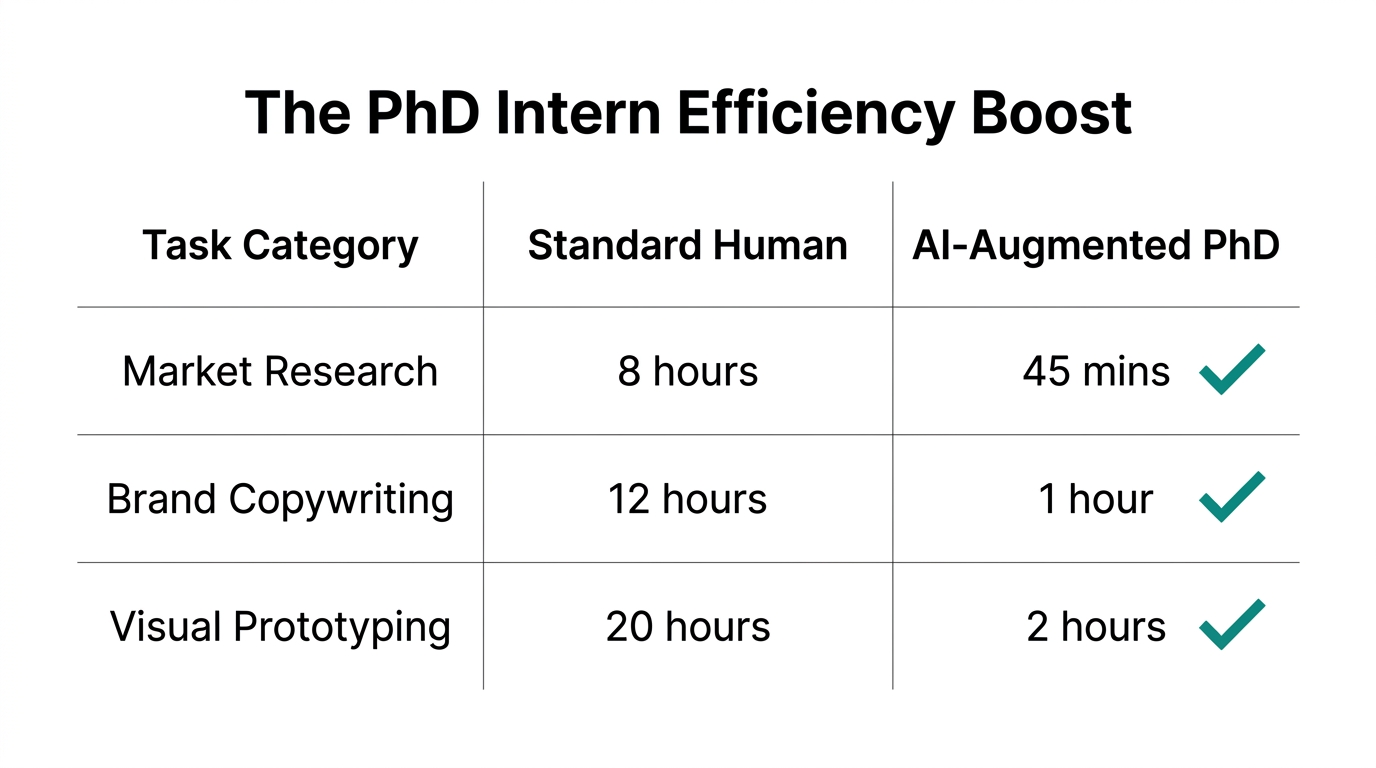
To understand why AI has become so powerful for brands this year, we have to look at the concept of the 'PhD Intern.' Think of ChatGPT as an intern who has a PhD in everything but knows nothing about your specific business. To make it useful, you have to provide it with 'shelf space'—or what engineers call a context window.
By using Retrieval-Augmented Generation (RAG) and vector embeddings, you can give your AI intern access to your entire company history, previous winning ad copy, and customer feedback. Furthermore, the 2026 breakthrough of 'Tool-Calling' means the AI doesn't just write; it acts. It can 'pretend' to have access to a calculator, a browser, or your CRM to fetch real-time data and include it in your creative briefs.
"You shouldn't just think with AI; you should think of AI as a digital teammate that can see around corners you didn't even know existed."
Scaling Creative Output: From Static to Agentic
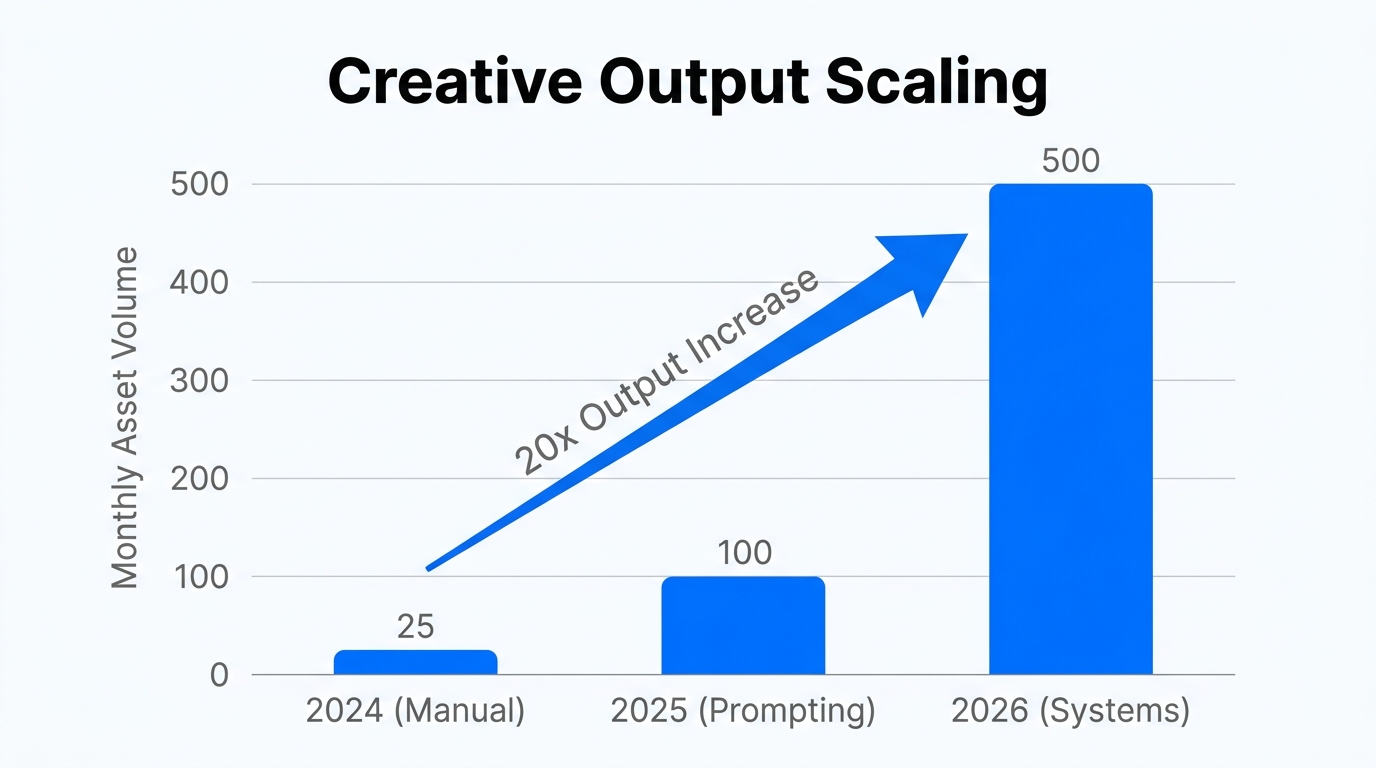
In 2026, the workflow for a modern marketing team has shifted from generation to orchestration. We are seeing the rise of the 'Agentic Manager'—a human role dedicated to managing an army of AI agents. One agent handles the Midjourney visual iterations, another handles the voiceovers in Descript, and a third researches trending creators on Stormy AI to ensure the brand world feels culturally relevant.
This allows brands to scale their creative output by 100x. Instead of one hero ad per month, brands are now deploying 100 hyper-personalized variations of their 'world' to different sub-niches on TikTok and YouTube. This is the ultimate expression of the 2026 creator economy: high-fidelity personalization at infinite scale.
Conclusion: The Net Creativity Boom
There is a common fear that AI will lead to a reduction in human creativity. In reality, the opposite is happening. By lowering the barrier to technical execution, AI is unlocking a massive wave of net creativity. Millions of people who had 'songs in their heads' or 'worlds in their hearts' but lacked the skill to draw or compose can now manifest those ideas with startling clarity.
As we navigate 2026, the winning brands won't be those with the biggest budgets, but those with the most detailed, cohesive, and immersive 'worlds.' Use ChatGPT to build the lore, use Midjourney to paint the walls, and use 30fps video tools to bring it to life. The tools are here. The intern is waiting. It's time to start architecting.
For more insights on navigating the 2026 creator landscape, follow the work of AI pioneers like Andrej Karpathy and stay updated on the latest in agentic workflows.