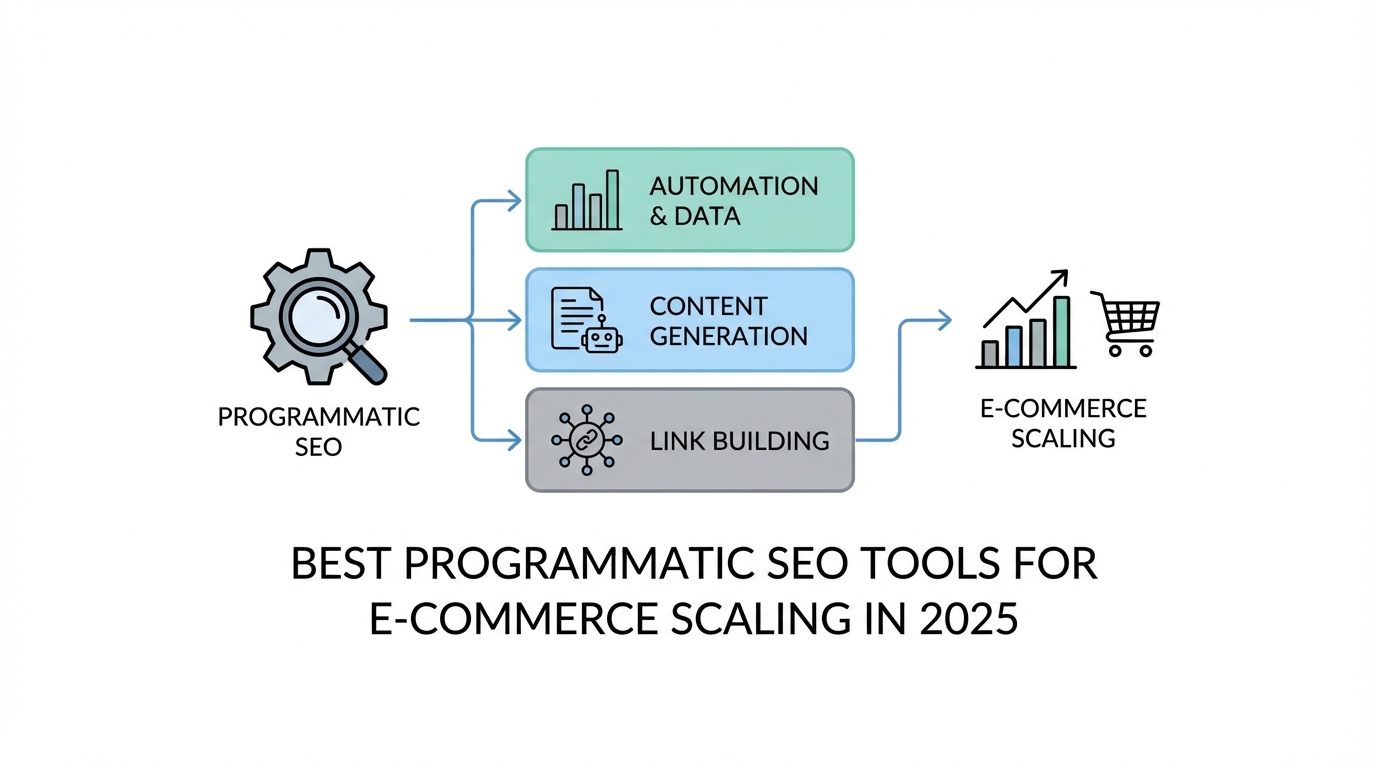
The landscape of digital commerce has undergone a fundamental shift. In the early days of search, e-commerce scaling was often a manual, grueling process of writing product descriptions and category pages one by one. Today, that model is obsolete. Modern retailers are leveraging programmatic SEO (pSEO) to build high-performance, data-driven architectures that capture thousands of long-tail search queries simultaneously. According to industry benchmarks from WordLift and Seomatic, high-growth e-commerce brands using pSEO reported an average 30%–80% surge in organic traffic and a 25%–35% increase in conversion rates within just months of implementation. This article explores the essential programmatic SEO software and strategies to help your brand scale efficiently in 2025.
The New Era of GEO: Generative Engine Optimization
As we move into 2025 and 2026, the focus of pSEO has shifted from simple "keyword stuffing" to what experts call Generative Engine Optimization (GEO). The goal is no longer just to satisfy Google's crawlers, but to ensure that your scaled pages are "citable" by AI agents like ChatGPT, Perplexity, and Google Search Generative Experience (SGE). By 2026, over 30% of daily product research is projected to happen via voice search and AI assistants, according to ClickSlice. This means brands must prioritize structured data over bulk text to serve these emerging AI search behaviors.
"By 2026, 30% of product research will be conducted via AI agents. If your data isn't structured, your products don't exist in the AI search economy."
To succeed in this environment, e-commerce managers need a tech stack that focuses on automated metadata management and real-time data synchronization. Industry leaders like Flyhomes and Transit have already proven the power of this approach, expanding their web presence from 10,000 to over 425,000 pages in under 90 days without triggering quality penalties, as noted by JB Impact. The secret lies in using a composable architecture that moves away from monolithic CMS features toward headless or API-first structures.
Step 1: Finding 'Low-Hanging Fruit' Keywords

Before you build thousands of pages, you need to know what people are actually searching for. In pSEO, you aren't looking for high-competition head terms. You are looking for long-tail, high-intent variations. This is where LowFruits becomes an indispensable part of your programmatic SEO software stack. LowFruits specializes in finding keywords with low domain authority competitors in the top results, making them ideal for automated page generation.
For an e-commerce brand, this might look like identifying every possible variation of a product category. Instead of just targeting "running shoes," you use LowFruits to find clusters like "running shoes for flat feet under $100" or "breathable waterproof trail runners for women." These low-hanging fruit keywords allow you to dominate the SERPs by providing a hyper-specific landing page for a hyper-specific need.
Step 2: The Database Backbone (Airtable & WP All Import)

At the heart of every successful pSEO campaign is a "Source of Truth" database. For many modern marketers, Airtable for SEO has become the industry standard. Airtable allows you to organize product attributes—such as price, SKU, weight, color, and local availability—into a relational database that can be used to generate unique content for thousands of pages.
If you are running a WooCommerce store, the bridge between your data and your site is often WP All Import. This plugin allows you to import large datasets from CSVs or XML feeds into templated product pages. By combining Airtable with WP All Import, you can automate the creation of faceted navigation pages. Instead of a single "Men's Shoes" category, you can generate indexable pages for every filter combination, ensuring that every long-tail query has a dedicated, relevant landing page.
"The goal of pSEO is not to churn out thin pages... but to efficiently create useful, targeted pages you would have made if you had infinite time." — Deepak Gupta, SEO Strategist.
Step 3: Real-Time Data Syncing with Whalesync
One of the biggest risks in e-commerce pSEO is outdated information. If your database says a product is in stock but your programmatic page says it's sold out, you lose trust and rankings. This is why e-commerce automation tools like Whalesync are critical. Whalesync acts as a two-way sync engine that connects your Airtable database to CMS platforms like Webflow or WordPress in real-time.
Using a headless or API-first structure ensures that when you update a single cell in Airtable, that change is reflected across all 50,000 of your programmatic pages instantly. This level of automated metadata management is what separates world-class e-commerce operations from those that get penalized for "thin" or inaccurate content. It allows for dynamic updates to prices, availability, and even AI-generated descriptions without manual intervention.
Specialist E-commerce AI Agents: Verbolia and ConvertMate
While building a custom stack with Airtable and Whalesync offers maximum control, some brands prefer specialized AI agents that handle the heavy lifting. Verbolia is a powerhouse for large-scale retailers and marketplaces. Its unique vPage feature automatically identifies long-tail search gaps and generates high-converting landing pages that sit outside your main site structure to preserve page speed and site integrity.
For Shopify users, ConvertMate serves as a dedicated AI assistant. It manages bulk product page updates, optimizes metadata, and even runs A/B tests on product descriptions specifically for the Shopify ecosystem. These tools are best SEO tools for scaling because they require minimal technical setup while delivering massive organic reach.
When you are managing a massive volume of pages, maintaining a human touch is essential to prevent your site from looking like a "bot-generated wasteland." This is where incorporating User-Generated Content (UGC) becomes vital. Forward-thinking brands often use platforms like Stormy AI to discover and collaborate with UGC creators. By finding creators who align with your niche, you can source authentic video reviews and social proof to embed across your programmatic pages, significantly increasing the conversion rate of your automated traffic.

Winning Strategies for Scaled E-commerce Content
To maximize the impact of your programmatic SEO software, consider implementing these three high-converting page types:
- Comparison Pages (Product X vs Product Y): Use your product database to generate "Head-to-Head" comparison pages. These target "Decision Stage" buyers and typically see conversion rates 3–5x higher than standard blog posts. Think of how Zapier dominates search by creating pages for every app integration (e.g., "Slack + Google Sheets").
- Faceted Navigation Pages: Create indexable pages for every high-intent filter. If you sell furniture, don't just have a "Tables" page. Have a "Mid-Century Modern Walnut Dining Tables Under $1000" page.
- Smart Internal Linking (Hub & Spoke): Automate your internal linking so every long-tail "spoke" page links back to the main "hub" category. Tools like Verbolia offer vLink to automate this at scale, ensuring search engines can discover and crawl your new pages efficiently.
"Canva didn't just build a design tool; they built 1.3 million landing pages for every possible template search. That is the power of programmatic SEO at scale."
Common Mistakes to Avoid When Scaling
Despite the massive potential, many brands fall into the "Traffic Cliff" by making common technical errors. Keyword cannibalization is a major risk; if you create multiple pages targeting the same intent (e.g., "Running Shoes" and "Shoes for Running"), you confuse crawlers and dilute your ranking power. Always ensure each programmatic page has a unique primary intent.
Another critical factor is Page Speed. Large-scale sites often suffer from slow server responses when using heavy plugins on every page. To combat this, modern experts recommend using static site generators like Next.js for high-performance scaling. Static pages load nearly instantly, which is a major ranking factor in Google's Core Web Vitals. Finally, avoid Orphan Pages. If your programmatic pages aren't linked in your main navigation or your XML sitemap, Google will likely ignore them.
Conclusion: Building for the Future of Search
Programmatic SEO in 2025 is no longer an optional tactic—it is a requirement for e-commerce brands that want to remain competitive. By combining a robust database in Airtable, real-time syncing via Whalesync, and specialized agents like Verbolia, you can build a search presence that captures every possible customer query. The key to success is quality and structure. Ensure your pages are rich with data, include structured schema like JSON-LD for "Rich Results," and maintain a human element through UGC and expert insights. Start small by targeting your "low-hanging fruit" and scale your architecture as you see the traffic climb.