Performance marketing in the current landscape is a battle against the clock and the algorithm. As the digital advertising ecosystem shifts toward 2026, we are witnessing the emergence of what experts call the "Efficiency Gap"—a widening performance chasm between marketers relying on manual dashboard management and those leveraging autonomous systems. With the average Cost Per Lead (CPL) rising to $27.66, representing a staggering 20% year-over-year increase according to research by Azarian Growth Agency, the ability to reduce ad fatigue is no longer a luxury; it is a fundamental survival requirement.
The traditional workflow of manually monitoring CTRs and swapping images is failing. To stay competitive, brands are turning to a creative automation playbook that treats the marketing funnel not as a series of static assets, but as dynamic code. By implementing automated ad rotations, high-performing teams are seeing a 27% higher ROAS and a 15.6% reduction in ad fatigue. This guide will walk you through the technical and strategic steps to transition from "Chat AI" brainstorming to "Action AI" execution using agentic tools like Claude Code.
The Rising Cost of Manual Management
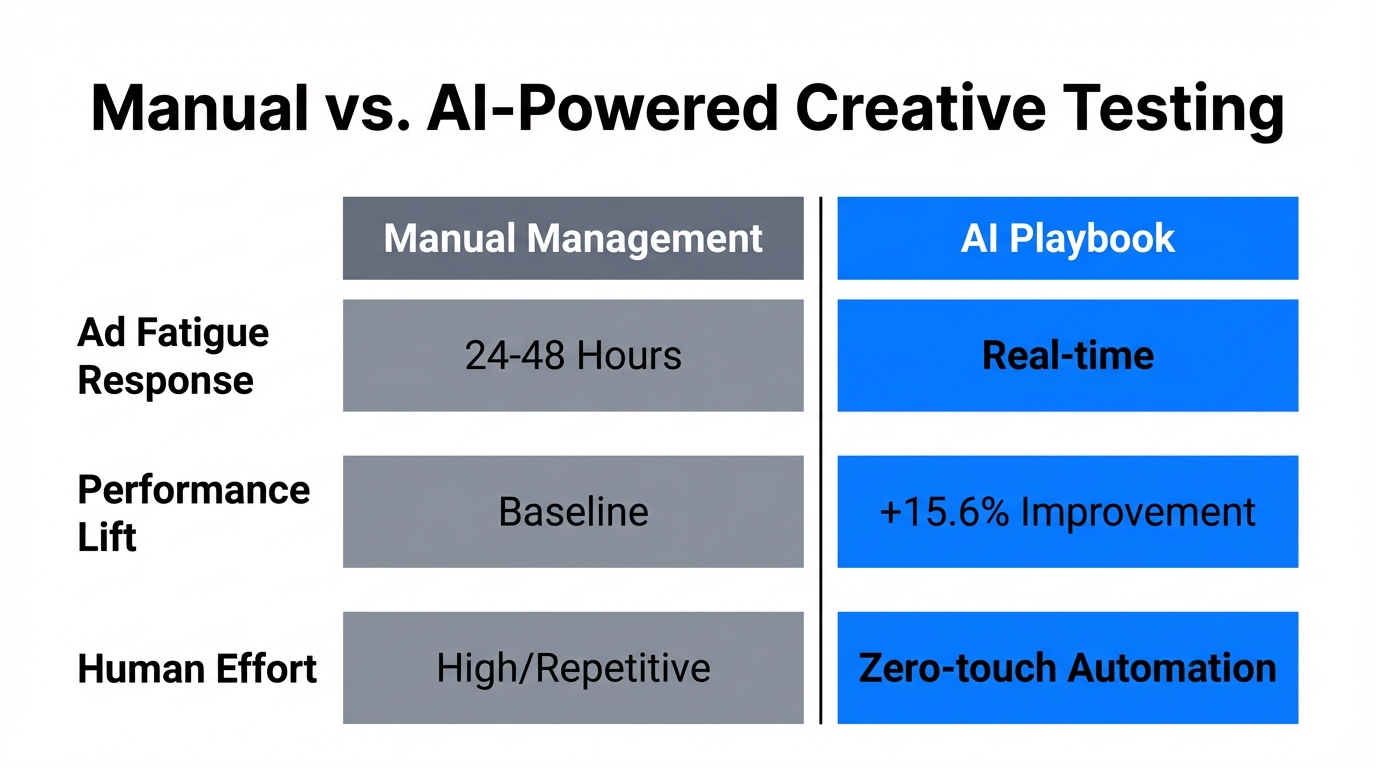
Why is automation becoming the default? The answer lies in the data. According to AIivine, manual bidding and creative management are increasingly inefficient compared to AI-driven alternatives. When a human marketer manages a Facebook campaign, they often fall victim to the "Context Death Spiral." This phenomenon, identified by experts at Anthropic, describes the 12 hours per week lost simply switching between browser tabs—moving from Facebook Ads Manager to Google Sheets to Figma and back again.
This friction doesn't just waste time; it kills performance. By the time a marketer notices that an ad's CTR has plummeted, the budget has already been bled dry by a fatigued audience. High-volume creative testing requires a speed of iteration that human hands cannot match. The shift toward "Funnel as Code" allows marketers to centralize data manipulation in a terminal, executing complex Facebook creative testing scripts that monitor live data and react in milliseconds.
"The real value of AI in 2026 isn't in generating copy; it's in the autonomous execution of the entire marketing lifecycle—from deployment to optimization."
Setting Up the Workflow: MCP and Real-Time Monitoring
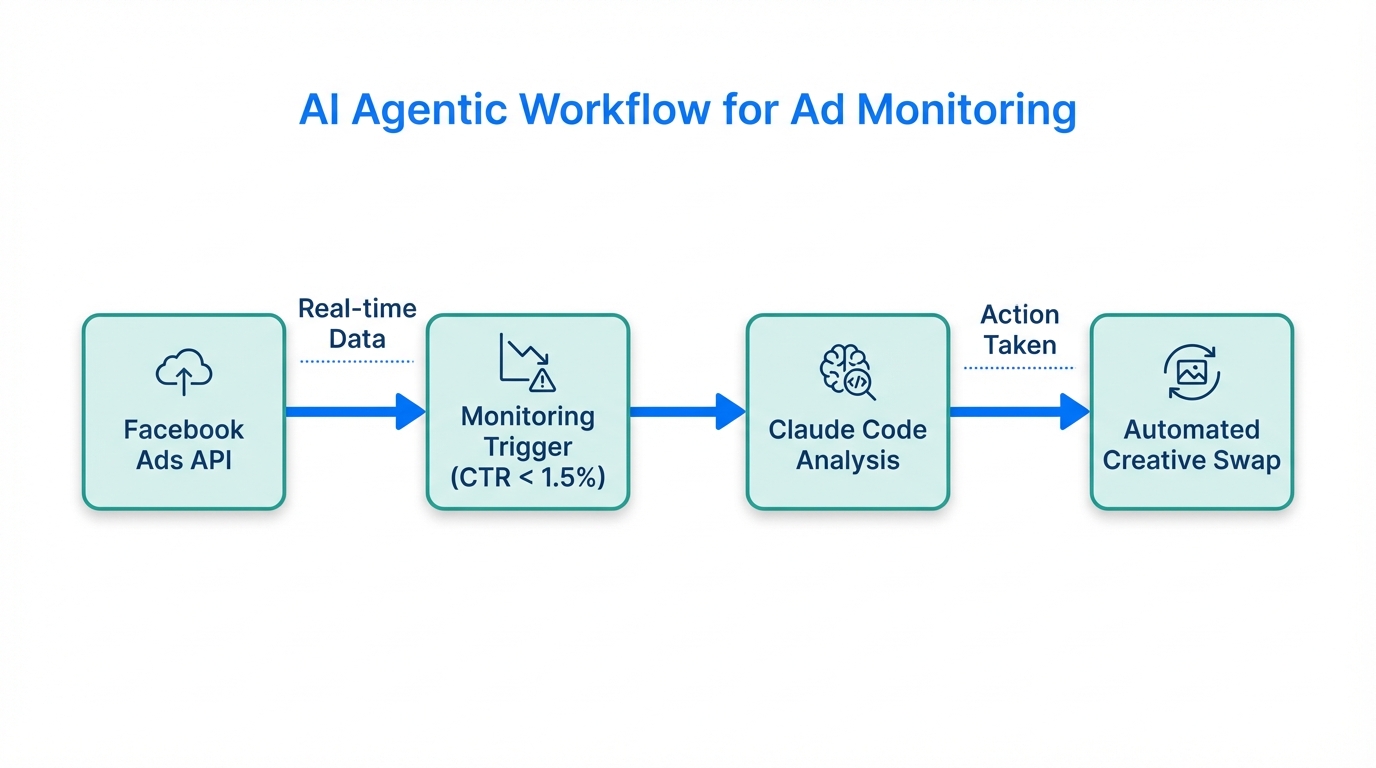
To begin your journey into automated ad rotations, you must first bridge the gap between your AI agent and the Meta ecosystem. This is done through the Model Context Protocol (MCP). Instead of manually exporting CSVs, you can use tools like Pipeboard or Madgicx to create a dedicated server that allows Claude Code to query live ad data directly via the Meta Marketing API.
Once the bridge is established, the next step in your creative automation playbook is defining the triggers for fatigue. Relying solely on Meta Ads Manager's internal Advantage+ tools can lead to "creative homogenization." Instead, professional marketers use custom scripts to monitor specific KPIs based on an industry benchmark:
- Frequency Threshold: If the frequency exceeds 3.0 within a 7-day window.
- CTR Trigger: If the Click-Through Rate (CTR) drops below 1.5%.
- Conversion Decay: A 20% drop in conversion rate over 48 hours relative to the 7-day average.
Automating the Rotation: The "Ralph Wiggum" Technique
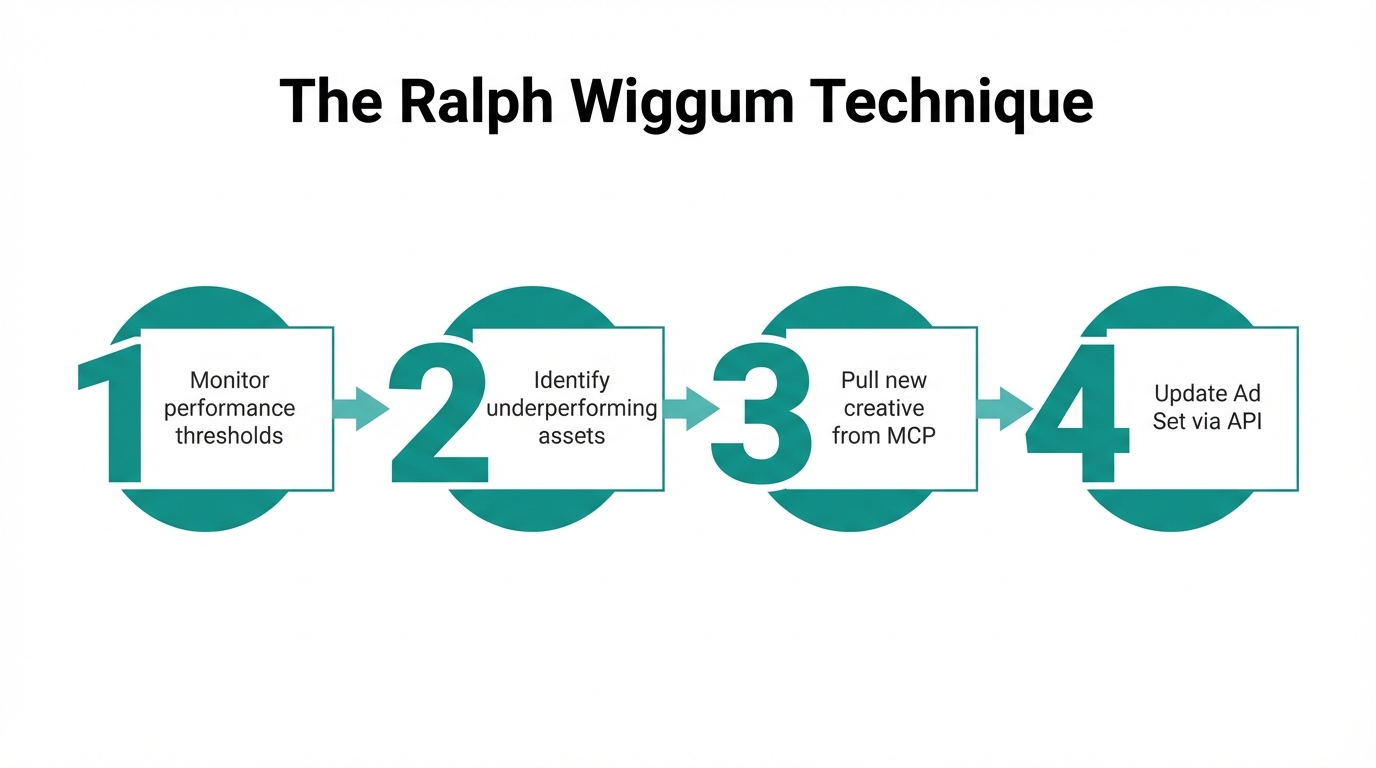
The goal of automated testing is to reach a state of persistent iteration. Developers and growth hackers, such as those discussed on Reddit marketing communities, often use what is colloquially known as the "Ralph Wiggum" optimization technique. This involves a loop where Claude Code iterates on a task—such as refining ad copy for character limits or testing visual variants—until it meets predefined success criteria.
For example, using a command like /RSA --refine --target-ctr=2.5%, the AI agent can generate new copy, check it against your brand guidelines in Notion, and cross-reference it with live traffic data from PostHog. When an asset is flagged as fatigued, the script automatically swaps the underperforming image with a high-performing variant stored in a local directory or a Figma-connected folder.
| Strategy Component | Manual Testing | Automated AI Rotation |
|---|---|---|
| Setup Time | 30-60 Minutes | 30 Seconds |
| Creative Volume | Limited by Designer Output | 10x Increase (via Scripting) |
| Fatigue Response | Reactive (Weekly Checks) | Proactive (Real-time Triggers) |
| ROAS Impact | Baseline | +27% Improvement |
Centralizing the Creative Pipeline
One of the biggest hurdles in Facebook creative testing is sourcing the volume of assets required to feed the automation engine. If your script detects fatigue but has no fresh assets to rotate in, the system stalls. This is where modern sourcing tools become essential. To maintain a constant flow of fresh perspectives, platforms like Stormy AI can help source and manage UGC creators at scale, providing the raw material for these automated tests.
By integrating a tool like Stormy AI into your workflow, you can ensure that your AI agents always have access to new, authentic content. You can then use CData Connect AI to funnel these assets and their performance metrics directly back into your terminal for analysis. This creates a closed-loop system where creative discovery, deployment, and rotation happen autonomously while you sleep.
"Treating your marketing funnel as a codebase allows you to deploy variations directly via terminal commands, bypassing the friction of legacy dashboards."
Common Pitfalls: Budget Bleed and API Limits
While the benefits are clear, automated ad rotations require a steady hand during initial setup. A common mistake is the "Set it and Forget it" myth. While automation handles the tactics, the human must handle the strategy. Failing to check KPIs regularly can lead to budget bleed if an automation script begins testing an unprofitable niche too aggressively via Zapier or custom webhooks.
Another technical hurdle is API Rate Limiting. Meta's Marketing API has strict limits on how frequently you can query data. If your Claude Code script pings the API every minute, you risk a temporary account lock. It is vital to set your monitoring frequency to sustainable intervals—typically once every 4 to 6 hours—to stay within safe bounds. Furthermore, ensure your Facebook Pixel and Conversions API (CAPI) are verified; automating on top of bad data will only scale your errors.
Conclusion: The Future is Agentic
Transitioning to an automated creative testing framework is the only way to combat the rising costs of the modern ad ecosystem. By utilizing Claude Code, MCP bridges like Pipeboard, and sourcing high-quality UGC through Stormy AI, you can build a marketing engine that is faster, cheaper, and more effective than any manual operation. The marketers who succeed in 2026 will not be those who work harder, but those who build the best code to work for them.
Start by setting up a simple monitoring script today. Define your CTR and Frequency triggers, connect your terminal to the Meta API, and watch as your creative automation playbook begins to reduce ad fatigue and reclaim your most valuable asset: time.