In early 2026, the barrier to entry for software entrepreneurship has effectively vanished. What used to be a $50,000 custom app build requiring a six-month roadmap is now being compressed into an afternoon. Founders are leveraging the 10-minute AI playbook to ship MVPs (Minimum Viable Products) at a fraction of the cost, often using tools like Bolt.new to generate full-stack applications from a single prompt. However, as the initial dopamine hit of "vibe coding" fades, a new reality is setting in: the AI coding hangover.
While worldwide AI spending has surged to $2.52 trillion in 2026, a 44% increase year-over-year according to Gartner, the hidden costs of unmanaged AI code are beginning to surface. Rapid scaling is no longer about who can prompt the fastest; it is about who can fix AI-generated technical debt before it collapses the foundation of their business.
The Rise of Bolt.new and the Era of 'Vibe Engineering'
The current landscape is dominated by "prompt-to-app" generators. Tools like Bolt.new allow non-technical founders to see live, browser-based edits of their software in seconds. This has led to a shift from "vibe coding" (blindly accepting AI output) to "vibe engineering," where the builder treats AI context like a critical infrastructure asset. As Lovable and Replit Agent continue to reach massive ARR milestones, the methodology of shipping is changing forever.
| Feature | Traditional Custom Build ($50k+) | AI Playbook Build (~$1k) |
|---|---|---|
| Speed | 3–12 Months | 2–4 Weeks |
| Ownership | Agency-managed; high fees | 100% Code ownership |
| Scalability | High (Production-ready) | Medium (Needs refactoring) |
| Risk | High financial outlay | Low cost; rapid validation |
For founders, the goal is velocity-to-revenue. We have seen entrepreneurs use these tools to generate millions in revenue in record time. However, the 10-minute AI playbook works best when you understand the pitfalls of scaling AI apps for business. Without a strategy to manage the underlying logic, you aren't building a SaaS; you're building a house of cards.
Identifying and Fixing AI-Generated Technical Debt
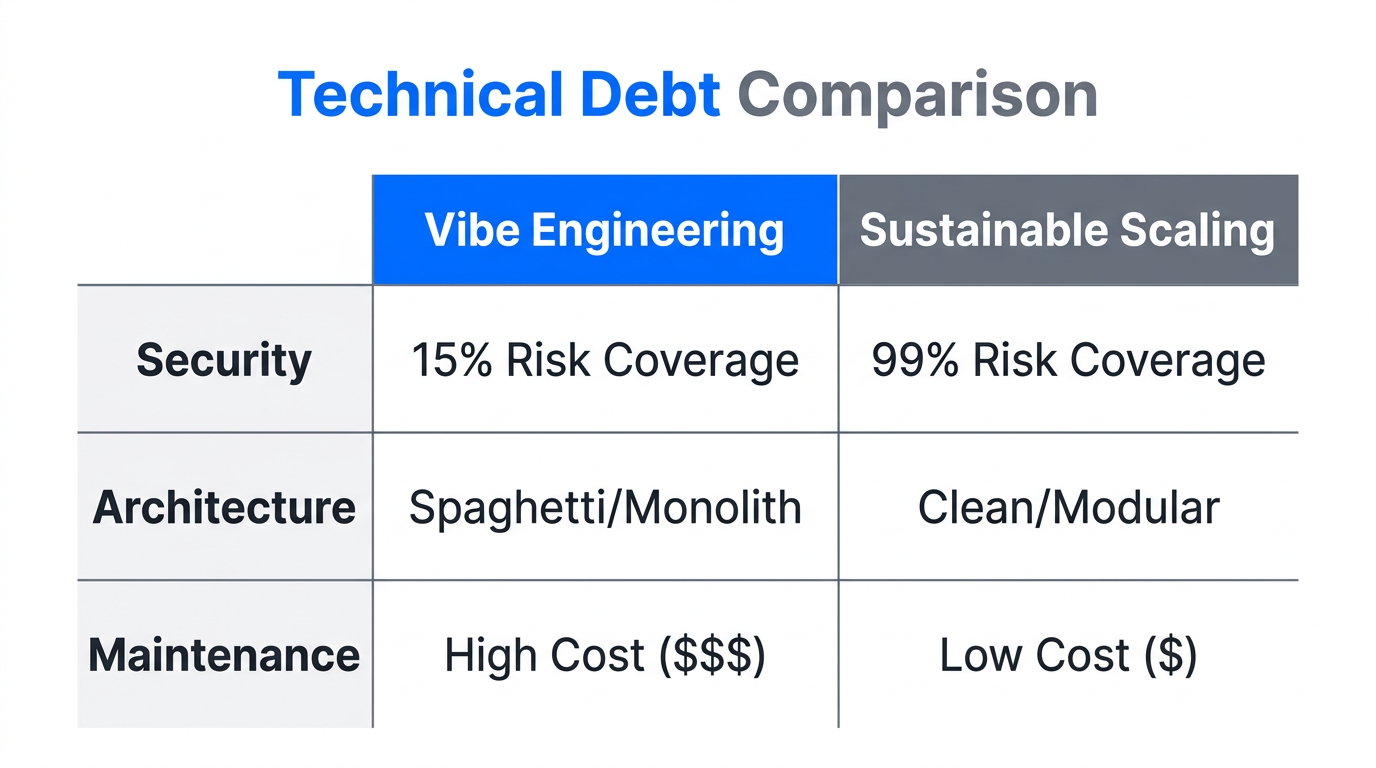
The most dangerous aspect of AI-generated code is its deceptive quality. It often looks clean, runs perfectly on your local machine, and handles basic user flows with ease. Yet, CodeRabbit reports that 90% of AI-written codebases contain significantly high technical debt. This is often referred to as "Zombie Code"—logic that functions but is so convoluted or inefficient that no human can easily maintain or debug it.
"The speed is real... but vibe coders who never learned to debug are screwed when the AI generates 15,000 lines of code they don't understand."
To fix AI generated technical debt, founders must move away from a "one-and-done" prompt mindset. As your app grows, the AI begins to lose track of global dependencies. You might ask for a new button and suddenly your entire database connection breaks. To avoid this, you must prioritize modular prototyping. Break your app into tiny, isolated functions rather than asking for a monolithic build. This ensures that when the AI refactors code, it only impacts a specific module, making bugs easier to isolate and squash.
Security Benchmarks: Addressing the 29.1% Vulnerability Risk
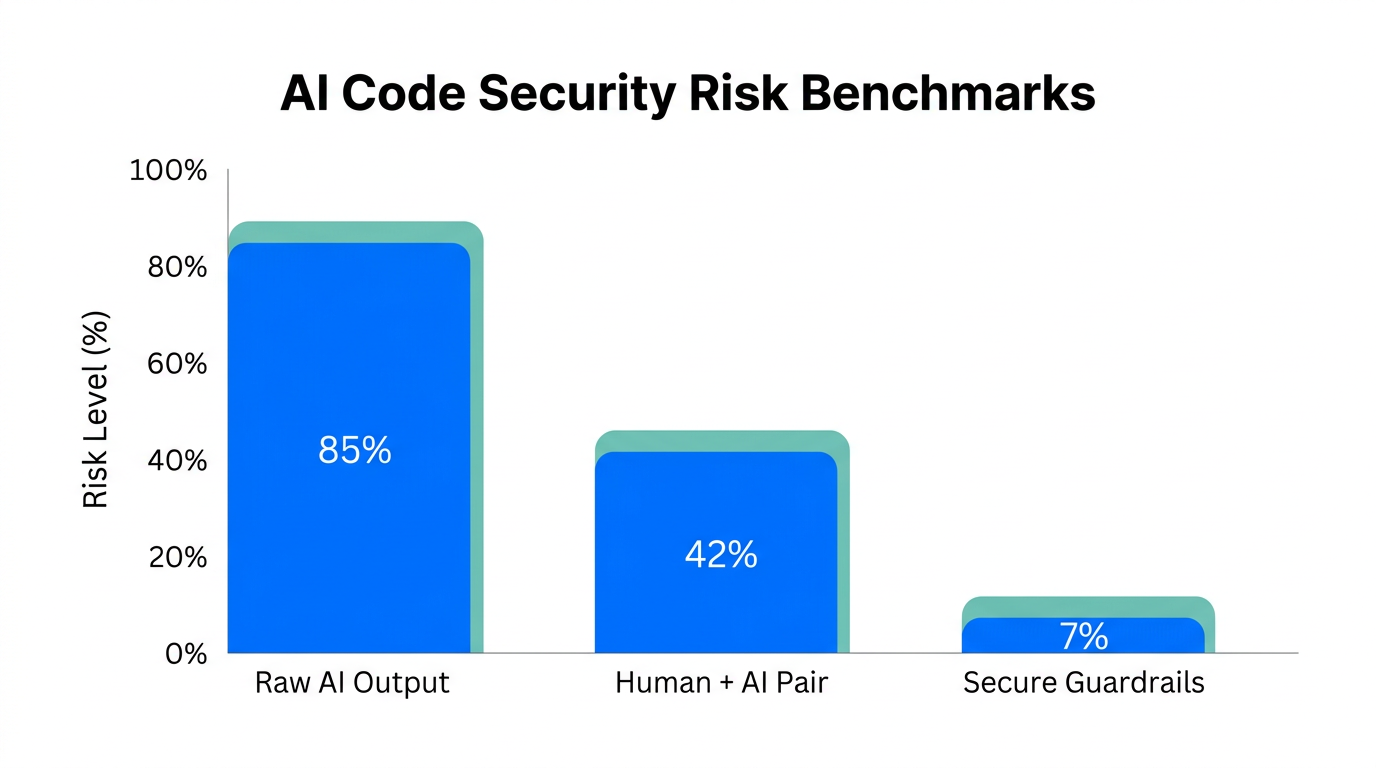
In 2026, AI coding security is the primary concern for enterprise-grade applications. Research from security platforms like Snyk indicates that 29.1% of AI-generated Python code contains potential security weaknesses, ranging from insecure API handling to SQL injection risks. For a business scaling an app, this isn't just a technical glitch—it is a massive liability.
When using Bolt.new or Lovable, founders should integrate automated security scanning tools early in the process. You cannot assume the AI is prioritizing security over functionality. The AI's objective is to make the code "work" based on your prompt, not necessarily to make it "secure" against modern cyber threats. Always prompt the AI to use modern security libraries and request an explicit "security audit" of its own output as a separate step in the workflow.
The 'Conductor' Mindset: Shifting from Builder to Orchestrator
The role of the founder is evolving. You are no longer the one typing out every line of CSS; you are the Conductor. This shift means managing multiple specialized AI agents. For example, you might use v0.dev for UI components, Nx for monorepo management, and Cursor for deep context-aware refactoring. This multi-agent approach prevents a single model from becoming overwhelmed by the complexity of a large codebase.
Professional builders are standardizing on the "Boring Stack" (AI Edition): Next.js + Tailwind CSS + Supabase. By using a standardized, highly readable schema, you make it easier for AI agents to "understand" the architecture. When you build tools for complex ecosystems—like a dashboard for managing influencers—using specialized platforms like Stormy AI for the data layer ensures your AI-generated frontend is powered by high-quality, reliable discovery and analysis engines.
Context Management: Preventing AI Hallucinations
As your Bolt.new codebase grows, the AI's "context window" becomes crowded. This leads to hallucinations—where the AI suggests code that references non-existent files or uses deprecated variables. To maintain a clean build, you must practice aggressive context management.
- Clear Context Regularly: Don't keep a single chat thread running for three weeks. Once a feature is done, start a new thread and feed it only the relevant snippets of the existing code.
- AI Documentation: Use the AI to document every function it writes. This serves as a "memory map" that you can feed back into the AI when you need to make changes months later.
- IDE Migration: When the app moves beyond a simple prototype, migrate from the browser-based builder to a professional AI-native IDE like Cursor. This allows for deep, multi-file indexing that browser builders currently struggle with.
"AI isn't replacing developers; it's changing what they do... human roles expand toward orchestration and systems thinking."
Financial Modeling: Why AI Cloud Bills Are Growing Faster Than Revenue
A shocking trend in 2026 is the "efficiency gap." Because AI focuses on speed over optimization, AI-generated code often over-allocates cloud resources. Functions may be written with redundant loops or inefficient database queries that a human developer would have streamlined. This results in enterprise cloud bills on platforms like AWS or Vercel growing faster than the revenue generated by the app.
By early 2026, companies like Lovable have shown that the market rewards speed, but sustainability depends on the final 20% of polishing. If your cloud costs eat your margins, your "10-minute app" becomes a financial burden rather than a business asset.
The 7-Step Playbook for Scaling AI Apps
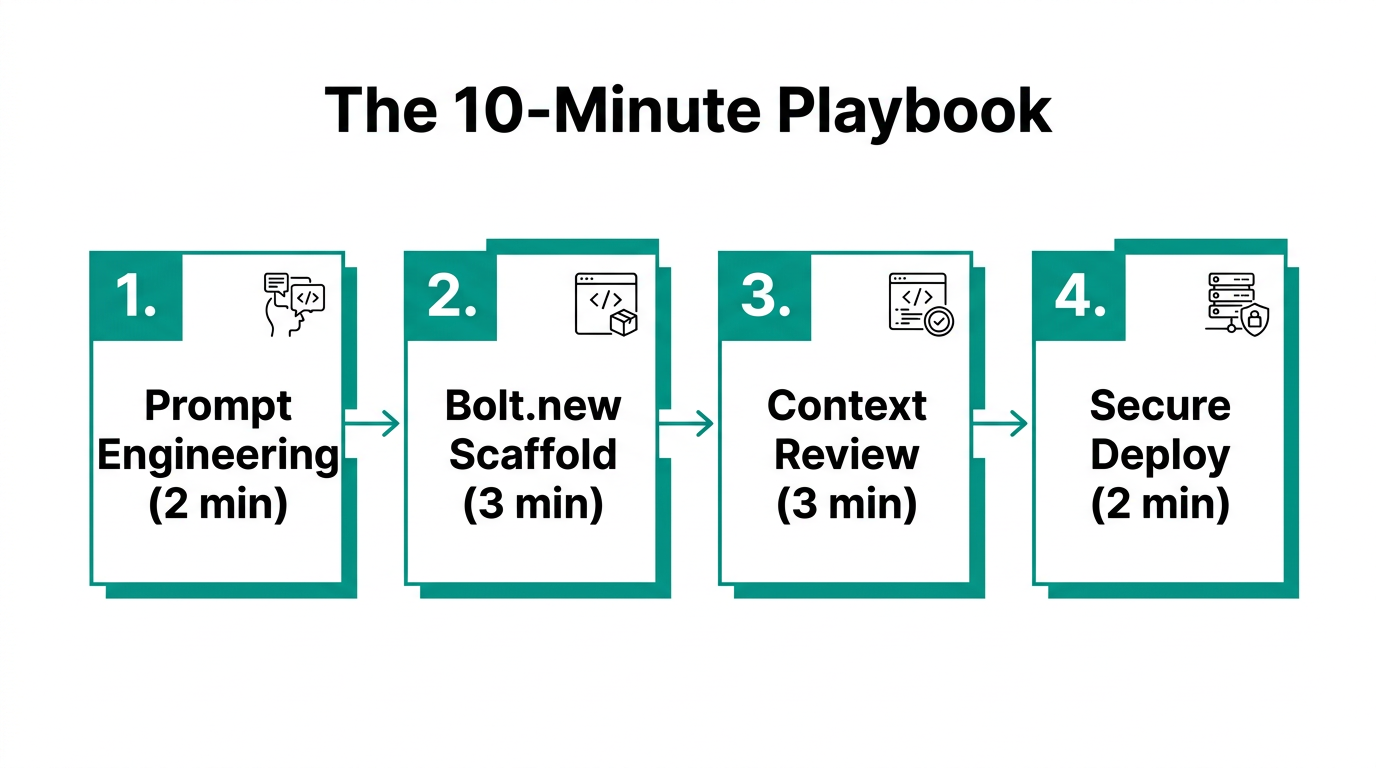
To succeed in the 2026 market, follow this sequence to bypass traditional agencies while maintaining structural integrity:
- PRD with AI: Use Claude or ChatGPT to write a detailed Product Requirements Document (PRD) before touching any code.
- Modular Prototyping: Build the app in "tiny modules" in a builder like Bolt.new.
- Active Debugging: Test, observe errors, and feed logs back to the AI immediately. Never manually fix something without letting the AI know, or it will break it again later.
- Context Management: Clear context aggressively to prevent hallucinations as the codebase expands.
- Environment Migration: Move to Cursor or Windsurf for final control and complex refactoring.
- AI Documentation: Force the AI to write a "readme" for every major module so you can manage it long-term.
- Early Submission: Submit to the App Store or launch your web app early; use the AI to handle the rejection/fix cycles iteratively.
When your app requires deep integration with social media or creator data—common for modern marketing tools—don't try to build the discovery engine from scratch. Integrate with specialized tools like Stormy AI to handle the heavy lifting of influencer analysis while your AI agents focus on your unique business logic.
Conclusion: Surviving the Hangover
The 10-minute AI playbook is the most powerful tool in a founder's arsenal today. It allows for rapid market validation and a 95% reduction in initial costs. But the success of your business depends on your ability to transition from a "Vibe Coder" to an "Agentic Engineer."
By proactively addressing security vulnerabilities, managing your AI's context, and auditing your technical debt, you can build software that doesn't just launch, but lasts. In 2026, the real winners aren't those who can generate the most code—they are the ones who can orchestrate it into a scalable, secure, and profitable machine.