Automating High-Velocity Technical SEO and Metadata with Claude Code
Learn how to use Claude Code for technical SEO automation in 2026. Scale ecommerce SEO strategy with AI schema markup generators and automated metadata enrichment.
In 2026, the bottleneck of ecommerce growth is no longer traffic generation—it is technical execution velocity. As global online sales soar toward $6.86 trillion, accounting for over 20% of total retail according to Craftberry, the competition for visibility has shifted. We are no longer just optimizing for human eyes; we are optimizing for AI agents that buy on behalf of humans. This era of "agentic commerce" requires a level of structured data and metadata precision that manual teams simply cannot maintain. Enter Claude Code, the terminal-based agentic environment from Anthropic that is fundamentally changing how technical SEO automation is handled at scale.
The State of Technical SEO in 2026: The Machine-to-Machine Shift
The traditional SEO funnel has evolved into what industry experts call a "growth loop." According to the Reforge Growth Engineering framework, success in 2026 is defined by how quickly a brand can close the gap between content creation and search visibility. AI-driven referrals have seen a staggering conversion increase of 1,247% recently, as reported by Signifyd, because search engines are now acting as personal shopping assistants.
For these AI assistants to recommend your products, your technical SEO must be flawless. Structured data—specifically Schema.org markup—is no longer a "nice-to-have" enhancement; it is the primary language of commerce. If an AI agent cannot parse your inventory's availability, shipping dimensions, and real-time pricing via JSON-LD, your product does not exist in the 2026 search ecosystem. This is why technical SEO automation 2026 has become the top priority for high-growth ecommerce brands.
"AI agents aren't just a future interface; they're a new operating layer for commerce, requiring retailers to optimize for machine-to-machine transactions."
Understanding Claude Code for SEO Engineering
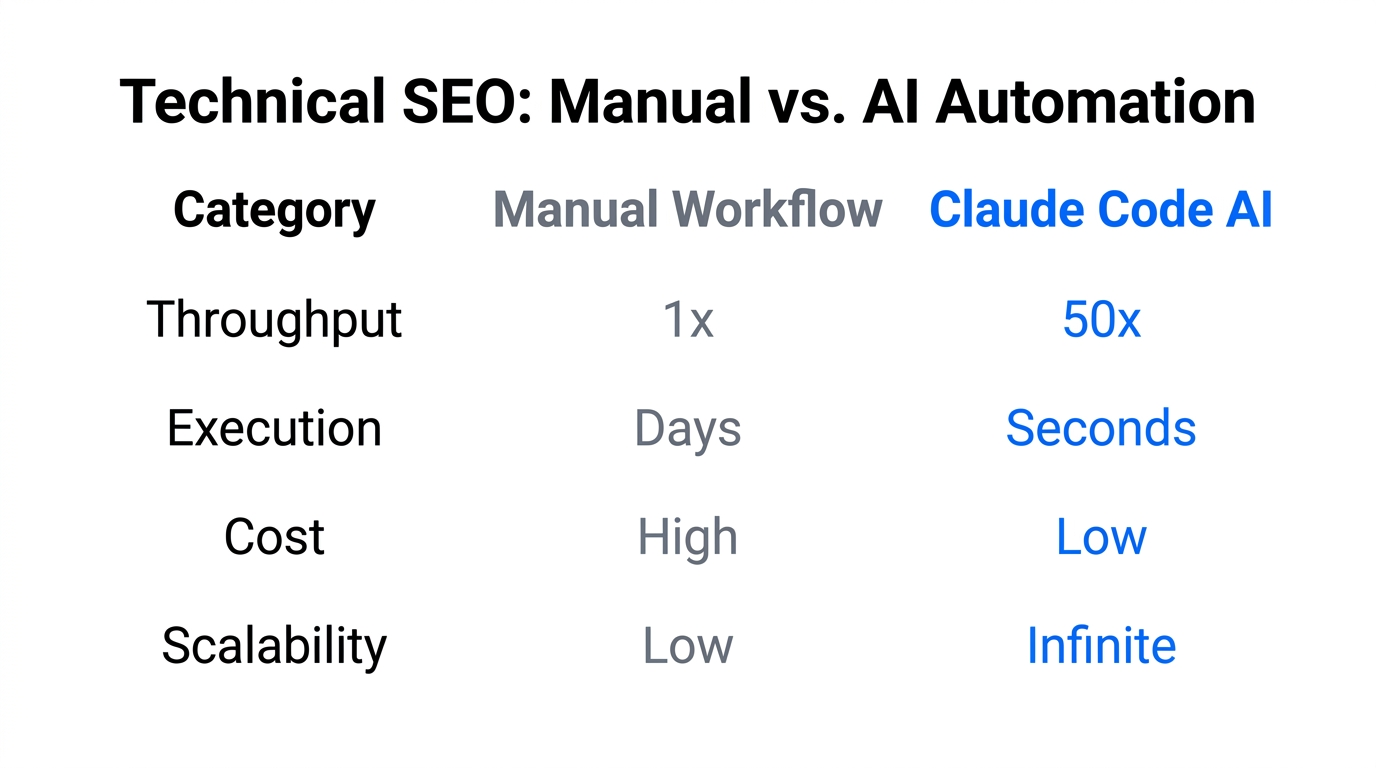
Unlike standard AI assistants that offer code snippets, Claude Code is an autonomous agent that operates within your repository. It doesn't just suggest changes; it executes them. It can run terminal commands, index your entire codebase to understand dependencies, and iteratively test its own deployments. For growth engineers, this means Claude Code for SEO acts as a 24/7 technical auditor and implementation specialist.
By leveraging the Model Context Protocol (MCP), Claude Code can connect to external databases like NeonDB or local product catalogs to pull raw data and transform it into rich metadata. Developers using these agentic loops are shipping 60% more Pull Requests and saving nearly 4 hours of manual labor every week, according to the latest DX Report. This velocity is what allows massive ecommerce catalogs to stay ahead of the curve.
| SEO Task | Manual Workflow (Hours) | Claude Code Workflow (Minutes) | Impact Factor |
|---|---|---|---|
| Schema Generation | 15-20 hours / batch | 12 minutes | High visibility in AI Search |
| Image Alt-Text Enrichment | 40+ hours / catalog | 35 minutes | Accessibility & Image SEO |
| Technical Audit & Fixes | Weekly recurring | Autonomous Loop | 0% Downtime for metadata |
Automated Metadata Enrichment and Schema Generation
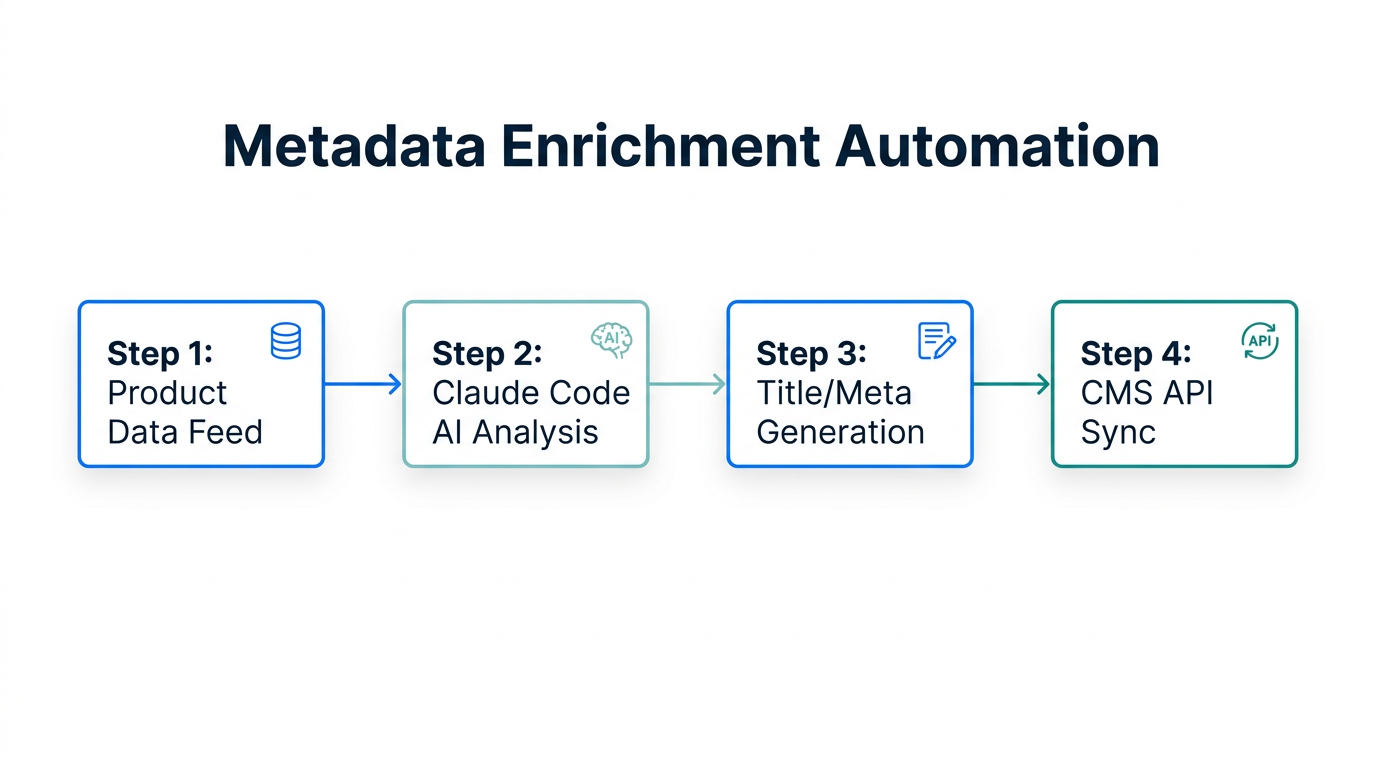
The most tedious part of an ecommerce SEO strategy is the constant need for metadata enrichment. When a new product line drops, generating unique meta titles, descriptions, and AI schema markup often lags behind the actual launch. Claude Code solves this by autonomously crawling your product database and generating localized, SEO-optimized content in real-time.
For example, a growth engineer can prompt Claude Code to: "Scan the new 'Summer 2026' collection, identify missing 'Product' and 'Offer' schema, and write a script to inject JSON-LD into the head of each React component." Because Claude understands the codebase context, it ensures that shipping scripts or pricing APIs aren't broken during the process. This shift toward "intent-based development" (or vibe coding) allows engineers to focus on strategy while the agent handles the boilerplate, as noted by Newline.
Automating the FAQ Loop: Capturing Long-Tail Search Intent
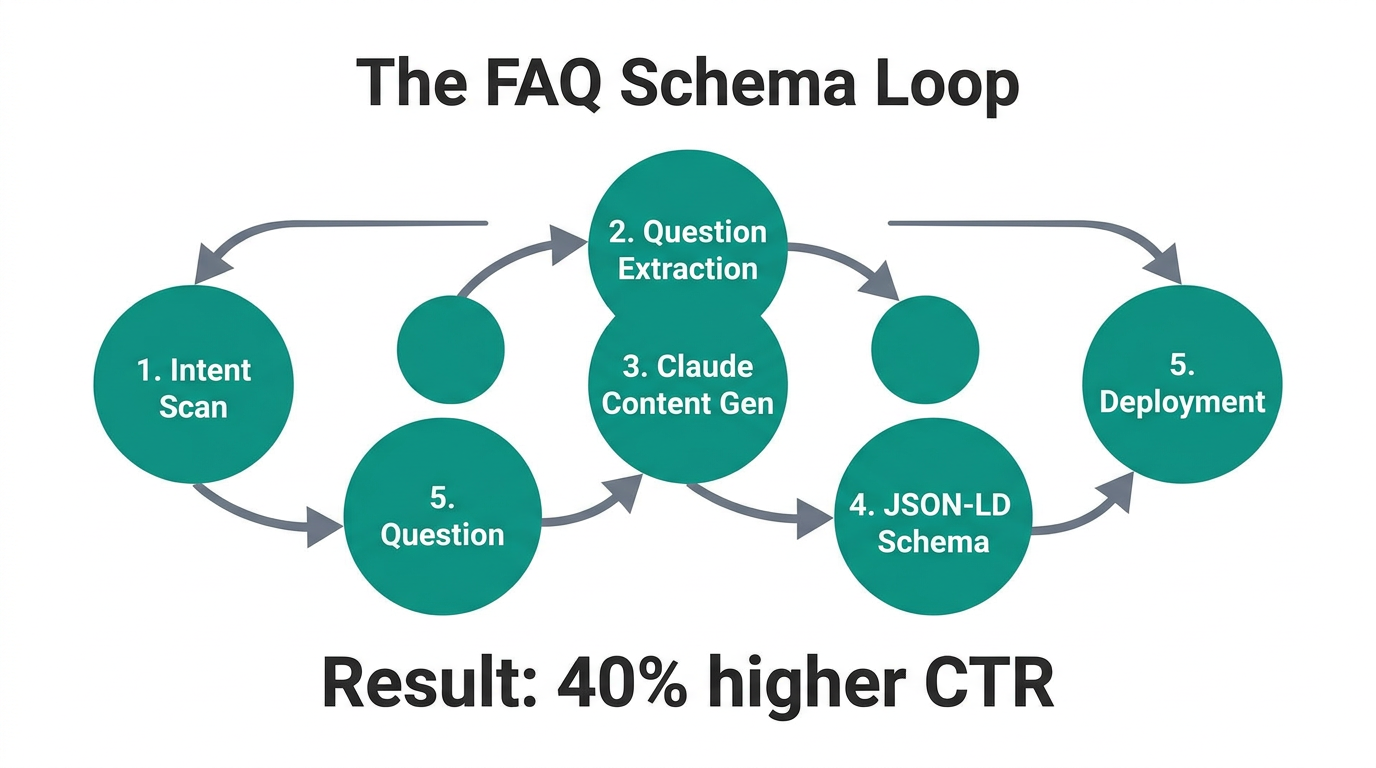
One of the most powerful ways to drive organic traffic is through dynamic FAQ sections. In 2026, search intent is increasingly long-tail and conversational. By using Claude Code to build an automated FAQ loop, you can turn customer support data into SEO-rich content. The workflow involves piping real customer queries into Claude, which then generates and deploys Schema-compliant FAQ sections for relevant product pages.
This is where social proof and technical SEO intersect. When sourcing creators on Stormy AI, the user-generated content (UGC) they produce provides a goldmine of semantic data. Claude Code can analyze transcriptions of creator videos to identify frequently asked questions that customers actually care about—like "Does this fitness tracker work in salt water?"—and instantly update the product's technical SEO to answer that specific query. This creates a proprietary data loop that generic competitors cannot replicate.
"The 80/20 rule of AI: 80% of your success depends on data hygiene; only 20% depends on the model itself."
The 80/20 Rule: Why Data Hygiene is the Foundation
Despite the capabilities of agentic tools, many AI ecommerce projects fail. Statistics from Bintime suggest a 68% failure rate, often attributed to "garbage in, garbage out" scenarios. Before deploying Claude Code for SEO automation, your product data must be clean, structured, and accessible.
Using tools like dbt for data transformation and NeonDB for scalable infrastructure is essential. If your product descriptions are riddled with typos or inconsistent formatting, your automated metadata enrichment will produce hallucinated or low-quality results. Growth engineers should spend the majority of their time setting up robust data pipelines before letting the AI agent loose on implementation.
Playbook: Setting Up an Autonomous SEO Audit Agent
Ready to automate? Follow this step-by-step guide to setting up an autonomous SEO agent using Claude Code that identifies and fixes metadata issues weekly.
Step 1: Define the Environment and Scope
Initialize Claude Code in your main web repository. Define the scope by giving the agent access to your product routing and SEO components. Use a tool like Cursor if you prefer a visual IDE for the initial configuration of React/Next.js components.
Step 2: Connect to the Data Source
Use an MCP server to connect Claude to your product CMS or database. Ensure the agent has read-only access to your inventory data so it can compare live pages against the "source of truth" in your database.
Step 3: Script the Audit Loop
Command Claude to run a weekly script that checks for:
- 404 errors on high-traffic product pages.
- Missing
og:imagetags for social sharing. - Stale pricing in JSON-LD markup compared to the actual database.
- Images missing descriptive alt-text.
Step 4: Automate the Pull Request (PR) Workflow
Configure the agent to not only find errors but to fix them by creating a PR. You should still maintain human oversight—AI-assisted developers can ship 10x more security risks if not audited, as reported by Fast Company. Set up a review process where an engineer approves the SEO fixes before they hit production.
The Future of High-Velocity SEO
In 2026, the winners in ecommerce aren't those with the biggest budgets, but those with the fastest technical SEO automation. By leveraging Claude Code, brands can eliminate the manual bottleneck of metadata enrichment and schema management, ensuring their products are always discoverable by both humans and AI agents.
To truly scale this strategy, remember that SEO doesn't exist in a vacuum. High-quality metadata requires high-quality content. Integrating a tool like Stormy AI to discover and manage influencers ensures you have a constant stream of UGC to feed your SEO loops. When you combine autonomous technical execution with authentic human content, you create a growth engine that is virtually impossible for competitors to beat. Start by cleaning your data, then let Claude Code build your path to the top of the search results.