In 2026, the gap between mid-market Shopify stores and enterprise giants isn't just about ad spend—it’s about architectural efficiency. Manual page creation is officially a relic of the past. As we enter a year where the global AI SEO software market is projected to skyrocket toward $4.97 billion by 2033, top-tier brands are moving toward programmatic SEO (pSEO) to capture high-intent traffic at a scale previously reserved for Amazon. High-growth ecommerce brands leveraging automated discovery and landing page generation have reported a 30%–80% surge in organic traffic and a 25%–35% increase in conversion rates within months of implementation.
Scaling a catalog of 1,000+ SKUs manually is no longer a viable growth strategy. To win in 2026, you need a machine that builds your SEO presence while you sleep. This guide provides a technical playbook for building an automated page-generation engine using the powerhouse combination of Whalesync, Airtable, and ConvertMate.
The Rise of Programmatic Shopify: Why Scale Matters Now
Traditional SEO focuses on a handful of high-volume "head terms," but the real revenue in 2026 lies in the long-tail. While old-school strategies might target 50 to 500 pages, a programmatic approach allows brands to target 5,000 to 5,000,000+ indexable pages. This isn't just about quantity; it's about precision mapping of user intent to specific product variants.
"The shift from 'ranking on Google' to 'dominating the search ecosystem' requires a shift from manual content production to automated data-driven architecture."
With 57% of global ecommerce sales now occurring on mobile devices, these automated pages must be lightning-fast and perfectly templated. Sites that load in 1 second achieve 2.5x higher conversion rates than those taking 5 seconds. By using a programmatic stack, you ensure every page adheres to the same high-performance technical standards automatically.
| Objective | Traditional Method | 2026 Automated Method |
|---|---|---|
| Page Creation | Manual CMS entry | Whalesync + Airtable |
| Content Quality | Copywriting team | ConvertMate AI Optimization |
| Technical SEO | Manual tag updates | WordLift Schema Automation |
| Conversion | Static templates | Dynamic comparison tables |
The Whalesync Engine: Syncing Massive Data to Shopify CMS
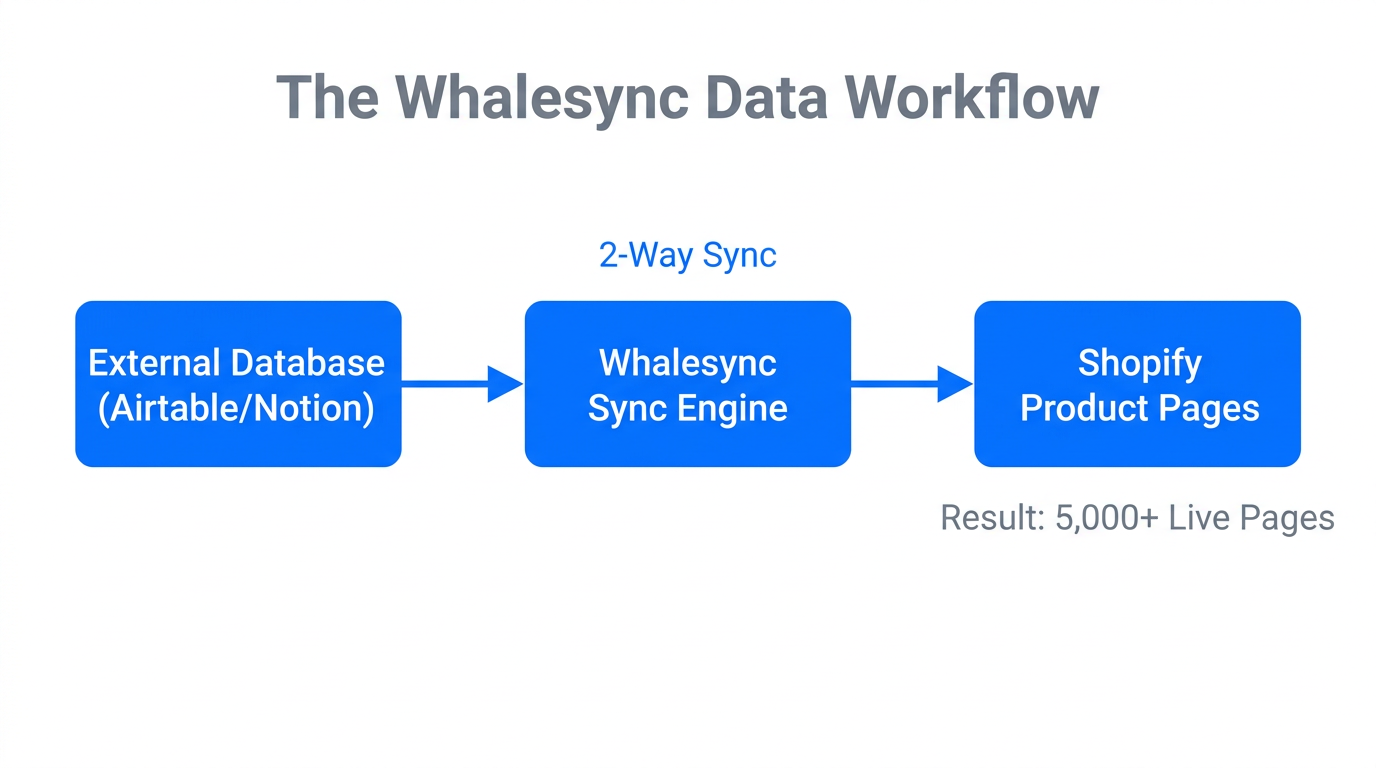
The biggest hurdle in Shopify pSEO has always been the platform's rigid CMS. Enter Whalesync for Shopify. This tool acts as the connective tissue between your primary data source (Airtable) and your Shopify store. Instead of dealing with clunky CSV imports that break every time you update a price, Whalesync creates a two-way, real-time sync.
Step 1: Building Your Data Source in Airtable
Your Airtable base is the "brain" of your operation. For every product, you shouldn't just store name and price; you need dynamic attributes. This includes specific use cases, competitor names (for vs pages), and local modifiers. By structuring your data in Airtable, you can create thousands of variations of a single product page without ever touching the Shopify admin.
Step 2: Mapping Fields for Shopify CMS
Using Whalesync, map your Airtable columns to Shopify Metafields. This allows you to inject unique data points—like "Sustainability Rating" or "Battery Life Comparison"—into your Shopify templates. When you change a single cell in Airtable, Whalesync updates the Shopify page in under 30 seconds.
The 'Product X vs Product Y' Playbook
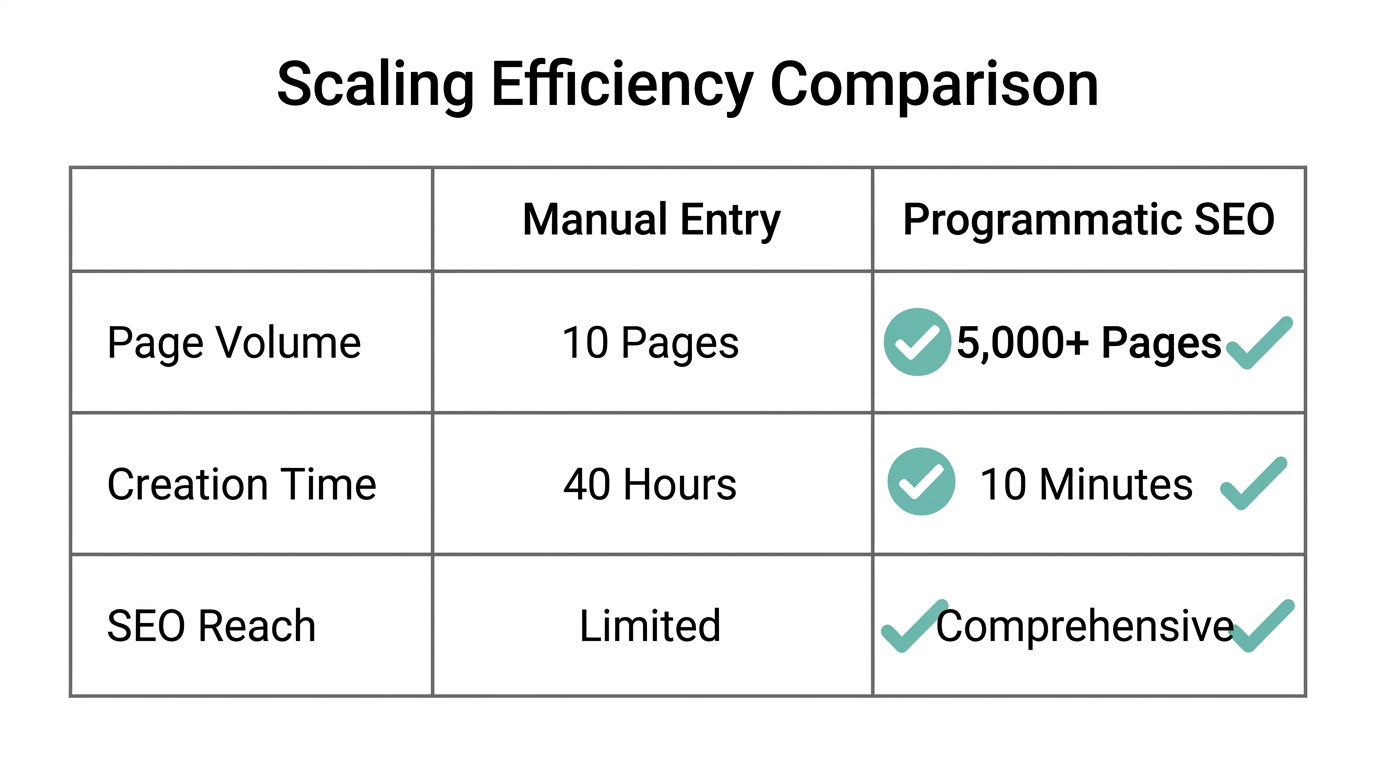
One of the most effective strategies for high-intent traffic is the automated comparison page. When a user searches for "Your Brand vs [Competitor]," they are at the bottom of the funnel. They are ready to buy—they just need a reason to choose you.
By automating this, you can generate a comparison page for every major competitor in your niche. Here is the workflow:
- Identify Competitors: List your top 20 competitors in Airtable.
- Define Comparison Vectors: Price, key features, shipping speed, and customer reviews.
- Automate the Template: Use Shopify's Metafields to pull these competitor data points into a pre-designed comparison table.
- Deploy: Let Whalesync populate these pages across your site.
Companies like Verbolia have seen month-over-month traffic increases of 80% by identifying these long-tail gaps. In 2026, targeting these consideration-phase keywords is the fastest route to a 5% to 14% conversion rate.
"Comparison pages don't just capture traffic; they steal market share directly from your competitors at the moment of decision."
ConvertMate Automation: AI-Powered Conversion Optimization
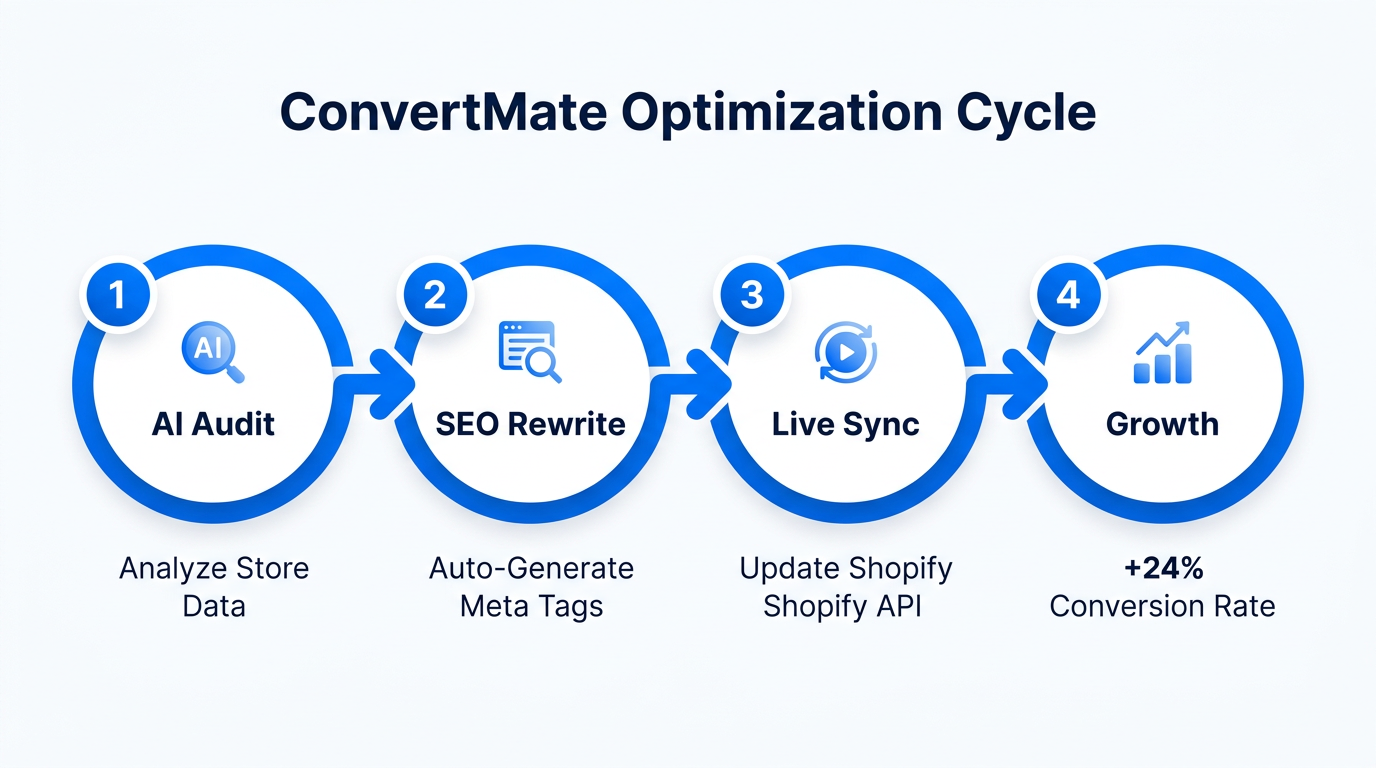
Generating pages is only half the battle. If those pages have thin content or generic descriptions, they won't rank, and they certainly won't sell. This is where ConvertMate automation becomes essential. For Shopify stores, ConvertMate specializes in automated meta-tag optimization and product description rewriting.
Solving the 'Thin Content' Crisis
Google’s 2026 algorithms are ruthless toward thin content. You need at least 500 words of unique, helpful content per page. ConvertMate uses AI to analyze your product data and generate high-quality, non-duplicate descriptions. It doesn't just describe the product; it highlights benefits based on the specific intent of that programmatic page.
Automated Schema for Rich Snippets
To win in 2026, your products must appear in Google Shopping and AI-driven search results. Combining ConvertMate with a tool like WordLift ensures that every programmatic page has full "Product" and "Offer" Schema. This makes your data readable for both search bots and Large Language Models (LLMs), a process now known as Answer Engine Optimization (AEO).
Geotargeted Growth: '[Category] in [City]'
For Shopify stores with physical locations or localized delivery options, geotargeting is a goldmine. Using localized SEO strategies, you can build collection pages like "Organic Skincare in New York" or "Sustainable Yoga Mats in Austin."
Why this works: Localized search intent often has much lower competition than broad national terms. By programmatically combining your category list with a list of the top 100 most populous cities, you instantly create 100 new ranking opportunities. When managed via Whalesync, these pages stay updated with local stock levels, ensuring a seamless customer experience.
Avoiding the Pitfalls: Duplicate Content and Crawl Waste
The danger of automation is creating digital noise. If you generate 10,000 pages that all look identical, Google will flag your site for "crawl waste" and stop indexing new content. Avoid these common mistakes:
- Orphan Pages: Every programmatic page must be linked within your site's hierarchy. Tools like Omnius can automate internal linking to ensure authority flows to your new pages.
- Manufacturer Descriptions: Never use the default supplier text. Use AI to rewrite every description so it is 100% unique to your brand.
- Slow Load Speeds: Keep your programmatic templates lean. As noted by many Core Web Vitals case studies, speed is a primary ranking factor for ecommerce in 2026.
- Ignoring AEO: pSEO is no longer just about keywords. Ensure your data is structured for Generative Engine Optimization (GEO) so AI assistants like ChatGPT can cite your products.
| Pitfall | Result | 2026 Solution |
|---|---|---|
| Duplicate Content | Crawl suppression | AI rewriting via ConvertMate |
| Orphan Pages | Zero indexing | Automated "Hub and Spoke" linking |
| Thin Content | Helpful Content penalty | Adding data-rich comparison tables |
Conclusion: The Future of Shopify is Programmatic
By 2026, the brands winning the SEO game aren't just writing better blogs—they are building better systems. The combination of Whalesync for Shopify for data management and ConvertMate automation for content optimization allows mid-market stores to compete at an enterprise scale.
Whether you are building high-intent comparison pages or localized collection hubs, the goal is the same: to meet the customer at the exact point of their search query with a perfectly optimized, high-converting experience. As we've seen with giants like Amazon and REVOLVE, those who master the long-tail today will dominate the market tomorrow. Start building your automated growth machine now, and turn your Shopify store into a traffic-generating powerhouse.