In 2026, the traditional boundaries between marketing and development have officially dissolved. The rise of "vibe marketing"—the ability to build complex, high-traffic assets using natural language—has transformed how growth teams approach AI keyword research 2026. No longer are we tethered to clunky, expensive SaaS tools that offer lagging data. Instead, the modern marketer operates directly within the development environment, leveraging Claude Code MCP marketing workflows to discover, validate, and deploy programmatic SEO pages in minutes.
By combining Cursor, Claude Code, and the Model Context Protocol (MCP), you can build a self-sustaining traffic engine. This isn't just about finding keywords; it's about automating the entire pipeline from discovery to production-ready landing pages. This guide will walk you through the exact stack used to generate thousands of organic visits by identifying the high-intent "seed" keywords that competitors are missing.
The 2026 Growth Stack: Cursor, Claude Code, and MCPs
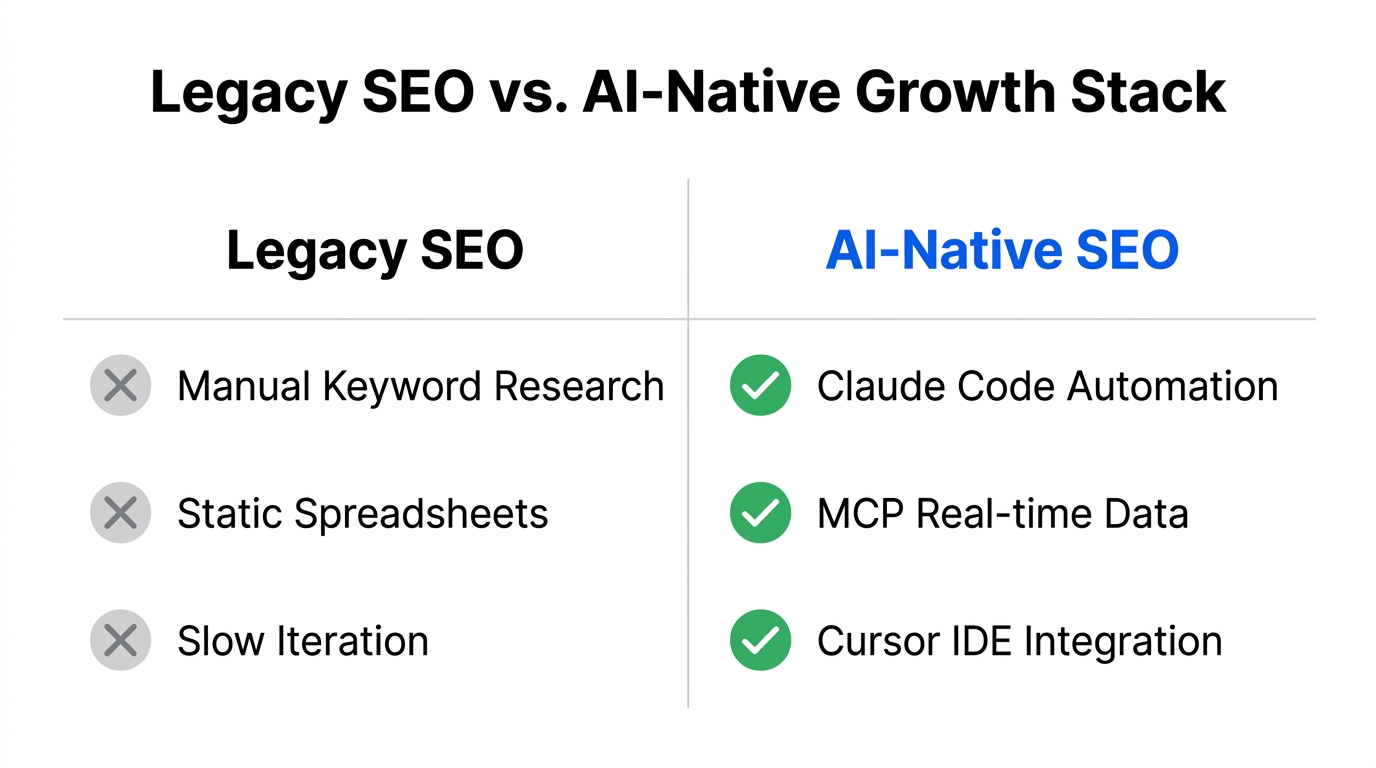
To understand the power of this workflow, we must first look at the tools. Cursor is an AI-native code editor that allows even non-technical marketers to "chat" with their entire codebase. However, the real magic happens when you integrate Claude Code into the terminal. Unlike standard web interfaces, Claude Code has deep context over your file structure and can execute tasks autonomously.
The bridge between these AI models and the real world is the Model Context Protocol (MCP). MCPs allow your LLM to connect directly to external data sources like Google Search, real-time scrapers, and SEO databases. Instead of copying and pasting data from a browser into a chat, the data flows directly into your terminal environment via GitHub-hosted connectors.
"The upside of learning a tool like Cursor is totally worth it; it is the interface for everything from research to implementation in 2026."
Configuring Firecrawl and Perplexity MCPs
 9:14
9:14Before you can find "money" keywords, you need to set up your eyes and ears. The two most critical MCPs for high-intent keyword discovery are Firecrawl and Perplexity.
- Firecrawl MCP: Acts as a high-performance scraper. It can crawl entire websites and return clean Markdown files directly into your Cursor environment.
- Perplexity MCP: Provides real-time web search capabilities. It allows Claude to stay updated on the latest trends, tool launches, and search shifts that occurred just minutes ago.
Setting these up is simpler than it sounds. You can simply ask the Cursor Agent, "Help me set up the Firecrawl and Perplexity MCPs." Once configured, these tools allow Claude to 'see' the current state of the internet. This is a critical advantage for automated competitor analysis, as you are no longer relying on database snapshots that are months old.
The Competitor Scrape: Mapping Architecture in Seconds
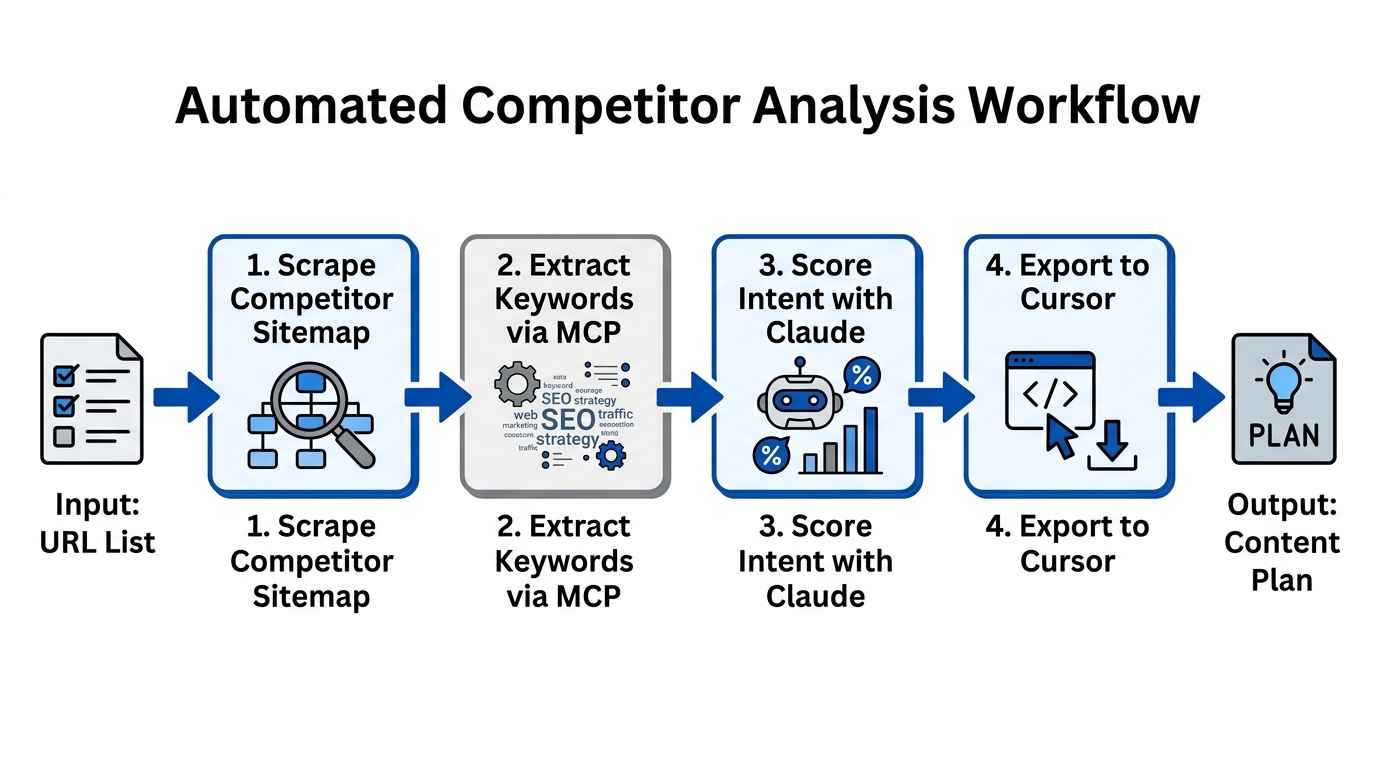
One of the fastest ways to find lucrative keywords is to map out a competitor's site architecture to identify content gaps. Using the Firecrawl MCP, you can prompt Claude: "Use Firecrawl to scrape [Competitor URL] and create a summary of their core offerings and top-performing page structures."
Within seconds, Claude will generate a `.md` file in your repository containing the competitor’s entire strategy. You can see their navigation, their primary CTAs, and their programmatic subfolders. This visibility allows you to see exactly which 'money' pages are driving their revenue. Once you have this summary, you can reference it in subsequent prompts to build something better on modern platforms like Framer or Webflow.
| Feature | Traditional SEO Tools | Claude Code + MCPs |
|---|---|---|
| Data Latency | Weeks to Months | Real-Time (Seconds) |
| Workflow | Manual Export/Import | Seamless Terminal Integration |
| Output | Spreadsheets | Production-Ready Code |
| Cost | High Monthly Subs | Pay-per-token (Highly Efficient) |
Validating 'Money' Keywords with Data for SEO
20:10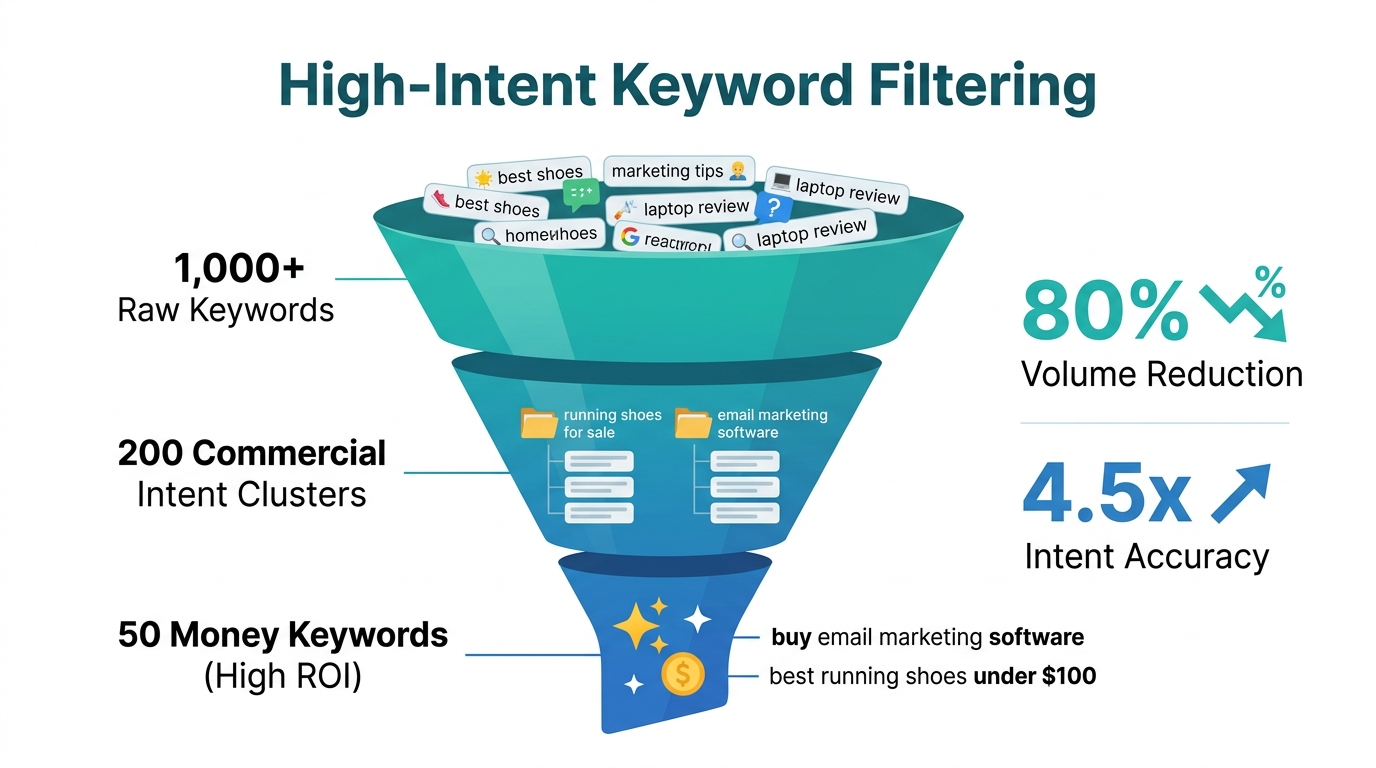
Discovery is useless without validation. Once Perplexity for SEO has helped you identify "seed" keywords (like "AI marketing tools"), you need to know if they are worth the effort. This is where the Data for SEO MCP comes into play.
Instead of logging into a clunky SaaS dashboard, you can ask Claude Code: "Use the Data for SEO MCP to pull the search volume and difficulty for these seed keywords." Claude will then return a structured list of metrics. This allows you to prioritize keywords that have high intent but low competition—the sweet spot for startups in 2026. This data-driven approach ensures that your AI keyword research 2026 efforts are focused on the 20% of keywords that will drive 80% of your conversions.
"Stop guessing which keywords matter. Use live API data inside your dev environment to validate every 'money' term before writing a single line of content."
Programmatic Idea Generation: The 4,000+ Combo Rule
The true power of this stack is unlocked when you move into programmatic SEO. A classic strategy is the "Head-to-Head Comparison." If you have a list of 20 relevant tools in your niche, you can create comparison pages for every possible combination (e.g., Tool A vs Tool B).
Math shows the scale here: 20 tools vs 20 tools across 10 different use cases equals 4,000 unique keyword combinations. If each page only gets 20 visitors per month, you are looking at 80,000 monthly organic visitors. Platforms like Stormy AI can augment this by helping you find the right niche creators to review these tools, adding a layer of social proof to your programmatic pages.
You can prompt Claude Code to identify these combinations automatically: "Based on our tool list, identify 4,000 head-to-head comparison combinations and estimate the total potential traffic using search volume averages." This allows you to visualize the entire growth ceiling of your project before you even build it.
From Research to PRD: Automating the Handoff
22:41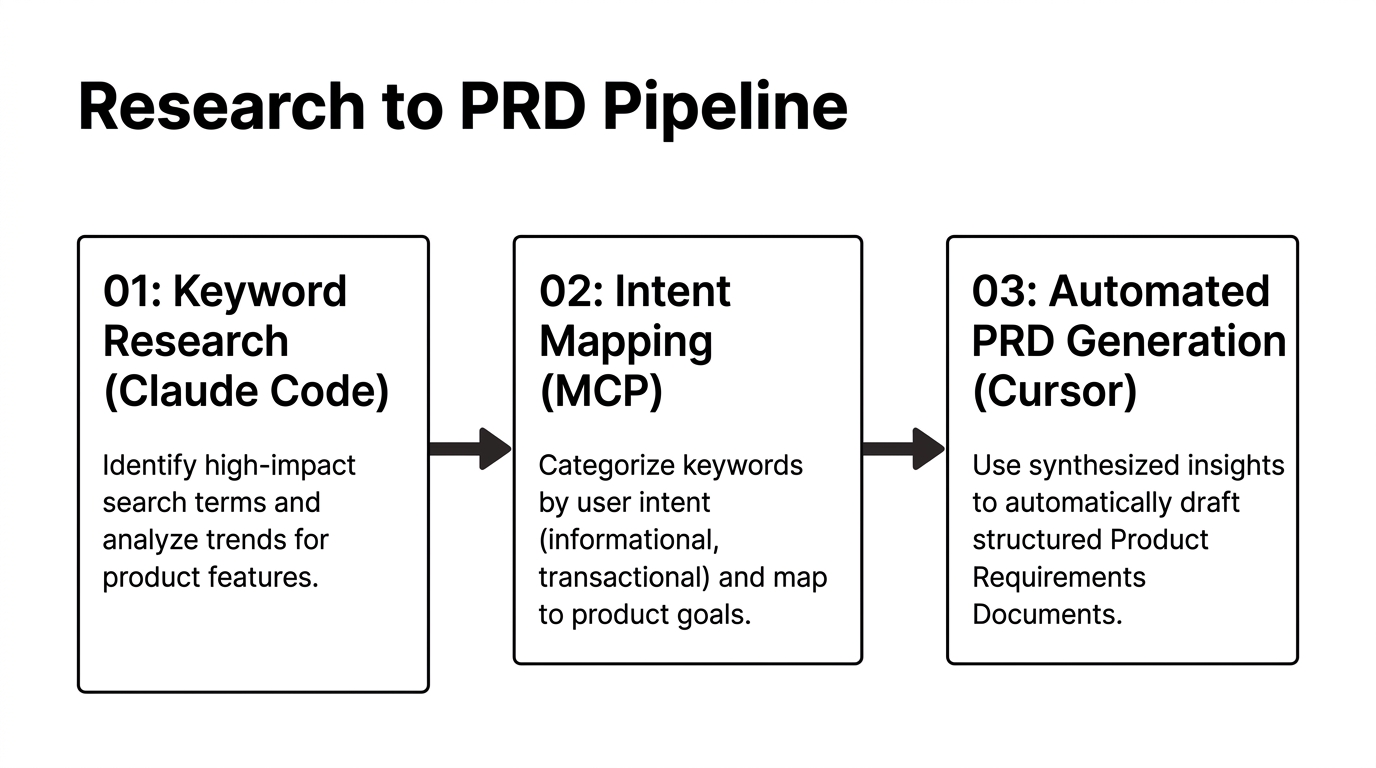
One of the biggest friction points in marketing is the handoff from research to implementation. In the old world, a marketer would write a brief, and a developer would build it weeks later. With Claude Code, you can automate the creation of a Product Requirement Document (PRD) that the AI then uses to build the actual site.
Once your keyword research is finished, simply prompt: "Create a PRD for a programmatic page template based on this research. Prioritize tool comparisons, interactive calculators, and email capture components." Claude will generate a structured plan in a tool like Confluence or Notion. You can then say, "Start building according to the PRD," and watch as the AI generates the components, sets up the data structures, and implements the SEO schema markup automatically.
To ensure your pages actually rank, you can integrate tools like Apple Search Ads or Google Ads insights to refine your keyword targets even further during the build process.
Deployment and Automated Technical Audits
53:59Once Claude Code has built your pages, deployment is as simple as typing a command. Using Vercel or Netlify, you can push your programmatic engine live directly from the terminal. But the work doesn't stop there.
The final step in this 2026 workflow is the automated technical SEO audit. You can ask Claude to use Firecrawl to crawl your newly deployed production site and find any errors, following the latest Google Search Central guidelines. "Find any broken links, missing meta tags, or slow-loading components and fix them immediately." Instead of receiving a PDF report of errors you have to fix manually, the AI identifies and executes the fixes in real-time.
"The convergence of marketing and engineering means you can go from a 'seed' keyword idea to 1,000 live, optimized pages in a single afternoon."
The Future of High-Intent Growth
The era of manual keyword research is over. By mastering Claude Code MCP marketing and the Cursor environment, growth teams can move with a velocity that was previously impossible. You are no longer just a marketer; you are a builder who uses data to construct high-intent traffic machines. As you scale, remember to keep your focus on the user experience—use Perplexity for SEO to keep your data fresh and ensure your programmatic pages provide genuine value.
If you're ready to amplify your reach even further, tools like Stormy AI can help you source the creators needed to build authority around your new content hubs. In 2026, those who can bridge the gap between AI insight and technical action will own the search results.