Automating Competitive Intelligence: Using OpenClaw for Real-Time Market Research
Learn how to use OpenClaw agents for real-time competitor monitoring and automated sales battlecards in 2026. Scale your market research with AI browser control.
In the fast-paced marketing landscape of 2026, the traditional method of manually tracking competitors through Google Alerts and spreadsheet updates has become a relic of the past. We have entered the era of Agentic Sales, where autonomous AI agents don't just summarize text—they execute complex workflows, navigate the live web, and deliver actionable intelligence directly into your workflow. As of early 2026, 81% of high-performing sales teams have implemented AI agents to maintain their edge, according to Autobound. At the heart of this revolution is OpenClaw, an open-source framework that has fundamentally changed how growth teams approach market research and competitive intelligence.
The "OpenClaw Moment": Why It Matters for Market Research
What experts now call the "OpenClaw Moment" occurred when AI officially escaped the lab and began interacting with the real world through browser control and file management. Unlike static chatbots, OpenClaw agents use a paradigm called "Vibe Coding," where researchers describe desired outcomes in natural language, and the agent determines the steps to achieve them. This shift is why the OpenClaw GitHub repository exploded to over 264,000 stars in record time, as tracked by 36kr.
"The claw is the law—we are moving from AI that talks to AI that actually does things, navigating the web with the same autonomy as a human researcher."
For growth marketers, this means the ability to build a custom "AI SDR" or research assistant for roughly $25 per month, replacing legacy SaaS stacks that cost upwards of $1,500. By owning your "Agentic Revenue Architecture" on OpenClaw, you ensure data sovereignty while maintaining a live pulse on every competitor move.
Step 1: Configuring OpenClaw Agents for Competitor Web Scraping
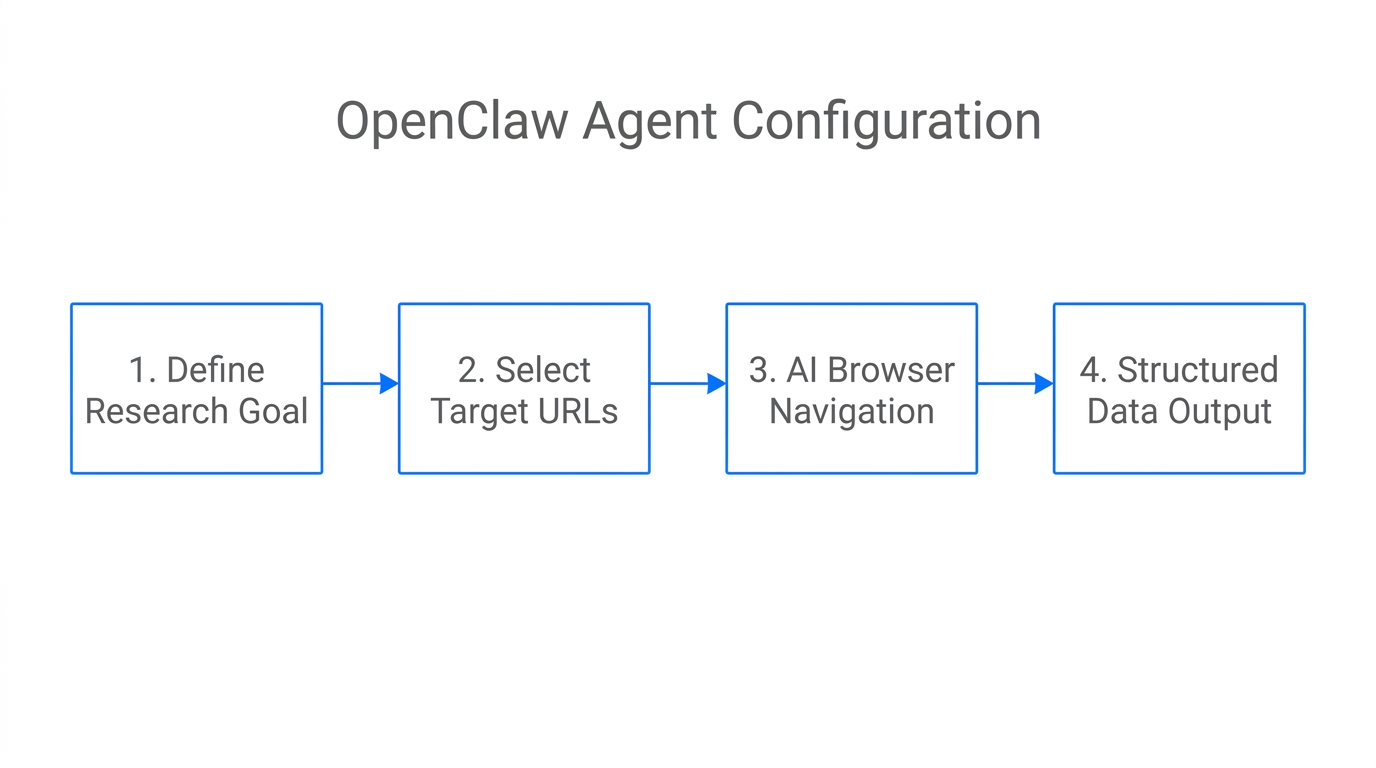
The core strength of OpenClaw lies in its Browser Control module. Unlike traditional scrapers that break when a website changes its HTML structure, OpenClaw agents "see" the page like a human does. To begin automating your competitive intelligence, you must configure a specialized agent focused on price monitoring and feature tracking.
Using a sandboxed Docker environment, you can schedule your agent to visit competitor pricing pages every Monday at 6:00 AM. The agent doesn't just look for numbers; it interprets changes. For example, if a competitor shifts from a flat monthly fee to usage-based billing, the agent can flag this as a strategic pivot. Research from JVM Weekly highlights how this "Vibe Coding" approach allows non-technical marketers to set up these complex crawlers without writing line-by-line code.
- Identify Target URLs: Feed the agent a list of competitor homepages, pricing tables, and documentation logs.
- Define Extraction Parameters: Ask the agent to look for "new feature announcements," "pricing tier changes," and "integrations added."
- Handle Dynamic Content: Because OpenClaw controls a live browser, it can click through modals and login screens to access data that traditional crawlers miss.
Step 2: Automating the Generation of Real-Time Sales Battlecards
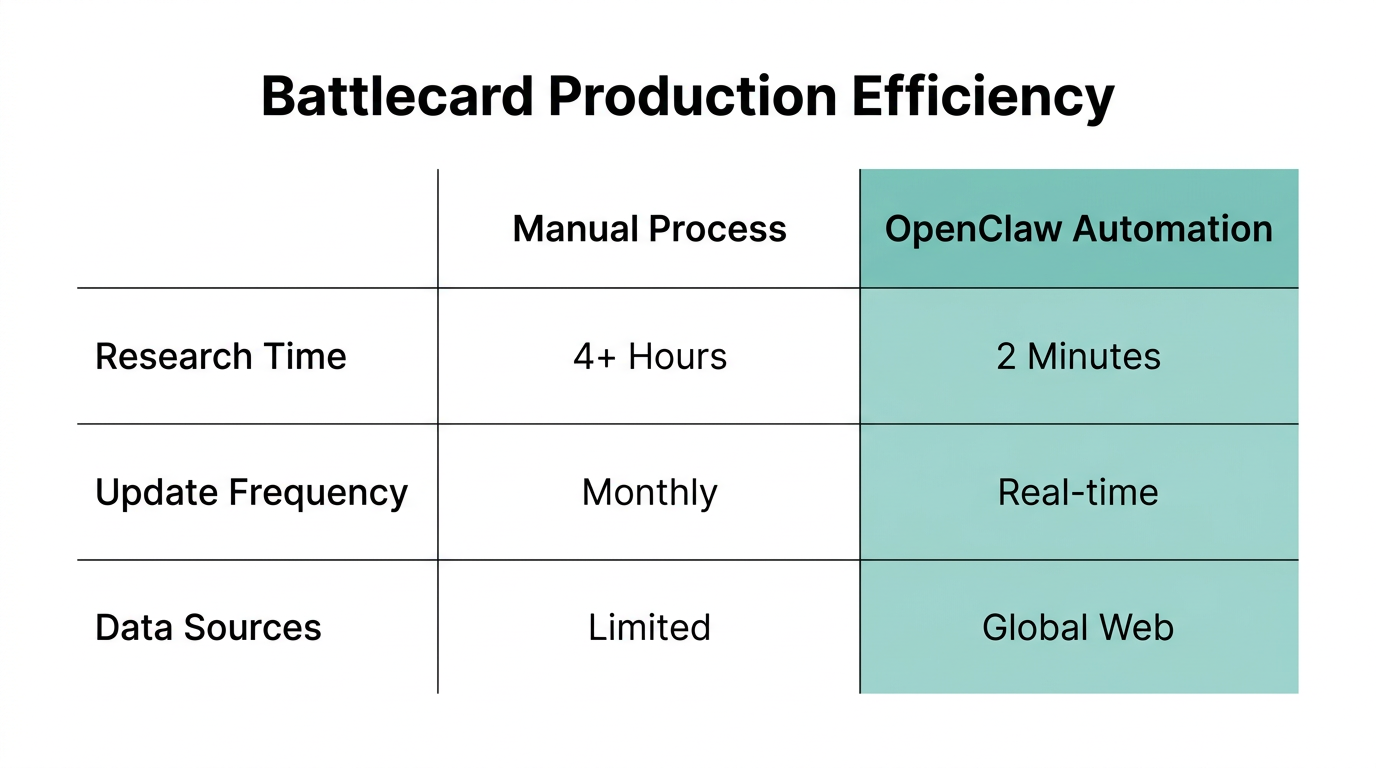
A sales battlecard is only useful if it is current. In the past, these documents were updated quarterly, meaning they were often out of date by the time a rep used them in a call. With OpenClaw, you can move to Real-Time Sales Battlecards that refresh automatically based on live web data.
By connecting OpenClaw to your internal knowledge base or Notion, the agent can draft "Battlecard Updates" whenever it detects a competitor weakness. For instance, if a competitor’s support forum shows a spike in complaints about a specific bug, the agent can immediately update your battlecard with a talking point on your product’s reliability. This level of responsiveness is why the AI SDR market is projected to reach $15.01 billion by 2030.
| Feature | Manual Research | OpenClaw Agentic Research |
|---|---|---|
| Update Frequency | Monthly / Quarterly | Daily / Real-Time |
| Data Depth | Surface-level (Headlines) | Deep-dive (Forum sentiment, Pricing logs) |
| Cost | High (Human hours) | Low (~$25/mo API costs) |
| Actionability | Static PDF | Automated Slack/CRM Alerts |
Monitoring Influencer Trends and Social Sentiment
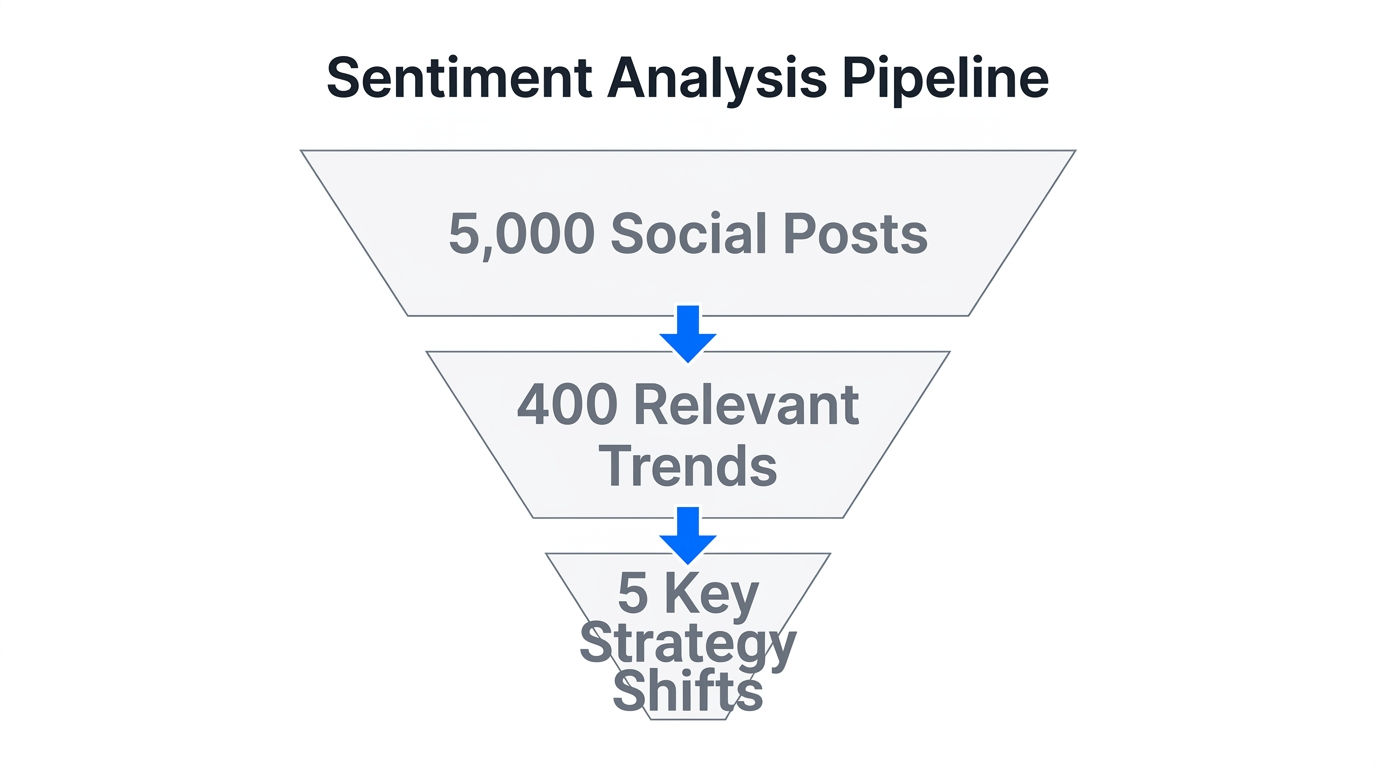
Competitive intelligence isn't just about what your rivals say on their websites; it's about what the market says about them. OpenClaw agents can be programmed to "claw" through social platforms to monitor mentions and sentiment. However, for specialized creator-led marketing, pairing OpenClaw with dedicated platforms like Stormy AI provides a more comprehensive view of the landscape.
While OpenClaw handles the technical scraping of competitor updates, Stormy AI can be used to track which influencers your competitors are partnering with in real-time. By analyzing engagement rates and audience quality of competitor-led campaigns, you can identify which creator niches are delivering the best ROI for your rivals and pivot your strategy accordingly. This hybrid approach—using OpenClaw for infrastructure and Stormy AI for creator-specific intelligence—ensures no blind spots in your market research.
"The future of growth is multi-agent coordination. One agent finds the data, another analyzes the sentiment, and a third drafts the response strategy."
Integrating Insights into Slack and CRM for Immediate Action
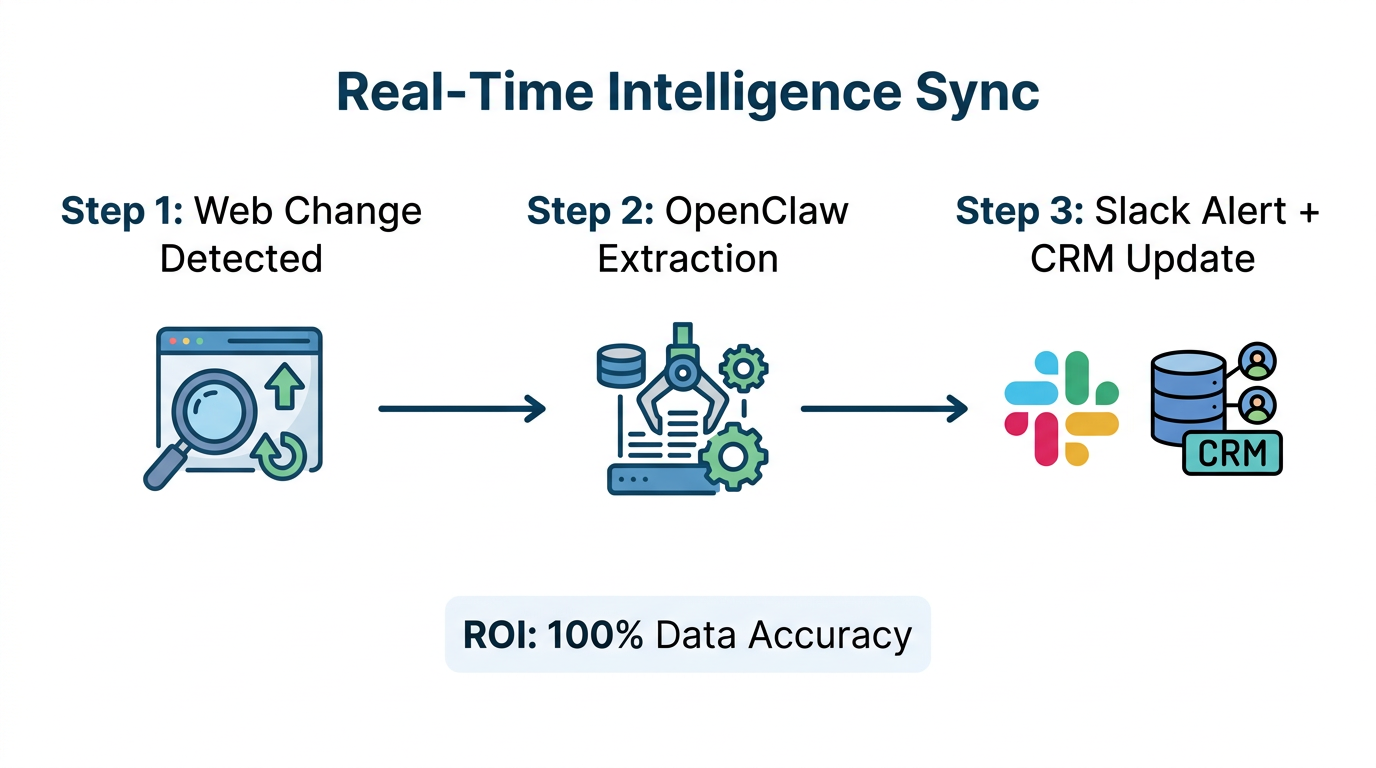
Data is only valuable if it reaches the right person at the right time. The final step in the OpenClaw pipeline is integration. According to MarketBetter, top-tier CROs are now using agents to pull data from Meta Ads Manager and TikTok Ads Manager, summarize competitor ad spend, and post the brief to a dedicated Slack channel at 8:00 AM every morning.
You can also use OpenClaw to enrich leads within your CRM. When a new prospect enters your HubSpot or Salesforce pipeline, the agent can automatically research the lead's company news, find their latest LinkedIn posts, and draft a hyper-personalized "warm-up" email. This workflow has been shown to increase response rates by 40% because the agent references nuances that generic templates miss.
Scaling Research: From Manual Alerts to Autonomous Agents
As you scale, the cost of running high-powered models like Claude 3.5 Opus for routine tasks can add up. To optimize your budget, experts at SSNTPL recommend using "Sonnet" or local models for basic web crawling, reserving the more expensive "Opus" models for complex reasoning tasks and battlecard drafting.
It is also vital to distinguish between the core open-source framework and commercial "wrappers" like OpenClaw Blaster. For professional market research, the GitHub-hosted framework maintained by Peter Steinberger (the creator recently hired by OpenAI) is the gold standard. This allows your team to host the agents locally, maintaining full control over your competitive data and preventing leaks of your target lists.
Conclusion: Building Your Agentic Advantage
In 2026, competitive intelligence is no longer a static report—it is a live, breathing part of your sales engine. By leveraging OpenClaw’s autonomous browser control, growth teams can move from being reactive to proactive, identifying market shifts before they appear in industry headlines. Owning your agentic architecture is the ultimate competitive moat.
Start by identifying one repetitive research task—whether it’s tracking a competitor’s pricing or monitoring a specific niche on social media—and delegate it to an OpenClaw agent. For teams looking to supercharge their creator-led research, integrating specialized tools like Stormy AI will provide the granular data needed to dominate the 2026 market. The tools to build your own "Jarvis-style" briefing are now available and open-source; the only limit is how quickly your team can adapt to the agentic shift.