For the modern marketing manager, the battle to lower Amazon ACOS (Advertising Cost of Sales) often feels like a manual war of attrition. You spend hours downloading CSVs, filtering for high-performing keywords, and adjusting bids in a Seller Central UI that feels increasingly legacy. However, a fundamental shift occurred in early 2026: the introduction of the Model Context Protocol (MCP). This open-source standard, often described as the USB-C for Large Language Models, has turned AI from a simple chatbot into a functional agency partner capable of executing marketing workflow automation with precision.
By leveraging the Amazon Ads MCP Server, advertisers are no longer just asking an AI for advice; they are giving it the keys to the engine. Current data indicates that 74% of SMBs are already actively testing or deploying AI tools for their advertising operations, according to research from Retail Technology. The result? A staggering 5.6 hours saved per week on manual data analysis—equivalent to reclaiming 30 full working days per year.
The 'Auto-to-Manual' Bridge: Automated Keyword Harvesting
One of the most tedious tasks in Amazon PPC is the constant mining of search term reports. Traditionally, you would scan your 'Auto' campaigns, find gems with high conversion rates, and manually move them into 'Exact Match' campaigns while negating them in the original source. This is the definition of a process ripe for amazon keyword research ai.
Using Claude Desktop connected to an Amazon Ads server, you can now execute this entire workflow via a single natural language prompt. Instead of clicking through five different screens, you simply instruct the model: "Access my 'Auto-Targeting' report for the last 30 days. Identify high-converting search terms with at least 3 orders and an ACOS under 20%. Move these as Exact Match into the 'Scale-Manual' campaign and add them as Negative Phrase in the 'Auto' campaign."
This method ensures that your amazon advertising efficiency remains high by preventing budget bleed on broad terms that have already proven their value as specific targets. Statistics show that this level of AI-driven automation leads to 67% faster campaign launches compared to manual setups.
"The shift from 'clicking and scrolling' to 'describing outcomes' is the single biggest productivity jump in the history of e-commerce advertising."
Real-Time Bid Optimization via MCP Servers
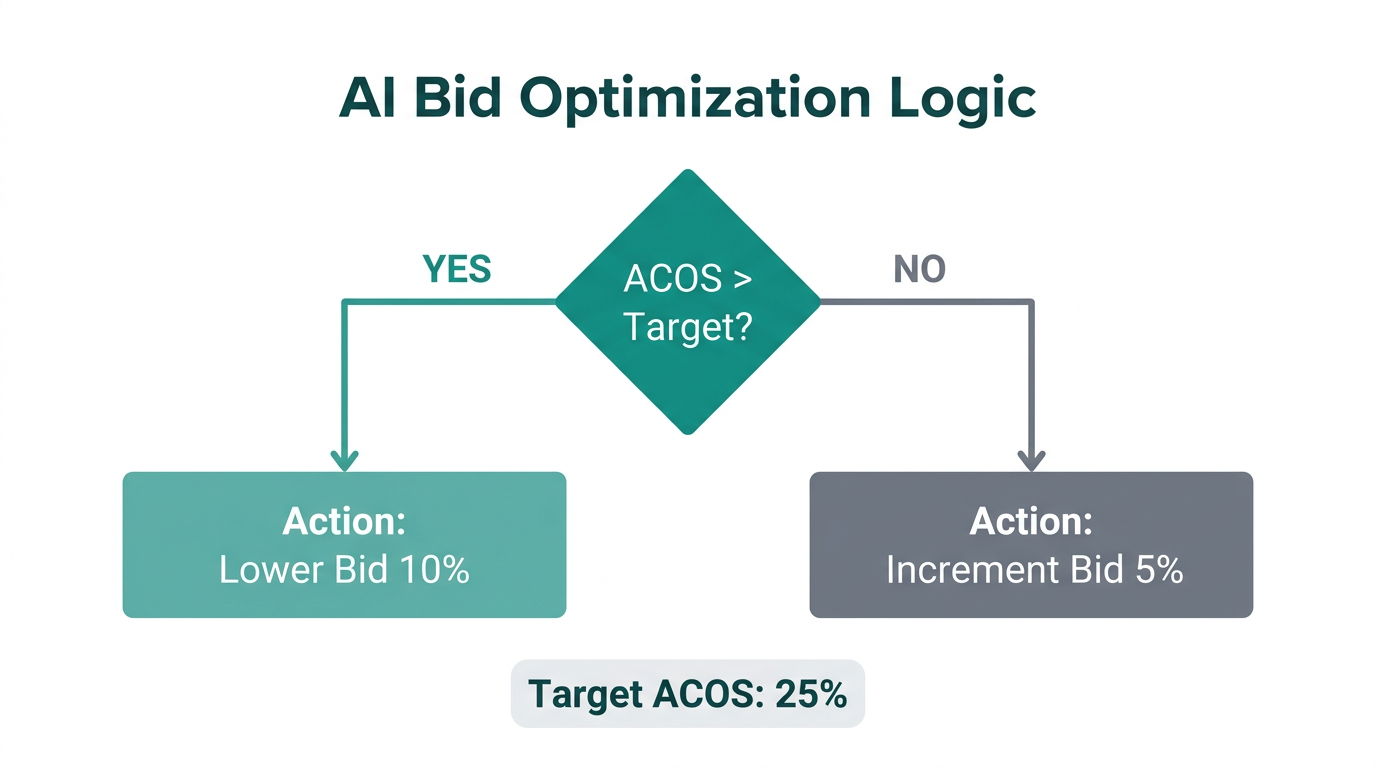
Static bidding is the enemy of a healthy margin. Markets change by the hour, yet most managers only adjust bids once or twice a week. Amazon ppc automation tools powered by MCP, such as Marketplace Ad Pros, allow for dynamic, hourly adjustments based on live performance data. Developers can find many of these integrations on GitHub's MCP server repository.
Imagine a scenario where your high-ticket item converts best in the evenings but drains budget during the afternoon. You can set up a Claude workflow to "Analyze hourly performance for the 'Launch-ASIN-123' campaign. If ACOS exceeds 35% between 2 PM and 6 PM, decrease Top-of-Search placement modifiers by 15% for that window only." This level of granularity, known as day-parting, was previously reserved for high-end enterprise software. Now, it is accessible via plain English.
Hourly Performance Analysis and Day-Parting
The real power of Claude MCP lies in its ability to interface with the Amazon Marketing Cloud (AMC). Historically, querying AMC required a data scientist proficient in SQL. With the latest MCP integrations, you can perform SQL-free data science. You can ask Claude to identify the "multi-touch attribution path" of your customers to see if your Sponsored Brands ads are actually driving downstream sales for your Sponsored Products campaigns.
| Feature | Manual Management | Claude MCP Automation |
|---|---|---|
| Keyword Discovery | Manual CSV downloads (1-2 hours) | Instant API Pull (30 seconds) |
| Bid Adjustments | Static, weekly updates | Real-time, hourly triggers |
| Reporting | Templates & SQL / VLOOKUPs | Conversational analysis |
| ACOS Impact | Slow correction of waste | 300% Avg. ROI on automation |
This automated analysis allows you to react to competitor price drops or inventory changes in minutes. If a competitor goes out of stock, Claude can be programmed to identify the opportunity and immediately increase bids on their branded keywords to capture displaced traffic.
Creative Testing Velocity and UGC Integration
Performance in 2026 is no longer just about bidding; it is about creative testing velocity. Amazon's AI Creative Studio now allows for rapid iteration of ad copy and imagery. However, the most successful brands are pairing these AI tools with authentic User-Generated Content (UGC).
To fuel this creative engine, platforms like Stormy AI can help source and manage UGC creators at scale. Once you have a library of creator content, you can use Claude to analyze customer sentiment from your reviews and generate 25+ ad copy variations that mirror the language of your most satisfied customers. These can then be pushed directly into Sponsored Brands Video experiments via MCP tools like Openbridge.
"AI handles the repetitive tasks, but human-centric content—sourced through platforms like Stormy AI—is what ultimately converts the click."
Case Study: Reclaiming 30 Working Days a Year
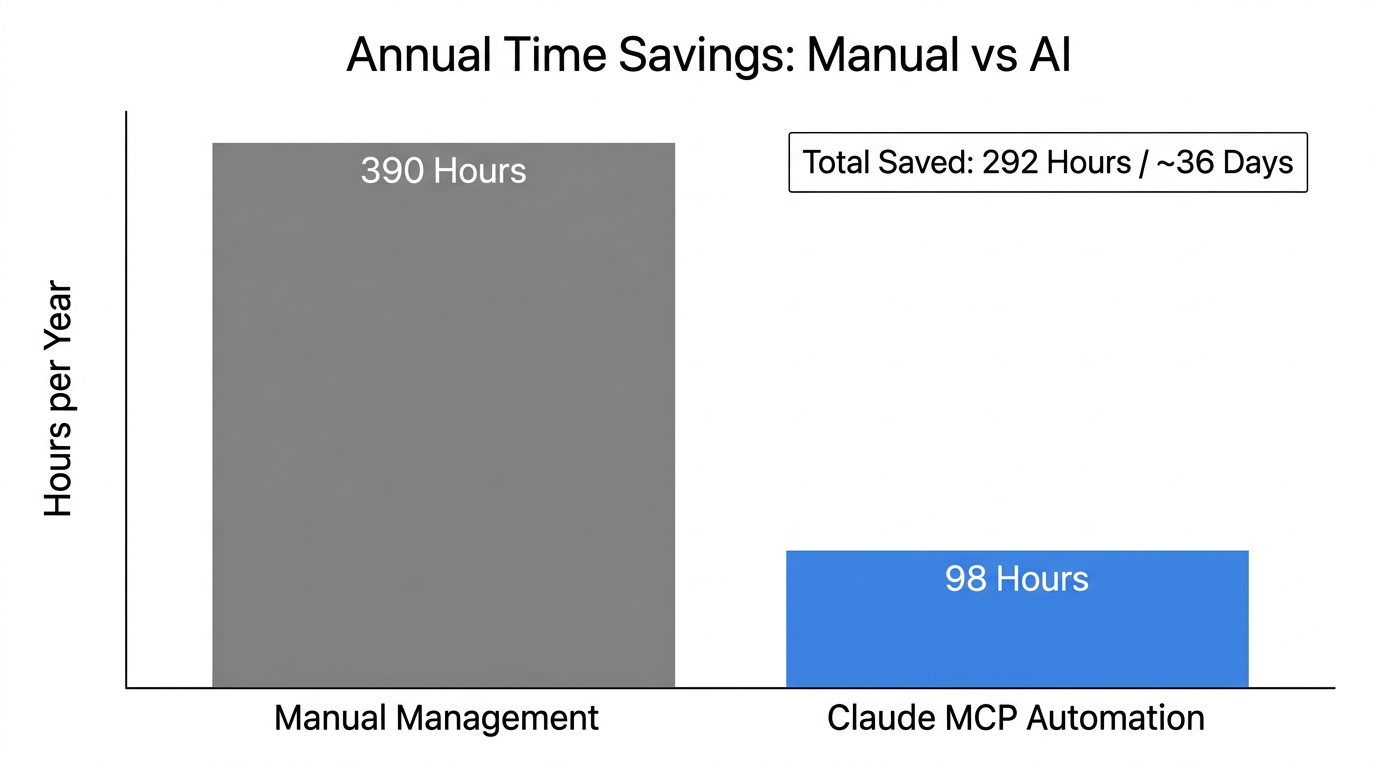
Consider a mid-sized beauty brand managing 500+ SKUs. Before implementing an AI-driven marketing workflow automation, their lead PPC manager spent 15 hours a week on reporting and manual bid tweaks. By integrating Claude MCP with their tech stack—including tools like Adzviser—the brand saw the following results:
- Time Saved: Manual reporting time dropped from 8 hours to 45 minutes weekly.
- ACOS Reduction: By automating the negation of non-converting terms, ACOS dropped by 12% in the first quarter.
- Scaling: They were able to launch 3x more campaigns without increasing headcount.
The total time saved averaged 5.6 hours per week. Over a 52-week year, that is 291.2 hours—or roughly 36 working days. This allows the marketing team to focus on high-level strategy rather than the minutiae of bid increments.
Common Mistakes: Hallucinations and API Mismatches
While the benefits are clear, blindly trusting AI is a recipe for disaster. LLMs are known for numerical hallucinations. If you ask Claude to "calculate the sum of my spend from this text block," it might make a math error. To avoid this, always use MCP servers that perform calculations via the Amazon Ads API itself, rather than asking the model to do arithmetic on raw text.
Another common pitfall is the region mismatch. Many sellers attempt to adjust bids for the UK marketplace while using a North American (NA) advertiser profile in their claude_desktop_config.json. This leads to failed API calls and data fragmentation. Always verify your region settings before running autonomous prompts.
Conclusion: The First-Mover Advantage
The integration of Claude MCP into the Amazon ecosystem represents a paradigm shift. According to Xavora, early adopters of these conversational campaign management tools currently hold a 12 to 24-month advantage over their competitors. By the time natural language interfaces become the standard within Seller Central, those who have mastered the Amazon Ads MCP Server will have already optimized their margins and scaled their operations.
To start lowering your Amazon ACOS today, begin by setting up your Claude Desktop environment and connecting it to a verified MCP server. Focus on the low-hanging fruit: automate your keyword harvesting and set up basic day-parting triggers. As you save those 5.6 hours a week, use that time to reinvest in creative strategy and brand building—the two things AI still can't replace.