The era of the "AI Chatbot" that simply writes clever copy is ending. In its place, a more powerful paradigm is emerging: agentic marketing. Digital marketers are no longer looking for tools that just suggest ideas; they are deploying autonomous systems that can research, draft, publish, and optimize campaigns without constant hand-holding. At the forefront of this shift is OpenClaw, an open-source, local-first AI agent platform that has seen an unprecedented explosion in adoption, growing from 9,000 to over 200,000 GitHub stars in early 2026. This isn't just a trend; it's a fundamental restructuring of how media buying works.
The Shift from Assistant to Agentic Operations
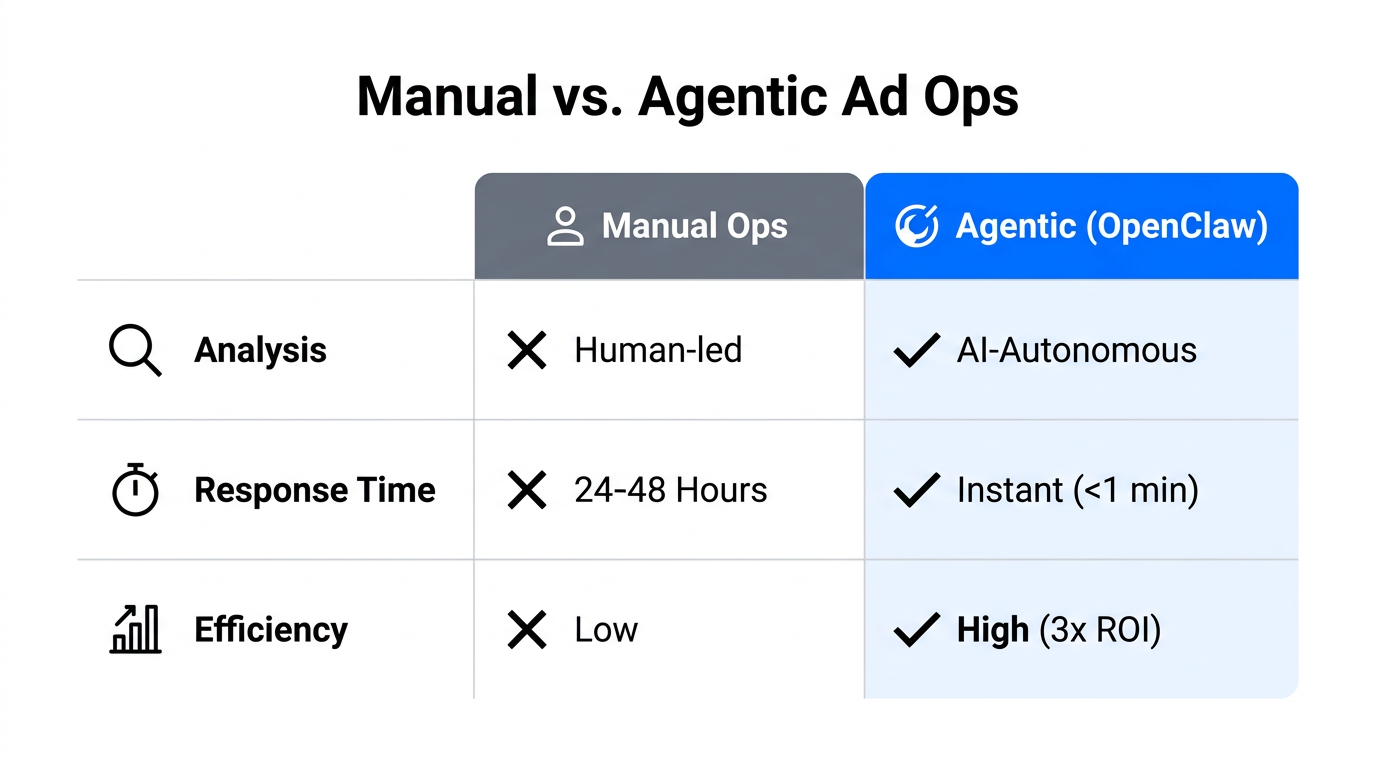
For years, media buyers have been tethered to complex dashboards on Google Ads and Meta Ads Manager. Traditional automation meant setting up basic "if-this-then-that" rules or writing custom scripts that frequently broke. Agentic marketing operations change the UI from a dashboard to a conversation. As AI pioneer Andrej Karpathy has noted, the evolution of the AI ecosystem represents a "sci-fi takeoff" in capability because these agents don't just talk—they execute tasks across the web.
The primary driver behind OpenClaw's success is its local-first privacy model. In an age of strict GDPR and CCPA regulations, advertisers are wary of sending sensitive first-party customer data to cloud-based LLM providers. OpenClaw allows growth teams to run their agents on local hardware or a private DigitalOcean VPS, ensuring data stays within their controlled environment while still leveraging the power of advanced models via the Model Context Protocol (MCP).
"OpenClaw is a true personal AI agent that moves beyond chat to execution, effectively becoming a tireless member of your media buying team." — Peter Steinberger, Creator of OpenClaw
Step 1: Connecting OpenClaw to Ad Platforms via AdCP
To begin ad management automation, you must bridge the gap between your AI agent and the ad networks. This is achieved through the Ad Context Protocol (AdCP). Unlike traditional API integrations that require deep coding knowledge, AdCP provides a standardized way for agents to read performance data and push changes to Meta and Google Ads.
- Environment Setup: While you can run OpenClaw on a local machine, for 24/7 execution, it is recommended to host it on a VPS like those provided by AWS Lightsail. This ensures your AI marketing agents don't go offline when your laptop closes.
- Install the AdCP Skill: Visit the ClawHub registry and install the AdCP advertising skill. This allows the agent to understand concepts like campaigns, ad sets, and creative assets.
- API Authentication: Securely link your Meta Ads Manager and Google Ads developer tokens. OpenClaw uses these permissions to pull live data directly into its context window.
Once connected, you can use natural language to command your agent. Instead of navigating the Meta UI, you can simply type: "Launch a $5,000 display campaign targeting tech professionals in California using the assets in my 'Spring-Launch' folder."
| Feature | Manual Operations | OpenClaw Agentic Ops |
|---|---|---|
| Reporting | Manual CSV exports & pivot tables | Real-time natural language queries |
| Optimization | Daily manual checks | 24/7 autonomous ROAS auditing |
| Creative | Subjective analysis | Skill-based fatigue monitoring |
Step 2: Automating Performance Audits and ROAS Triggers
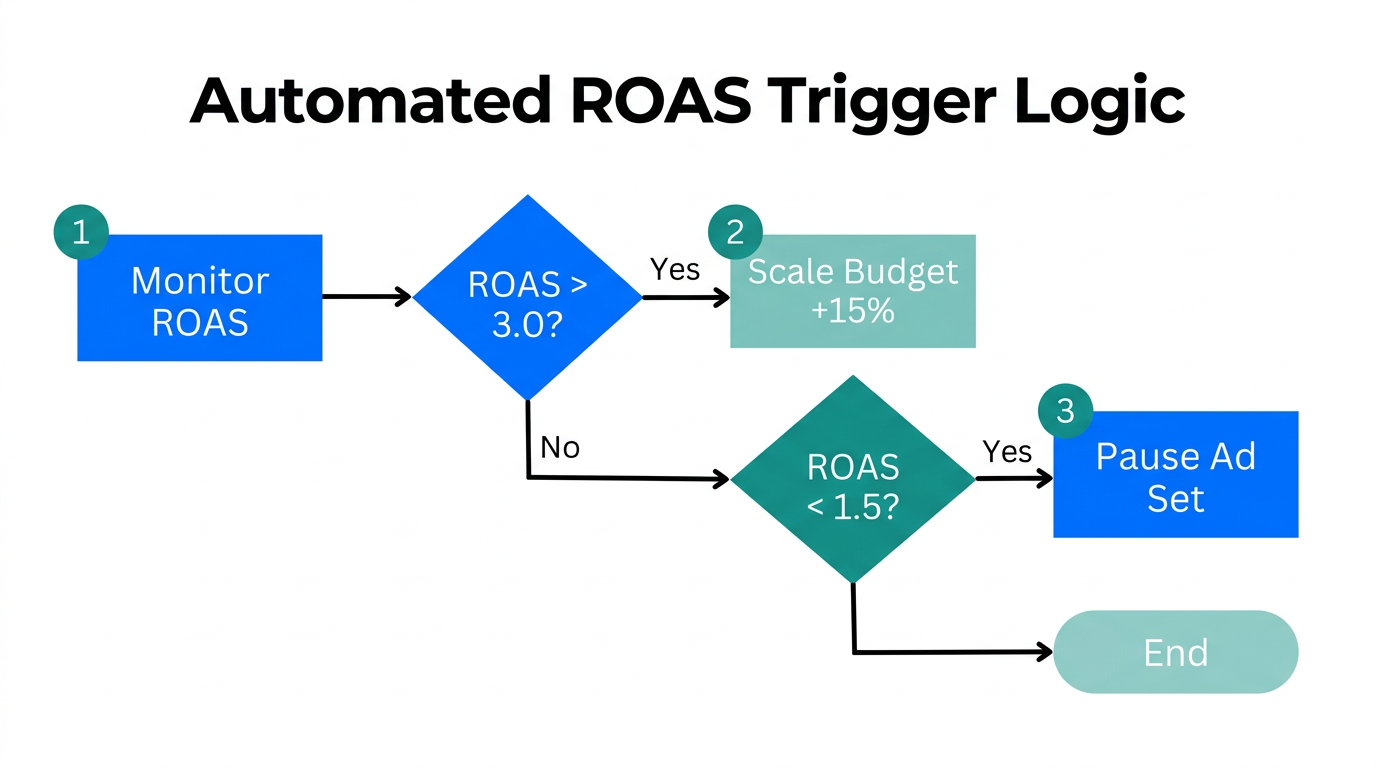
One of the most immediate benefits of automated ad operations is the ability to run uninterrupted performance audits. By deploying a specific "Auditor" skill from the OpenClaw Playbooks, you can set strict performance boundaries that the agent monitors in real-time.
For example, you can instruct your agent: "Run a full audit every 4 hours. My target ROAS is 4.0. If any ad set falls below 2.5 over a 72-hour window, pause it and send me a summary of why." This level of agentic marketing prevents budget bleed that often happens over weekends or holidays when human eyes aren't on the accounts. For more strategic oversight, many marketers use Google Analytics alongside their agents to verify conversion data.
Beyond simple pausing, advanced users are leveraging agents to manage pacing and budget distribution. On platforms like Meta, where the "learning phase" is sensitive, OpenClaw can use pacing monitor skills to catch over-delivery early, ensuring your budget is spread evenly across the month rather than being exhausted in the first week by a volatile algorithm.
"Early adopters of agentic ad ops report saving 10+ hours per week on reporting and manual campaign adjustments."
Step 3: Managing Creative Fatigue with the 'Creative Analyst'
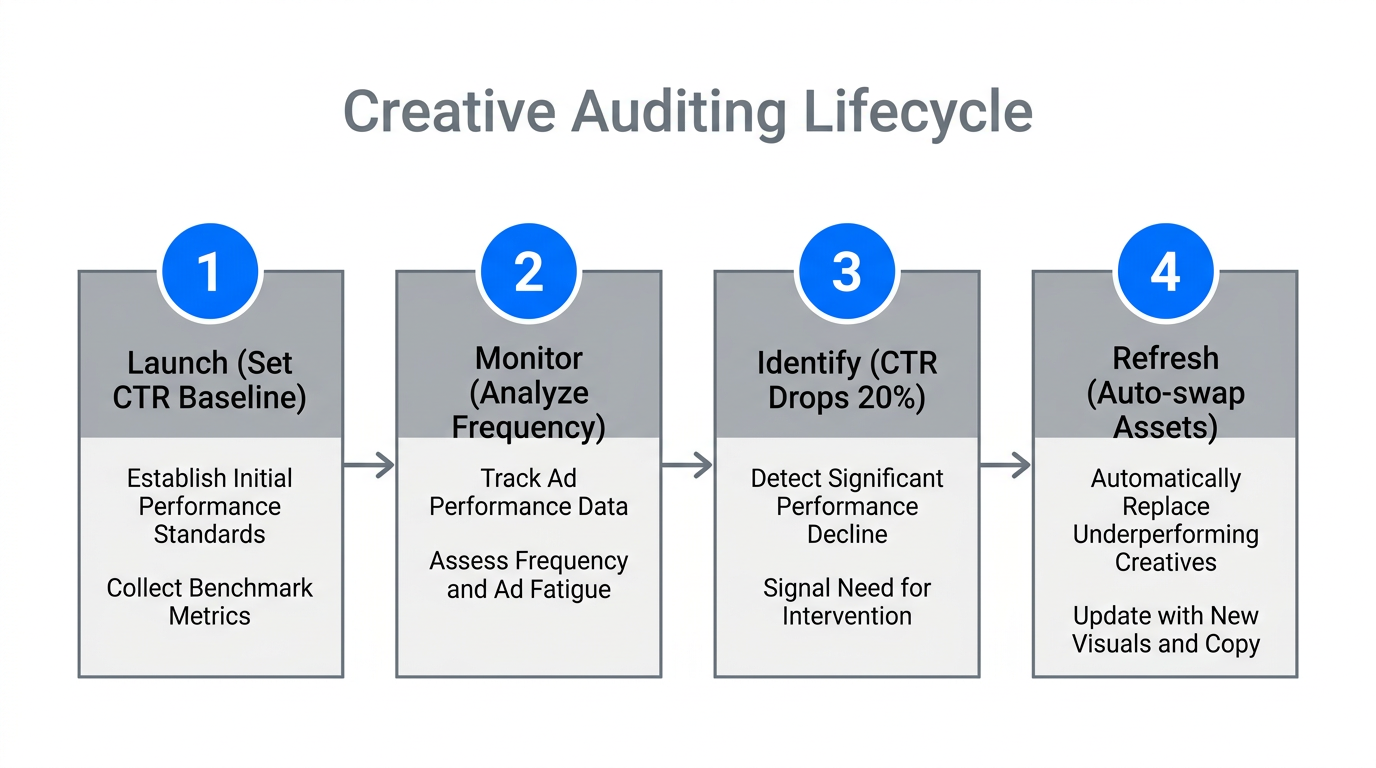
Creative is the single biggest lever in modern performance marketing. However, tracking exactly when a video or image starts to fatigue is a tedious task. By utilizing a "Creative Analyst" skill, your agent can track CTR (Click-Through Rate) trends over 7, 14, and 30-day windows. When it detects a statistically significant dip, it doesn't just flag the ad—it can research what's working elsewhere.
Teams often pair this with competitor research. Using a web scraping API like Decodo, OpenClaw can visit the Meta Ads Library, extract every ad a competitor is running, and perform a funnel stage breakdown. If your own creative is fatiguing, the agent can suggest new hooks based on what is currently gaining traction in your niche.
When you need to refresh your creative pipeline, platforms like Stormy AI can help source and manage UGC creators at scale, providing the raw assets that your OpenClaw agent then deploys and tests. This combination of AI-driven execution and high-quality human-generated content creates a powerful growth loop.
Step 4: Human-in-the-Loop Gating and Security
While the goal is ad management automation, giving an AI agent full "write" access to six-figure ad budgets comes with significant risks. Security researchers at Microsoft Security and the Dutch Data Protection Authority have issued warnings regarding the broad system permissions these agents require.
To prevent accidental overspending or "context compaction" errors—where the agent "forgets" its original constraints—you must implement human-in-the-loop gating. Never grant an agent autonomous permission to increase budgets beyond a certain threshold without a manual confirmation via a messaging interface like Slack or Discord.
- The "Context Compaction" Trap: In long sessions, agents may summarize their memory to fit context windows, potentially losing a "Stop" command. Always keep your instructions concise.
- Malicious Skills: The "ClawHavoc" campaign in early 2026 saw over 1,100 malicious skills on ClawHub. Only install verified skills or those with high community trust.
- Token Burn: Using top-tier models like Claude 3.5 Sonnet for high-frequency scraping can lead to $500+/day API bills. Use smaller, local models for routine monitoring and reserve the heavy hitters for strategic analysis.
Managing these complex creator-led campaigns doesn't have to be purely manual. While OpenClaw handles the technical ad operations, using a Stormy AI creator CRM ensures that your relationships with the influencers providing your ad creative remain organized and your performance tracking is centralized.
The Future of Media Buying
The transition to openclaw for ads and agentic marketing is not about replacing the media buyer; it is about elevating them. By automating the repetitive "drudge work" of auditing, reporting, and pacing, marketers are free to focus on high-level strategy and creative direction. The success of the OpenClaw ecosystem proves that the demand for autonomous, local-first tools is only going to grow.
As you begin your journey with AI marketing agents, start small. Automate your reporting first with tools like Looker Studio, then your auditing, and finally your campaign deployment. By building a robust, gated system, you can leverage the speed of AI while maintaining the strategic oversight that only a human marketer can provide.