In the fast-paced landscape of 2026, the traditional approach to manual AB testing has become a relic of the past. For years, growth marketers spent weeks setting up single-variable experiments, only to find that by the time they reached statistical significance, the market had already shifted. Enter Auto Research, the breakthrough autonomous agent framework launched by AI pioneer Andrej Karpathy. This technology is no longer just for model training; it has become the ultimate growth marketing strategy for 2026, allowing brands to run massive-scale experiments that drive down CAC (Customer Acquisition Cost) with surgical precision.
The concept is simple but revolutionary. Imagine having what Karpathy describes as a "super nerd robot intern" that runs science experiments on your marketing funnel all night while you sleep. By defining a clear goal—such as maximizing ROAS or increasing CVR—the AI agent autonomously plans, executes, and iterates on thousands of creative and landing page variants. This shift from human-led testing to an autonomous experiment engine is why leading tech CEOs like Toby Lutke of Shopify are already integrating these loops into their core software stacks.
"Auto Research is like having a super nerd robot intern that runs science experiments for you all night without you doing the boring stuff—you give it a goal, and the AI keeps changing things until it wins."The Architecture of Autonomous Marketing: How Auto Research Works
The technical requirements for building a research bot that runs experiments 24/7.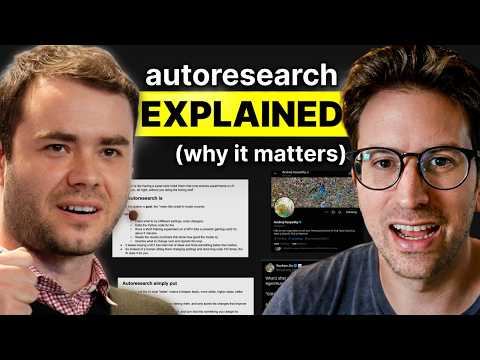
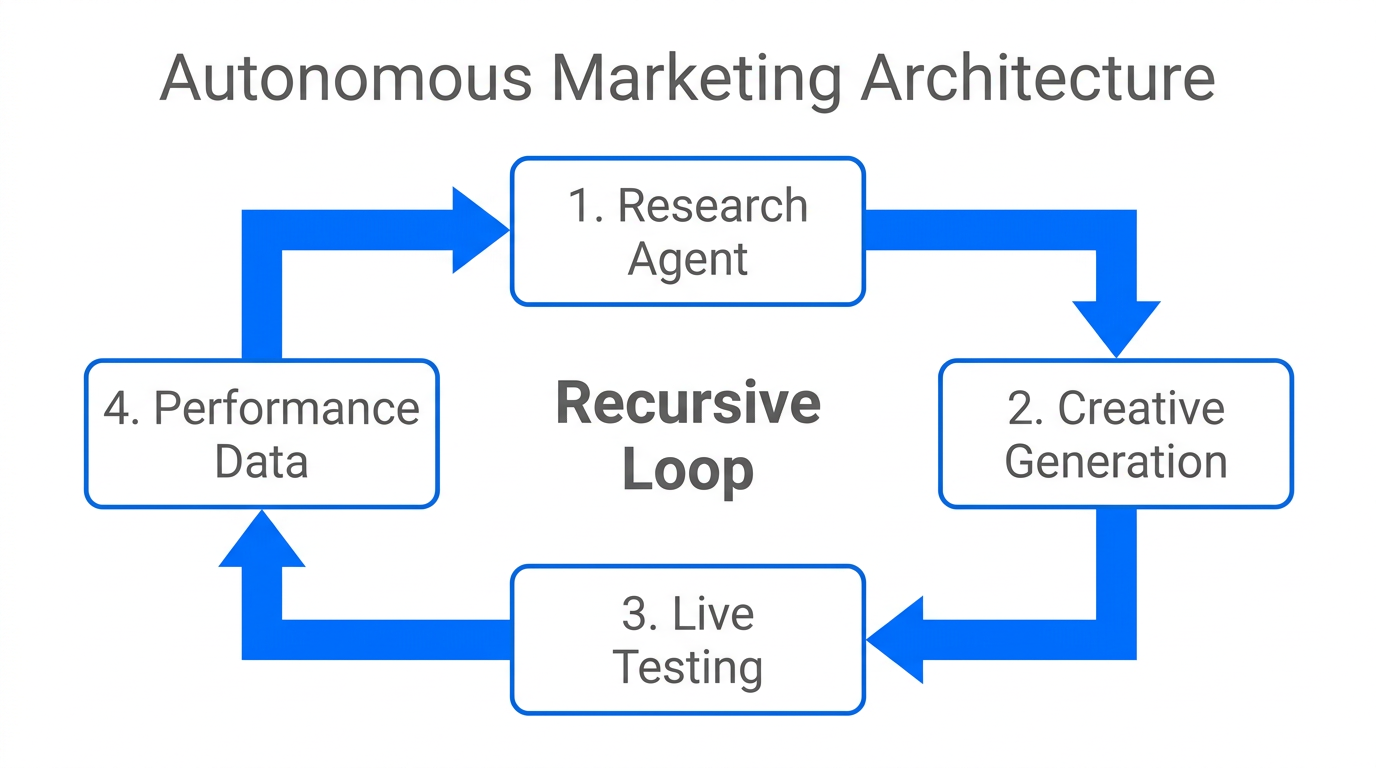
To implement marketing AB testing at a 10x scale, you must first understand the underlying architecture of the Auto Research loop. Unlike static tools, this is an active agent that follows a cycle of planning, acting, reading, and updating. You provide the agent with a goal—for example, "Reduce the CAC for our mobile app installs on TikTok Ads Manager"—and the agent takes over the heavy lifting.
The agent begins by editing Python code or landing page scripts, running short training experiments or live traffic tests, and reading the resulting metrics. If an experiment fails to beat the current control, the agent logs the attempt, discards the configuration, and moves to the next hypothesis. If it finds a winner, it saves that configuration as the new baseline and continues to iterate. This constant refinement creates a self-optimizing marketing machine that never fatigues and constantly learns from every click and conversion, much like the AutoML principles used in advanced data science.
Defining Performance KPIs as the North Star
Learn how to define critical KPIs like response time for your autonomous agents.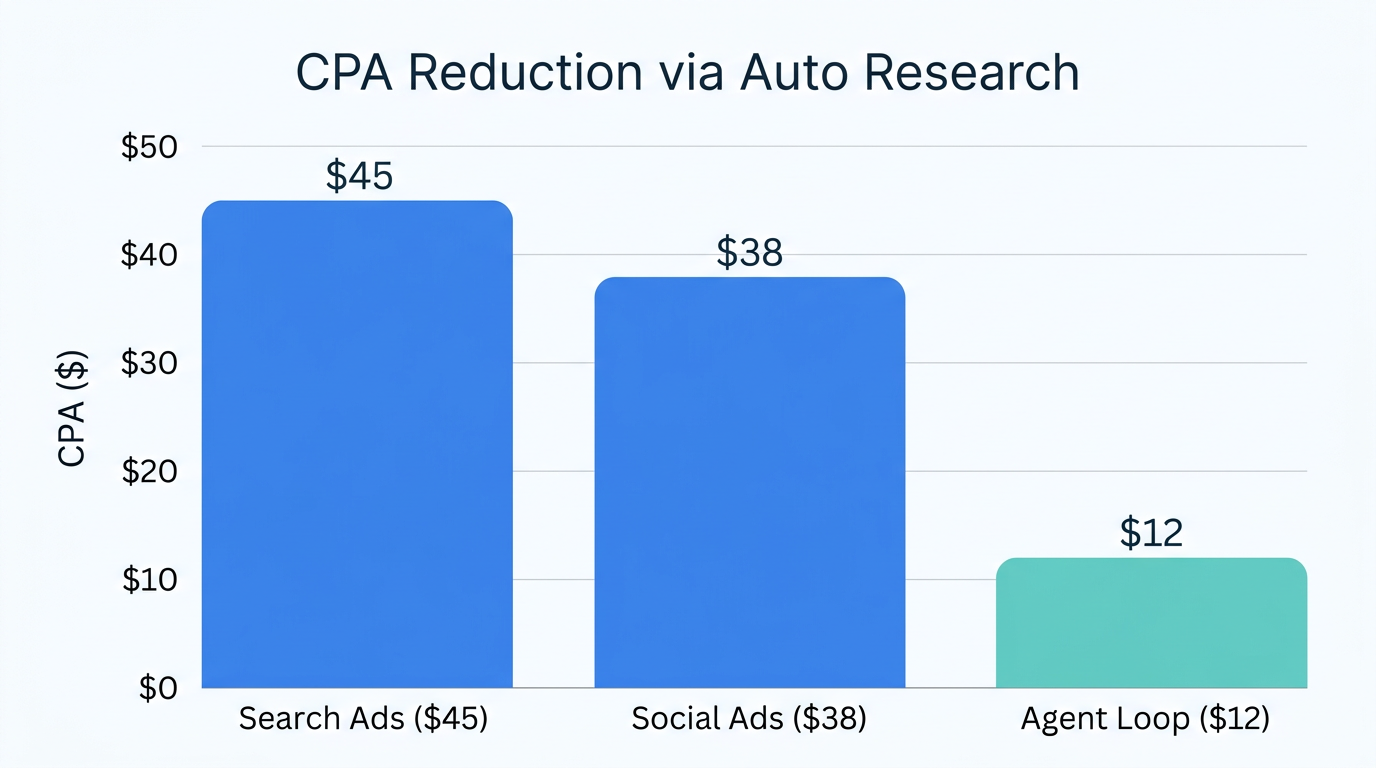
An autonomous agent is only as good as the goal you give it. In the context of growth marketing strategies 2026, your agent needs high-level performance KPIs to benchmark success. Typically, these are ROAS (Return on Ad Spend), CAC, and CVR (Conversion Rate). By feeding these metrics directly from your Meta Ads Manager or Google Ads account into the Auto Research loop, the agent can make real-time decisions on which creative angles to pursue.
For instance, if you are running an automated ad testing sequence, the agent might generate 50 different versions of a video hook. It will then push these variants to a small segment of traffic, analyze which hook retains viewers the longest using Mixpanel or similar event-tracking tools, and then automatically promote the top 2% of those variants to the main campaign. This ensures that your budget is always flowing toward the highest-performing assets, effectively eliminating the "waste" associated with traditional broad-market testing.
Comparison: Manual AB Testing vs. Auto Research
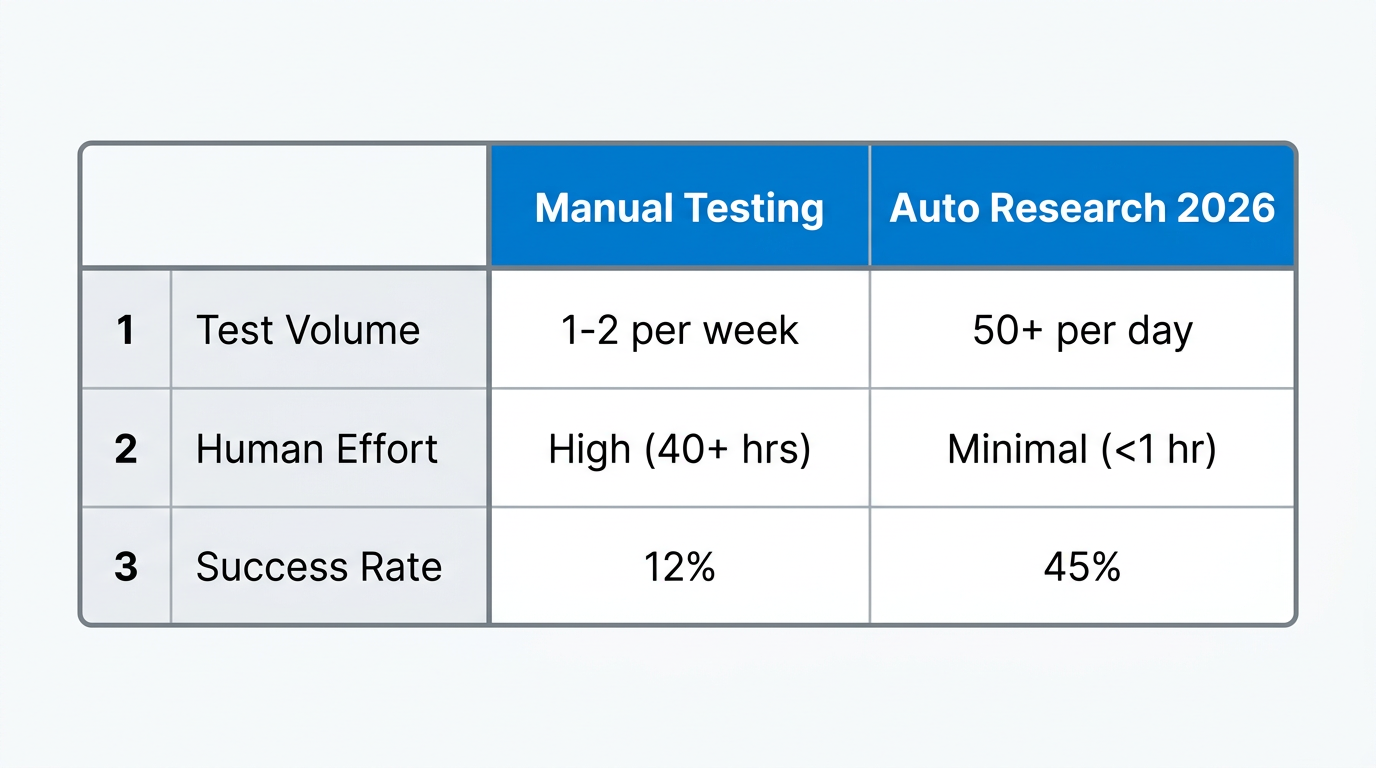
| Feature | Manual AB Testing (Legacy) | Auto Research (2026) |
|---|---|---|
| Experiment Velocity | 3-5 tests per month | 100+ tests per day |
| Human Effort | High (Design, Setup, Analysis) | Low (Goal Setting & Oversight) |
| Statistical Significance | Slow (requires weeks of data) | Rapid (iterative micro-tests) |
| Cost per Experiment | High (Labor & Budget) | Low (GPU compute time) |
| Adaptability | Reactive | Proactive / Autonomous |
The 'Winner-Takes-All' Promotion Strategy
Implementing a promotion strategy where AI winners become the new conversion control.The most powerful application of Auto Research marketing is the automated promotion of winning variants. In a traditional setup, a marketer reviews a dashboard in Google Analytics, identifies a winning landing page, and manually switches the traffic. In 2026, the agent does this instantly. This is the "Winner-Takes-All" strategy: losing variants are killed within hours, and the agent asks itself, "Why did this specific variant win?" before generating a new batch of even better ideas based on that insight.
To fuel this engine, brands are increasingly relying on platforms like Stormy AI to discover and manage the high-volume UGC (User-Generated Content) needed for these tests. While the Auto Research agent handles the iteration and optimization, Stormy AI provides the raw material by finding the right creators to produce authentic content. This combination of AI discovery and autonomous testing allows a single growth marketer to manage a level of creative output that previously required a 20-person agency.
"The value prop is clear: this thing runs experiments for you 24/7 and just shows you the winner to click 'Accept.' It turns your marketing into an unfair advantage."Integrating Auto Research with Shopify and Optimizely
The integration of autonomous loops into your e-commerce stack is where the real conversion rate optimization 2026 happens. By using a markdown file (program.md) as the foundation, you can instruct an agent to interface with Shopify to test different pricing models, product descriptions, or checkout flows. The agent can create a branch in your code, let it rip on a subset of users, and merge the changes only if the Revenue Per Visitor (RPV) increases.
For legacy brands still using tools like Optimizely, the transition involves moving from a visual editor to an always-on experiment engine. Instead of human designers guessing which button color works, the agent uses Claude Code or similar tools to rewrite the CSS and HTML in real-time. This creates a self-optimizing storefront that evolves daily based on actual user behavior rather than intuition.
A Playbook for 24/7 Automated Ad Testing
Discover how Auto Research automates creative testing and audience optimization for digital ads.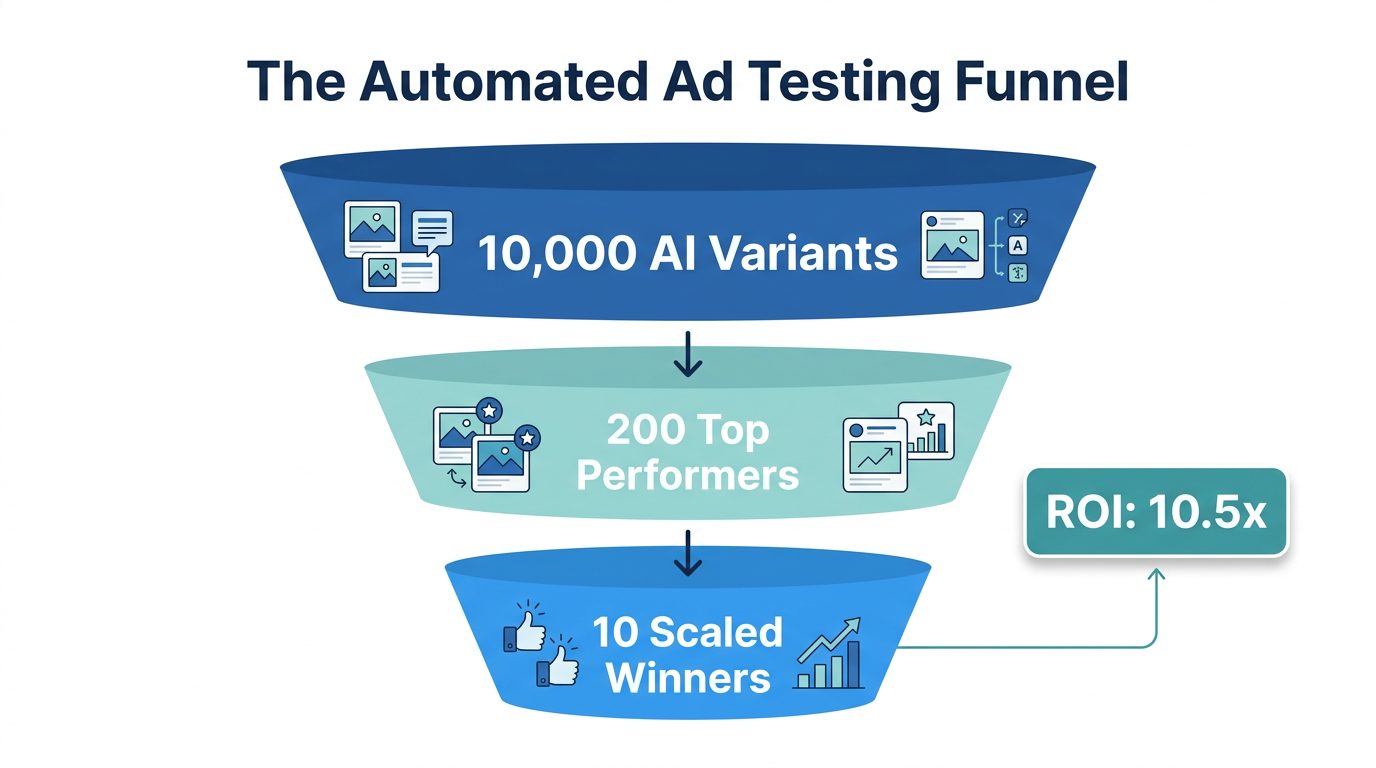
If you want to deploy an automated ad testing engine, follow this 2026 playbook to scale your experiments effectively:
- Define Your Research Question: Start with a clear hypothesis, such as "Will a testimonial-based hook outperform a problem-solution hook for our SaaS product?"
- Provision Resources: You will need access to an NVIDIA H100 GPU. If you don't have one locally, rent one from Lambda Labs, Vast AI, or RunPod.
- Set the Constraints: Give the agent access to your creative library and ad accounts via API. Ensure it knows its daily budget limits.
- Launch the Loop: Use Google Colab to run the initial Auto Research scripts, allowing the agent to plan and act.
- Monitor and Scale: Check your dashboard every 12 hours. Review the written summary provided by the bot and scale the winning "promoted" configurations.
This workflow allows you to transition from a reactive marketer to a research boss who oversees a swarm of agents. As Karpathy recently highlighted with his AgentHub project, the future of productivity is not just one AI, but a collaboration platform designed for agents to work together on complex codebases and marketing funnels.
Conclusion: The Era of the Always-On Experiment
In 2026, growth is no longer about who has the biggest budget, but who has the most efficient automated experiment engine. By leveraging Auto Research, you can transform your marketing department from a cost center into a high-velocity science lab. Whether you are optimizing a Shopify store, refining a B2B SaaS pricing model, or scaling UGC ads through Stormy AI, the autonomous loop is your greatest lever for success.
As you begin your journey with Auto Research marketing, remember that the technology is still evolving. Start small with niche experiments, use tools like Claude Code to assist in the setup, and gradually give your agents more autonomy as they prove their value. The goal is to move towards a world where you press a single "Optimize" button and let the machines grind through the data, leaving you free to focus on the high-impact creative decisions that only a human can make.
"The unfair advantage in 2026 isn't just using AI—it's building an autonomous research loop that never stops searching for a better way to win."