In the high-stakes world of performance marketing, the difference between a profitable campaign and a budget-draining disaster often comes down to invisible settings. For years, PPC managers have relied on manual checklists and monthly audits to catch errors. But as 2025 approaches, the landscape has shifted. Recent data indicates that the average brand is wasting a staggering 34% of its budget on fixable issues. For a company spending $50,000 a month, that is $17,000 disappearing into thin air every single month, according to research from W3 Solved. The solution isn't just more frequent manual reviews; it is Agentic Automation. By leveraging Claude Code, founders and growth leads can now treat their ad accounts like living codebases, running 180+ automated checks in seconds to reclaim their lost margins.
The Silent Killers: Why 34% of Your Budget Is Wasted
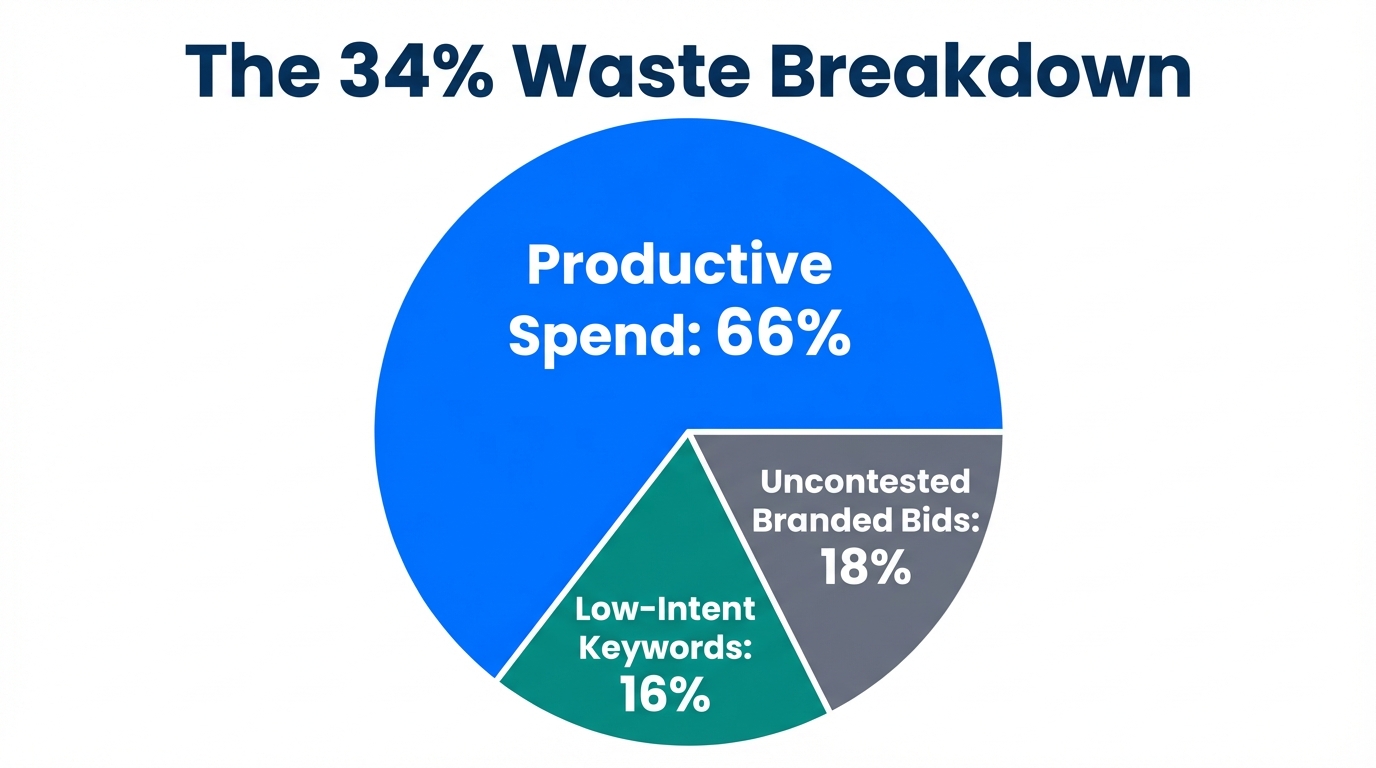
The 34% waste benchmark isn't a random figure—it's the result of compounding inefficiencies across search, display, and video networks. In 2024, approximately 5.1% of all ad clicks were fraudulent, resulting in roughly $38 billion in global losses, a trend highlighted by North Country Growth. When you combine this with a 10% average increase in CPCs across most industries, as reported by 3P Digital, the margin for error has effectively vanished.
But fraud is only part of the story. The biggest drain often comes from internal configuration errors. Conversion tracking errors remain the #1 silent killer of ad spend. When a brand double-counts conversions, it feeds junk data into Google’s machine-learning algorithms. This causes AI-driven bidding strategies to aggressively overspend on low-value traffic because the system "thinks" it's winning, a common pitfall identified by JumpFly. Without a programmatic way to audit these settings, you are essentially optimizing on garbage data.
What is Claude Code for PPC Managers?
To understand how to fix these issues, we must first look at the tool. Unlike the standard ChatGPT or Claude browser interface, Claude Code is a terminal-based AI coding agent. It operates directly within your local environment, allowing it to interact with files, scripts, and APIs in ways a chatbot cannot. This is the heart of "Agentic Marketing."
Claude Code uses the Model Context Protocol (MCP) to bridge the gap between AI and external data sources. For a PPC manager, this means Claude can:
- Directly access the Google Ads API to pull real-time performance data.
- Use tools like Puppeteer to crawl your landing pages and check for speed or copy mismatches.
- Write, debug, and deploy Google Ads Scripts autonomously to handle bid adjustments while you sleep.
"The era of the manual PPC manager is ending. We are becoming architects who design systems, while AI agents like Claude handle the boilerplate execution of audits and bid management."| Audit Type | Manual Approach | Agentic Claude Code Approach |
|---|---|---|
| Negative Keywords | 5-10 hours/week manual review | Instant categorization via API script |
| Landing Page Check | Spot-checks of top 10 URLs | Automated crawl of all 1,000+ active URLs |
| Conversion Audit | Monthly verification of tags | Real-time Data Layer monitoring |
| Branded Bidding | Difficult to quantify overlap | Detection of 'uncontested' organic wins |
The Claude Ads Audit Playbook: Recovering Your Spend
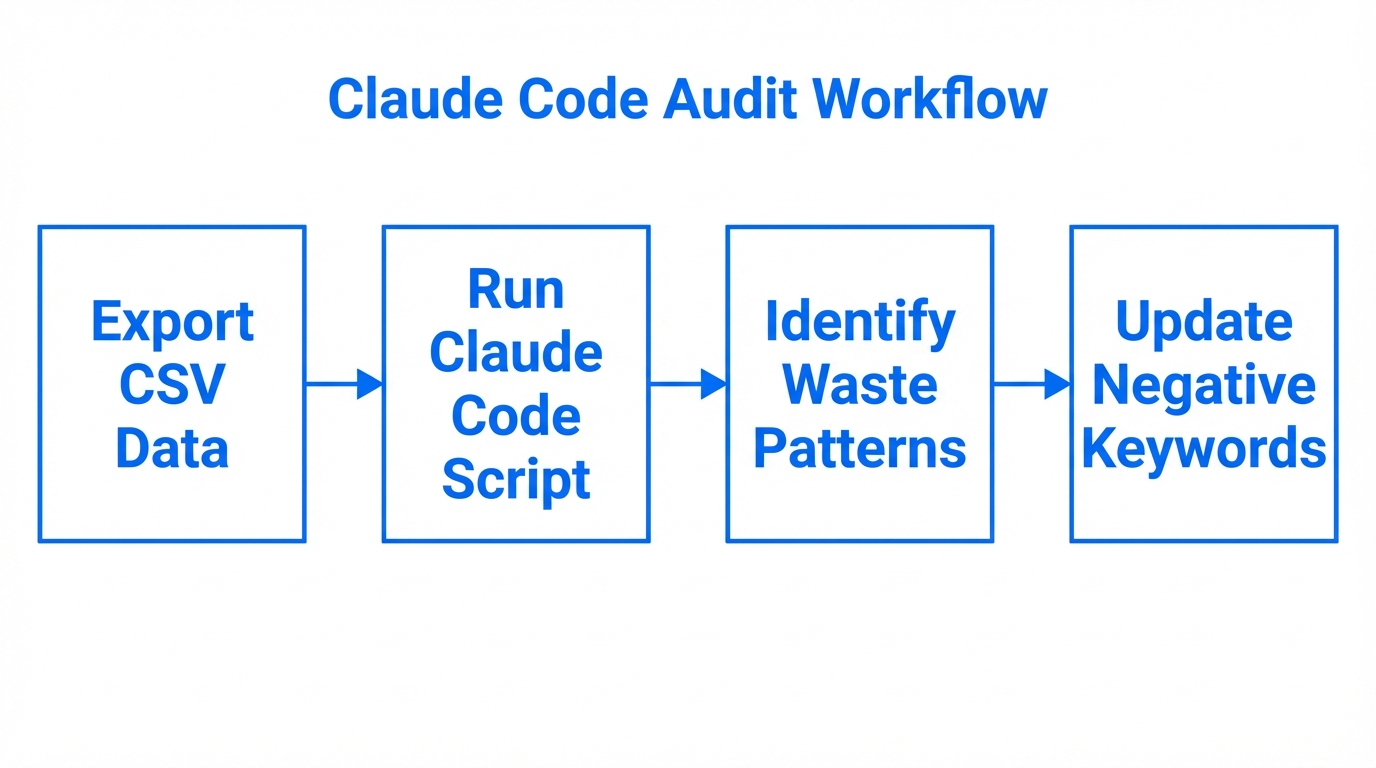
If you're ready to move beyond manual spreadsheets, follow this step-by-step playbook to implement an agentic audit. This workflow uses community-driven tools and standard AI engineering practices to find the leaks in your funnel.
Step 1: Deploy the Claude Ads Audit Tool
Start by utilizing the Claude Ads Audit Tool on GitHub. This community-developed skill allows Claude to run 186+ automated checks across your account. It scans for everything from "Broad Match Traps" to missing ad extensions. By running this via the terminal, you get a comprehensive health score and a prioritized list of fixes in minutes.
Step 2: Automate the "Negative Keyword" Audit
Manual search term review is the most tedious part of PPC. Using Claude Code, you can run a script that pulls your Search Terms Report and uses the AI's reasoning capabilities to categorize terms by intent. Instead of looking at 1,000 rows, you can ask Claude to: "Identify all terms with zero conversions and a high spend that do not match our primary buyer intent, then generate a .csv for bulk upload." This single move can slash wasted spend on irrelevant traffic by 15-20% almost instantly.
Step 3: Establish CPA Spike Alerts
Integrate Claude Code with a tool like Make or n8n. Create a workflow where, if a campaign's CPA exceeds a 20% threshold for more than four hours, a payload is sent to Claude. The AI agent then audits the specific geography, device, and keyword set causing the spike and proposes an immediate bid adjustment. This prevents a small tracking glitch or a competitor's aggressive bidding from draining your entire daily budget before you even log in.
Eliminating the 'Uncontested Bids' Brand Trap
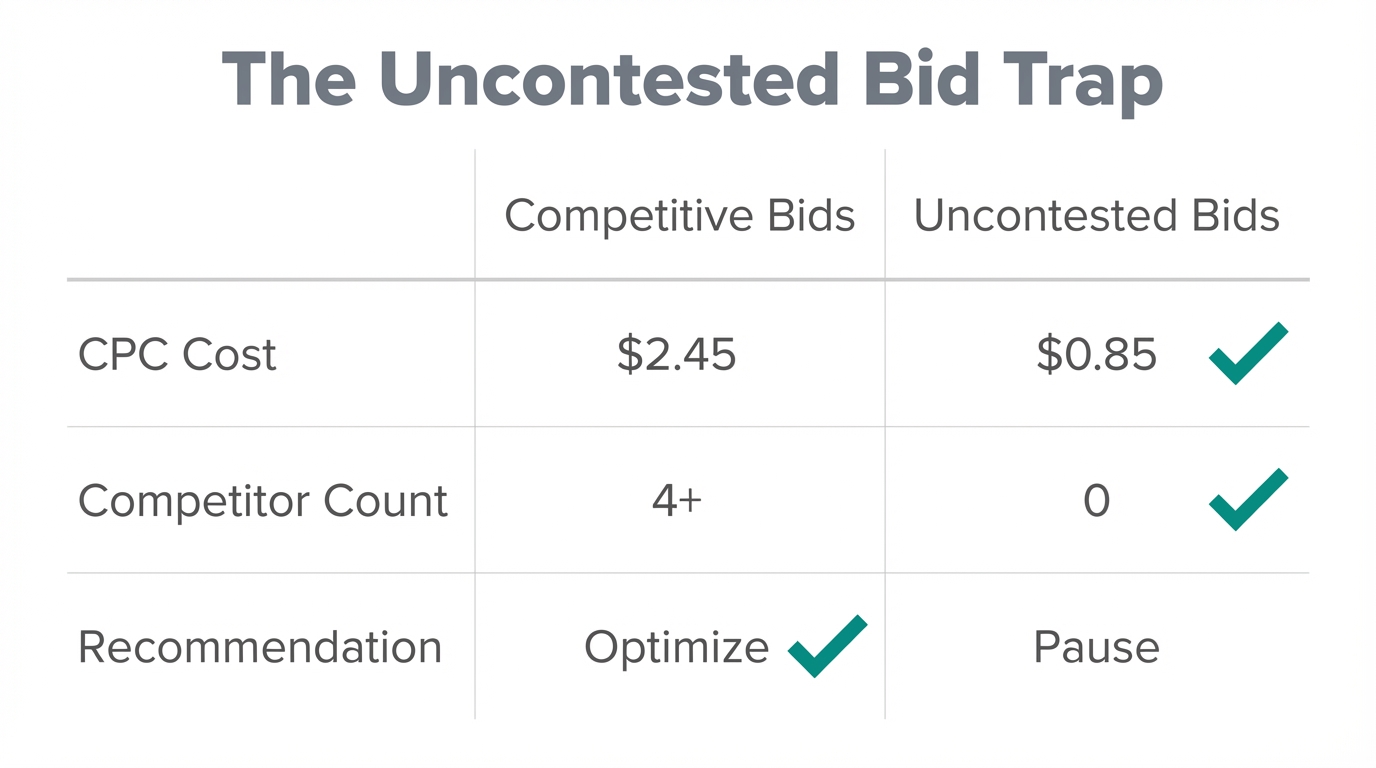
One of the most frequent causes of wasted spend is bidding on your own brand name when you already dominate the organic search results. Research shows that 20-30% of branded search ads run in uncontested auctions, meaning brands are paying for clicks they would have received for free via organic search, according to AgileSpace Digital.
Claude Code can be programmed to detect these scenarios. By analyzing your Search Console data alongside your Google Ads data, Claude can identify keywords where your organic position is #1 and there are zero competitor ads. In these cases, reducing or pausing branded spend can save thousands of dollars without impacting your total traffic volume. This is a level of granularity that most manual audits completely miss.
"If you are the only one bidding on your brand name and you already rank #1 organically, you aren't buying growth—you're paying a 'tax' to Google for traffic you already own."The Plan-Review-Execute Loop: Avoiding AI Disasters
While Claude Code is incredibly powerful, it is not infallible. The biggest mistake marketers make is jumping straight into "Edit Mode" and allowing the AI to change campaign settings without oversight. To maintain control, you must follow the Plan-Review-Execute loop recommended by DataCamp.
- Plan: Ask Claude to analyze the data and provide a detailed plan of action.
- Review: A human marketer reviews the proposed changes (e.g., the new negative keyword list or bid changes).
- Execute: Once approved, Claude runs the script to push the changes live.
Furthermore, ensure you have a .claude/rules file in your repository. This file acts as your brand’s "source of truth," defining your target ROAS benchmarks, global negative keyword lists, and specific brand guidelines that the AI must never violate. This ensures consistency across every audit it performs. For marketers scaling UGC (user-generated content) campaigns, platforms like Stormy AI streamline creator sourcing and outreach, ensuring the creative side is as optimized as the technical side.
Conclusion: From Manager to Architect
The transition from manual PPC management to agentic automation is not just a trend; it is a fundamental shift in how businesses grow. By using Claude Code to audit your Google Ads, you aren't just saving time—you are systematically recovering the 34% of your budget that is currently being lost to waste. Whether it is identifying uncontested branded bids, automating negative keyword discovery, or monitoring the data layer for conversion errors, the ROI of AI-driven auditing is undeniable.
As you integrate these tools into your workflow, remember that data quality is paramount. As noted by Ratan Jha Digital, optimizing on garbage data only leads to faster failure. Start by auditing your tracking, then move to your settings, and finally, use AI to scale your creative and influencer outreach through platforms like Stormy AI. The brands that win in 2025 will be the ones that spend less on waste and more on the high-impact strategies that move the needle.