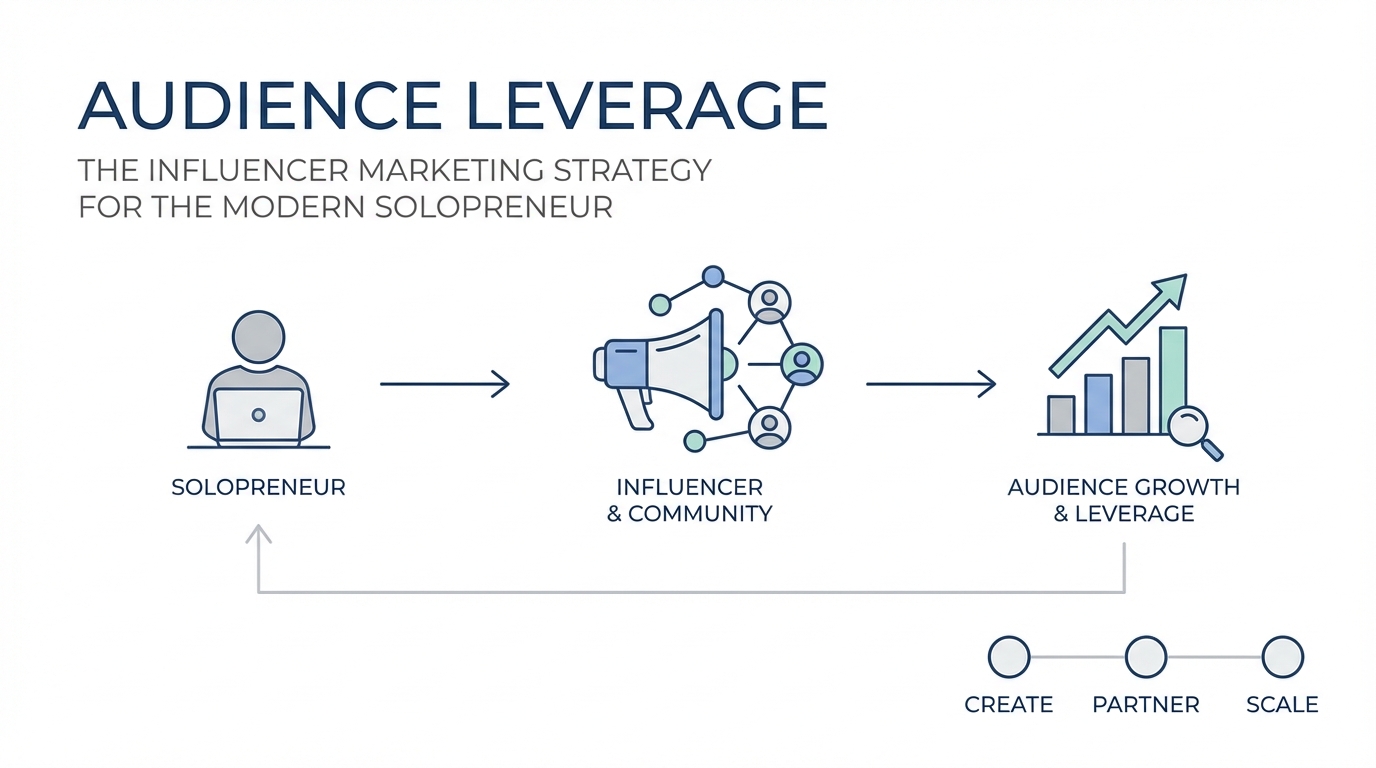
When Sam Altman, the co-founder of OpenAI, predicted that we would soon see a one-person billion-dollar company, the tech world paused. It sounded like science fiction. Historically, reaching a billion-dollar valuation required hundreds of employees, massive office footprints, and layers of middle management. But the landscape has shifted. We are entering the era of the "idea guy," where AI-first companies allow a single founder to manage a fleet of autonomous agents instead of human departments. At the heart of this revolution isn't just better code—it is audience leverage. For the modern solopreneur, distribution is no longer something you buy at the end; it is the engine you build at the beginning.
The Three Pillars of Leverage: Code, Capital, and Audience
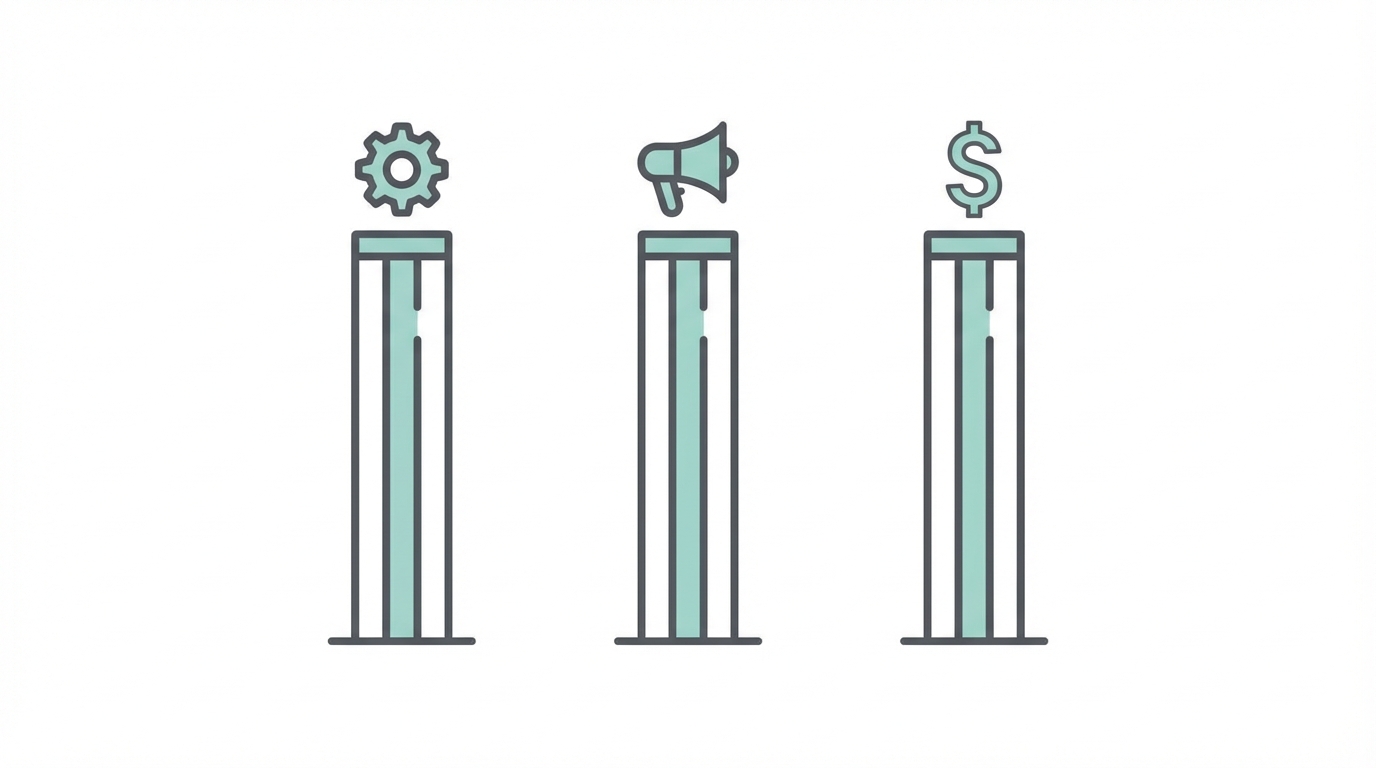
To understand how a solopreneur reaches unicorn status, we have to look at how leverage is built. As popularized by thinkers like Naval Ravikant, there are three primary ways to gain leverage in the modern economy: code, capital, and audience. Traditionally, founders focused on capital first—raising money to hire people to write code. Today, the order has flipped. Code leverage is now more accessible than ever through tools like Cursor and LLMs that allow founders to "vibe code" entire applications without deep technical backgrounds. Capital leverage has become more efficient as AI agents reduce the need for massive payrolls. However, the most critical pillar for the 2020s is audience leverage.
Audience leverage is the ability to command attention and trust. In a world where anyone can generate a product using AI, the product itself becomes a commodity. The real value lies in who can distribute that product. By building an audience on platforms like X, Instagram, or TikTok, you create a top-of-funnel engine that works while you sleep. This is the foundation of creator-led growth, where the founder’s personal brand serves as the primary marketing channel for their software or service.
The Distribution Revolution: Why the 2020s are Different

Every era of technology has been defined by a specific type of revolution. In the 1990s, it was the computer revolution. The 2000s brought the cloud revolution, and the 2010s were dominated by mobile and SaaS. Each step brought more leverage, making it quicker and cheaper to launch products. We are now in the distribution revolution. The barrier to building has dropped to near zero, but the barrier to being noticed has skyrocketed. This is why a build in public strategy is no longer just a trend—it is a survival mechanism.
In this new era, services are becoming software. Instead of hiring a traditional agency, businesses are buying AI-powered products that fulfill the service. This shift allows solopreneurs to capture instant distribution by leveraging high-precision ad platforms and influencer dynamics. When you have a product that solves a repetitive, high-value problem, and you combine it with an existing audience, the growth curve isn't linear; it’s exponential. Success today is about standing on the shoulders of giants, integrating with established stacks like Supabase for backend, Shopify for commerce, and Netlify for deployment, allowing the founder to focus entirely on the distribution and strategy.
The Rise of Trust in Small Brands: Indie Hackers vs. Big Tech
There is a growing cultural shift toward "shopping local" in the digital world. Users are increasingly wary of faceless Big Tech corporations and are gravitating toward indie hackers and small brands. This trust is a massive advantage for the modern solopreneur. People want to buy from individuals like Pieter Levels or Marc Lou because they feel a personal connection to the journey. This trust-based distribution is the ultimate moat. While a competitor can clone your AI features, they cannot clone the relationship you have built with your community.
This is why influencer marketing for startups is so effective. It’s not just about reach; it’s about the transfer of trust. When a trusted creator recommends a product, it carries more weight than a generic Meta Ad. For the solopreneur, this means your primary job is to be the Chief Distribution Officer. Whether you are building your own following or partnering with others, your goal is to create a community rather than just an audience. Communities provide feedback loops, early beta testers, and a defensive barrier against market shifts.
The New Startup Playbook: From Discovery to Scale
The old path of building a startup involved fundraising, hiring a team, and then launching. The new path for the AI-first solopreneur is fundamentally different. Follow this playbook to leverage the current landscape:
Step 1: Start with an Audience
Before you write a single line of code, start an account on X or Instagram. Share your thoughts on a specific niche—whether it’s mobile app design, productivity hacks, or AI trends. The goal is to learn what resonates with people. For example, the founder of Idea Browser started by simply tweeting startup ideas to see which ones got the most engagement.
Step 2: Vibe Code a Solution
Once you identify a pain point through your audience, use AI tools to build a micro SaaS. This should be a single-feature product that solves one specific problem. Don't worry about perfection; focus on utility. The goal is to move from an idea to a functional product in days, not months.
Step 3: Build a Community
Move your most engaged followers into a private community. This could be a Discord server, a Slack channel, or a paid community. This group becomes your engine for growth. They provide the social proof and word-of-mouth marketing needed to scale beyond your initial circle.
Step 4: Automate with AI Agents
As the business grows, don't hire people. Instead, build an org chart of AI agents. Use LLMs to handle engineering, marketing, and customer support. By keeping the team size at one (or very small), you maintain a high valuation-per-employee ratio, which is the key to the billion-dollar solopreneur model.
Partnering with Creators: Instant Distribution at Scale
Not every solopreneur wants to be a professional content creator. If you prefer to stay behind the scenes, you can still achieve audience leverage by partnering with existing influencers. This is the fastest way to get your product in front of thousands of potential customers without building a following from scratch. The key is to find micro-niche creators whose audience perfectly aligns with your product’s value proposition.
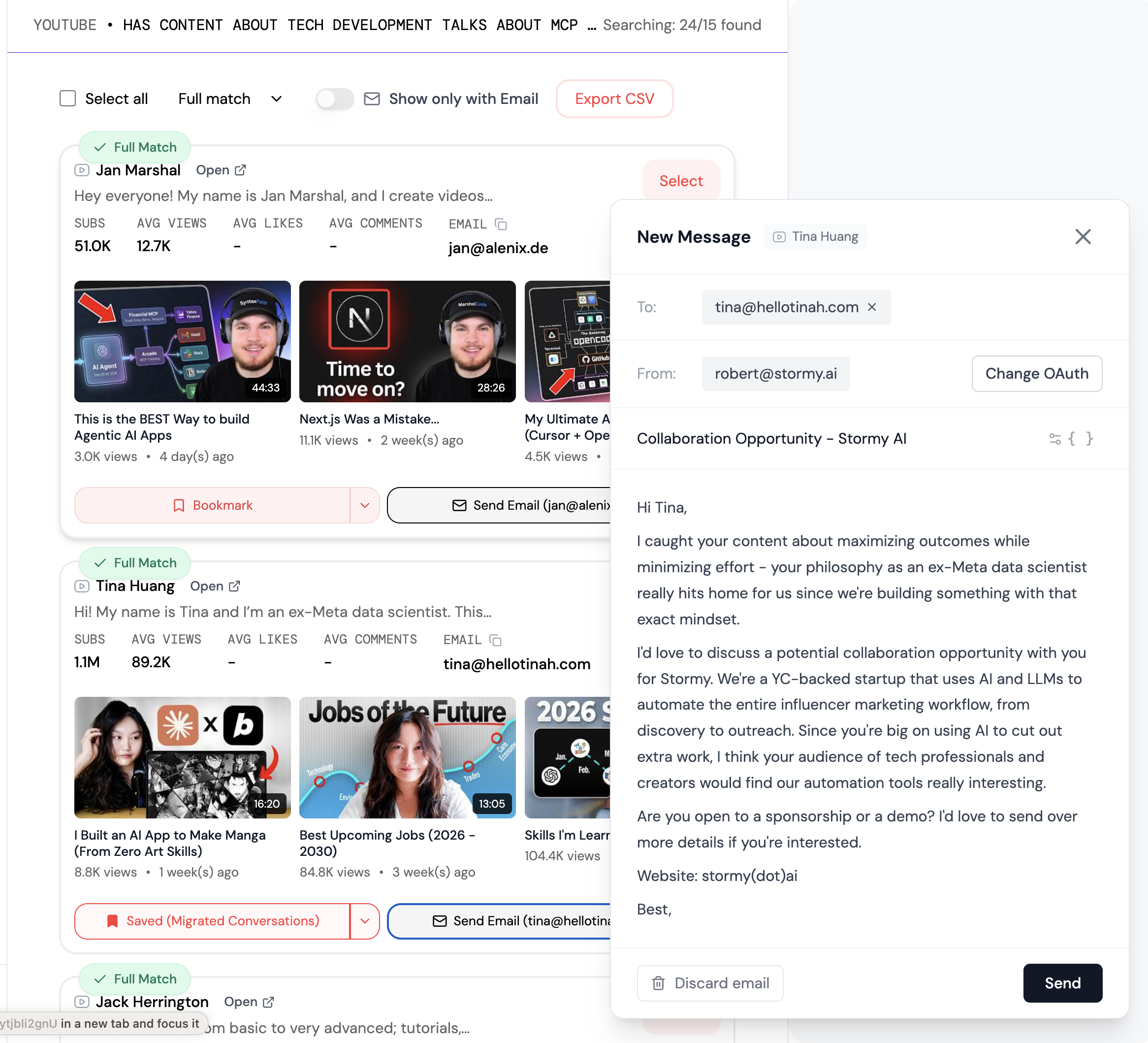
Managing these relationships can be complex, but modern tools have simplified the process. AI-powered platforms like Stormy AI can help source and manage UGC creators at scale. Instead of spending hours manually searching for the right fit, you can use AI search engines to find creators based on natural language prompts. Whether you need a product designer to showcase your new app or a fitness influencer to promote a health tool, leveraging an AI agent to handle the outreach and vetting allows you to maintain the solopreneur lifestyle while achieving enterprise-level reach.
Building the Top-of-Funnel Engine: Proven Hooks
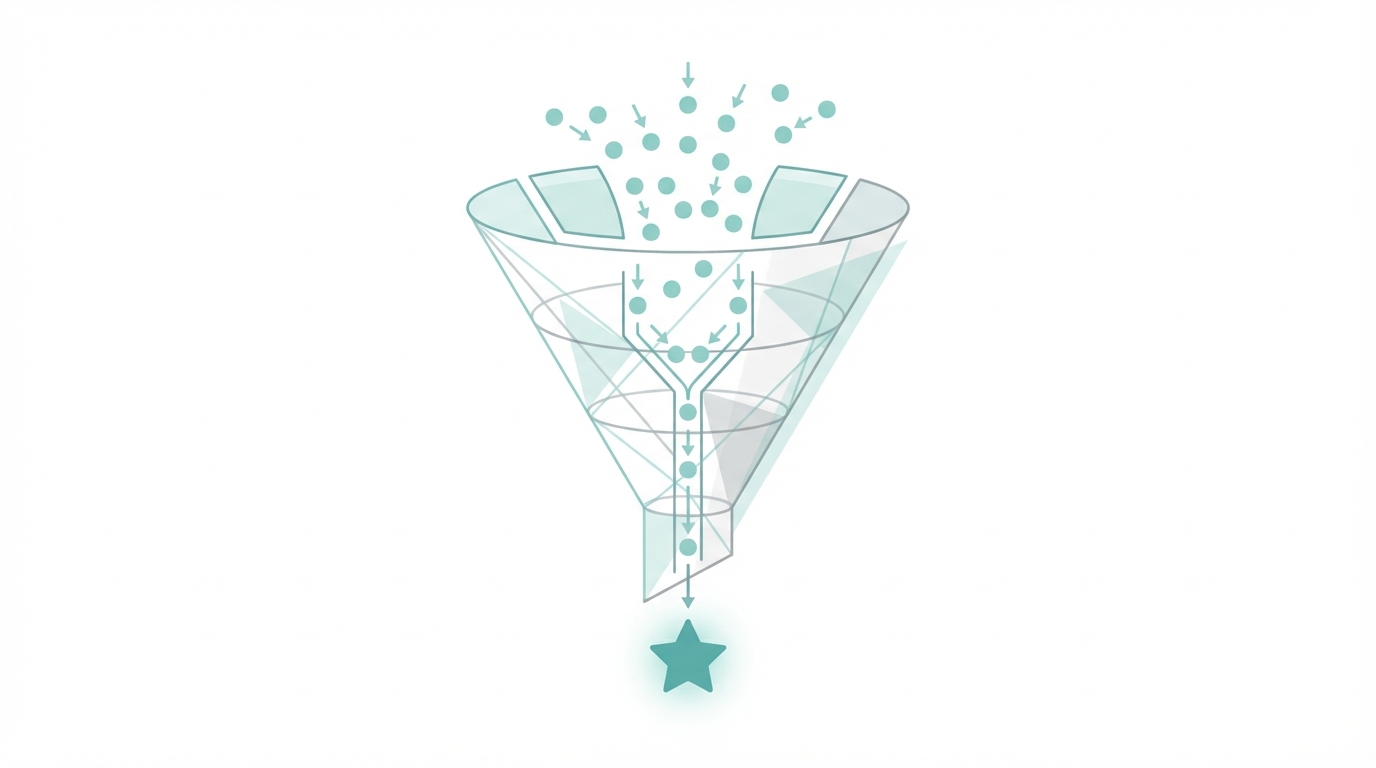
To win at solopreneur distribution, you must master the art of the hook. Whether you are running ads or posting organically, the first three seconds determine your success. Using proven viral formats is the secret to consistent growth. Based on research from successful creators like Murata, here are some high-converting hooks you can adapt for your product:
- POV: "POV: You just found the app that replaced your [Competitor]."
- The Mystery: "This is why your [Metric] is actually [Negative Result]."
- The Hack: "Your [Industry] doesn't know about this [Outcome] hack."
- The Comparison: "Stop using [Old Way], use [New AI Way] instead."
Building an audience requires high-precision consistency. You have to live and breathe the metrics, refining your content daily. As your followers grow, so does your capital leverage. A founder with 100,000 engaged followers can launch a product and hit $10k MRR (Monthly Recurring Revenue) in a fraction of the time it takes a traditional startup using cold traffic.
The AI Org Chart: Managing a Billion-Dollar Empire Solo
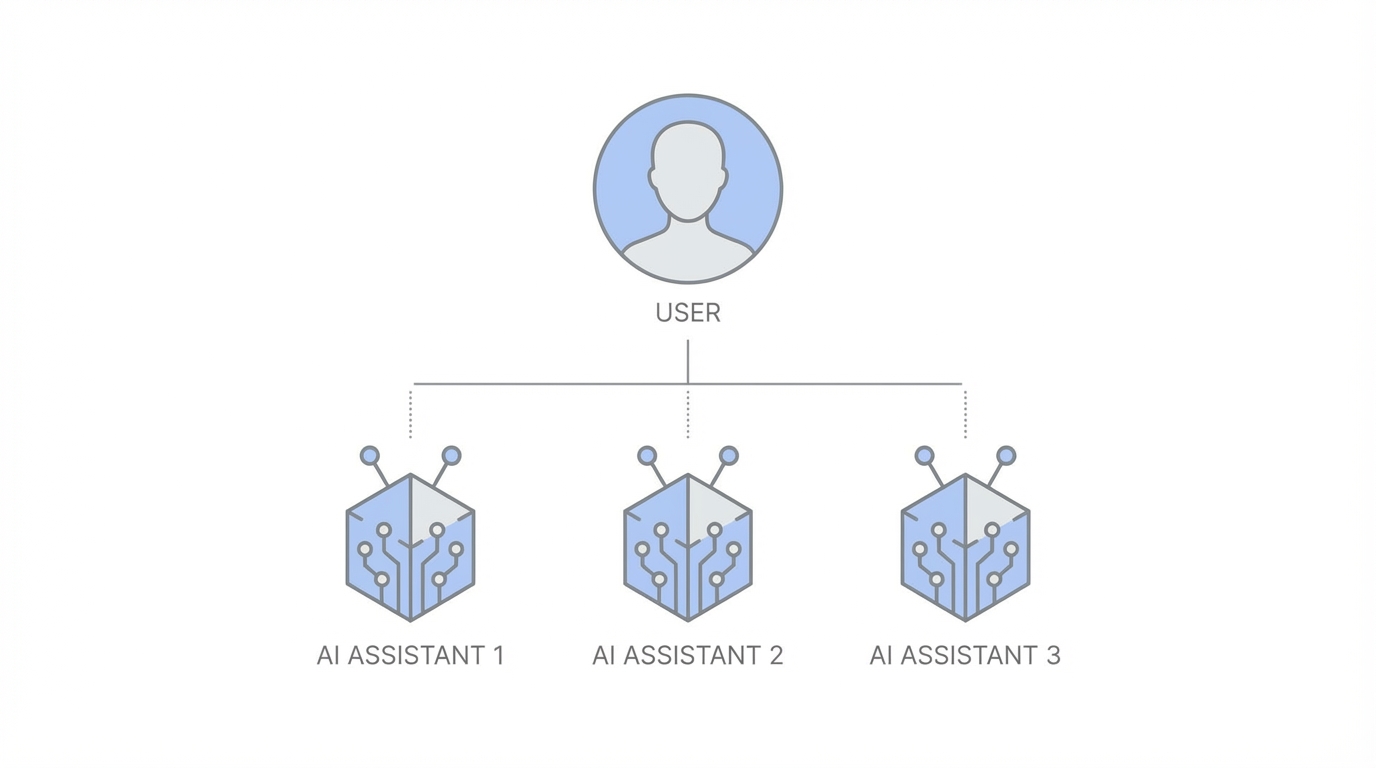
How does one person manage a company worth a billion dollars? They don't do it alone; they do it with an autonomous agent hierarchy. Imagine your organization where you are the solo founder, and your "executives" are all LLMs managing specific tasks. This is the AI-first company structure:
- Marketing Agents: Handling content creation, SEO, and social media scheduling.
- Sales Agents: Performing lead qualification, cold outreach, and demo booking.
- Engineering Agents: Writing code, performing QA testing, and managing DevOps.
- Support Agents: Handling ticket triage and automated documentation.
The core skill of the modern founder is context engineering—the ability to feed these agents the right rules and data to ensure high-quality output. To stay lean, focus on usage-based or outcome-based pricing models. As noted in discussions on Lenny's Podcast, these pricing archetypes are often the fastest way to scale an AI business because they align the cost directly with the value delivered to the customer.
Choosing the Right Business Model for Solo Success
Not every business is suited for the solo-billionaire path. To succeed, your business should ideally be a digital product with low human labor requirements. B2B SaaS and consumer mobile apps are the prime candidates. If your business requires complex regulatory compliance (like fintech or healthcare) or a large physical sales team to close Fortune 500 deals, it will be much harder to remain a one-person show. Look for opportunities with high repetition and high value. This is the "gold mine" quadrant where AI agents can perform tasks multiple times a day for a premium price.
While the road is difficult—with solopreneurs like Marc Lou noting that it can take months of consistent effort just to hit the first $1,000 in MRR—the compounding effect of audience leverage eventually takes over. The curve is slow at first, and then it happens all at once. By the time 2026 rolls around, the first solo unicorn will likely have emerged, built on a foundation of creator-led growth and AI efficiency.
Conclusion: The Era of the Solo Unicorn
The dream of the one-person billion-dollar company is no longer just a thought experiment; it is a blueprint being followed by thousands of founders today. By prioritizing audience leverage, embracing the build in public strategy, and automating everything through AI agents, you can bypass the traditional hurdles of startup growth. Whether you are building your own brand or using tools like Stormy AI to partner with the creator economy, the distribution revolution is your greatest opportunity. The tools are here, the audience is waiting, and the era of the solo founder is just beginning. Happy building.