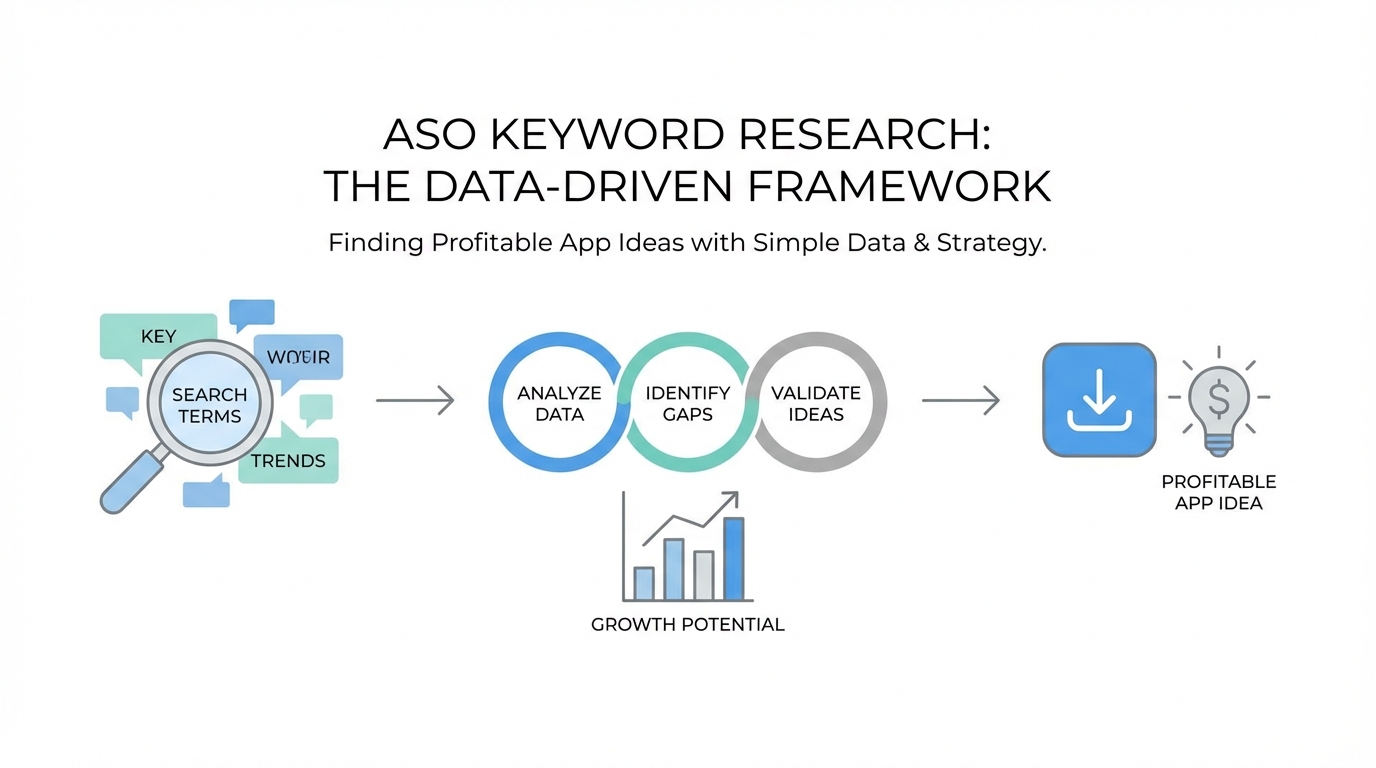
Most mobile app developers approach product development backward. They start with a spark of inspiration, spend six months perfecting a codebase, and only then do they ask: "Does anyone actually want this?" In the hyper-competitive landscape of mobile marketing, this is a recipe for wasted time and empty bank accounts. The modern gold rush in software isn't about having the most original idea; it’s about having the most validated one. By leveraging aso keyword research and quantitative market analysis, developers can identify profitable app niches before writing a single line of code. This guide breaks down the technical framework used by top-tier builders to ship high-performing apps based on app store search volume and real-world demand.
The Paradigm Shift: Data Over Intuition

For years, the standard advice for developers was to focus all energy on a single "unicorn" project. However, recent success stories from the developer community show that a portfolio of tiny bets is often a more reliable path to financial freedom. Consider the case of Max, an iOS engineer who went from making $200 a month to $10,000 in monthly recurring revenue (MRR) in just eight months. His secret? He didn't build one perfect app; he built 28 simple mobile apps that were precisely targeted at high-intent search terms.
This strategy relies on the 80/20 rule: out of 28 apps, four of them generate $1,500 each, while the rest contribute smaller amounts. By using app store optimization (ASO) as a discovery tool rather than a post-launch chore, you can identify exactly what users are searching for and meet them right at the point of intent. Instead of guessing, you are fulfilling existing demand identified via search patterns on the Apple App Store and Google Play.
The ASO Keyword Research Framework: How to Find App Ideas

To find how to find app ideas that actually convert, you need to look at search behavior through specialized ASO tools. Platforms like Astro and FoxData allow you to see exactly how many people are typing a specific phrase into the search bar and how difficult it is to rank for that phrase. For those building growth engines, Stormy AI is an AI-powered search engine for creator discovery, especially for mobile app marketing and UGC campaigns, which can eventually help scale these validated ideas through creator-led content, but the foundation must always be keyword-driven.
Step 1: Set Your Metrics. When conducting research, you must apply strict filters to avoid entering "ghost town" niches. A winning keyword typically meets two criteria:
- Minimum 20% Popularity: This represents the search volume. Anything lower usually doesn't generate enough organic traffic to sustain a business.
- 60% to 70% Difficulty Benchmark: While high difficulty sounds intimidating, it often indicates a market where users are actively spending money. The goal is to find the "sweet spot" where the competition is beatable by a leaner, more focused MVP.
Step 2: Identifying "Adjacent" Opportunities. Let’s say you search for "Tree Identifier." You might find it’s too competitive. However, a tool like App Radar might reveal that "Wood Identification" has a popularity score of 20+ but a much lower difficulty. This is your entry point. By pivoting slightly to a less crowded but highly relevant term, you gain the App Store Boost without fighting the industry giants. While researching keywords, you can simultaneously use Stormy AI to vet potential creators in these niches, analyzing their audience demographics and content quality scoring to see where your app might fit.
Benchmarking Market Viability: The Sensor Tower Strategy
Keywords alone aren't enough. You need to know if the people searching for those terms are willing to open their wallets. Before writing any code, you must perform a "financial sanity check" using a tool like Sensor Tower. This allows you to spy on the monthly revenue of the top 3-5 apps currently ranking for your target keyword.
The Benchmark: If the top competitors are making less than $100 to $200 per month, the market is likely too small or the user pain point isn't painful enough to warrant a subscription. However, if you see simple utility apps generating $1,000+ per month with mediocre UI, you’ve found a goldmine. This is where profitable app niches are born. You aren't looking for a billion-dollar idea; you're looking for a portfolio piece that contributes to your $10k/month goal.
The 'Related Niche' Strategy: Scaling One Codebase
One of the most efficient ways to grow an app portfolio is the Related Niche Strategy. This involves building a core technology—for example, an AI chat interface or an image recognition tool—and skinning it for different keywords. If you build a "Physics AI" tutor, you have already built 90% of a "Chemistry AI" and "Math AI" tutor. They target the same user demographic (students) but solve slightly different problems through unique aso keyword research hooks.
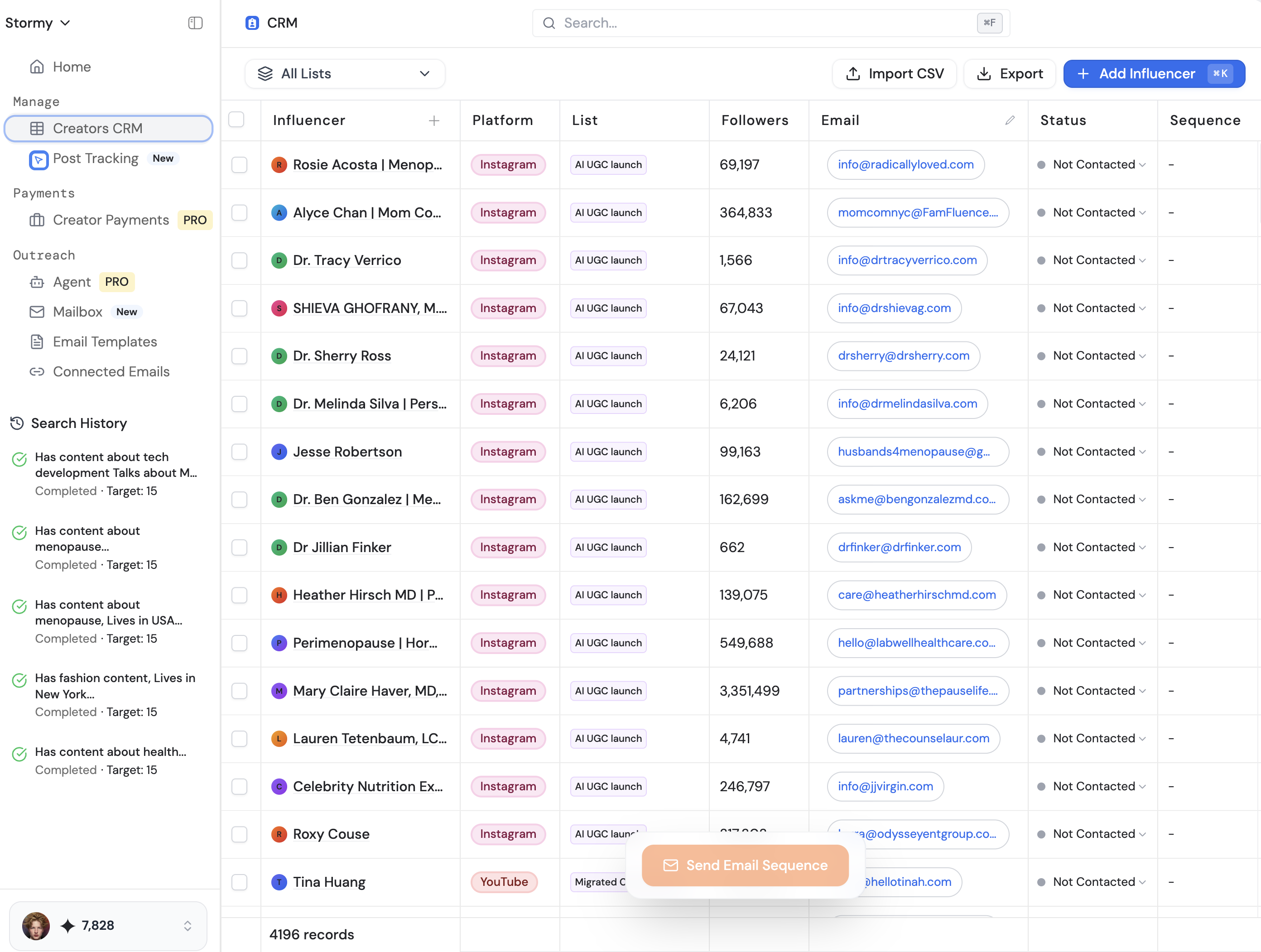
This is where leveraging Stormy AI for finding UGC creators and influencers becomes a competitive advantage. Once you have a cluster of related apps, you can use a built-in creator CRM to track your relationships and find UGC creators who specialize in education or student lifestyle to create content for all three apps simultaneously. This multi-app approach reduces your customer acquisition cost (CAC) because you are reusing assets, code, and marketing strategies across a wider net of keywords.
The 48-Hour Build Playbook: From Idea to App Store

Speed is your greatest ally. If you spend three months on an app that fails, you’ve lost a quarter of your year. If you spend 48 hours, you’ve only lost a weekend. Here is the technical playbook for shipping apps at lightning speed:
Step 1: AI-Powered Planning
Once you have your keyword (e.g., "Wood Identification"), use an AI tool like ChatGPT or Claude to generate a detailed implementation plan. Ask for the core feature set, the screen flows, and even the UI/UX constraints. This removes the "blank page" syndrome and gives you a roadmap to follow.
Step 2: Modular Development
Stop rebuilding the wheel. Successful portfolio builders use a library of pre-made components. Your "Settings" screen, "Onboarding" flow, and "Paywall" should be drag-and-drop elements from previous projects. Use frameworks like Flutter for cross-platform efficiency and Google Firebase for a serverless backend to keep your infrastructure costs near zero.
Step 3: Rapid Asset Creation
Use Figma templates for your App Store screenshots and icons. Don't overthink the design; focus on keyword-rich titles and clear, benefit-driven imagery. Your metadata—title, subtitle, and keyword field—should be meticulously crafted based on your aso keyword research.
Managing the App Empire: Tools and Costs
Running a portfolio of 28 apps might sound expensive, but it can be done incredibly leanly. By focusing on profitable app niches with low overhead, your margins can stay high. Max’s stack demonstrates that you don't need a massive budget to generate $10k/month:
- AI Coding: Cursor ($20/mo) for rapid development.
- Infrastructure: Firebase ($5-$10/mo) handles auth and database.
- Deployment: Fastlane ($0) for automated App Store submissions.
- Analytics: Mixpanel ($0/Free plan) for tracking user retention.
- Search Intel: Astro ($10/mo) for ongoing keyword monitoring.
The total cost to manage an "empire" of dozens of apps is often less than $300 per month, most of which goes toward API credits for OpenAI or Google Gemini if your app relies on AI features.
The "Ship and Forget" Philosophy: Scaling the Winners
Once an app is live, your job isn't to market it endlessly. It's to watch the data. Every new app receives an initial App Store Boost where Apple's algorithm tests your relevance. Over time, that traffic will either stabilize or sink. If an app stabilizes and shows organic retention, that is when you return to it for polishing.
For the "floaters" (the apps that maintain a steady stream of downloads), you can double down on growth. This is the stage where you should move beyond organic app store optimization and start looking at paid acquisition or creator partnerships. Working with Stormy AI to find UGC creators is particularly effective here, as social proof from real users can significantly improve your conversion rate on the App Store page, turning more "lookers" into "subscribers."
Conclusion: Building the Shipping Muscle
The secret to finding profitable app niches isn't a stroke of genius; it's a commitment to the process of elimination. By using aso keyword research to validate every idea, you remove the emotional attachment that often leads to developer burnout. Treat your apps like experiments. If a keyword has a 20% popularity score and your competitors are making €200/month, build the MVP. If it doesn't, move to the next keyword.
The future of app development belongs to the fast and the data-driven. Start by exploring tools like Astro today, identify your first high-intent keyword, and commit to shipping a functional version in 48 hours. Don't wait for the perfect idea—build the shipping muscle first, and the revenue will follow.