In 2026, the mobile landscape has shifted from simple keyword matching to a complex ecosystem of semantic intent and technical performance. With approximately 70% of all app installs originating from an app store search, according to research by Pocketworks, search remains the single most powerful organic growth lever for developers. However, ranking high is no longer just about stuffing a description with keywords. Today, the fundamental differences between the Apple App Store and Google Play Store algorithms require a bifurcated strategy to maintain visibility among the 3,500+ new apps released every single day, as tracked by Statista.
Decoding the Algorithmic Divide: Lexical vs. Semantic
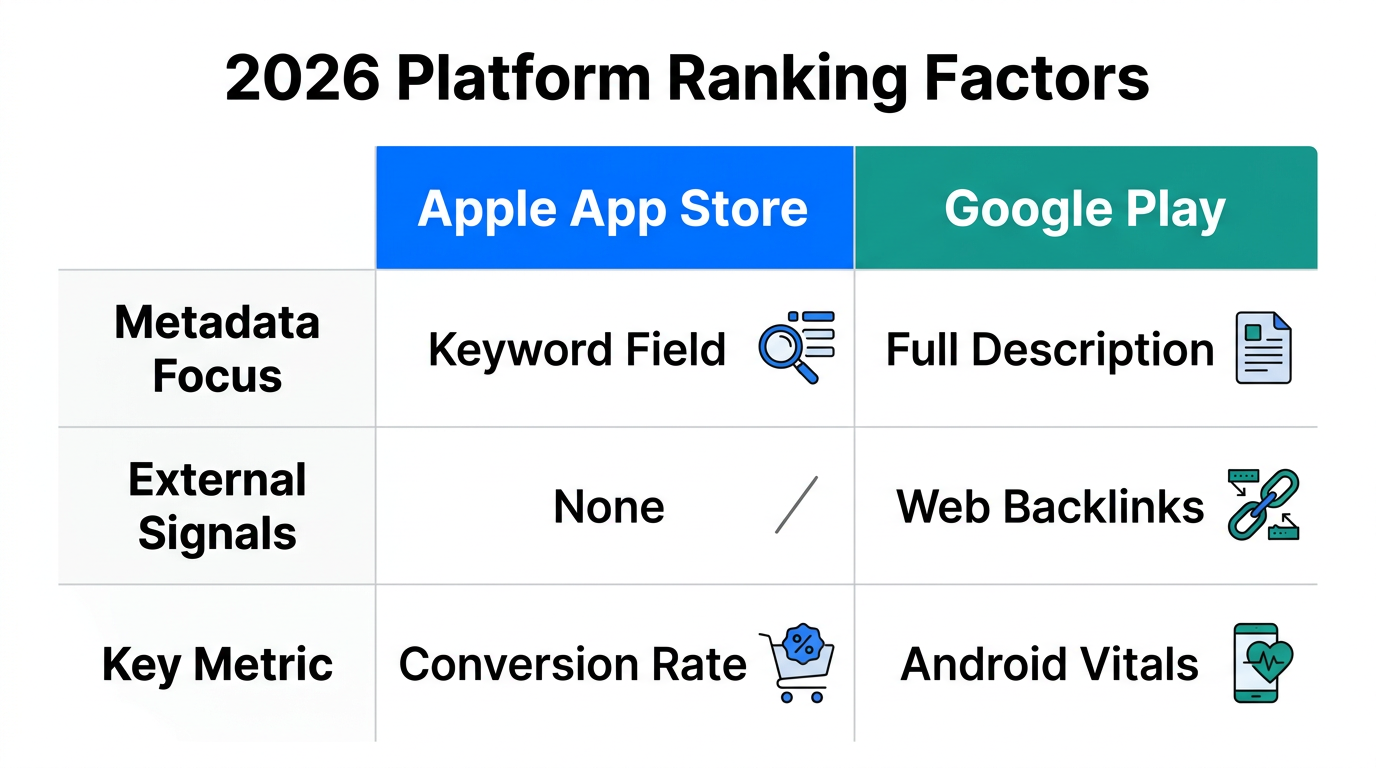
To master app store keyword ranking, you must first understand how each platform "thinks." Apple’s App Store still leans heavily on a lexical, combinatorial logic. This means the algorithm mixes and matches terms from your Title, Subtitle, and Keyword Field to determine your ranking for specific queries. Conversely, Google Play has fully embraced Natural Language Processing (NLP). Similar to Google’s web search engine, the Play Store analyzes the context, relationship, and density of your entire long description to assign relevance.
| Factor | Apple App Store (iOS) | Google Play Store (Android) |
|---|---|---|
| Primary Fields | Title (30) & Subtitle (30) | Title (30) & Short Description (80) |
| Hidden Keywords | Yes: 100-character field | No: Description NLP density |
| Technical Weight | Moderate impact | Critical: Android Vitals ranking impact |
| Backlinks | No direct correlation | Yes: Boosts domain authority |
While Apple relies on a specific set of metadata fields, Google’s AI analyzes the "semantic fingerprint" of your app. For instance, in 2026, if you rank for "calorie tracker," the Asolytics research suggests the algorithm may automatically rank you for "diet log" or "weight loss manager" based on the category relevance, even if those exact phrases aren't in your text.
"The 2026 ASO landscape isn't about matching words; it's about matching user intent through technical excellence and semantic depth."
iOS Metadata Optimization: The 100-Character Puzzle
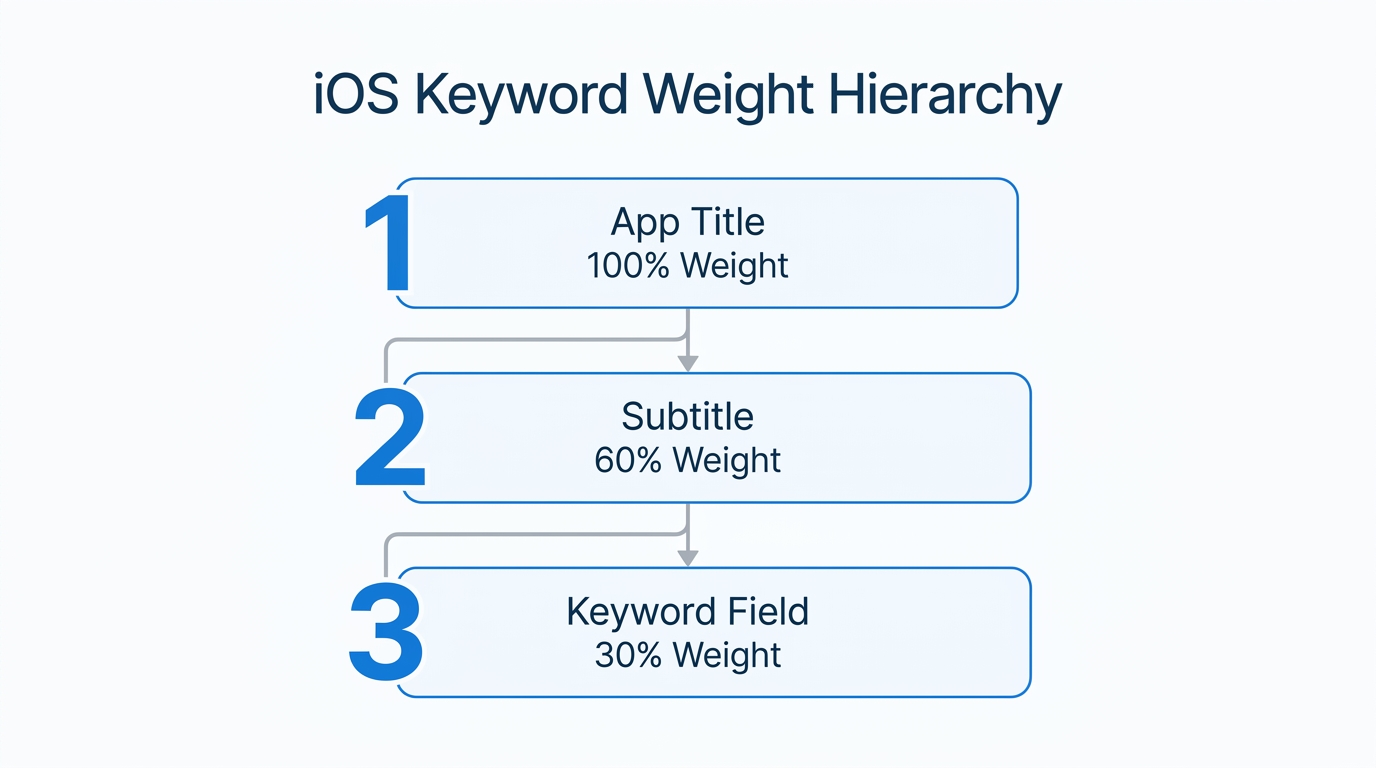
For iOS metadata optimization, every character is precious real estate. Apple provides a unique 100-character keyword field that is invisible to users but vital for the algorithm. The secret to 2026 success lies in avoiding repetition. Repeating a keyword in your Title and Subtitle does not increase its weight; it simply wastes space that could be used for a high-volume secondary term. According to AppTweak, developers who eliminate redundant words and "stop words" (like 'the' or 'and') see a significant lift in their ranking breadth.
The Rise of OCR (Optical Character Recognition) Indexing
A major breakthrough in 2026 is Apple’s use of OCR (Optical Character Recognition) to index keywords directly from screenshots. In previous years, screenshots were purely for conversion. Now, high-relevance keywords placed in your first two screenshots can influence your search visibility. This means your creative team and SEO team must be perfectly aligned. If your app is a "budgeting tool," having that phrase clearly visible in a large font on your primary screenshot can reinforce your metadata signals, a tactic often discussed in Apple's Developer Search documentation.
Google Play: Authority, Backlinks, and NLP Density
The Google Play vs Apple App Store ASO debate often centers on how much "web SEO" carries over to mobile. On Google Play, the answer is: a lot. Unlike Apple, Google uses your app’s web presence as a ranking signal. High-quality backlinks from reputable tech blogs or news sites boost your app's authority in the Play Store. This makes off-page ASO as important as on-page metadata for competitive categories like FinTech or Health & Fitness.
When writing your long description, you must aim for a 2-3% keyword density. Over-stuffing beyond 5% is now met with a ranking penalty, as Google’s NLP can easily detect "keyword vomiting." Instead, focus on natural, descriptive prose that incorporates your primary keywords early in the first 160 characters. Tools like App Radar are essential for monitoring these density levels and ensuring your description remains both user-friendly and algorithm-optimized.
The 1.09% Rule: Why Android Vitals Can Kill Your Growth
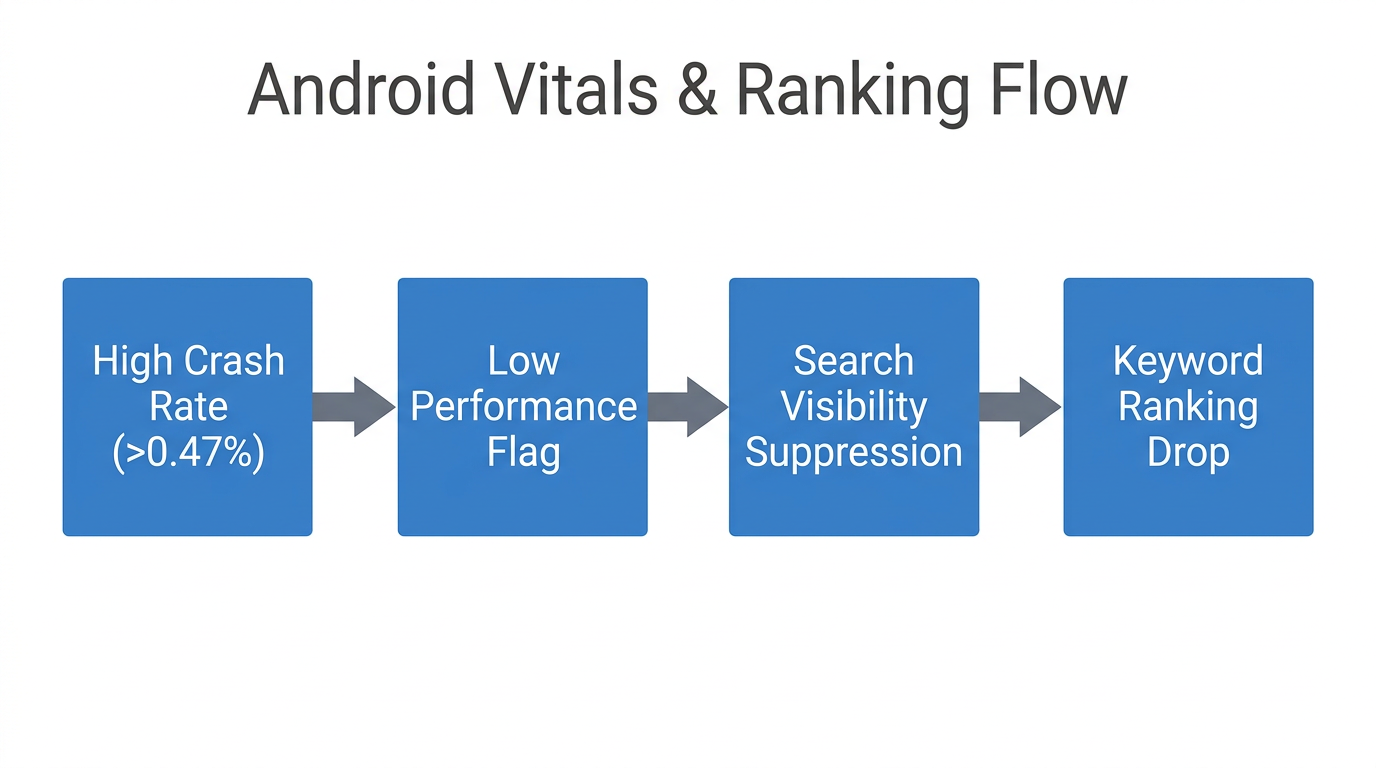
Perhaps the most ruthless part of the Google Play algorithm is the Android Vitals ranking impact. In 2026, Google has made it clear that technical performance is a prerequisite for visibility. If your app’s crash rate exceeds the 1.09% threshold, or if your ANR (App Not Responding) rates are in the bottom quartile, your keyword rankings will plummet regardless of how well your metadata is optimized, as detailed in the Android Developers Console guidelines.
Google views technical stability as a core part of the user experience. A crashing app is a bad recommendation, and their algorithm will actively hide such apps from search results to protect the store's integrity. Developers should use the Appfigures dashboard to monitor their Vitals daily. If you notice a sudden drop in rankings for your top terms, the first place to look isn't your keywords—it's your crash logs.
"No amount of keyword optimization can save an app with a crash rate above 1.09% on Google Play."
AI Assistants and the New Sentiment Index
With the integration of Google’s "Ask Play" and Apple’s advanced Siri search, the stores are now prioritizing user sentiment scores. These AI assistants don't just look for keyword matches; they parse thousands of user reviews to understand if an app is actually "good" for a specific task. If your reviews consistently mention that your "video editor" is "easy to use" and "fast," you will start ranking for those descriptive terms automatically.
This is where social proof and creator marketing intersect with ASO. By using platforms like Stormy AI to find and collaborate with UGC (User-Generated Content) creators, you can drive a steady stream of high-quality users who are more likely to leave positive, keyword-rich reviews. This feedback loop between social influence and store sentiment is a critical component of a modern growth stack.
2026 ASO Strategy Playbook
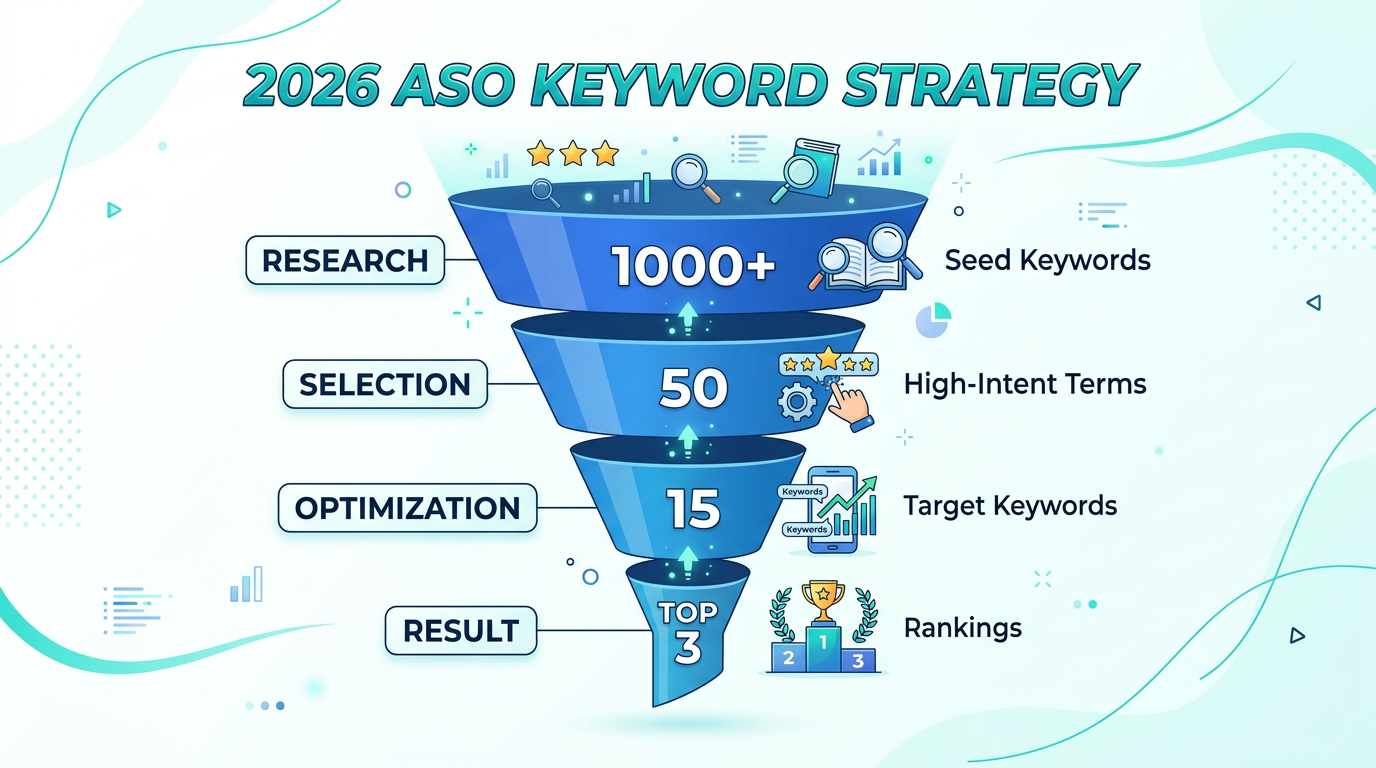
To succeed across both platforms, follow this structured approach to app store keyword ranking:
- The Rule of Firsts: Place your most important, high-volume keyword at the very beginning of your Title. Keywords at the start carry the most algorithmic weight.
- Target Long-Tail Keywords: Avoid broad terms like "Fitness." Instead, target niche phrases like "weight loss for busy moms." Research from Semnexus shows that while volume is lower, the conversion rate (CVR) is often 2-3x higher.
- Culturalization over Translation: Don't just translate keywords. Use region-specific terms (e.g., "Football" in the UK vs. "Soccer" in the US). Localized apps see a 30%+ increase in visibility according to Mobile Action data.
- Custom Product Pages (CPPs): On iOS, use Apple's Custom Product Pages to match specific keywords to tailored landing pages. This ensures the user sees exactly what they searched for, boosting CVR.
- Monitor Seasonality: Update your metadata for events like "World Mental Health Day" or "New Year's Resolutions." ConsultMyApp notes that seasonal updates can lead to a 40% boost in visibility during peak periods.
Conclusion: The Technical Future of ASO
As we navigate 2026, the gap between the Apple App Store and Google Play Store strategies continues to widen. iOS remains a game of precise metadata engineering and visual indexing through OCR, while Google Play has evolved into a technical and authority-based ecosystem where Android Vitals and backlinks reign supreme. To truly dominate the charts, developers must move beyond "keyword stuffing" and embrace a holistic strategy that balances technical stability, user sentiment, and semantic relevance.
Whether you are managing a portfolio of apps or a single startup, staying ahead of these algorithmic shifts is the only way to ensure your app doesn't get lost in the sea of 6 million competitors. By combining the data-driven insights of tools like Sensor Tower with the creator-driven growth of Stormy AI, you can build a sustainable, organic install machine that thrives regardless of platform changes.