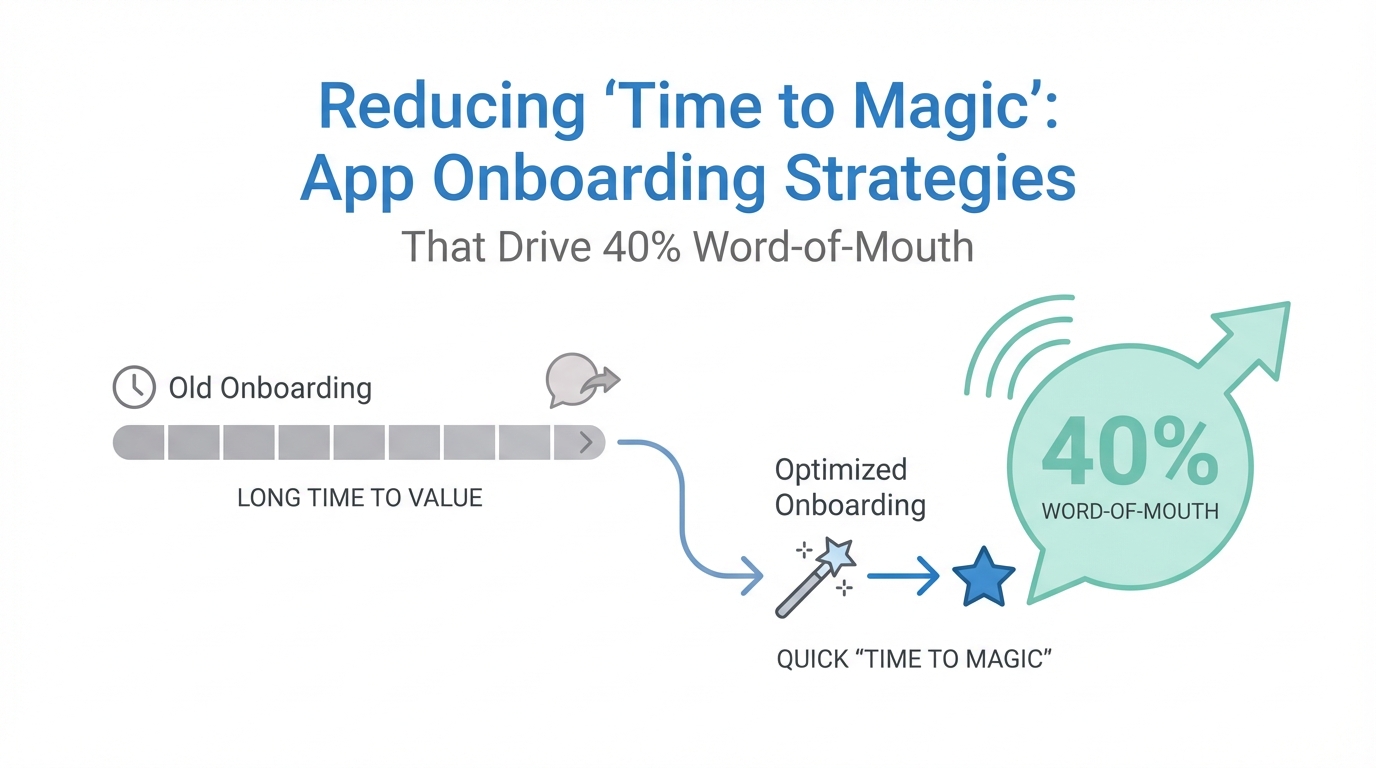
In the hyper-competitive world of mobile applications, the difference between a viral sensation and a forgotten icon on page three of a smartphone is often measured in seconds. For Julian Alvarez, the co-founder of Jungle, an AI-powered study platform, those seconds are the "Time to Magic." Jungle currently generates $80,000 to $100,000 in Monthly Recurring Revenue (MRR), but its success wasn't built on a perfect product from day one. Instead, it was built on a radical realization: you have less than a minute to prove your value to a user before they vanish forever. By focusing on app onboarding best practices and reducing friction, Jungle has reached a point where 30% to 40% of all new users come from organic word-of-mouth. This article breaks down the exact product led growth strategies used to scale from 2K to nearly 100K MRR by prioritizing instant value and gamification.
The 'Time to Magic' Concept: Value in Under 60 Seconds

The most critical metric for any new app isn't downloads or even initial sign-ups—it's the speed at which a user experiences the core value proposition. In product led growth strategies, this is often referred to as the "Aha! moment," but Julian Alvarez calls it the "Time to Magic." For a study app like Jungle, the magic isn't in the account creation or the settings menu; the magic is seeing a complex PDF transformed into interactive, high-quality study questions instantly.
Most founders make the mistake of front-loading their apps with laborious sign-up flows, email verifications, and permission requests. According to insights shared on platforms like Twitter, this friction kills conversion rates. Jungle flipped the script by allowing users to experience the product's core utility before ever asking for a name or password. By reducing the steps to reach the "magic," they ensured that users were already "hooked" by the time the paywall or sign-up screen appeared. This philosophy aligns with the approach of industry leaders like Duolingo, which lets you start learning a language within two taps of opening the app.
Interactive Demos: The New Standard for Landing Pages

One of the most successful experiments Jungle ran involved moving the product experience onto the landing page itself. Instead of a static "Sign Up" button, they implemented an interactive demo where users could upload a document or paste a URL directly on the website. This immediately initiates the AI generation process, showing the user exactly what the app does without any commitment. For brands looking to improve user retention for apps, this strategy filters for high-intent users who already know the value of the tool.
When users see the tool working in real-time—generating flashcards or multiple-choice questions from their own lecture slides—the perceived risk of downloading the app drops to zero. Many modern marketing teams use Stormy AI to find relevant UGC creators who can demonstrate these interactive features in short-form video. By showing a screen recording of the "Time to Magic" on TikTok, developers can bridge the gap between curiosity and installation. Reducing the cognitive load during this first interaction is essential; Jungle specifically avoids asking users for question difficulty or page ranges in the first experience to keep the path to magic as simple as possible.
The Playbook for Phased Onboarding
A common pitfall in app onboarding best practices is trying to gather all the user data at once. This results in "onboarding fatigue." Jungle solved this by splitting their onboarding into three distinct phases. This approach prevents user overwhelm while strategically placing monetization triggers where they are most likely to convert.
Step 1: The Immediate Utility Phase
In this phase, the user performs one core action. For Jungle, this is generating and answering their first seven bite-sized questions. The goal is 100% completion. Only after this mini-review does the app ask the user to sign up. By the time the user reaches the account creation screen, they have already received a "win" from the product.
Step 2: Contextual Data Collection
Once the user is registered, the second phase begins. This is where you ask for specific details like exam dates or notification preferences. Tools like Superwall allow developers to manage these paywalls and data collection screens dynamically. By asking "When is your exam?" right after a successful study session, the app increases the relevance of its push notifications, leading to higher long-term retention.
Step 3: Personalization and Habit Formation
The final phase happens after the user has explored the home screen. This includes selecting a character or setting a weekly goal. Gamification in SaaS works best when the user feels a sense of ownership. Jungle uses a "Jungle River" map where users move through a path as they gain XP. Using a modern Stormy AI creator CRM can help brands manage the high volume of user-generated content that results from such highly personal features.
Visual Growth Loops and Gamification in SaaS
Gamification is often misunderstood as just adding badges or points. True gamification in SaaS involves creating visual and emotional loops that reward the user's progress. Jungle introduced a "growing tree" element that appears while a user is answering questions. As they get answers right, the tree grows. This single visual feature increased core engagement by 70%.
Beyond engagement, this tree serves as a physical-world growth loop. Julian noted that when students use Jungle in a library, the unique visual of the growing tree often prompts nearby students to ask, "Yo, what is that?" This creates a natural word-of-mouth effect that is highly effective in clustered environments like university campuses. When building your app, consider how the UI looks to a bystander. Is there a visual element so intriguing that it sparks a conversation? If so, you’ve unlocked an organic product led growth strategy that requires zero ad spend. For more inspiration on these mechanics, founders often look at the Octalysis Framework for gamification.
Scaling Distribution: From Micro-Influencers to Mass UGC
While product-led growth handles the bottom of the funnel, you still need a repeatable way to get people in the door. Jungle’s journey through distribution highlights a major shift in the creator economy. Early on, they found success with micro-influencers (5K to 100K followers). One specific creator, a med student, posted a video that drove Jungle from $2K MRR to $15K MRR in just two weeks. However, the team found that this "lottery" approach was difficult to replicate consistently.
They eventually transitioned to a high-volume UGC (User Generated Content) model. By working with 30+ creators and posting nearly 400 videos per week, they achieved $2 CPMs, which is significantly more efficient than traditional influencer deals. For app founders looking to scale, using an AI-powered platform like Stormy AI for finding UGC creators and influencers can help identify authentic creators who fit your niche instantly. Julian warns, however, that traditional UGC is becoming a saturated growth hack. Consumers are becoming smarter at spotting inauthentic "organic" content, meaning the quality of the narrative and the honesty of the creator are more important than ever.
The Retention Dilemma: Why It’s the Hardest Metric to Move

A common debate among bootstrapped founders is whether to focus on distribution or retention. Julian’s take is contrarian: while distribution provides the "right now" cash flow, retention is a long-term play that most founders can't afford to ignore, but also struggle to influence. Retention is notoriously difficult because it requires deep psychological alignment with the user’s habits. In Jungle's case, the problem wasn't learning efficacy—it was student motivation.
By focusing on user retention for apps, Jungle created a product that people actually wanted to return to daily. If you are in "survival mode," you will naturally lean toward distribution to keep the lights on. But once you reach a baseline of 30 to 100 new users per week, your focus must shift toward the product-led loops that keep them there. Companies often use Stormy AI to track account performance and monitor views on viral content to see which features are driving the most discussion. This level of virality is only possible when the Time to Magic is short and the experience is memorable.
Conclusion: Building a Product-Led Powerhouse
The success of Jungle proves that scaling a consumer app to $100K MRR requires more than just a good AI wrapper; it requires a relentless focus on the user's first 60 seconds. By implementing app onboarding best practices like interactive demos, phased data collection, and visual gamification, you can turn a simple utility into a viral sensation. Remember that product led growth strategies are not a "set it and forget it" tactic. You must continually tinker, get your hands dirty with new distribution channels, and always prioritize the "magic moment." For those just starting out, the best advice remains: spend two weeks focusing purely on distribution. If you can't get 100 people to care about the magic you've built, it's time to pivot. But if they do care, the strategies outlined here—from high-volume UGC via Stormy AI to gamified retention loops—will provide the roadmap to your first $1M ARR.