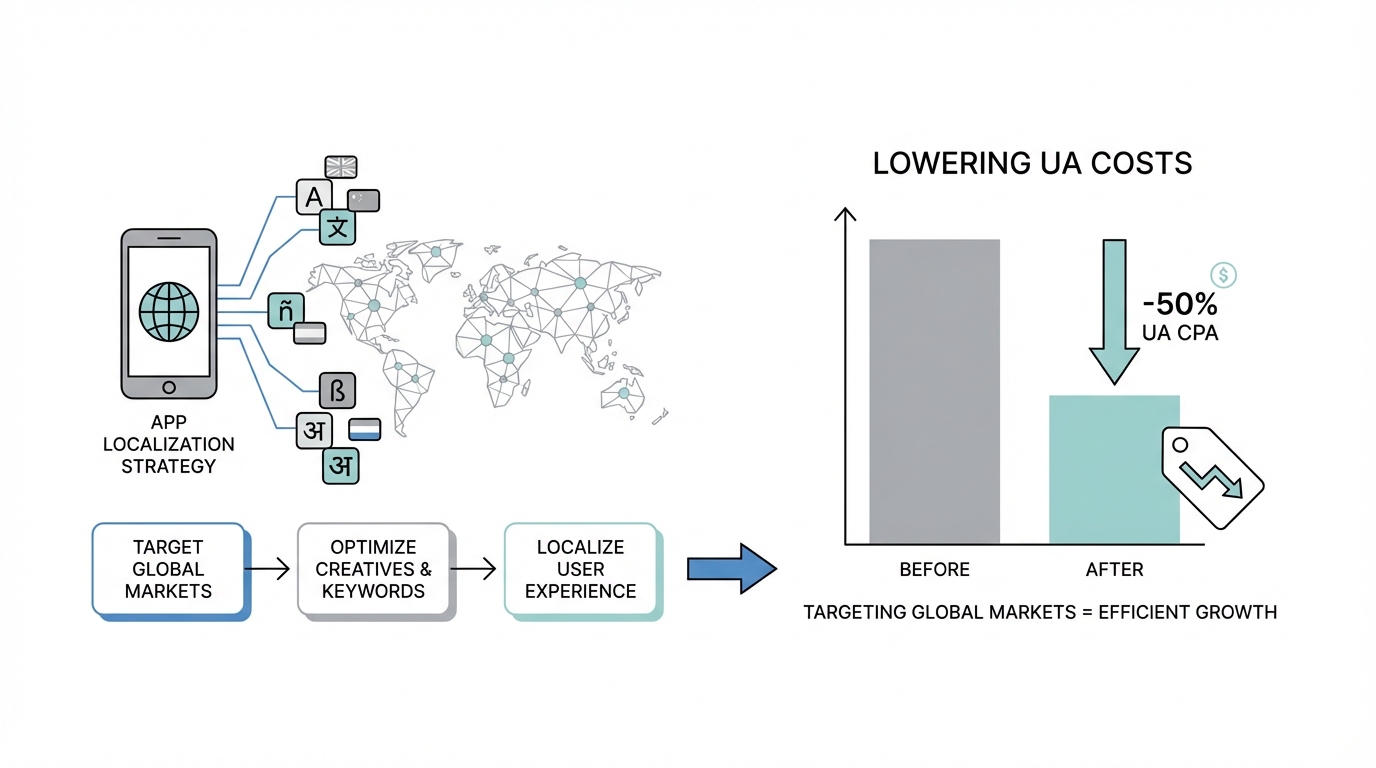
Most mobile app developers and founders fall into a common trap: they focus their entire user acquisition (UA) budget on the United States, United Kingdom, and Australia. While these Tier-1 markets offer high lifetime values (LTV), they are also incredibly crowded and expensive. When competition is fierce, the cost-per-click sky-rockets, often making it impossible for bootstrapped startups to achieve a positive return on ad spend. However, a shift in focus toward an app localization strategy can unlock massive growth in untapped regions. By targeting Spanish-speaking markets in South America, for example, developers are finding they can acquire users at a fraction of the cost, achieving global mobile growth without the need for a multi-million dollar venture capital injection.
The Financial Advantage of Global Markets vs. Tier-1 Regions
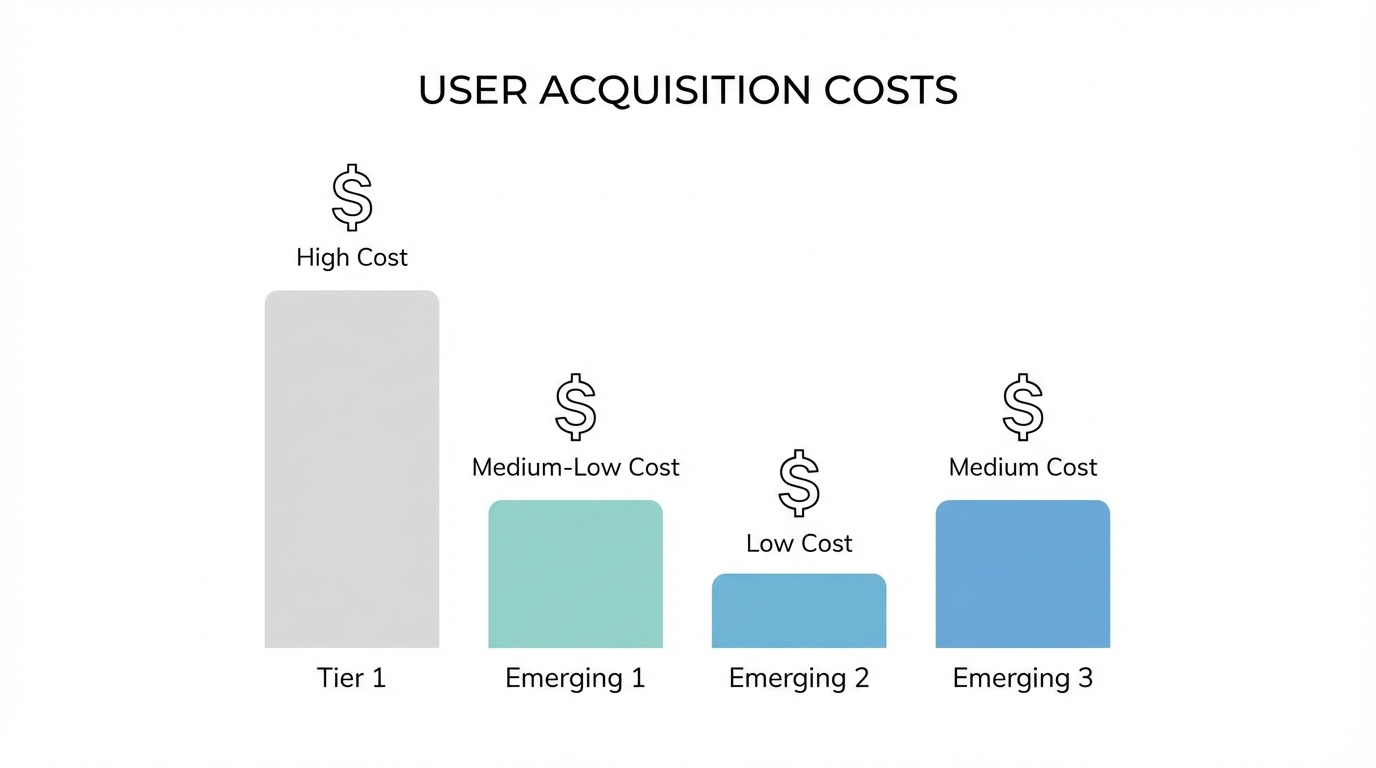
The math behind low cost user acquisition is simple but powerful. In the US market, a single app install can cost anywhere from $2.00 to over $10.00 depending on the niche. In contrast, emerging markets like South America offer a significantly lower barrier to entry. Julian, the co-founder of the AI fitness app Gravel, discovered this firsthand. After building a successful MVP, his team realized that international app marketing was the key to scaling sustainably. By translating their app into Spanish and shifting their focus to South American ad markets, they were able to run hyper-efficient campaigns with a daily budget as low as $50.
This approach isn't just about saving money; it's about volume. When you are spending less than $50 a day on Meta Ads Manager and still seeing a steady stream of subscriptions, your ability to test and iterate increases exponentially. Platforms like Stormy AI help developers identify the right regions and creators to target, ensuring that even a small budget yields high-quality data. In Julian's case, this strategy helped scale Gravel to over 70,000 subscribers and a staggering $440,000 in monthly revenue. The takeaway is clear: the US isn't the only place where users are willing to pay for value, but it is often the most expensive place to find them.
Step-by-Step: Localizing Your App for Spanish-Speaking Audiences
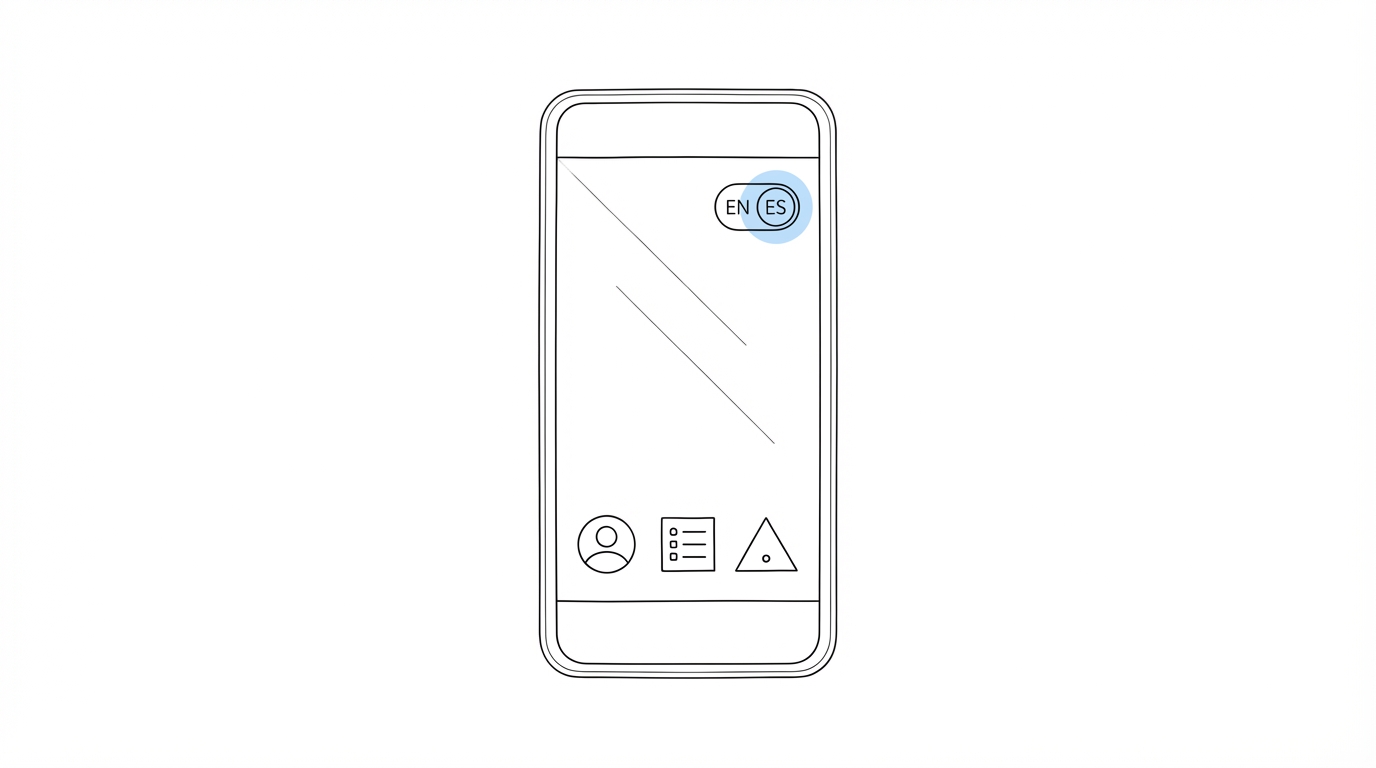
Effective international app marketing goes beyond a simple Google Translate job. To truly resonate with a new demographic, you must consider the cultural nuances of your target region. If you are targeting South America, your app localization strategy must include a deep dive into the local terminology and user expectations. For fitness apps, this might mean adjusting weight measurements or referencing local gym cultures. Julian and his team leveraged their native Spanish-speaking background to ensure the app felt local, even though it was being managed from Australia.
Step 1: Audit Your Current UI/UX
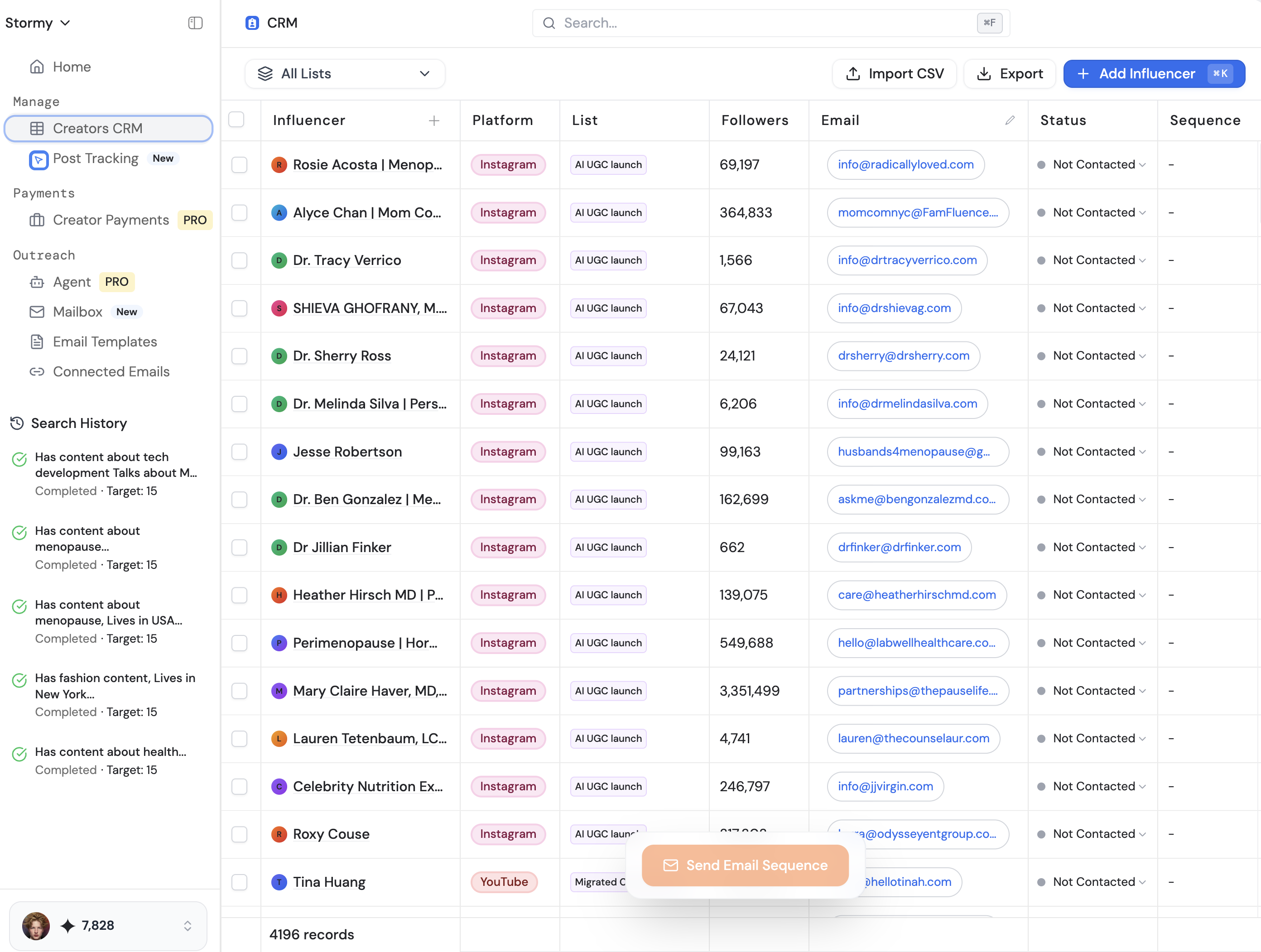
Before writing a single line of translated code, identify every touchpoint where language and culture intersect. This includes your onboarding flow, paywalls, and push notifications. Using tools like Stormy AI can help you organize these localized creator relationships through a centralized CRM and identify opportunities for AI-driven localization across your marketing channels.
Step 2: Implement a Scalable Translation Workflow
Avoid hard-coding strings into your application. Instead, use localization files that can be easily updated by native speakers. Julian's team utilized a tech stack featuring React Native and Expo, which allowed them to push updates and language fixes quickly. If you're managing subscriptions, ensure your backend, perhaps using RevenueCat, is configured to handle different currencies and regional pricing strategies effectively.
Step 3: Cultural Nuance and Tone
Spanish spoken in Spain is different from Spanish spoken in Argentina or Mexico. If you want to achieve global mobile growth, you need to decide whether to use a neutral Spanish or tailor the copy to a specific country. For Gravel, a focus on the broader South American market meant keeping the tone accessible and professional, ensuring the AI-driven workout suggestions felt personal and safe for users regardless of their specific dialect.
The Playbook for Running Ads on $50/Day

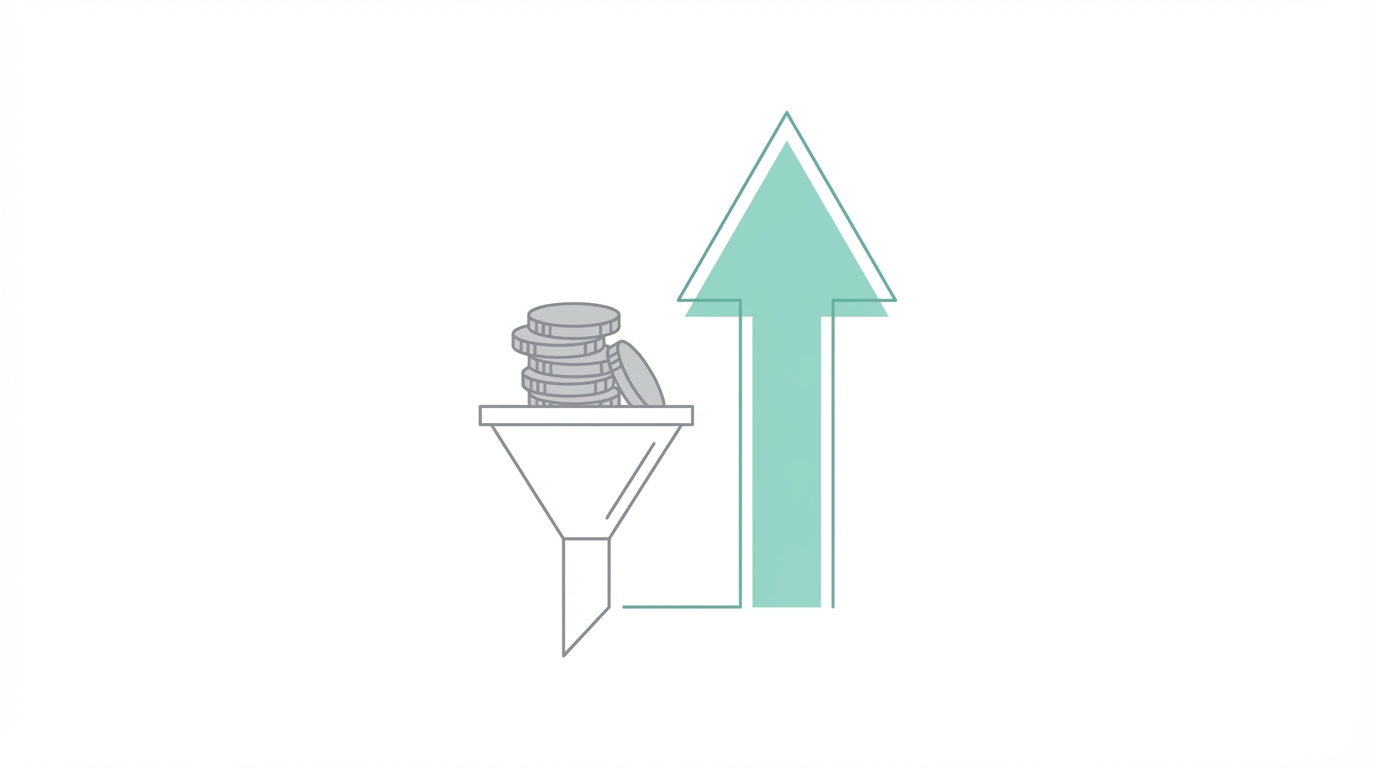
One of the most impressive aspects of the Gravel story is their ability to scale while maintaining a lean ad spend in the early days. Achieving low cost user acquisition requires a disciplined approach to testing and a willingness to move fast. Instead of pouring thousands into unproven creatives, start with small, highly targeted tests in emerging markets. This allows you to gather data on click-through rates (CTR) and conversion rates without blowing your entire budget in 24 hours.
A key tactic for this app localization strategy is the use of the Meta Ads Library. By analyzing what competitors are doing in specific regions, you can identify winning creative patterns. Julian suggests that "copying what works" is a valid starting point for any founder. Look at the hooks, the captions, and the call-to-action buttons that successful apps are using in your target market. You don't need to reinvent the wheel; you just need to make it more relevant to your specific audience.
To maximize a $50/day budget, focus on User-Generated Content (UGC). Modern consumers are increasingly immune to highly polished, studio-produced commercials. They want to see real people using your app in real-world scenarios. For mobile apps, this often means vertical video content that looks like a native TikTok or Instagram Reel. You can discover talented creators who specialize in specific regional content through Stormy AI. Stormy AI is an AI-powered search engine that allows you to find creators across TikTok, YouTube, and Instagram using natural language prompts, simplifying the process of finding and managing influencers for UGC-heavy campaigns.
Balancing Global Reach with 24/7 Human-Led Support
As you expand your international app marketing efforts, the complexity of customer support increases. Scaling to $440k a month brings a high volume of inquiries, bug reports, and feature requests. While many companies look to automate everything with AI, Julian found that human-led support was a massive differentiator. Gravel offers a 24/7 support chat inside the app where users talk to real people, not bots. This builds immense brand loyalty and reduces churn, especially in markets where users might be skeptical of new technology.
Implementing this requires a distributed team. As Gravel grew to 13-14 employees, they prioritized support staff who could communicate fluently in the languages of their largest markets. By providing actual human interaction, they were able to guide users through the AI fitness features and ensure they were getting the most value out of their subscriptions. This level of care is often what separates a viral flash-in-the-pan app from a sustainable, multi-million dollar business.
Measuring the ROI of International Expansion
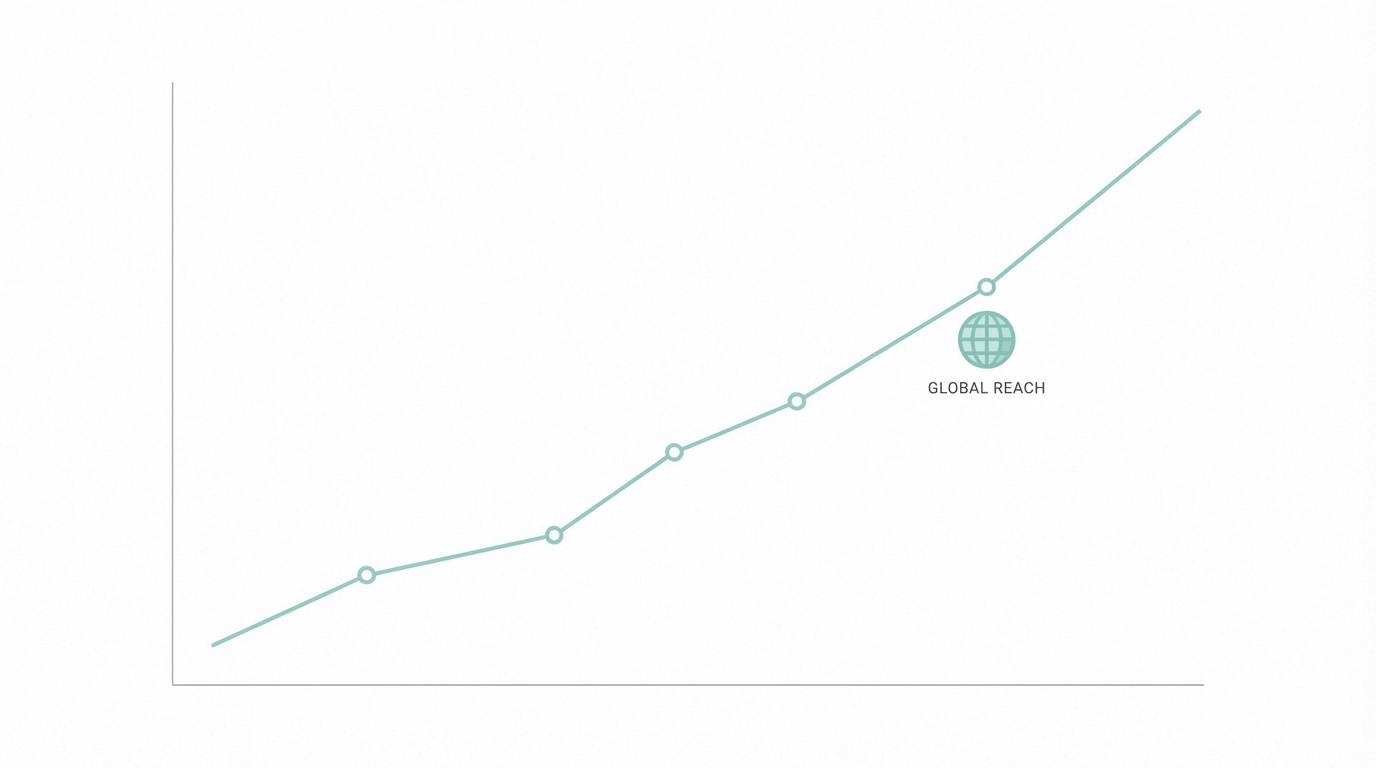
How do you know if your app localization strategy is actually working? For subscription-based mobile apps, the most important metrics are Cost Per Install (CPI), Return on Ad Spend (ROAS), and Customer Lifetime Value (LTV). In Julian's model, roughly one-third of their revenue is reinvested back into paid acquisition across platforms like Google Ads and Apple Search Ads. This aggressive reinvestment is only possible because they have validated their product-market fit in lower-cost regions first.
When measuring ROI, don't forget the platform costs. In addition to ad spend, you can use Stormy AI to track the performance of your creator campaigns, monitoring views and engagement across all posts to ensure your localization efforts are hitting the mark. Apple and Google typically take a 15% to 30% cut of all revenue. Additionally, tools like RevenueCat take a small percentage (around 1%) to manage the infrastructure. Julian's transparency regarding these numbers—sharing that their infrastructure and AI bills cost around $1,000 a month—provides a realistic blueprint for other developers.
Conclusion: The Localization Advantage
Scaling a mobile app in 2025 requires more than just a great product; it requires a strategic approach to global mobile growth. By embracing an app localization strategy and targeting regions like South America, you can escape the high-cost trap of the US market. Start small with a $50/day budget, focus on high-quality UGC from creators found on Stormy AI, and prioritize human-led support to build long-term retention. As Julian's story with Gravel proves, the path to $400k+ per month is paved with smart experiments and a willingness to look beyond your own borders. Validating your product in emerging markets isn't just a cost-saving measure—it's a competitive advantage that can fuel your brand's journey to becoming a global leader.