In the early days of the App Store, ranking for a high-volume keyword was often as simple as placing it in your title and hoping for the best. Fast forward to 2025, and the landscape has undergone a seismic shift. With over 7.5 million apps competing for attention, the algorithms at Apple and Google have evolved beyond mere metadata matching. Today, your app's visibility is inextricably linked to how users behave *after* they hit the download button. We are entering the era of App Experience Optimization (AXO), where retention, stability, and conversion are no longer just product metrics—they are the most powerful app store ranking factors in your arsenal.
The Shift from Acquisition to App Experience Optimization (AXO)
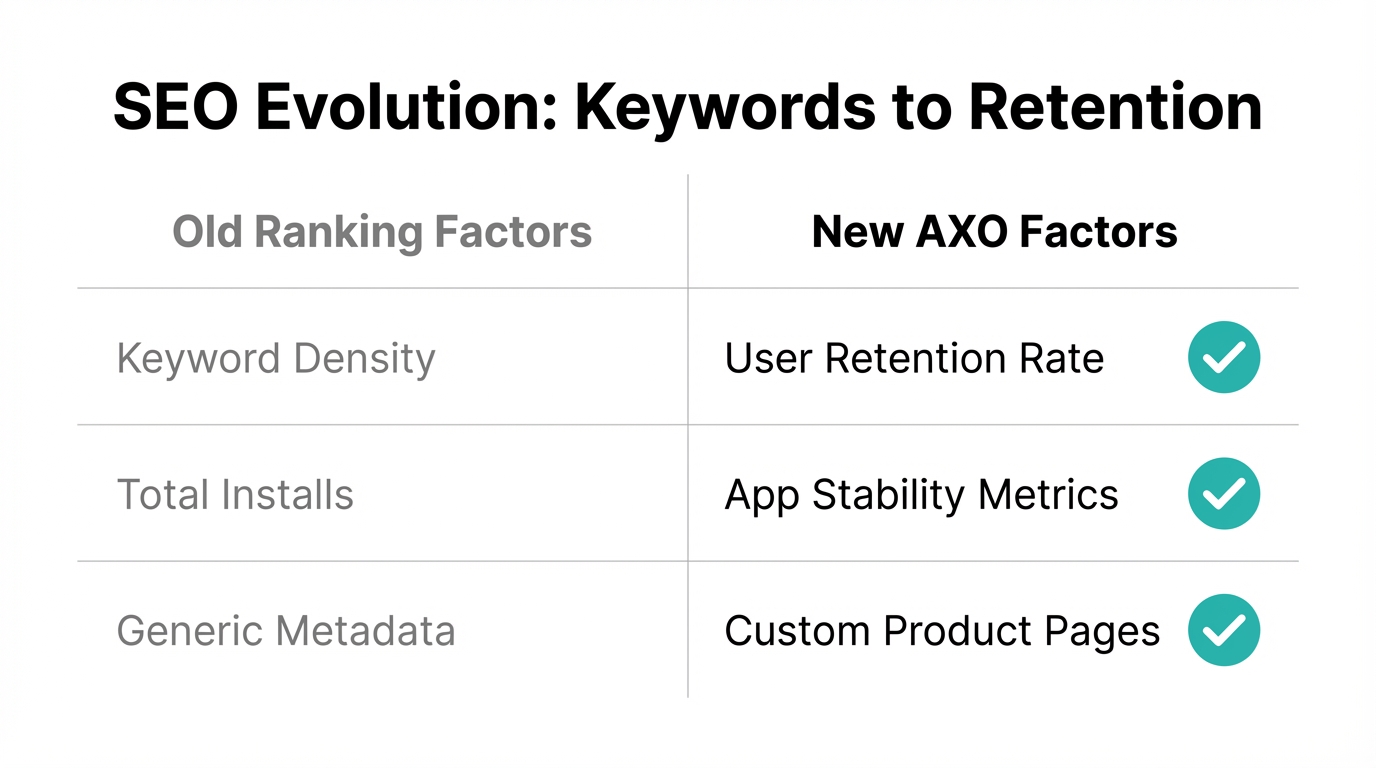
For years, mobile marketers treated App Store Optimization (ASO) as a front-end funnel activity. However, data from Business of Apps reveals that the App Store ecosystem is projected to generate $138 billion in 2025, and the algorithms are now tuned to surface the highest-quality experiences to capture that revenue. The search engines have effectively become "relevance engines," prioritizing apps that demonstrate long-term value over those that simply win the click.
According to research from AppTweak, 70% of all queries in the App Store are now branded, meaning users are looking for specific solutions or names they already trust. To capture the remaining 30% of generic search traffic, your app must prove it can satisfy the user's intent. This is where AXO marketing takes center stage: it is the practice of aligning every touchpoint of the user journey—from the first search impression to the 30-day retention mark—to signal quality to the algorithm.
Why 'App Quality' Now Dictates Keyword Positions
Modern algorithms use App Quality as a proxy for relevance. If your app ranks #1 for "fitness tracker" but suffers from a high crash rate, the App Store will quickly demote you in favor of a more stable competitor. This is because every failed session is a lost opportunity for the platform to monetize that user. Experts at App Radar have noted that search bots even use Optical Character Recognition (OCR) to "read" text inside your screenshots to ensure your visual promises match your technical performance.
Specifically, growth managers should monitor two critical thresholds: 7-day retention and conversion rate (CVR). As of 2024, the average CVR for the US App Store sits at 25%, according to data from SplitMetrics. If your conversion rate significantly lags behind this benchmark, the algorithm interprets your app as a poor match for the keywords you're targeting, leading to a steady decay in keyword velocity.
"The future of ASO isn't about gaming the system; it's about 'Relevance Engineering'—where your ranking is a direct reflection of your app's technical health and user satisfaction."
Building a 'Habit Loop' to Prevent Ranking Velocity Stalls
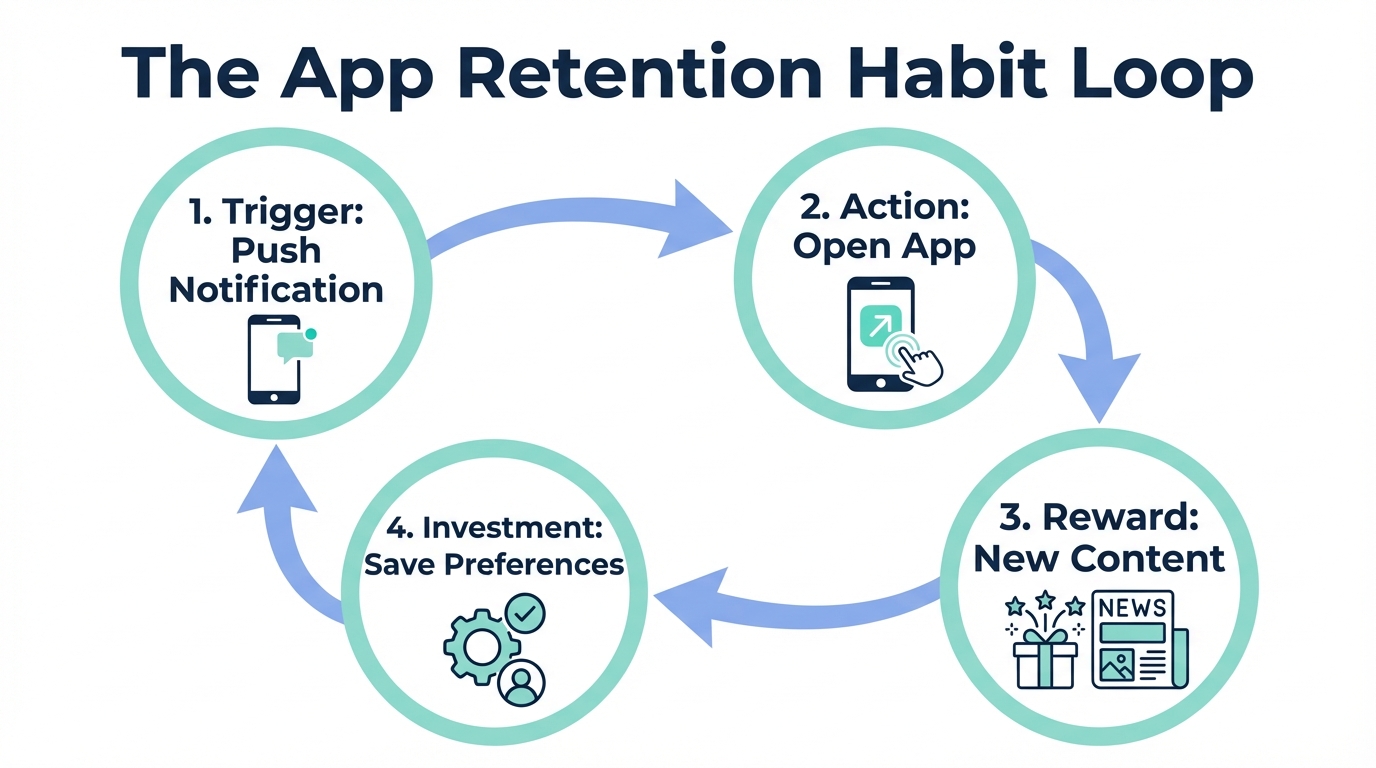
Ranking velocity is the speed at which your app gains (or loses) downloads over a specific period. Many apps experience a "launch spike" followed by a catastrophic drop because they fail to build a habit loop. If a user downloads your app and deletes it within 24 hours, it sends a negative signal to the store. To maintain your app retention strategy, you must facilitate an immediate "Aha!" moment.
Successful apps like iSharing have demonstrated that frequent metadata updates—often every 2-4 weeks—can help maintain this momentum. By using tools like AppTweak to identify trending niches, they jumped from rank #160 to #92 in their category. However, the metadata only gets them in the door; the habit loop keeps them there. To prevent a velocity stall, your AXO strategy should focus on reducing friction in the onboarding process and using push notifications to drive users back into the app within the first 48 hours.
| Metric Type | Traditional ASO Focus | Modern AXO Focus |
|---|---|---|
| Primary Goal | Keyword Placement | User Lifetime Value (LTV) |
| Success Signal | Click-Through Rate (CTR) | 7-Day Retention Rate |
| Visual Assets | Generic Screenshots | Custom Product Pages (CPPs) |
| Tech Health | Ignored | Crash Rate & ANRs |
Using Custom Product Pages (CPPs) to Align Intent with Experience
One of the most effective ways to boost your app store conversion rate optimization is through the use of Custom Product Pages (CPPs). CPPs allow you to create up to 35 different versions of your App Store listing, each tailored to a specific audience or keyword set. For example, the app CoinSwitch achieved a 400% conversion rate boost by aligning their CPPs with specific high-ranking search terms.
When you align a high-intent keyword with a specific landing experience, you reduce the cognitive load on the user. If someone searches for "budgeting for students," and your screenshots specifically highlight a "student discount tracker," the likelihood of a download—and subsequent retention—skyrockets. This synergy is a core pillar of AXO. As you scale your reach through tools like Stormy AI to discover creators who can drive targeted traffic to these custom pages, the data signals to the App Store that your app is the definitive answer to that specific query.
Breaking the '4.0-Star Ranking Ceiling'
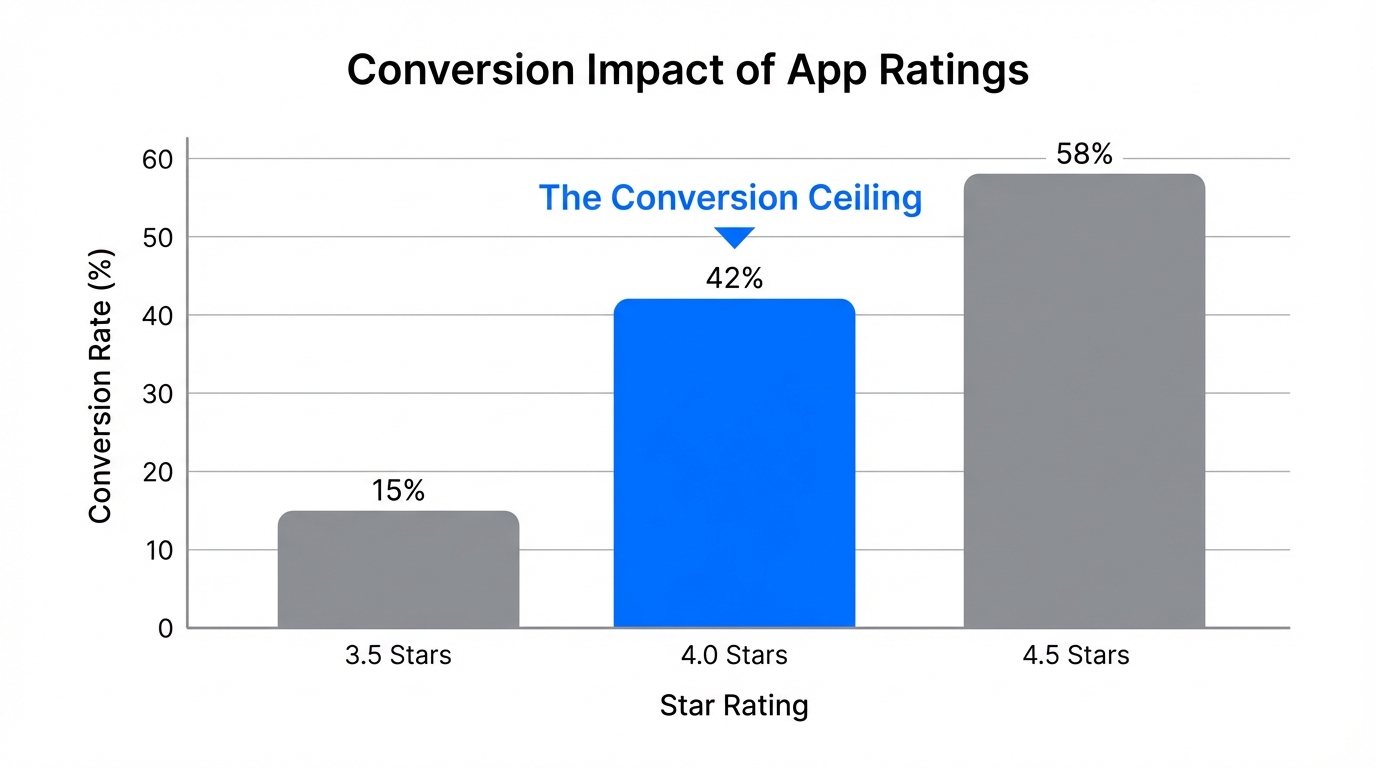
Ratings and reviews are no longer just social proof; they are a hard barrier to entry. Research suggests that ratings below 4.0 stars act as a "ranking ceiling." No matter how optimized your keywords are, if your sentiment score is low, the algorithm will cap your visibility. Users are 80% more likely to trust an organic search result if it has a 4.5-star rating or higher.
To manage this, implement an app experience optimization workflow that includes sentiment analysis. Tools like AppFollow allow you to track review trends and respond to bugs before they tank your average. Remember, localization also plays a role here. Apps that "culturalize" their content for markets like Japan or Germany see a 48% increase in installs. Ignoring regional feedback is a fast track to a poor rating in international markets.
"You cannot optimize a bad product. A 3.8-star rating is a leak in your marketing bucket that no amount of ad spend can fill."
The AXO Growth Playbook: Step-by-Step
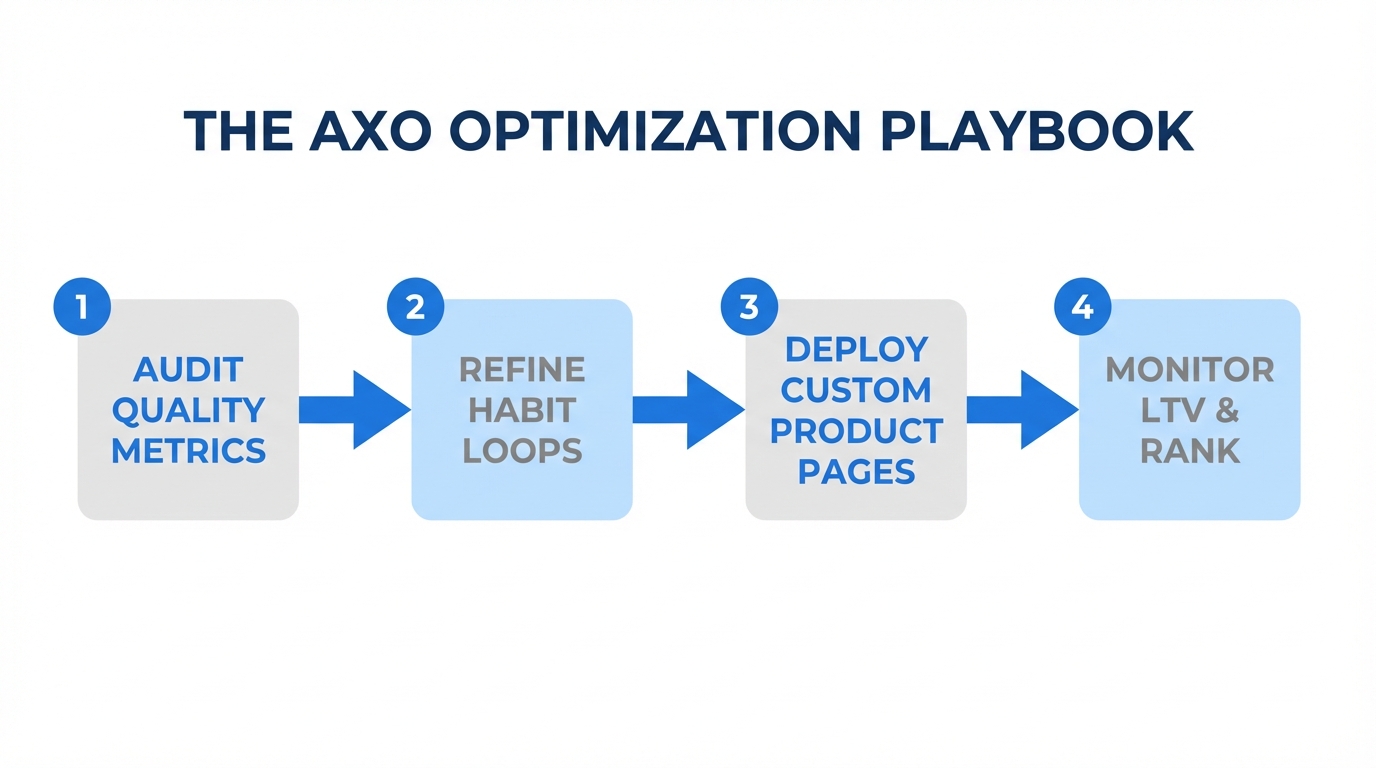
To dominate the 2025-2026 ranking landscape, follow this structured hierarchy of influence:
Step 1: Technical Foundation
Before touching a single keyword, ensure your crash rate is below 1%. Use Mobile Action to benchmark your technical performance against category leaders. High stability is the prerequisite for high ranking.
Step 2: Metadata Hierarchy
Your App Name carries the most weight. Place your highest-priority keyword within the first 25 characters. Use the 30-character Subtitle for secondary keywords and your Unique Selling Proposition (USP). On iOS, never repeat keywords across the title, subtitle, and keyword field—it's a waste of limited space.
Step 3: Conversion Alignment (CPPs)
Create dedicated Custom Product Pages for your top 5-10 high-volume keywords. Ensure the visual narrative on the page matches the search intent of the user. This is where AXO marketing bridges the gap between discovery and retention.
Step 4: Sentiment & Retention Loop
Monitor your 7-day retention rates. If users are dropping off, analyze your onboarding flow. Use ASOMobile to find regional slang and local search habits to ensure your app feels native to every user, further boosting your app retention strategy.
Looking Ahead: The 'Clickless' Future of ASO
By 2026, experts at Moz and Search Engine Land predict that "ranking #1" will change as AI assistants provide direct answers to voice queries. Success will be defined by being cited by the AI as the best solution. This makes AXO even more critical: AI models will recommend apps based on user sentiment, historical stability, and high retention rates.
Ultimately, App Experience Optimization is about building a product that the App Store *wants* to promote because it makes the platform look good. By connecting your keyword strategy directly to user retention and app quality, you create a self-reinforcing loop of growth that survives algorithm updates and outpaces the competition. App store ranking factors are no longer a mystery—they are a measurement of how much your users love your app.