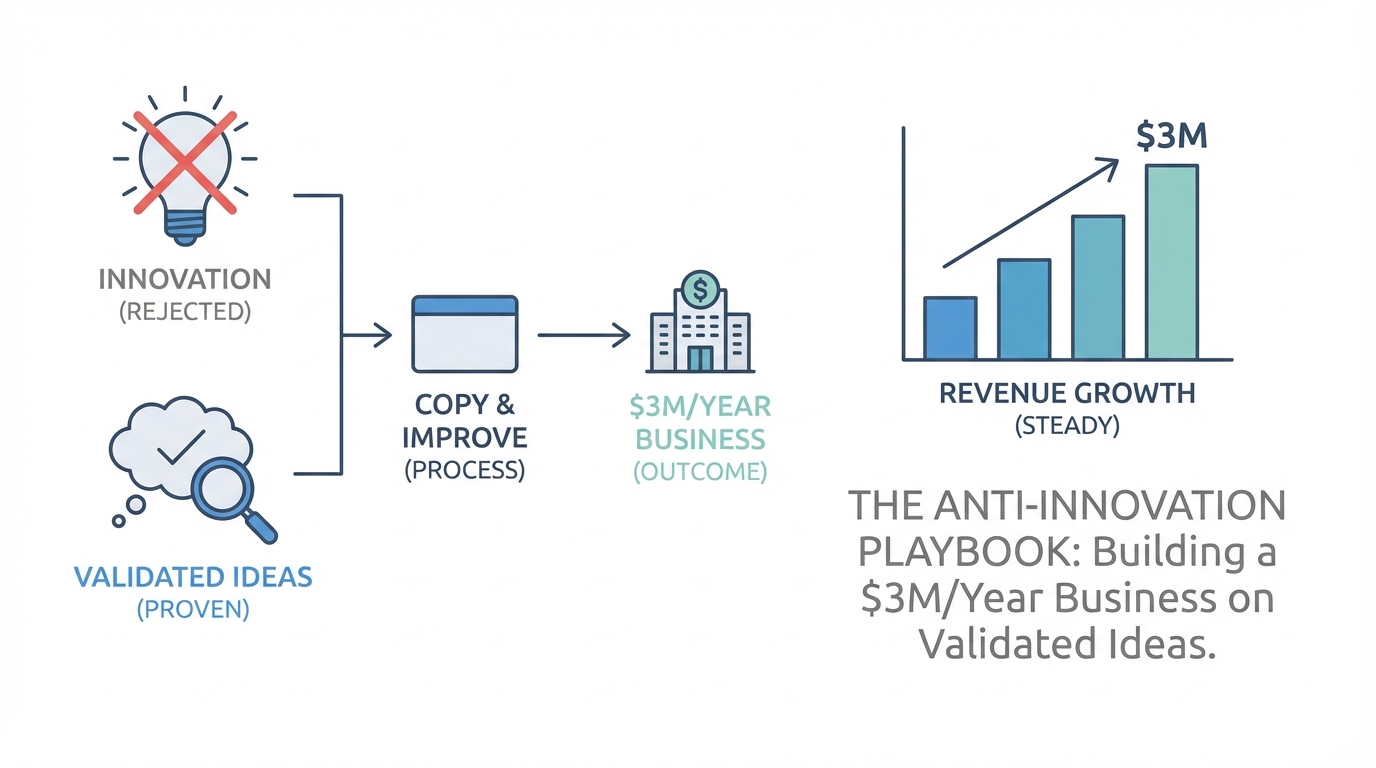
In the tech world, we are conditioned to believe that the only path to massive success is through radical innovation—the kind of world-changing 'first-of-its-kind' idea that disrupts industries. But for many founders, this pursuit of novelty is a trap. Anton, the founder behind the transcription sensation Letterly, spent 15 years building failed startups because he was obsessed with creating things that didn't exist yet. It wasn't until he pivoted to the 'Anti-Innovation' approach—taking a proven, validated market and simply making the user experience better—that he scaled to $250,000 in monthly recurring revenue. This article breaks down how you can stop chasing unicorns and start building a high-margin business based on AI startup validation and market gaps.
The Novelty Trap: Why Unique Isn't Always Better
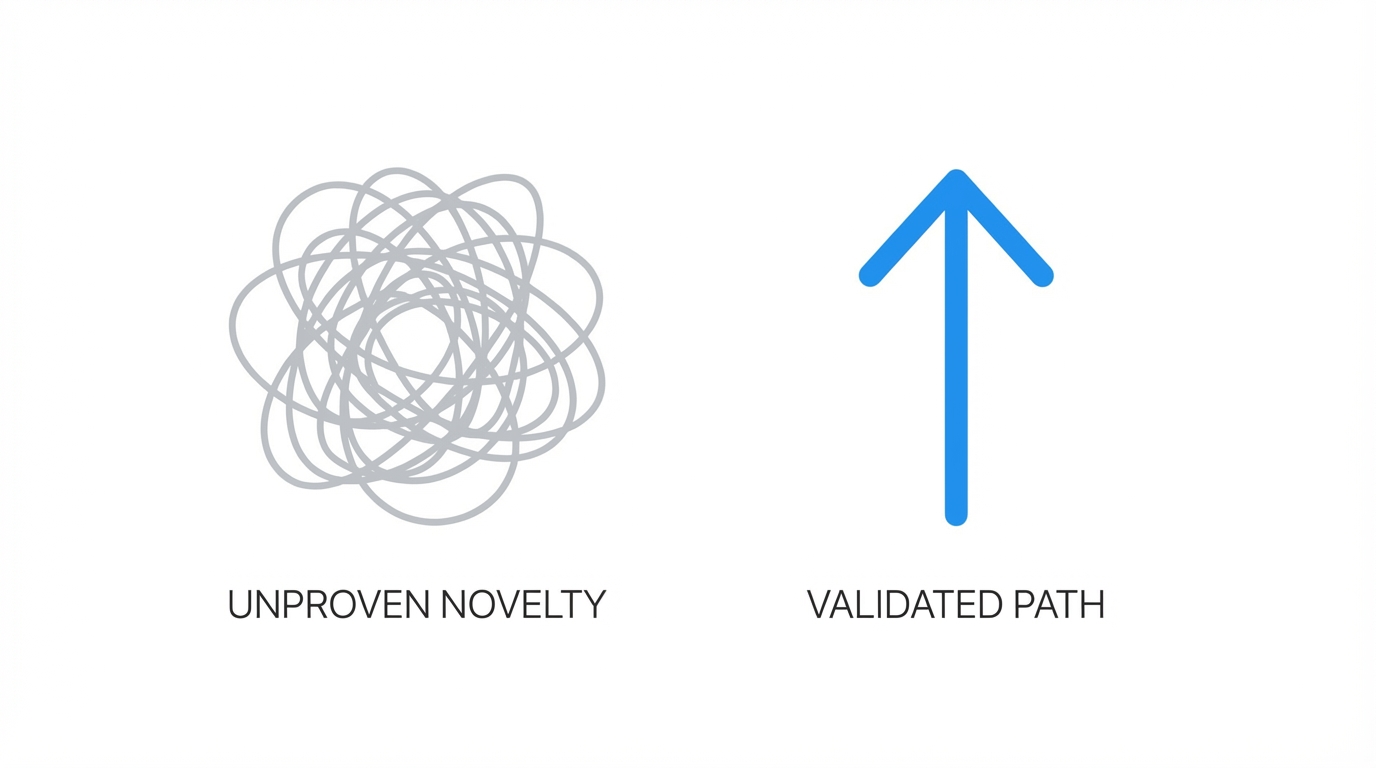
Most entrepreneurs feel a strange pressure to invent a new category. We look at companies like OpenAI and think we need to build the next LLM. However, Anton’s journey through six or seven failed ventures proves that novelty often leads to building things people don't actually need. When you build something entirely new, you have to educate the market, prove the value proposition, and create a habit from scratch.
By contrast, when you enter a validated business model, the hard work of market education is already done. People already know they need transcription; they already know they need better notes. The hurdle isn't convincing them the technology is useful; it's convincing them that your version of the technology is the most seamless part of their day. According to insights from Starter Story, the most successful profitable AI apps often focus on 'polishing' existing workflows rather than inventing new ones.
Analyzing the Letterly Model: $250k Per Month
Letterly is a masterclass in micro-SaaS growth strategy. The app's core function is simple: it turns speech into well-written text. On the surface, this seems like a crowded market. You can do this for free with built-in phone tools or even ChatGPT. Yet, Letterly boasts 20,000 paid subscribers and 30,000 monthly active users. Why?
The answer lies in simplicity and the elimination of friction. Every point of friction in a user's journey is a potential exit point. If a user has to open an app, find a prompt field, paste text, and ask for a summary, you've lost them. Letterly focuses on one-click recording and instant output. This focus on UX as a primary feature is what allows them to command a premium in a market where 'free' alternatives are everywhere. When you're looking for a SaaS business model, don't ask 'What can I build that's new?' Ask 'What can I build that's 10x easier to use?'
The Playbook Step 1: Market Gap Analysis on Existing Tools


To find your $3M/year idea, you need to look at the giants and find where they are 'heavy.' Platforms like ChatGPT are incredibly powerful, but they are generalists. They are the 'Swiss Army Knife' of the digital world. A Swiss Army Knife is great, but if you need to cut down a tree, you want a specialized axe.
Perform a gap analysis by looking at reviews for popular apps. Users often complain about clunky interfaces, too many features, or slow load times. These complaints are your roadmap. If you can build a 'light' version of a heavy tool that does one specific thing perfectly, you've found a market validation for apps. Platforms like Stormy AI are excellent for this stage, helping you find UGC creators and influencers via an AI search engine who are already talking about these pain points in their content, giving you raw, qualitative data on what users are actually frustrated with.
The Playbook Step 2: Simplicity as a Feature
Anton argues that simplicity is quite expensive. It requires thousands of hours of iteration. Most founders make the mistake of thinking that adding more features increases value. In reality, every feature you add is a potential complication. If you are building for the mobile app market, especially for users who need quick solutions on the go, user experience is your competitive advantage.
At Letterly, they iterate at three distinct levels:
- Prototypes: Drawing and discussing until the flow is logical.
- Build Phase: Constantly stopping to ask if the dream of simplicity is being maintained.
- Post-Release: Using feedback to ruthlessly prune features that confuse users.
The Playbook Step 3: The Financial Blueprint


Managing a profitable AI app requires a lean but effective team. Anton operates with a team of 10 people, maintaining a $30,000 monthly overhead for salaries. This may seem high for a 'micro-SaaS,' but it allows for the high-velocity iteration required to stay ahead of competitors. When you add in AI API costs—which for Letterly hover around $5,000 a month—the margins remain healthy, provided your growth is managed correctly.
The real eye-opener in the Letterly model is the advertising spend. They reinvest $200,000 a month into advertising. This aggressive scaling is only possible because the unit economics are validated. They aren't spending to 'find' a market; they are spending to capture a market they already know exists. For app developers looking to scale, leveraging Stormy AI, an all-in-one AI-powered platform for creator discovery and automated outreach, especially for mobile app marketing and UGC campaigns, can significantly lower the cost-per-install compared to generic creative assets.
The Playbook Step 4: Monetize from Day One
One of the biggest mistakes in the 'Silicon Valley' mindset is deferring monetization in favor of user growth. Anton’s advice is clear: build something that generates money from day one. Revenue is the ultimate form of market validation. If users aren't willing to pay for your 'simpler' version of a free tool, then your version isn't simple enough or the pain point isn't sharp enough.
Letterly uses a free trial model that converts into a paid subscription. This creates a predictable cash flow that can be reinvested into app store optimization (ASO) and performance marketing. By charging immediately, you also filter for high-quality users who provide better feedback. You can also monitor the performance of your creator-led marketing efforts using Stormy AI for post tracking and analytics to ensure your ROI remains high.
The Playbook Step 4: Choosing the Right Tech Stack
Efficiency in development is key to maintaining a 1-2 month launch window. Letterly originally started with React Native, a popular choice for cross-platform development. However, to achieve the level of seamless UX and speed they desired, they eventually transitioned to native Swift for Apple devices. This allowed them to leverage device-specific features like widgets and real-time transcribing more effectively.
The backend remains robust and flexible, powered by Python. This combination of a high-performance native frontend and a flexible backend allows them to integrate new AI capabilities from providers like OpenAI quickly. When building your SaaS business model, choose a stack that doesn't just work for 'now,' but allows you to polish the user experience to a mirror finish later. To manage the relationships that drive your growth, you can use the built-in creator CRM within Stormy AI to keep all your collaboration history in one place.
The Playbook Step 6: The Safe Exit Strategy
The 'burn the ships' mentality is popular in entrepreneurship, but it's often reckless. Anton suggests a more measured approach: leave your job only after hitting revenue milestones. Because the 'Anti-Innovation' playbook relies on validated ideas, you should be able to see traction early. If you can't generate revenue while working a side-hustle, you likely haven't found the right gap yet.
Once you see consistent growth and have a clear micro-SaaS growth strategy, that is the time to focus 100%. This reduces the 'desperation' factor, allowing you to make better product decisions based on long-term simplicity rather than short-term survival. Using tools like Google Ads and Apple Search Ads can help you test these waters with a small budget before you make the full leap.
Conclusion: The Power of the Polished Path
Building a $3M/year business doesn't require you to be a visionary genius who sees a future no one else can. It requires you to be a diligent observer of the present. By finding validated ideas that are currently 'good enough' and making them exceptional through simplicity, you create a moat that is very hard for giants to cross. Giants are too big to be simple; they have too many stakeholders to satisfy.
As you move forward, remember Anton’s core pillars: work with co-founders, launch fast, use validated models, and monetize immediately. If you're ready to start your own journey, keep an eye out for deals and education on platforms like Starter Story. The path to a successful AI startup isn't paved with 'new' ideas—it's paved with the better execution of old ones. Stop looking for the next big thing and start looking for the next thing you can make 10x easier for the person using it today.