In 2026, the battle for the Amazon buy box isn't won with just price or Prime shipping; it's won with trust. As Amazon's AI shopping assistant, Rufus, increasingly prioritizes specific use cases and technical feedback in its summaries, the quality of your product reviews has become more important than the quantity. For DTC founders, the decision often boils down to two paths: the internal Amazon Vine program or third-party User-Generated Content (UGC) platforms like Billo or Stack Influence. While both aim to bridge the social proof gap, their impact on your bottom line, tax liability, and long-term marketing rights could not be more different. Managing these moving parts manually is a recipe for burnout, which is why brands are increasingly delegating these audits to an AI ecommerce employee like Stormy AI to monitor enrollment status and follow up with creators in the background.
The Badge Battle: Vine Voice vs. Verified Purchase
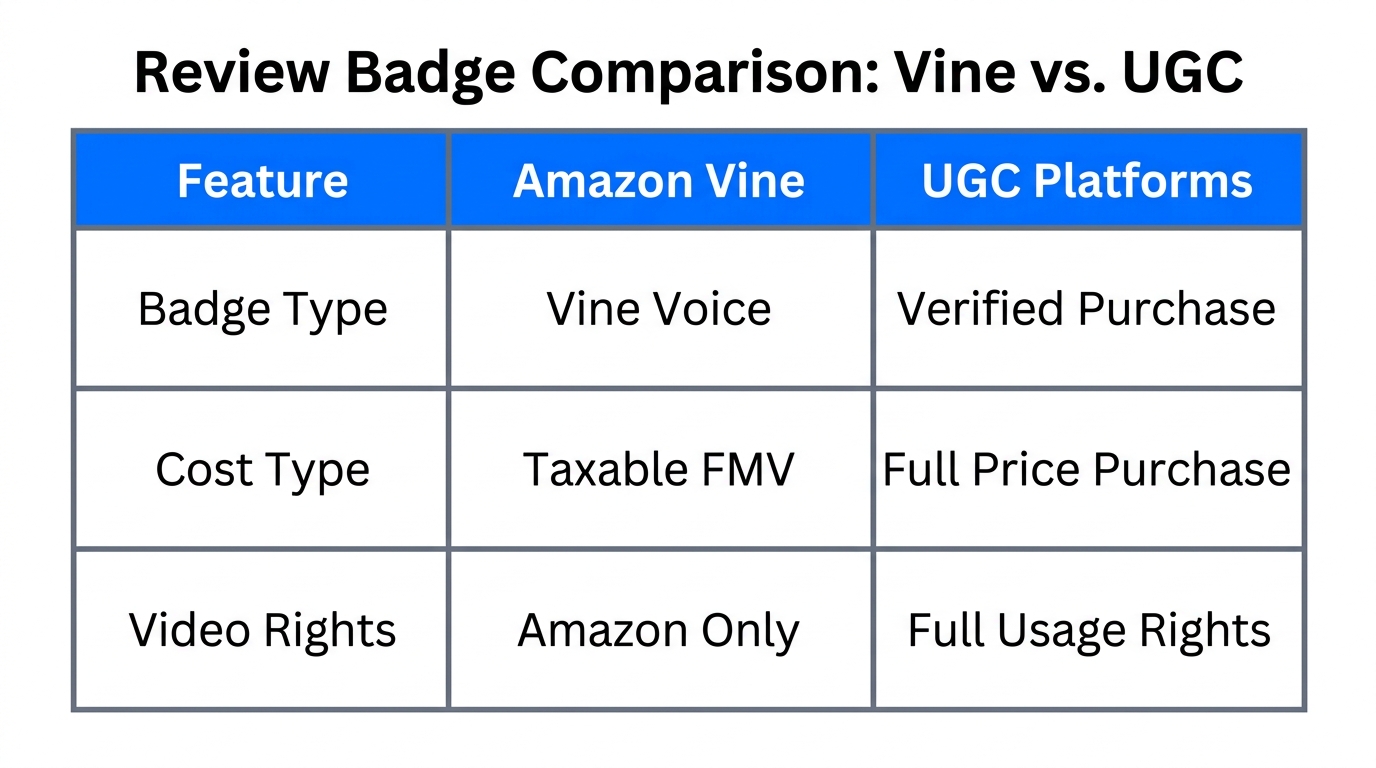
The first thing a shopper sees is the badge. Amazon Vine reviews carry the distinct green "Vine Voice" badge, signaling to customers that the reviewer is part of an elite, invited group. In 2026, this badge acts as a double-edged sword. According to data from Titan Network, products with 15+ reviews see conversion rate improvements of 15–25%, but the "Vine Penalty" is real: Vine reviews typically average 4.1 stars compared to the 4.3 stars found in organic reviews.
On the other side, UGC platforms focus on generating the "Verified Purchase" badge. Because these platforms usually involve a reimbursement or a "gifting" workflow, the reviewer actually purchases the product, making it look indistinguishable from a standard customer review. While the Vine badge offers authority, the Verified Purchase badge offers relatability. For high-ticket items where skepticism is high, the authoritative Vine Voice often wins. For lifestyle products (skincare, fashion, home decor), the organic feel of a standard verified purchase often performs better.
"In 2026, social proof isn't just about the star count; it's about the context Rufus AI extracts from those reviews to justify a purchase."
The Tax Liability Problem and the $2,000 Threshold
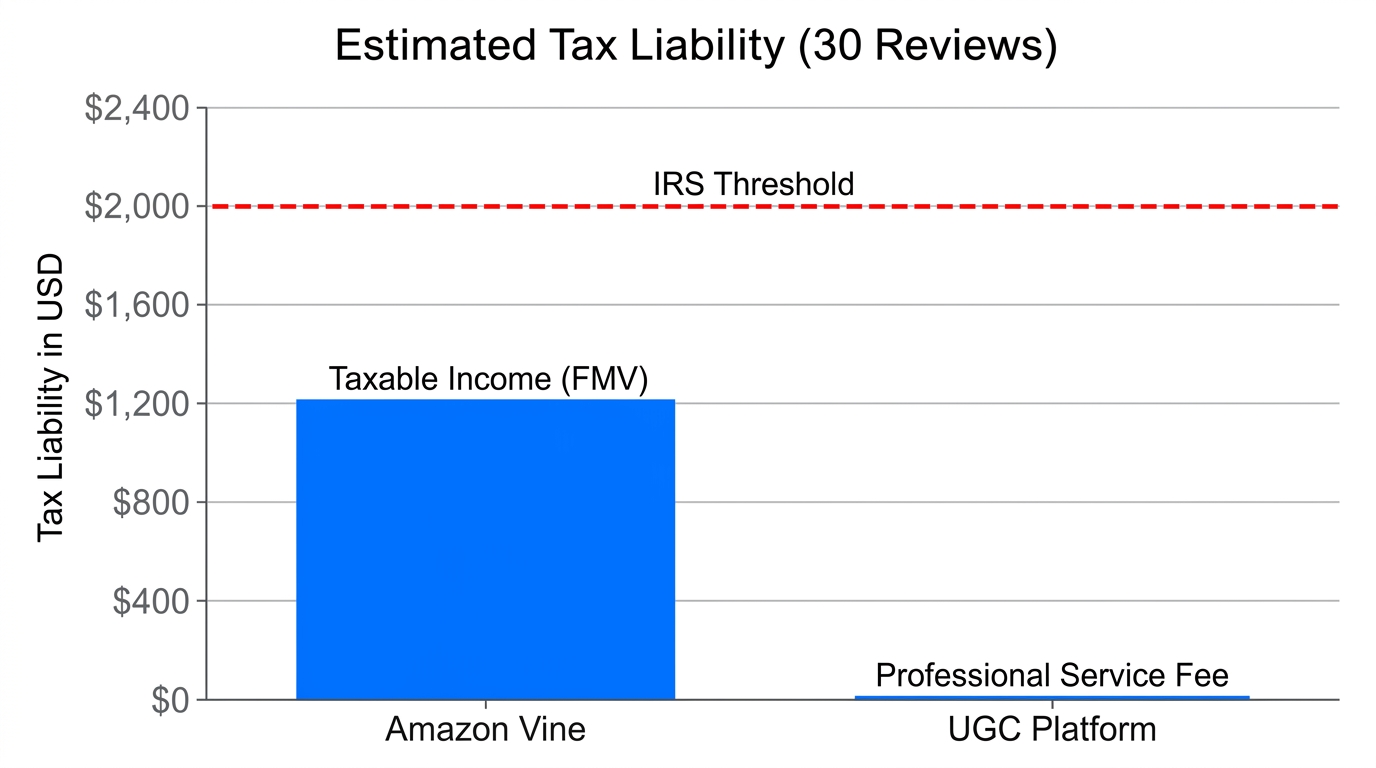
A major shift occurred in January 2026: the IRS reporting threshold for 1099-NEC forms was raised to $2,000. This has fundamentally changed the behavior of the Amazon Vine pool. Previously, reviewers were cautious of any item over $600. Now, high-value items between $600 and $1,999 are being claimed at record speeds, while items exceeding the $2,000 Fair Market Value (FMV) often sit unclaimed for weeks. This is known as the "High-ETV (Estimated Tax Value) Stall." [Source: IRS 1099-NEC Updates]
Sellers are navigating this by using Stormy AI to monitor their Amazon Vine tax calculator metrics. Stormy can flag when a high-value listing is stagnating in the Vine dashboard and suggest temporary price drops to lower the ETV, making the item more attractive to Vine Voices. This tactical pricing ensures your 30-unit enrollment doesn't result in wasted FBA storage fees.
Vine vs. Billo: Written Reviews vs. Video Rights
When you enroll in Amazon Vine, you are paying for text, photos, and occasionally video that lives exclusively on the Amazon detail page. You do not own those assets. You cannot legally download a Vine Voice video and run it as an ad on Meta Ads Manager or TikTok. This is where UGC platforms like Billo or Stack Influence provide a massive ROI advantage.
| Feature | Amazon Vine | UGC Platforms (Billo/Stack) | Stormy AI Management |
|---|---|---|---|
| Cost | $0–$200 + COGS | $39–$150 per video | Included in AI Employee fee |
| Asset Rights | Amazon Only | Brand Owned | Tracks and stores in CRM |
| Badge Type | Vine Voice | Verified Purchase | Monitors live status |
| Review Detail | Highly Technical | Lifestyle/Creative | Summarizes for Rufus AI |
If your goal is to fuel your top-of-funnel marketing, Vine is the wrong tool. Third-party platforms allow you to secure full usage rights for video content. While Vine provides the critical 15-30 reviews needed to make your Amazon Ads efficient, UGC platforms provide the creative assets that drive the traffic in the first place.
The 2026 Playbook: The "30-Review Kickstart"
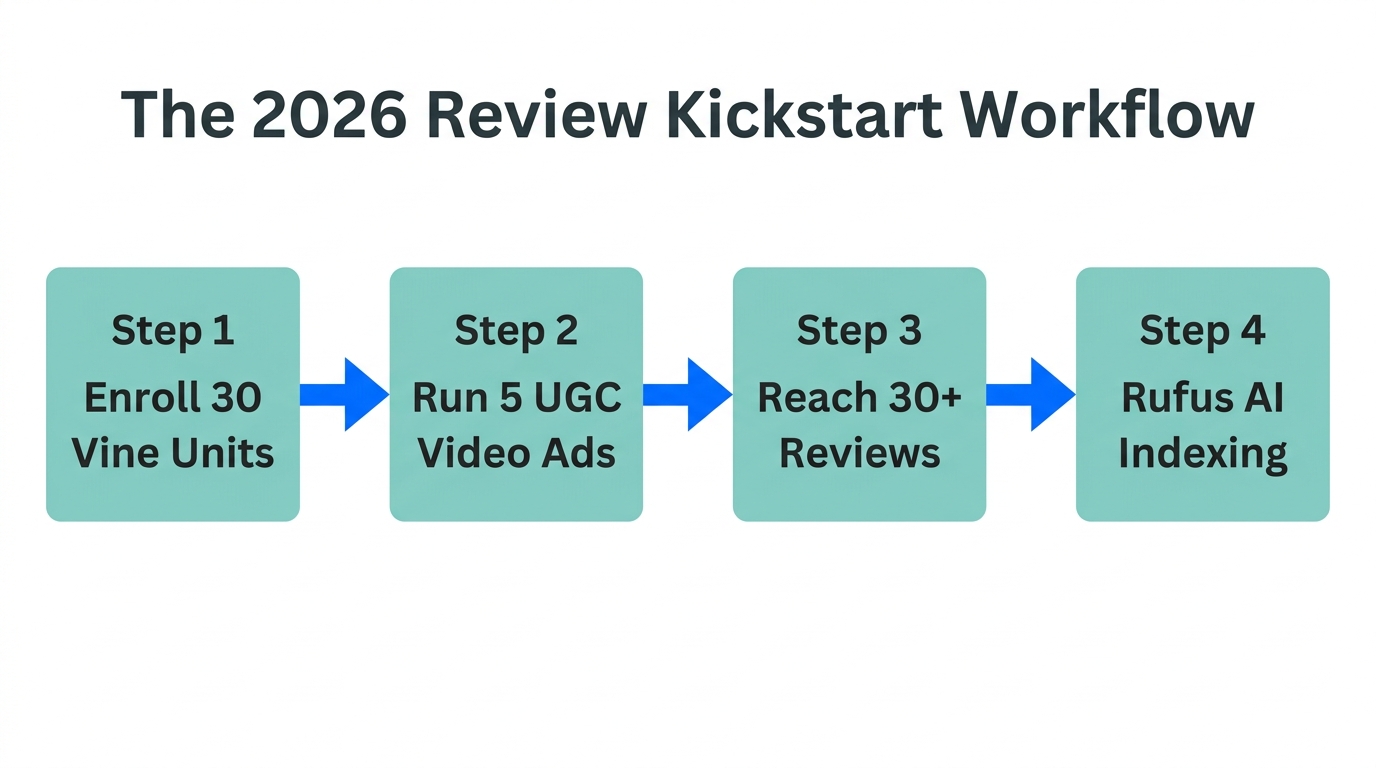
The most successful brands in 2026 don't choose between Vine and UGC; they use them sequentially. Here is the step-by-step playbook for a new product launch:
- Step 1: Enrollment Eligibility. Ensure your ASIN has fewer than 30 reviews and is Brand Registered. Use Stormy AI to check your inventory levels in FBA before enrolling to avoid stockout risks.
- Step 2: Day-One Vine Enrollment. Amazon now allows Vine reviews to be posted before the listing is fully public. Enroll the maximum 30 units immediately.
- Step 3: Tactical Micro-Influencer Gifting. Once you hit 30 reviews, Amazon Vine shuts off. This is when you switch to Stack Influence for micro-influencer gifting. This maintains your "review velocity," which is a key ranking factor for the A9 algorithm.
- Step 4: AI Content Audit. Use Stormy AI to scan new reviews for "AI-generated content" markers. Since the Spring 2026 Purge, Amazon has been banning accounts that use LLMs to write reviews. Stormy can flag these risky reviews before they trigger a listing suppression.
"The 'Review Gap' is widening. Brands that rely solely on Vine see a 0.2-star dip because reviewers are incentivized to be technical, not complimentary."
Variation Split Panic: The Feb 2026 Update
In February 2026, Amazon fundamentally changed how reviews are aggregated. According to Jarvio, reviews for variations with "functional differences" (e.g., a 10W charger vs. a 30W charger) are no longer shared across the parent listing. This means you can no longer use a low-cost variation to build reviews for a high-cost one. [Source: Amazon Variation Policy]
This update makes Amazon UGC strategy much more complex. You now need a dedicated review budget for every individual SKU. This is where Stormy AI becomes essential. Stormy can track the review count of every child ASIN, alert you when a specific variation falls below the 4.0-star threshold, and automatically suggest a new UGC outreach campaign to the relevant creators in your CRM.
Matching Reviewers with Rufus AI in Mind
Amazon's Rufus AI doesn't just look at stars; it reads the text to answer customer questions like "Is this good for small apartments?" or "Does the battery last in cold weather?" As noted by Tambo, Amazon is now using AI to match Vine Voices with products in their specific areas of expertise.
When using UGC platforms, you should mimic this behavior. Don't just look for creators with high follower counts; look for creators who actually use your product in a specific context. Stormy AI can help you discover these creators across TikTok and Instagram with natural-language searches like "find parents in New York who post about organic baby food." This ensures that the reviews generated will contain the keywords Rufus needs to recommend your product.
Conclusion: Which Strategy Wins in 2026?
If you are launching a brand-new ASIN with zero social proof, Amazon Vine is the winner for the first 30 reviews. The "Vine Voice" badge provides the foundational authority required to stop the scroll. However, the moment you hit that 30-review cap, or if your product has an FMV over $2,000, you must pivot to UGC platforms.
The brands that will dominate TikTok Shop and Amazon in 2026 are those that view reviews as a living operation, not a one-time task. By hiring an AI ecommerce employee like Stormy AI, you can ensure your review velocity stays high, your tax liability stays optimized, and your listings are always protected from the dreaded "Review Split" ranking drops. The most important takeaway for 2026: don't let your review strategy be a manual bottleneck. Use Vine for authority, UGC for ownership, and AI to run the entire back office.