On February 12, 2026, the Amazon landscape shifted for multi-ASIN brand owners. For years, the standard playbook was simple: enroll a single low-cost variation into the Amazon Vine program and watch the social proof aggregate across the entire parent listing. That era has officially ended. Under the new Amazon review policy 2026 updates, variations with "functional differences"—such as size, material, or technical specifications—no longer share Vine credits.
This decoupling of reviews has created a massive challenge for brands relying on variation-heavy catalogs. If you sell a 10ml and 50ml version of the same serum, a five-star review on the 10ml no longer helps the 50ml rank. In an environment where products with 15+ reviews see conversion rate (CVR) improvements of 15–25% on average (Source: Titan Network), this split can be the difference between a successful launch and a quiet failure.
As an AI ecommerce employee, Stormy AI handles the messy back-office work of monitoring these review splits, tracking which ASINs are losing social proof, and flagging listings that need immediate Vine enrollment before ad spend is wasted.
The Mechanics of the February 2026 Review Split
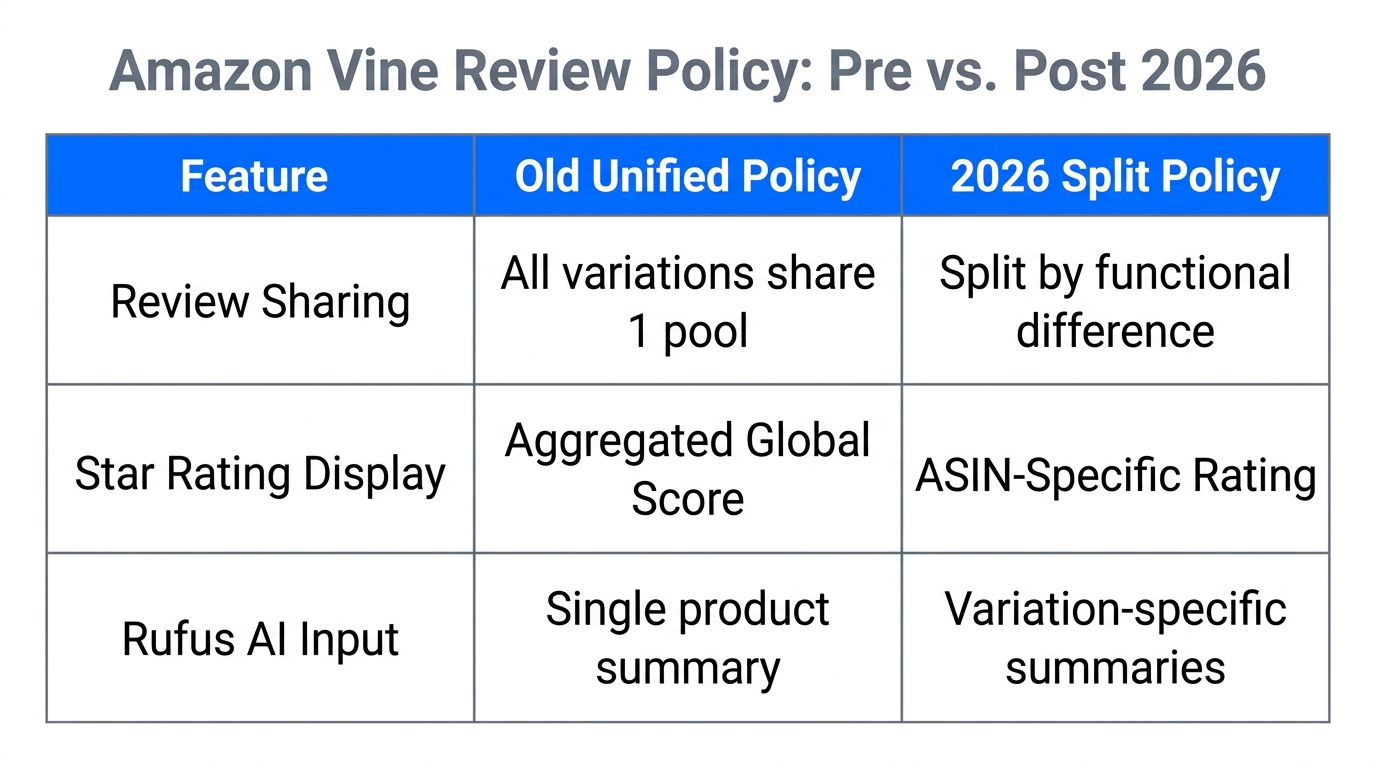
The core of the update focuses on "significant feature differences." Previously, Amazon's algorithm was lenient, allowing almost any variation under a single parent to pool reviews. Now, if the variation offers a different utility—like a 1TB hard drive versus a 2TB hard drive, or a cotton shirt versus a polyester one—the reviews are hard-coded to the specific child ASIN.
This policy shift, documented by Jarvio, means that Amazon ASIN management has become significantly more complex. You can no longer rely on a "hero" variation to carry the weight of an entire product line. Each individual variation must now earn its own authority.
"The 2026 variation split has decimated the 'social proof' of older listings that relied on aggregated reviews to mask underperforming variants."
The Rufus AI Factor: Why Variation Specifics Matter
In 2026, the primary way customers discover products is through Rufus, Amazon’s generative AI shopping assistant. Rufus doesn't just look at star ratings; it scans the text of reviews to generate search summaries for users. Because of the variation split, Rufus now weights reviews differently based on the exact variation the customer is querying.
If a customer asks, "Which size of this camping stove is best for backpacking?" Rufus will prioritize reviews specifically attached to the 'Small' or 'Lightweight' child ASIN. If those reviews are missing because you only enrolled the 'Large' version in Vine, Rufus may recommend a competitor instead. Data from Tambo indicates that Amazon is now using AI to pair products with "Vine Voices" who have specific category expertise, making these Rufus-friendly technical reviews even more critical.
To win in this environment, you must optimize for Amazon Rufus AI optimization by ensuring each variation has reviews that mention specific use cases. Stormy AI can analyze your competitor's Rufus summaries, identify the keywords the AI is highlighting, and then drop those insights into a shared workbook so you can adjust your product manuals accordingly.
Updating Product Manuals for Vine Voices
Vine Voices are required to leave detailed feedback. To guide them toward the technical details Rufus loves, consider these best practices:
- Include a "Technical Highlight" section in your packaging that encourages testing specific features.
- Clearly label the unique benefits of each variation (e.g., "Ideal for 4+ people" on a large variant).
- Use Stormy AI to track which technical keywords are appearing in your new Vine reviews and which ones are missing.
Strategies for Strategic ASIN Enrollment
With Amazon Vine variation splitting, you cannot afford to enroll 30 units of every single variation. It’s too expensive in terms of both enrollment fees and COGS. Instead, you need a tiered strategy. As of 2026, the enrollment fees are tiered: $0 for 1-2 units, $75 for 3-10, and $200 for 11-30 units.
| Strategy Tier | Unit Count | Purpose | Best For |
|---|---|---|---|
| The Test Tier | 1-2 Units | Verify product quality/market fit. | New designs or experimental materials. |
| The Social Proof Tier | 10 Units | Establish a baseline for PPC efficiency. | Niche variations with steady demand. |
| The Authority Tier | 30 Units | Dominate Rufus AI search summaries. | Top-selling hero variations. |
When deciding which ASIN to enroll, ask Stormy AI to pull a report on your inventory levels and sales velocity from Amazon Seller Central. Stormy can identify which variations have the highest inventory-to-sales ratio, suggesting where a Vine boost would provide the most immediate ROI. Enrolling the wrong variation is a sunk cost you can't recover.
How to Combat the 'Vine Death Spiral'
A dangerous trend in 2026 is the Vine Death Spiral. This occurs when a seller launches a complex product, and Vine reviewers—who are pressured to submit reviews within 30 days—leave "superficial" 3-star reviews because they haven't had time to fully understand the item. These 3-star reviews lower the category ranking, causing the algorithm to suppress the listing.
To avoid this, sellers are increasingly using tools like Stormy AI's creator discovery CRM to complement Vine with external UGC from TikTok and Instagram. While Vine provides the "Vine Voice" badge, external influencers can provide the context and long-term usage data that shoppers (and Rufus) crave.
"The 'Review Gap' is widening: Vine reviews currently average 4.1 stars, while organic reviews average 4.3. If your product is technically complex, expect a 0.2-star dip when using Vine."
Sellers must prepare for this "Vine Penalty." If your product has a technical flaw, Vine Voices will find it. There is no appeal process for a negative Vine review unless it explicitly violates community guidelines (Source: Reddit r/AmazonVine).
The Math of Amazon Vine in 2026
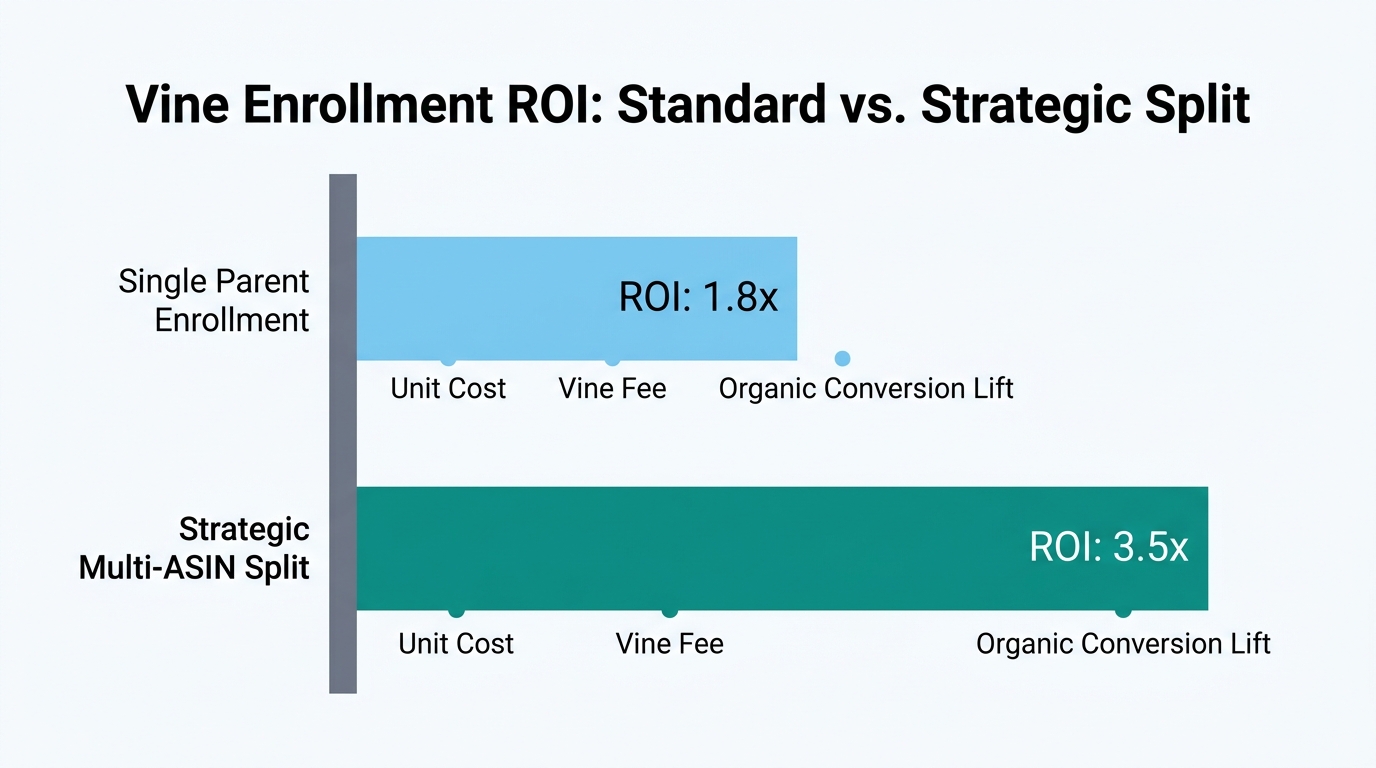
Launching in 2026 requires a cold, hard look at the numbers. Let’s break down the cost of a full 30-unit enrollment for a mid-tier product:
- Enrollment Fee: $200
- COGS (30 units at $12/each): $360
- FBA Fees (30 units at $5/each): $150
- Total Investment: $710
With an average completion rate of 70-85%, you can expect roughly 21 to 25 reviews for that $710 investment. This brings your Cost Per Review to approximately $28.40. If those reviews drive just 10 additional sales per month at a $10 profit margin, you break even in 7.1 months. Given that products with 15+ reviews often see far higher lifts, the ROI remains strong—but only if you choose the right variation.
How Stormy AI Automates the Back Office
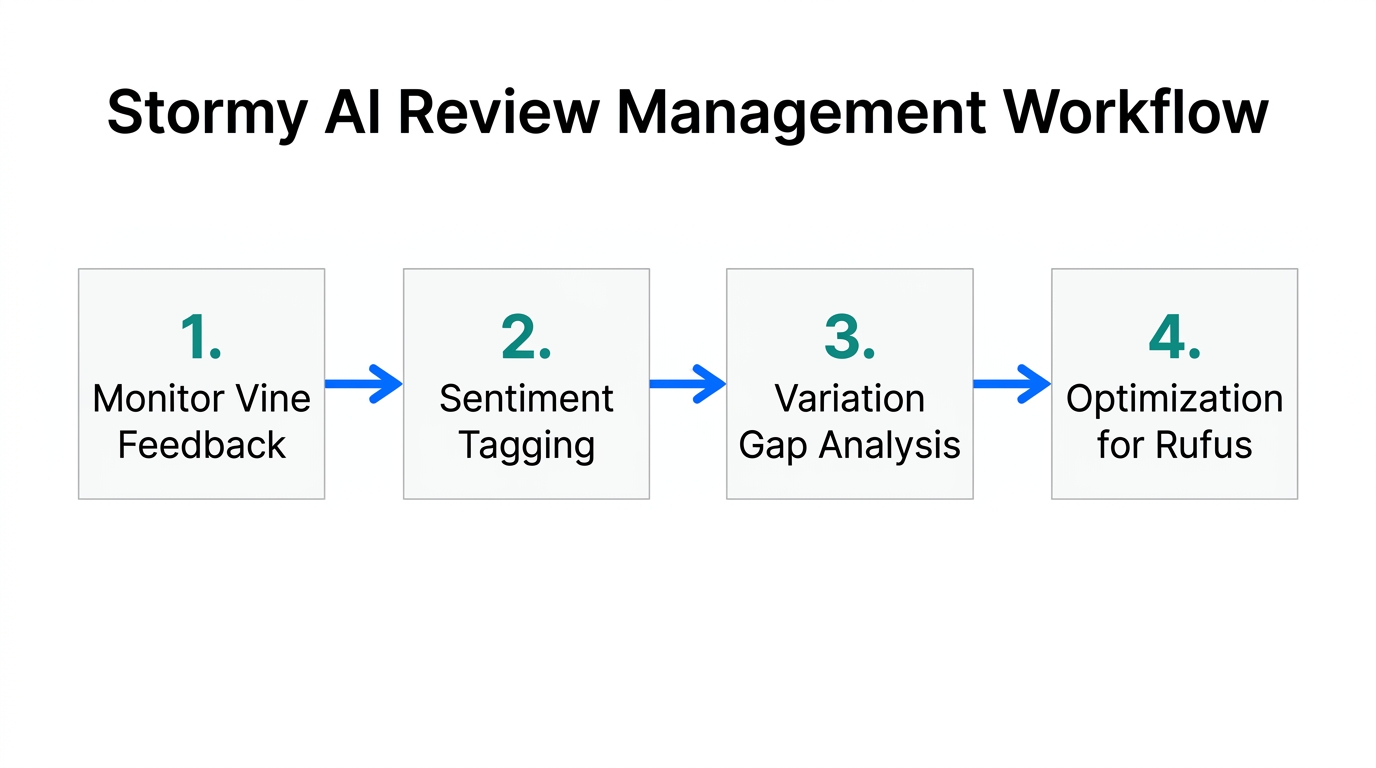
Managing a large catalog under the new Amazon review policy 2026 is a full-time job. This is where an AI ecommerce employee like Stormy AI excels. Instead of manually checking Seller Central every morning, you can ask Stormy to handle the heavy lifting:
- Monitor Review Splits: Stormy continuously scans your parent listings to see if reviews have been decoupled, flagging any variations that have dropped below the critical 15-review threshold.
- Inventory Follow-up: Stormy checks your FBA levels. If you're running low on a high-performing variant, Stormy will remind you to restock before you waste a Vine enrollment on an item that’s about to go out of stock.
- Competitor Analysis: Stormy pulls campaign performance and review data for your top 5 competitors, creating a comparison spreadsheet that highlights which variations they are prioritizing in their own Vine strategy.
- Email & Supplier Ops: If a Vine reviewer reports a recurring technical defect, Stormy AI can draft a message to your supplier to address the manufacturing issue before it affects your organic sales.
Conclusion: Adapting to the New Amazon Standard
The February 2026 Vine update is a clear signal from Amazon: the days of "hacking" social proof through variations are over. To succeed, brand owners must treat every child ASIN as a standalone product. By leveraging Amazon Rufus AI optimization, selecting variations strategically, and using an AI teammate like Stormy AI to monitor the messy back-office details, you can turn this policy shift into a competitive advantage.
Don't let your listings fall into the Vine Death Spiral. Start by auditing your current variation reviews and identifying the "Review Gaps" that Rufus is already noticing. The future of Amazon success belongs to those who build deep, technical authority for every single item they sell.