As we navigate 2026, the Amazon marketplace has evolved into a high-stakes environment where social proof is the only true currency. With Amazon’s total revenue hitting $717 billion and advertising spend climbing to $68.5 billion according to Statista projections, the competition for the Buy Box has never been more expensive. For performance marketers, the goal is no longer just 'getting reviews'; it is about utilizing Amazon Vine ROI as a strategic lever to slash customer acquisition costs (CAC). When you have an AI ecommerce employee like Stormy AI monitoring your listing health and ad performance in the background, you can turn the Vine program from a one-off experiment into a recurring profit engine.
The ROI Benchmarks of Amazon Vine in 2026
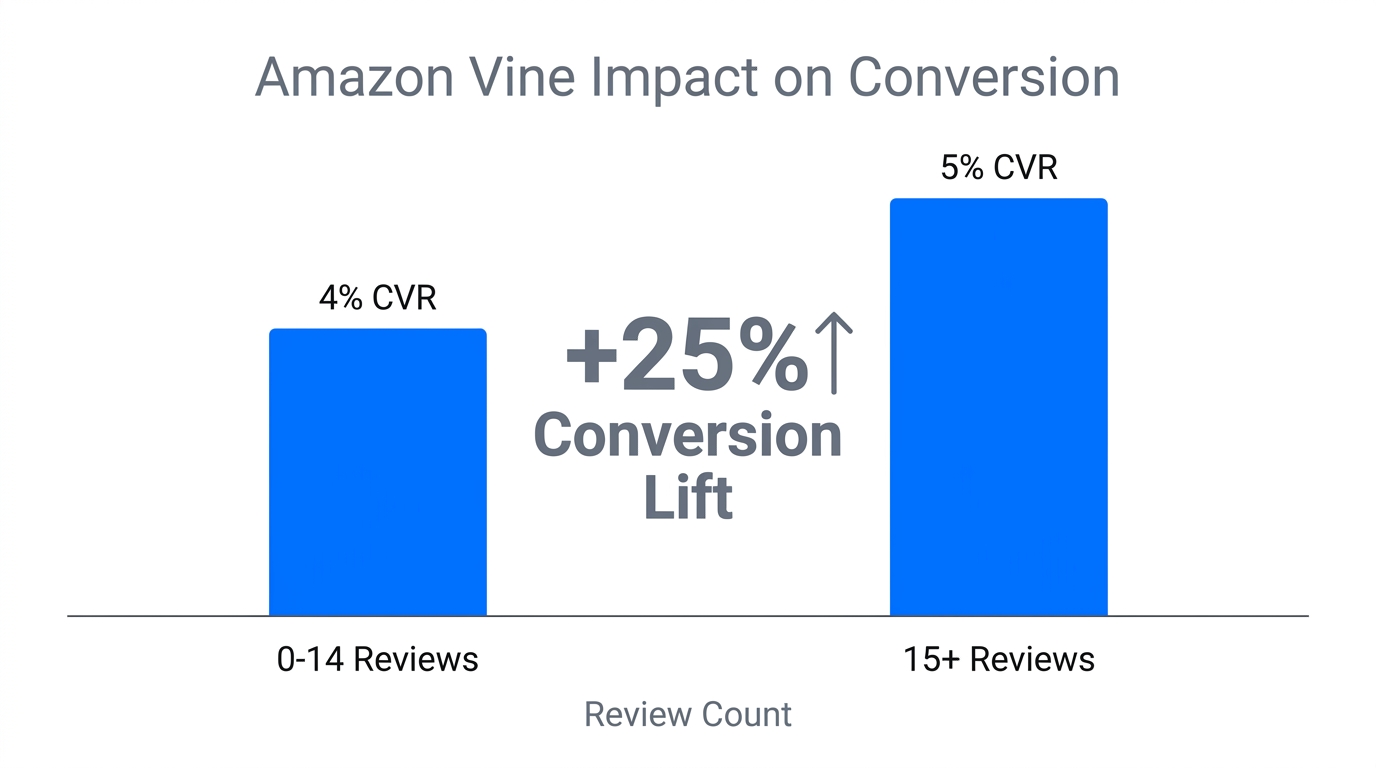
In the current 2026 landscape, the data is clear: products without a foundational layer of reviews are effectively invisible. According to research from the Titan Network, products that move from zero to 15+ reviews see an average Amazon review conversion lift of 18% to 25%. For high-ticket items priced above $150, that conversion uplift can jump as high as 24% as shoppers require more psychological safety before clicking 'Buy Now.'
"In 2026, Vine is no longer a 'nice-to-have'—it's a profit lever that reduces time-to-profitability by 40–60% on new launches."
To calculate your specific ROI, you must look beyond the $200 enrollment fee. A typical 2026 breakdown for a 30-unit enrollment looks like this:
| Expense Item | Estimated Cost (2026) |
|---|---|
| Amazon Vine Enrollment Fee | $200 |
| Cost of Goods Sold (30 units @ $12) | $360 |
| FBA Shipping & Referral Fees | $150 |
| Total Investment | $710 |
With an average completion rate of 70-85%, you are looking at a cost per review of approximately $23.66. While this might seem high, the long-term impact on your Amazon advertising costs 2026 is profound. A listing with 30 detailed reviews (often including photos and video) converts at a significantly higher rate than one with organic star ratings alone, allowing you to bid more aggressively on high-intent keywords while maintaining a healthy ROAS.
The 4.0-Star Baseline for PPC Efficiency
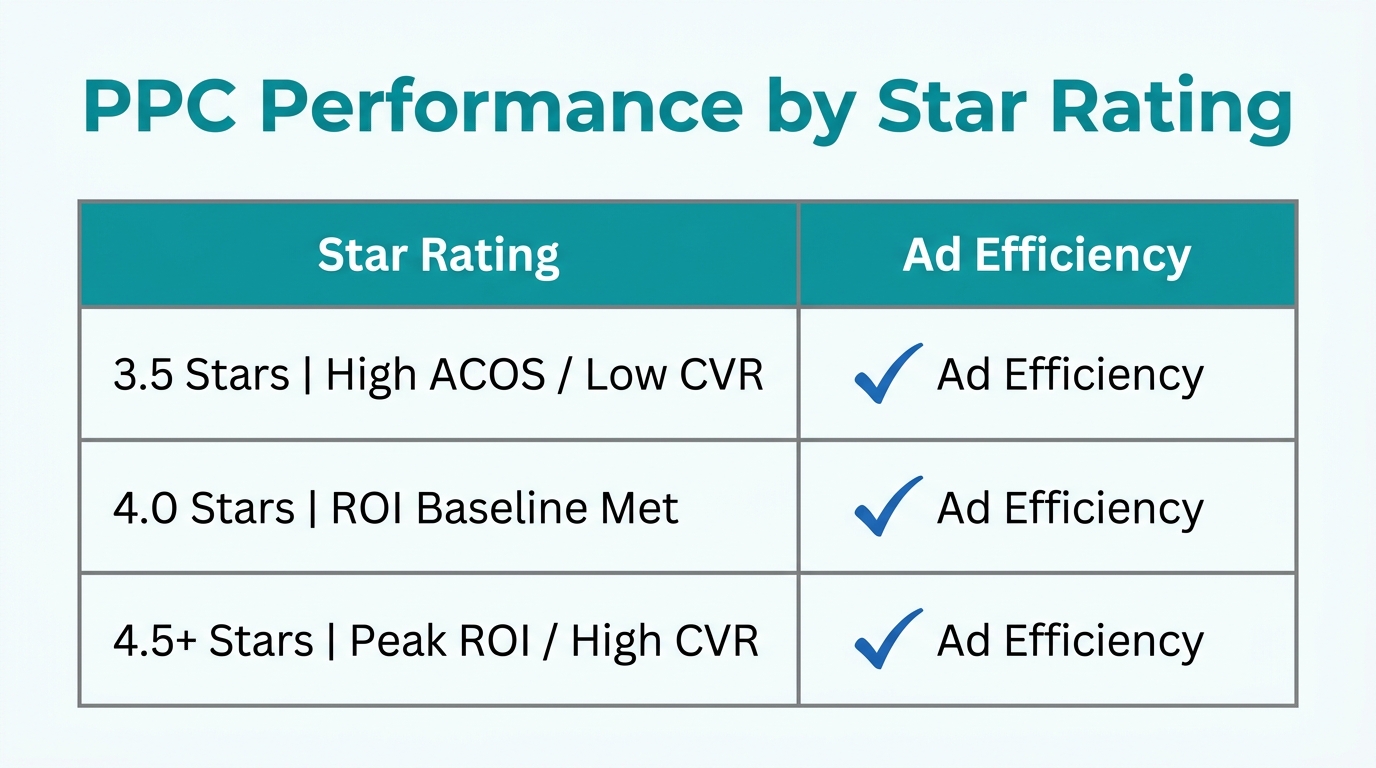
One of the biggest mistakes sellers make in 2026 is pouring ad spend into a 'cold' listing. Data from SalesDuo suggests that 62% of 3P sellers now use Vine as a prerequisite for launching Amazon PPC strategy 2026 campaigns. Why? Because a 4.0-star rating is the psychological 'floor' for consumer trust.
If your listing sits below 4.0 stars, your cost-per-click (CPC) will remain high while your conversion rate suffers, leading to a 'death spiral' where Amazon's A9 algorithm de-ranks you for poor performance. This is where Stormy AI becomes invaluable. You can ask Stormy to monitor your star rating daily; if a batch of Vine reviews drops your average below 4.0, Stormy can automatically pause your top-of-search campaigns to prevent wasted spend until the rating is repaired or the product issue is addressed.
Rufus AI and Review Depth
In 2026, Amazon’s AI shopping assistant, Rufus, has changed how reviews are consumed. Rufus doesn't just look at stars; it parses the text of Vine reviews to answer specific shopper questions. Reviews from 'Vine Voices' are often 2-3x longer than organic reviews, providing the rich keyword data Rufus needs to recommend your product. If a Vine reviewer mentions your 'ergonomic handle for small hands,' Rufus will summarize that specific benefit for future searchers, directly impacting your Amazon review conversion lift.
Managing the 'Vine Penalty' and Review Splitting
While Vine is powerful, it comes with a known risk: the 'Vine Penalty.' On average, Vine reviews tend to be 0.2 stars lower than organic reviews. While organic customers average 4.3 stars, Vine Voices—who are vetted for their critical eye—average 4.1 stars. They are technical, thorough, and brutally honest.
Furthermore, as of February 2026, Amazon has implemented a strict 'Variation Review Split' policy. According to Jarvio, reviews for variations with 'functional differences' (like different materials or tech specs) no longer aggregate. This means you can no longer use a high-performing 'Small' variant to carry a 'Large' variant. You must enroll each functional variation into Vine individually to build its own social proof.
"The 'Review Split' of 2026 has decimated the social proof of legacy listings—you must now earn trust for every SKU, every time."
The 2026 Playbook: From Vine to Automation
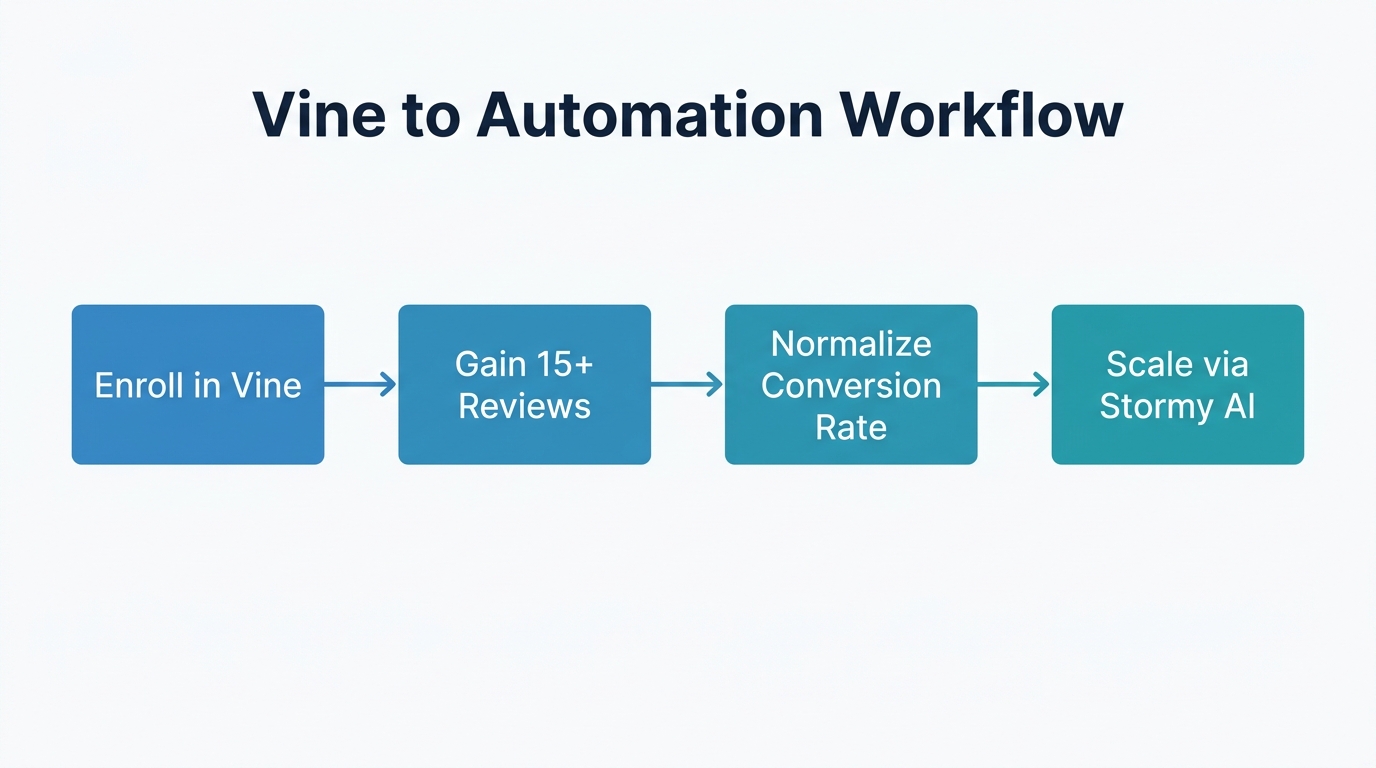
Amazon Vine is limited to your first 30 reviews. To scale beyond that, you need a transition plan. Once you hit that 30-review cap, the goal shifts to maintaining review velocity through automated 'Request a Review' flows.
- Step 1: Day-One Enrollment. Thanks to the June 2025 update, you can now enroll products the moment they hit FBA. Aim to have 10-15 reviews live before your official 'Launch Day' to maximize Amazon PPC strategy 2026 efficiency.
- Step 2: Monitor the 'Helpfulness' Ratio. Use tools like Helium 10 to track which Vine reviews are getting 'Helpful' votes. Rufus prioritizes these, so ensure your product manual highlights the problems your product solves to encourage reviewers to use those same keywords.
- Step 3: Automated Transition. Once the 30-unit limit is reached, switch to a tool like FeedbackFive. This automates the official Amazon 'Request a Review' button for every organic sale, ensuring your review count continues to climb without violating TOS.
Managing this handoff manually is a chore. Stormy AI can handle this entire lifecycle. Stormy monitors your Vine enrollment status in your shared workbook; the moment the 30th review is detected, Stormy can ping your team via Slack to activate the FeedbackFive automation and adjust your ad budgets to take advantage of the newly established social proof.
Scaling with Stormy AI: Ad Automation Based on Sentiment
The real secret to maximizing Amazon Vine ROI is integrating review sentiment with your ad spend. In 2026, manual ad management is too slow. By the time you realize a product has a 3.2-star average, you've already wasted thousands in Amazon advertising costs 2026.
Stormy AI acts as your eyes and ears in the back office. It can connect to your Amazon Ads account and your Seller Central reviews feed. Here is the playbook for an automated 'Review-Ad Loop':
- Sentiment Analysis: Stormy reads new Vine reviews. If multiple reviewers mention a specific flaw (e.g., 'packaging arrived broken'), Stormy flags this in your Slack or Telegram immediately.
- Budget Scaling: When a product hits a 4.5-star average with 20+ reviews, Stormy recognizes the high conversion potential and suggests a 20% budget increase for high-performing exact-match keywords.
- Inventory Protection: Stormy monitors your stock levels. If Vine reviews go viral and sales velocity spikes, Stormy will alert you to reorder from your supplier via email before you hit a stockout.
| Feature | Amazon Vine | Request a Review (Automation) | Stormy AI (Agent) |
|---|---|---|---|
| Primary Goal | Initial social proof (0-30) | Long-term velocity | Automated scaling & risk mgmt |
| Cost | $0–$200 + product | $0–$100/mo | Subscription (acts as employee) |
| Human Effort | Manual enrollment | Set and forget | Zero (Autonomous execution) |
Conclusion: The One-Person Brand Strategy
In 2026, running a successful Amazon brand doesn't require a massive team; it requires a smart stack of AI tools and a disciplined approach to social proof. By front-loading your launches with Amazon Vine, you create the conversion foundation necessary to lower your Amazon advertising costs 2026.
Don't let your review strategy happen by accident. Use Stormy AI to keep the spreadsheet updated, follow up with your suppliers when inventory runs low, and adjust your PPC spend based on real-time customer sentiment. The brands that win in 2026 are those that treat reviews not as a metric, but as a performance marketing asset.
Ready to automate your Amazon back office? Let Stormy AI handle the messy work of monitoring reviews and ads while you focus on building your next bestseller.