In 2026, the ecommerce landscape is defined by what industry leaders call "The Great Orchestration"—the strategic convergence of Google Ads search dominance and Amazon Ads transactional gravity. While Google remains the premier engine for top-of-funnel discovery, Amazon has evolved into a full-funnel ecosystem capturing 54% of all U.S. product searches according to recent eMarketer research. For the modern brand founder, the question is no longer which platform to use, but how to balance spend across both to maximize efficiency.
Managing this cross-platform complexity has become a full-time job. This is where an AI ecommerce employee like Stormy AI changes the game. Instead of spending hours reconciling Amazon Attribution tags with Google Search reports, Stormy AI monitors your performance in real-time, pulling campaign data into a unified dashboard and flagging underperforming SKUs before they drain your budget.
The 2026 ROI Benchmarks: Amazon’s Transactional Edge
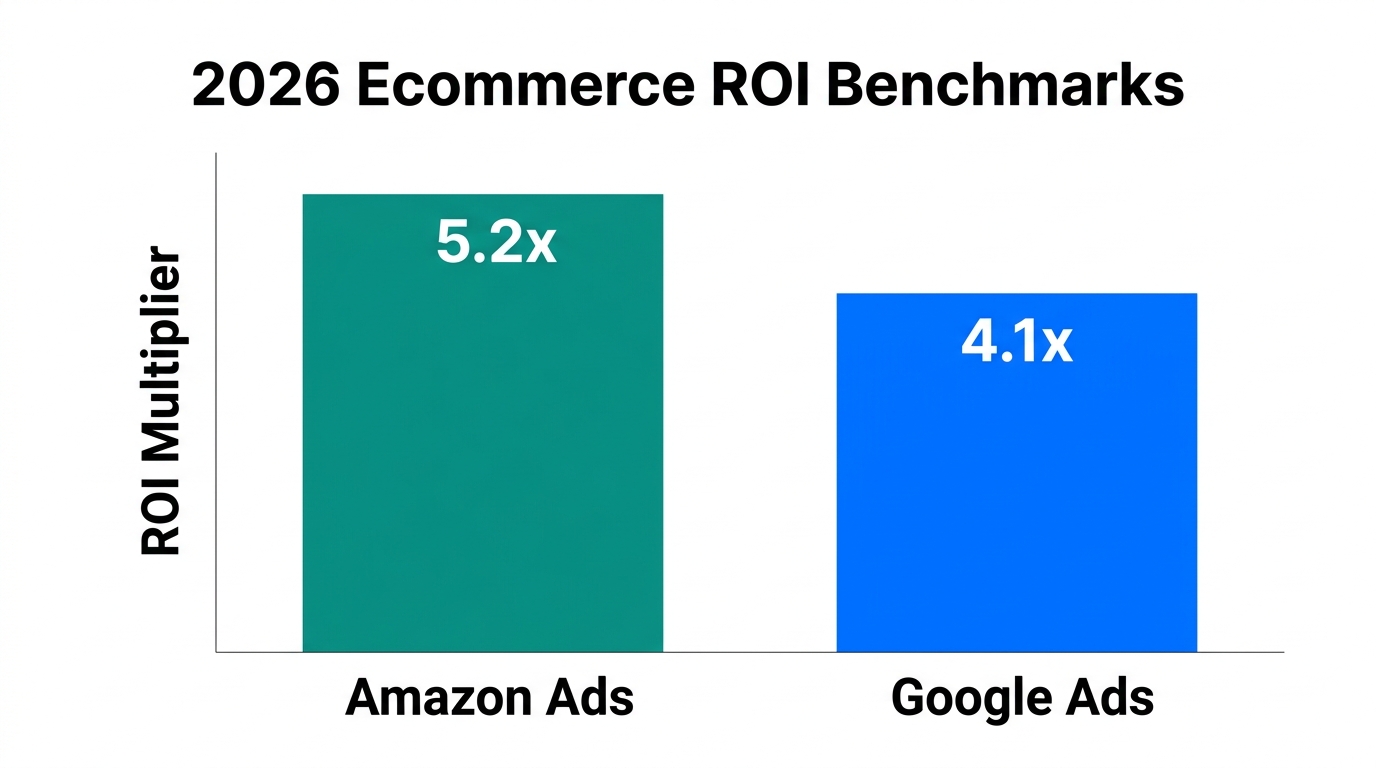
Data from late 2025 and early 2026 shows a widening efficiency gap between the two giants. Amazon Ads currently deliver an average 5.2x ROI, while retail-focused Google Ads hover around a 4.1x ROI. This discrepancy exists because Amazon utilizes first-party commerce data—knowing exactly what people buy—whereas Google relies on search intent, or what people are researching.
However, Amazon's dominance comes with a cost. Average CPCs for Amazon Sponsored Products have climbed to $1.12, a 15.5% increase from previous years. In contrast, Google Search (Retail) costs have stabilized at $2.69, though non-branded CPCs actually fell by 7% in late 2025 due to improved AI bidding efficiencies within the Google Performance Max ecosystem.
"2026 is the year retail media stops being a 'bespoke cottage industry' and becomes a programmatic standard. Brands are moving toward unified, signal-driven automation."
| Metric (2026) | Amazon Ads | Google Ads |
|---|---|---|
| Average ROI | 5.2x | 4.1x |
| Average CPC | $1.12 | $2.69 |
| Conversion Rate | 10–15% | 2–5% |
| Primary Intent | Transactional ("Buy now") | Discovery ("Find best") |
The Strategic Orchestration: Discovery vs. Gravity
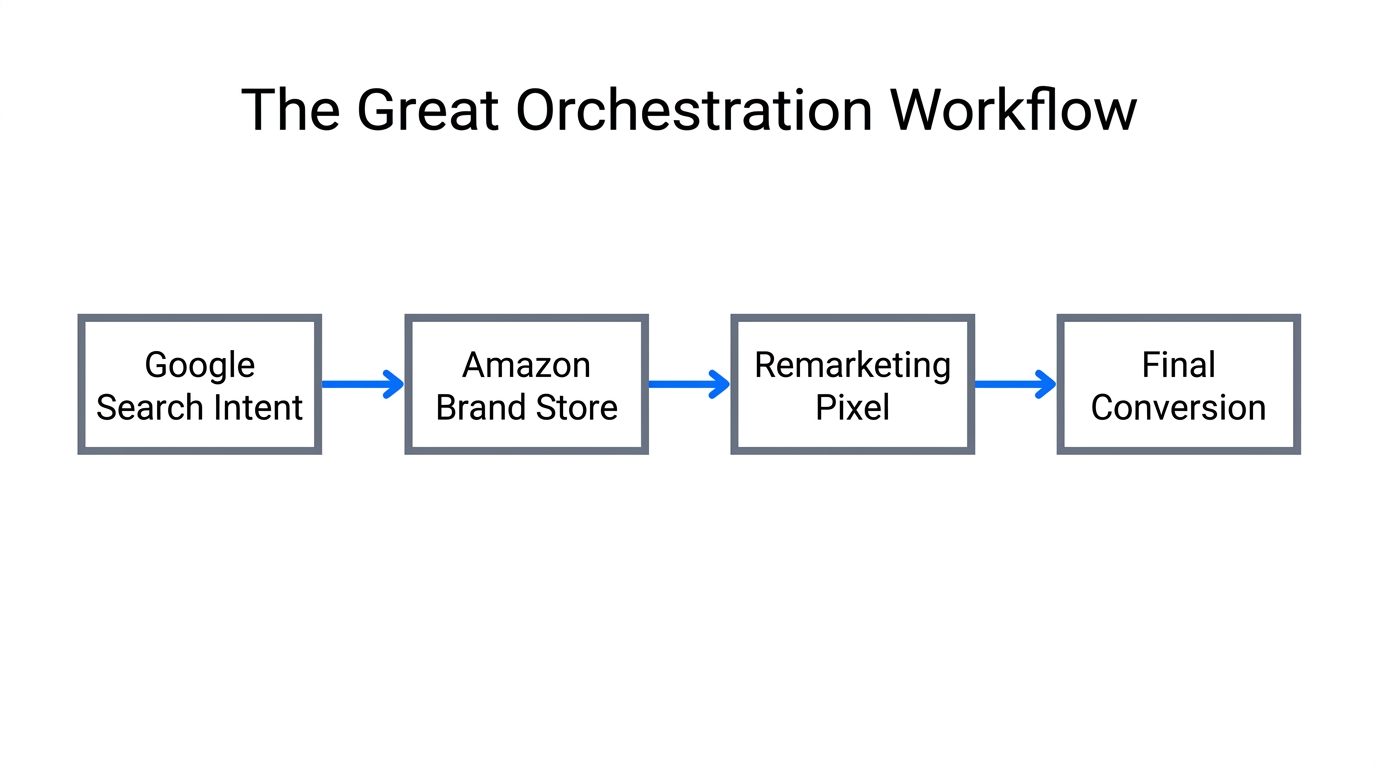
To win in 2026, you must utilize Google Shopping to build your audience and capture broad demand, while using Amazon Sponsored Products to capture high-intent shoppers. This is especially critical because of a massive shift in Amazon's A10 Algorithm: Amazon now gives 3x more ranking weight to sales originating from external traffic (like Google or Meta Ads) than internal PPC.
If you aren't driving external traffic to your listings, your organic rank will likely stagnate. Stormy AI can help orchestrate this by tracking your Amazon Attribution tags alongside your Google Ads spend, automatically identifying which Google keywords are driving the highest organic rank lift on Amazon.
When to Choose Google Shopping for Discovery
Google remains the king of brand ownership. When a user searches for "best organic coffee pods," they are in the research phase. Capturing them here via Google Shopping allows you to drive traffic to your Shopify store, capture their email, and build a long-term customer relationship. While Amazon "owns" the buyer data, Google allows you to own the customer.
When to Choose Amazon Sponsored Products for Conversion
Amazon is the ultimate closer. With Prime conversion rates often exceeding 20%, it is the most efficient place to spend your bottom-of-funnel budget. By 2026, many brands are shifting to Sponsored Video, which reports 20% higher conversion rates than static search ads, often at lower competition levels. Stormy AI can monitor these video campaigns, alerting you if your conversion rate dips below your category average so you can refresh your creative.
"The key to 2026 is driving 'cold' Google traffic to 'hot' Amazon listings to trigger the A10 ranking boost without sacrificing your unit session percentage."
Solving the 'Black Box' with Amazon Marketing Cloud (AMC)
A major pain point for advertisers using automated tools like Google Performance Max (PMax) or Perpetua is the lack of transparency. Critics on Reddit /r/PPC often argue that PMax cannibalizes branded search traffic. To solve this, savvy 2026 practitioners are turning to Amazon Marketing Cloud (AMC).
AMC acts as a "clean room" that allows you to link ad exposure to off-platform behavior. By using AMC, you can see the true conversion path—for example, a user seeing a Prime Video ad, then clicking a Google Search ad, and finally buying on Amazon. This level of cross-channel visibility is essential for proving incrementality—the true sales lift beyond what would have happened organically.
Case Studies: Cross-Channel Synergy in Action
Success in 2026 requires more than just high spend; it requires precision. Two brands, Vitacup and Cocolab, represent the pinnacle of this hybrid approach.
- Vitacup (CPG): Implemented a daily pattern-analysis strategy to shift bids dynamically across platforms. By using an AI-first approach to manage cross-channel spend, they reduced CPA by 34% while increasing total ad spend by 60% for aggressive scaling [Source: Amazon Case Studies].
- Cocolab (Oral Care): Leveraged a full-funnel approach combining Streaming TV ads on Amazon with targeted Google Search intent. This resulted in an 80% increase in new-to-brand (NTB) sales and 50% year-over-year growth.
- Serta Simmons: Used Amazon’s Omnichannel Metrics (OCM) to discover that 62% of their ad impact actually occurred offline or off-Amazon, revealing a true ROAS 2.2x higher than what the standard dashboard showed [Source: Amazon Ads OCM Study].
The 2026 Hybrid Playbook: Steps to Orchestration
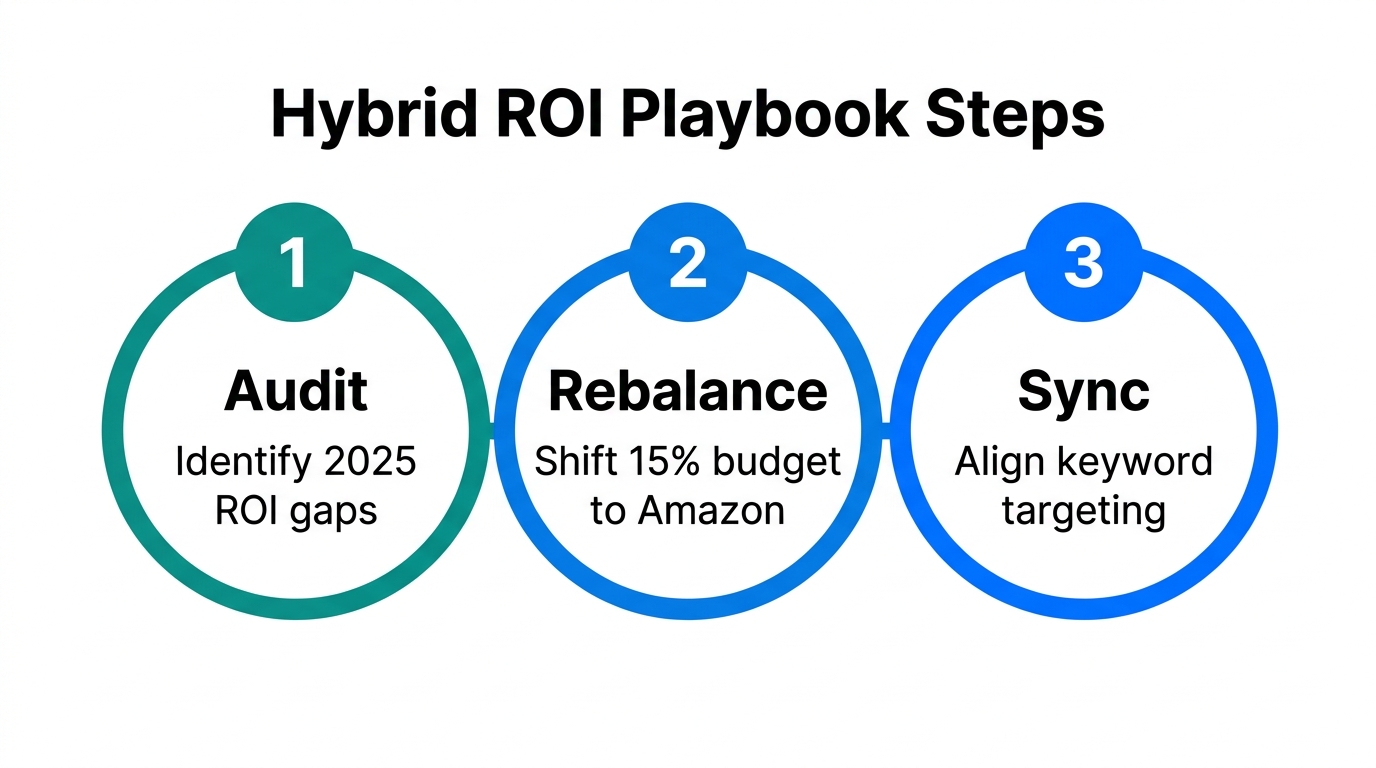
If you want to replicate these results, follow this step-by-step playbook to drive Google traffic to Amazon effectively.
- Strategic Selection: Choose 3–5 high-margin products with at least 50 reviews and a 4.2-star rating. Only drive external traffic to listings that are "retail ready."
- Deep Linking: Use tools like URLgenie to ensure your Google ads open the Amazon app directly on a user's phone. Failing to do this can result in an 80% bounce rate as users get stuck in mobile browser logins.
- Attribution Setup: Generate Amazon Attribution tags for every Google campaign. Without these, you are flying blind and won't know which keywords are actually converting.
- Brand Referral Bonus: Enroll in the Amazon Brand Referral Bonus program. You can earn a 10% credit on sales driven from external traffic, which essentially subsidizes your Google ad costs.
- Automation with Stormy AI: Let Stormy AI handle the daily grind. Ask Stormy to "Check my Google-to-Amazon attribution every morning and flag any campaign with a CPA over $15."
"The 'Black Box' of modern advertising is only a threat to those who don't have the tools to look inside. Clean rooms and AI agents are the keys to the kingdom in 2026."
Navigating Agentic Commerce: Rufus vs. Gemini
As we move deeper into 2026, consumers are increasingly using AI shopping agents like Amazon’s Rufus or Google’s Gemini to research products. Winning brands are shifting their ecommerce advertising strategy from keyword stuffing to "agent-readability."
Amazon has already launched sponsored placements within Rufus, where ads are dynamically generated based on conversational context. Similarly, Google's "AI Max" integrates ads directly into Gemini-powered AI Overviews. While this has slashed organic click-through rates for informational queries by 34.5%, it has made Bottom-of-Funnel (BOF) Shopping ads more valuable, as they are often the only visual elements that survive the AI summary.
Conclusion: The Verdict for 2026
The battle of Amazon Ads vs Google Ads is no longer a zero-sum game. The winners of 2026 are those who treat these platforms as a unified engine. Use Google to reach the curious, and Amazon to convert the committed. By leveraging Amazon Marketing Cloud for attribution and an AI employee like Stormy AI to handle the messy back-office orchestration, you can maintain high margins in an increasingly expensive market.
Stop wasting your time in spreadsheets and start scaling. Hire your first AI ecommerce employee at stormy.ai and let the machines handle the orchestration while you focus on the brand.