As we navigate the competitive landscape of 2026, the era of manual bid adjustments and spreadsheet-heavy campaign management is officially behind us. Amazon’s advertising ecosystem has undergone a radical transformation, evolving into an AI-first platform where success is determined by the precision of your automation logic rather than the hours spent in the console. According to data from Statista, Amazon’s advertising revenue has surged to $88.6 billion this year, representing a 57.6% increase since 2024. This growth is driven by a massive shift in advertiser behavior: 61% of all active Amazon ad campaigns are now managed by AI-automated tools.
For growth managers and brand owners, the stakes have never been higher. Average cost-per-click (CPC) rates have inflated to between $1.18 and $1.25, making every wasted impression a threat to your bottom line. However, the potential for high returns remains strong; average conversion rates (CVR) have climbed to 12.3% across the platform, with high-intent categories reaching as high as 15.8% when optimized correctly. To thrive in this environment, you need more than just general automation—you need specific, tactical playbooks that leverage Amazon’s latest AI capabilities. In this guide, we break down five actionable Amazon PPC automation 2026 strategies designed to maximize your ROAS and scale your operations efficiently.
"The year 2026 marks the shift from the art of approximation to the science of precision, where AI eliminates operational complexity so marketers can focus on strategy." — Mark Eamer, VP at Amazon AdsPlaybook 1: The Intraday Bidding Strategy (Dayparting 2.0)
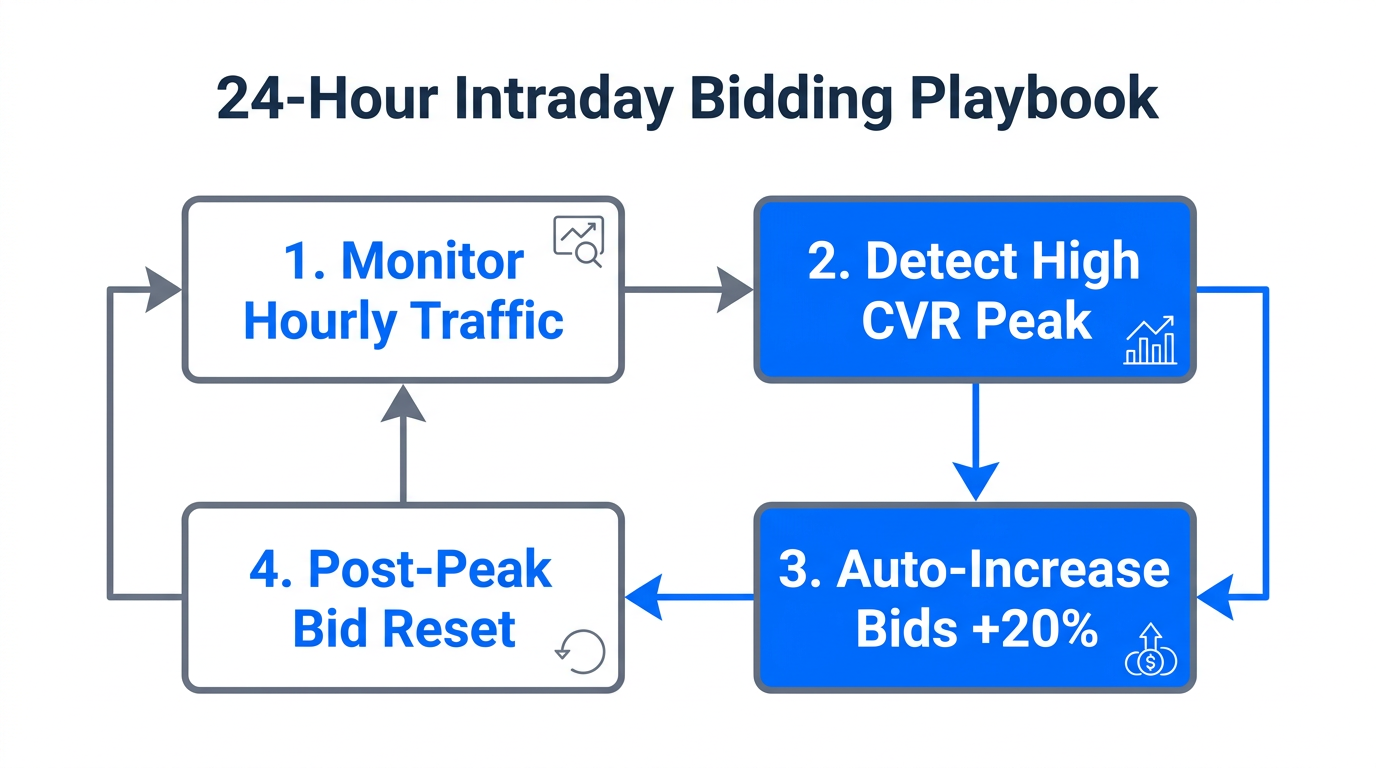
One of the most significant advancements this year is the widespread accessibility of Amazon Marketing Stream data. Unlike the static reports of the past, this hourly data stream allows for real-time bid adjustments based on when your customers are actually converting. Amazon Ads bidding automation now allows you to implement "Dayparting 2.0," where your bids automatically fluctuate throughout a 24-hour cycle.
To implement this, you must configure your AI tool—such as AiHello—to pull hourly performance metrics. For most consumer categories, data shows a significant spike in conversion rates between 7:00 PM and 11:00 PM EST. An effective AI playbook will increase your bids by 20-30% during these peak windows while aggressively scaling back during "dead zones" (typically 2:00 AM to 6:00 AM) where clicks are frequent but conversions are scarce. Many brands also sync this with Shopify inventory levels to ensure they aren't bidding on out-of-stock items.
Playbook 2: The 80/20 ASIN Prioritization Rule
In a large catalog, not all products are created equal. In 2026, successful brands are using AI to identify and fund the 20% of ASINs driving 80% of total revenue. This is no longer a manual auditing task; AI agents now monitor your entire catalog's contribution margin in real-time. By integrating your Amazon Ads data with internal sales reports, these agents can automatically reallocate budget toward your "Hero" products, often using Zapier to bridge data between systems.
We recommend a budget distribution where 70% of your total ad spend is concentrated on these top-performing ASINs. The AI should be programmed to detect "Rising Stars"—new products that show an early CVR above your account average—and automatically promote them into the high-budget tier. This ensures that you are never under-funding your winners while wasting capital on low-conversion tail products. Tools like Adbrew are particularly adept at this full-funnel ASIN management, helping brands achieve over $1M in incremental sales through precise prioritization.
Playbook 3: Automated Keyword Harvesting & Negation
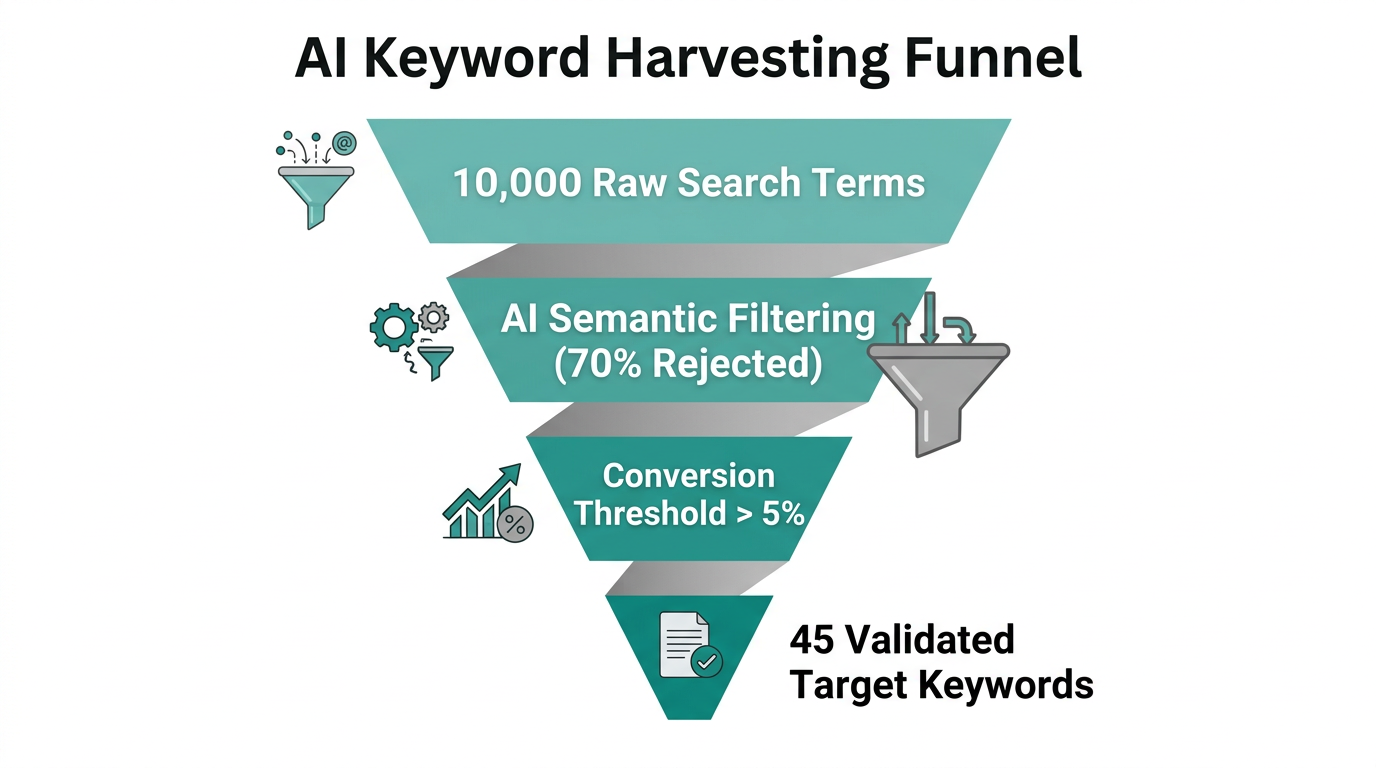
The manual "search term report" is a relic of the past. Amazon keyword harvesting AI now creates a continuous loop between discovery and conversion. A standard AI workflow for 2026 follows these specific steps:
- Auto Campaign Discovery: Run Sponsored Products Auto campaigns with a modest budget to discover new customer search terms.
- Performance Trigger: The AI monitors these terms. As soon as a term hits a threshold—for example, 2 conversions at a sub-25% ACOS—it is "harvested."
- Manual Migration: The AI automatically creates a new Exact Match keyword in your Manual campaign for that term.
- Negation: Simultaneously, the AI adds that term as a "Negative Exact" in the original Auto campaign to prevent internal bidding competition.
This "Set and Guide" approach ensures your manual campaigns are always fueled by proven data. To keep your creative assets fresh for these harvested keywords, many brands use Stormy AI to find TikTok and Instagram creators who can quickly produce video content for Sponsored Brands, ensuring the ad creative matches the high-intent keywords being discovered.
"AI turns complexity into clarity, enabling brands to adapt to performance in real-time across the full funnel." — Melissa Burdick, President of Pacvue| Automation Feature | Manual Workflow (Old) | AI Workflow (2026) |
|---|---|---|
| Keyword Mining | Weekly CSV Downloads | Real-time API Harvesting |
| Bid Adjustments | Reactive (Based on last week) | Predictive (Based on hourly trends) |
| Negative Keywords | Monthly Cleanup | Instant ROI-based Negation |
| Budget Management | Static Daily Caps | Dynamic Reallocation |
Playbook 4: Dynamic Budget Rules to Eliminate Blind Spots
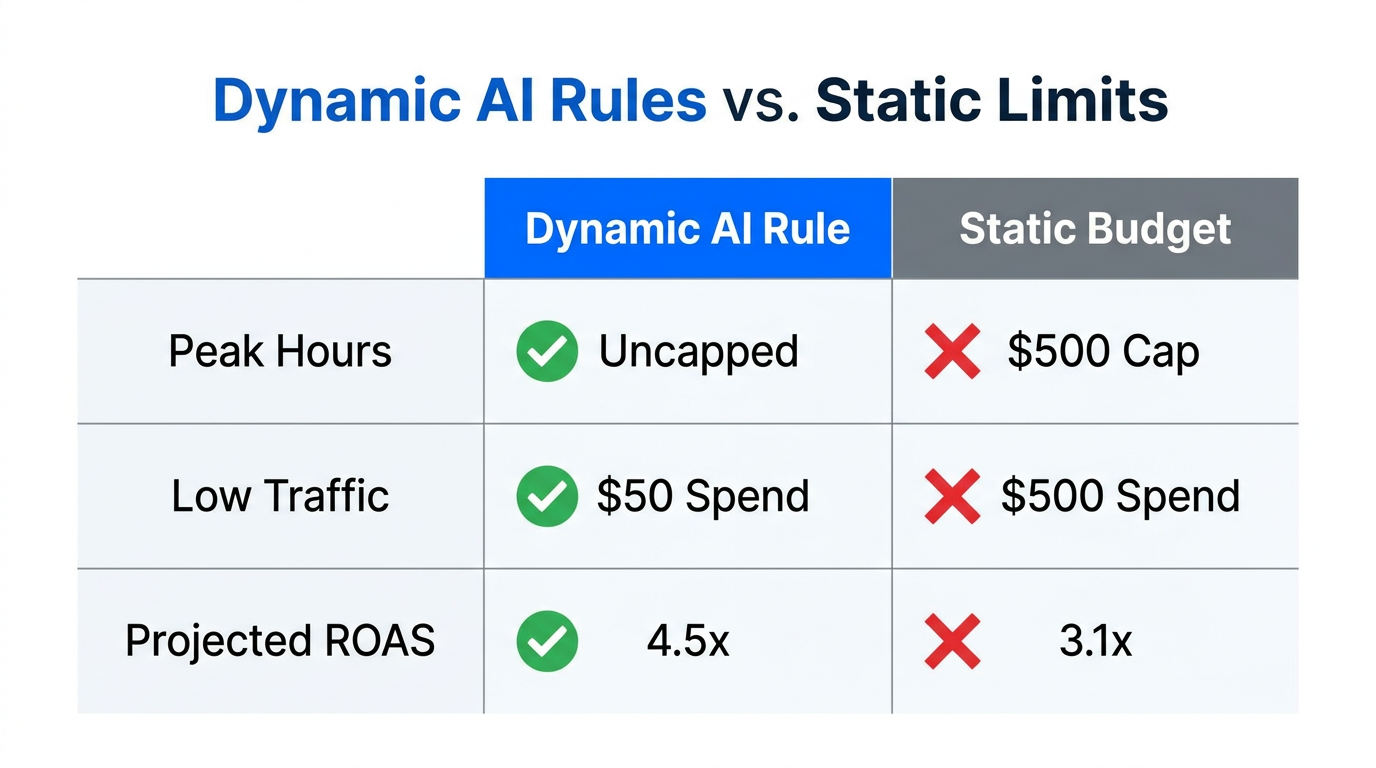
One of the most common mistakes is the "Budget Cap Blind Spot." If your best-performing campaigns run out of budget by 2:00 PM, you are missing the most profitable hours of the day. In 2026, Amazon Ads automation includes sophisticated "Budget Rules" that prevent this from happening. Instead of setting a hard daily limit, you set performance-based conditions.
For instance, you can create a rule that states: "If the ROAS is greater than 4.0 and the budget is 90% consumed, increase the daily budget by 20%." This allows your AI to scale winning campaigns infinitely as long as they remain profitable. Conversely, the AI should automatically pull budget from "Underperformers" to fund these high-efficiency campaigns. You can even set up Slack notifications to alert your team whenever a major budget shift occurs.
Playbook 5: Maintaining 7-14 Day AI Learning Cycles
While automation is fast, the data it consumes takes time to stabilize. A major trap for growth managers is the "Set and Forget" mentality, or its opposite: over-tinkering. Amazon’s machine learning algorithms require a 7 to 14-day window of stable data to optimize bidding effectively. If you change your targets every 48 hours, you are essentially resetting the AI's progress.
In 2026, the best practitioners manage the "Guardrails," not the individual bids. Set your target ACOS or ROAS and let the AI explore for at least a week. Furthermore, always account for attribution lag. Since Amazon can take up to 14 days to fully attribute a sale to a click, making decisions based on "Same Day" data is a recipe for poor performance. Use tools like Optmyzr to visualize these learning windows and ensure you aren't cutting off a campaign before it has had a chance to mature.
Building Your 2026 Amazon AI Stack
To execute these playbooks, you need a tech stack that integrates deeply with the Amazon Ads Console. Depending on your business size and complexity, different tools offer specialized capabilities:
- For Enterprise Brands: Use Pacvue or Adbrew for deep Amazon Marketing Cloud (AMC) integration.
- For Hands-off Management: Perpetua offers goal-based AI optimization that requires minimal daily oversight.
- For SMB Growth: Helium 10 (Adtomic) or SellerApp provide excellent AI insights for smaller catalogs.
- For Bidding Precision: Ad Badger remains a leader in automated negative keyword management and bid shielding.
Beyond the ads themselves, remember that Retail Readiness is the foundation of AI success. AI can drive traffic, but it cannot fix a poor product listing. Ensure your pages are optimized with high-quality A+ content and video. Platforms like Stormy AI can help you source the authentic UGC needed to maintain a high conversion rate, giving the AI the best possible "fuel" to work with.
Conclusion: The Future is Agentic
The transition to Amazon PPC automation in 2026 is not just about doing things faster; it is about doing things that were previously impossible for human teams. By implementing intraday bidding, automating your keyword harvesting, and respecting the AI learning cycle, you can reclaim hours of your week while significantly improving your ROAS. As experts at WordStream often note, automation is fast, but strategy still wins. Your role has shifted from the pilot of the aircraft to the air traffic controller—setting the destination and the safety parameters, then letting the AI handle the flight.