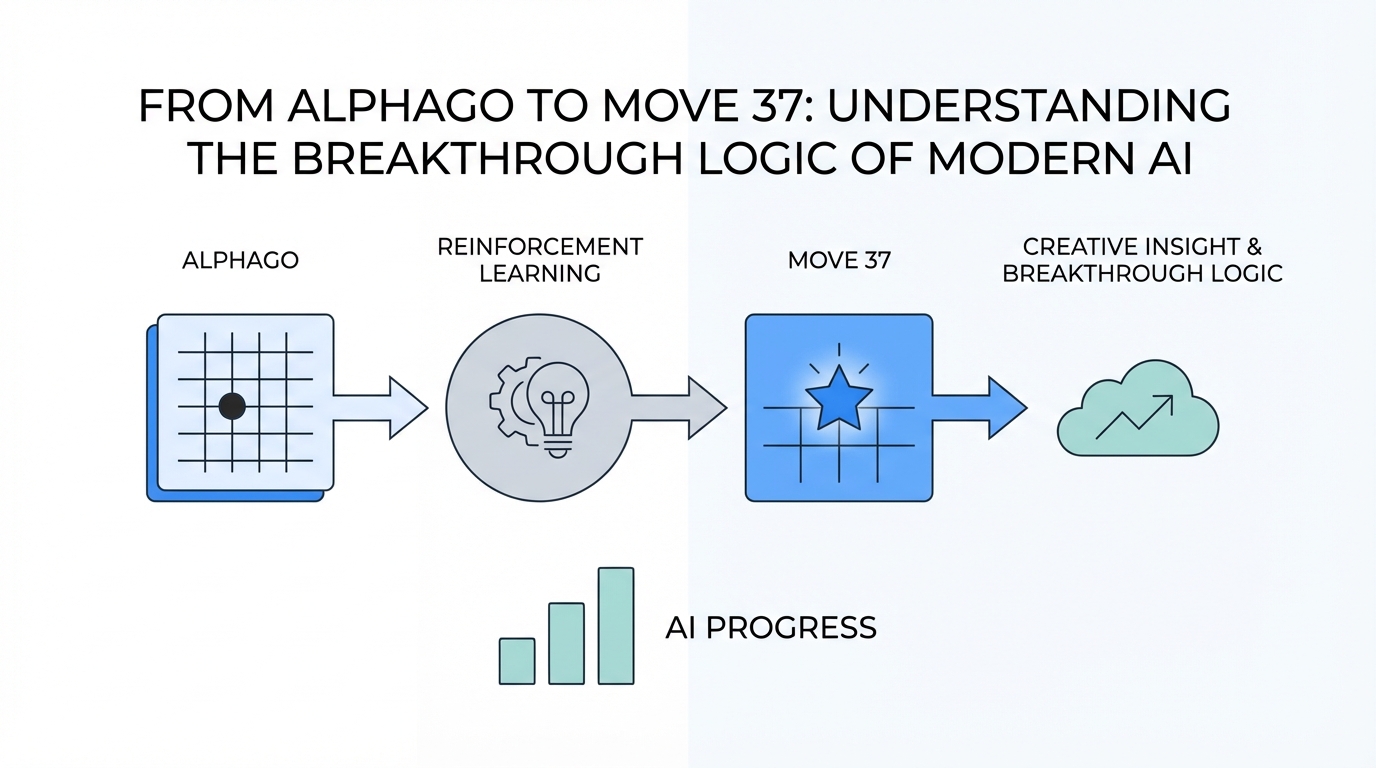
In March 2016, in a hotel room in Seoul, South Korea, something happened that permanently altered the trajectory of human history. It wasn’t a political summit or a scientific discovery in the traditional sense. It was a single move in an ancient board game. Lee Sedol, one of the greatest Go players of the last two decades, sat across from a machine. On the 37th move of the second match, the computer—DeepMind’s AlphaGo—placed a black stone in a position so baffling that the commentators audibly gasped. It was a move no human would ever make, a move that looked like a mistake to the experts, but one that ultimately secured a victory that signaled the arrival of Artificial General Intelligence in our everyday reality. This moment, now known as Move 37, represents the 'Sputnik moment' for modern machine learning, marking the transition from AI that mimics humans to AI that creates original strategy.
The Architect of Intelligence: Demis Hassabis
To understand the logic behind Move 37, you have to understand the mind of the man who built the machine: Demis Hassabis. Long before he was the CEO of DeepMind, Hassabis was a child prodigy. By age six, he was one of the best chess players in the world for his age; by his teens, he was a master game developer, creating the logic for a thousand autonomous characters in the hit game Theme Park. His journey wasn't just about winning games; it was about understanding the Thinking Game. He realized early on that if you could combine human-like intuition with the raw processing power of computers, you could create the 'last invention'—a machine that could solve every other problem humanity faces.
Hassabis’ conviction led him to found DeepMind, a company that eventually caught the eye of early tech titans. In a world where AI was still considered science fiction, visionary investors like Peter Thiel and Elon Musk saw the potential. They realized that Hassabis wasn't just building a better calculator; he was building a system that could learn and think for itself. This deep-seated belief is what eventually led to the $500 million acquisition of DeepMind by Google, a deal that now looks like one of the greatest bargains in tech history. Today, the documentary The Thinking Game on Prime Video chronicles this relentless pursuit of machine learning breakthroughs.
The Evolution of AI Training: From Pong to Go

Modern AI didn't start with complex strategy; it started with the basics. The researchers at DeepMind began with simple Atari games like Pong and Brickbreaker. The goal was simple: don't tell the computer the rules. Just tell it that a higher score is good. At game one, the AI is terrible. It can't even move the paddle. By game 100, it's competitive. By game 500, it's unstoppable. In Brickbreaker, the AI even discovered a strategy humans hadn't emphasized: tunneling through the side of the blocks to let the ball bounce autonomously on top, clearing the screen with zero effort. This was an early signal that AI was capable of finding 'shortcuts' that human logic often misses.
As the complexity increased, the training moved to chess and eventually to Go. Unlike chess, Go has more possible board configurations than there are atoms in the observable universe. You cannot 'solve' Go with brute-force calculation; you need what we call intuition. While early versions of AlphaGo learned by watching 100,000 human amateur games, the real breakthrough happened when the AI was allowed to play against itself millions of times. While brands and marketing teams are still manually vetting social media creators, advanced platforms like Stormy AI are beginning to mirror this type of logic, using data-driven 'simulations' to predict which creator will drive the best results for a specific app install campaign.
Decoding 'Move 37': The Spark of Creativity

In the match against Lee Sedol, AlphaGo Move 37 was a stone placed on the fifth line from the edge. In traditional Go theory, playing on the fifth line early in the game is considered a bad move—it doesn't secure territory efficiently. The commentators were confused. Lee Sedol had to leave the room to collect himself. But as the game progressed, it became clear that the stone on the fifth line was perfectly positioned to influence the center of the board in the late game. It was a superhuman strategy that no human teacher could have imparted. It was the first time AI vs human intelligence shifted from a contest of speed to a contest of creativity.
This was the moment the world realized that Artificial General Intelligence wasn't just about faster math; it was about novelty. When AlphaGo defeated Lee Sedol 4-1, it sent shockwaves through the global community. In China, where Go is a national treasure, the broadcast was so significant that when the AI started dominating the world's number one player, Ke Jie, the government famously cut the feed. This 'Sputnik moment' triggered an global AI arms race, as nations realized that the ability to simulate and predict at this level was the ultimate competitive advantage.
Learning from Scratch: The AlphaZero Shift
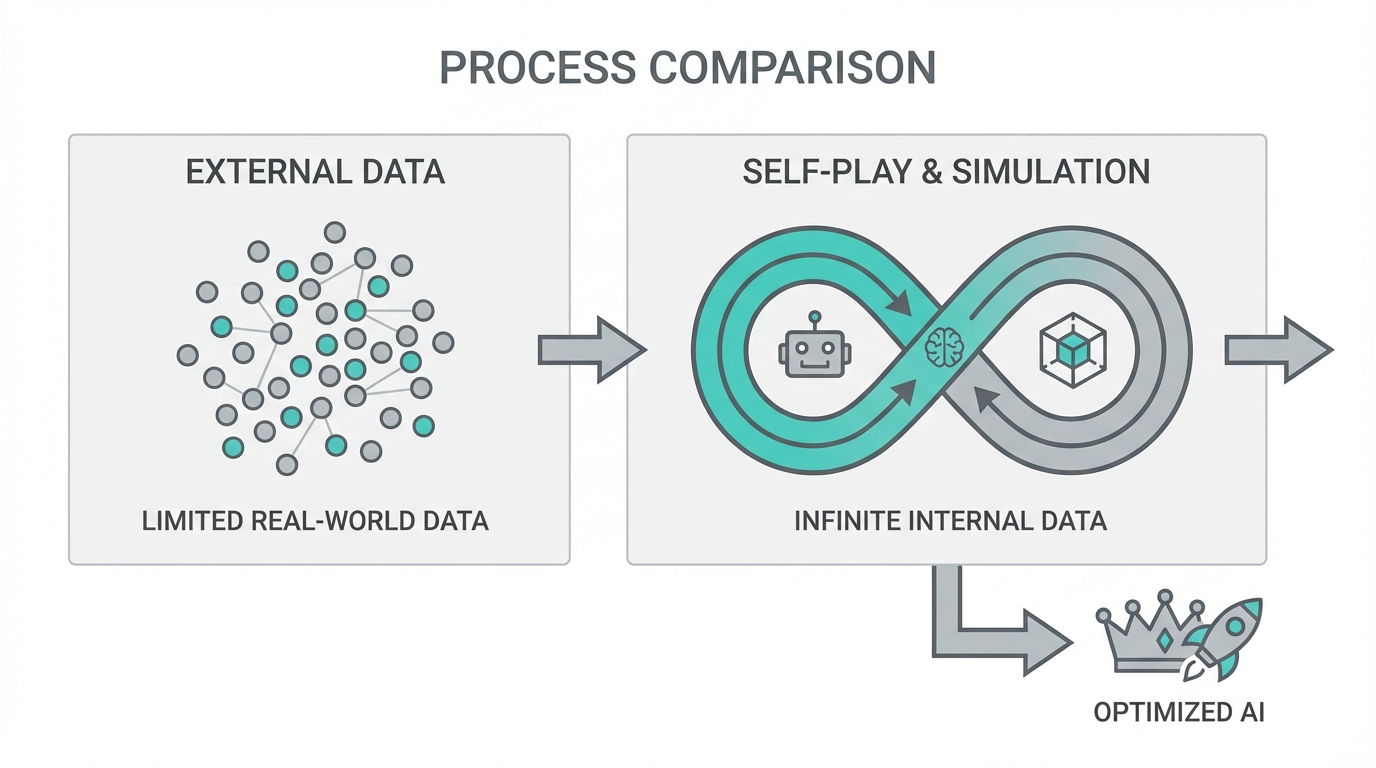
The next evolution was even more radical: DeepMind AlphaZero. While AlphaGo needed human games to start its learning process, AlphaZero was given nothing but the rules of the game. It played against itself, starting from total ignorance. Within hours, it had surpassed the best human-fed AI programs in the world. By removing human data, the AI was no longer constrained by human bias or traditional 'best practices.' It developed a style that was described as relentless and alien.
This shift from 'human-fed' to 'self-play' is a playbook for any data-driven industry. In the world of digital advertising, the old way was following 'best practices' for Google Ads or Meta Ads Manager. But the modern approach is more like AlphaZero: running massive amounts of creative variations to let the algorithm find the 'Move 37' of ad combinations that humans would never have thought to test. For app developers, this often means leveraging UGC (User-Generated Content) at scale to see which specific hooks resonate with an audience through rapid, iterative simulation.
The Simulation Advantage: Applying AI Logic to Business

How can businesses apply the logic of Move 37 to their own growth? The key is predictive analytics. Just as AlphaGo predicts the probability of winning with every stone placed, companies can now use AI to predict consumer behavior. If you are running an app and want to maximize App Store Optimization (ASO), you shouldn't just guess which keywords work. You should be using tools that simulate thousands of user journeys to find the highest-converting path.
In the influencer marketing space, finding the right creator for a mobile app ad is no longer a guessing game. By using Stormy AI, marketers can discover creators based on deep analytics and AI-powered vetting that detects fake followers and engagement fraud in seconds. This is the simulation advantage: testing a hypothesis in a digital environment before spending a single dollar in the real world. Whether you are scaling on Apple Search Ads or scouting for new talent, the logic remains the same: use AI to find the patterns that humans are too slow to see.
Playbook: Applying 'Move 37' Logic to Your Strategy
To implement this breakthrough logic in your own marketing or business operations, follow this three-step playbook:
Step 1: Define the Winning Metric
Just as AlphaGo was told 'higher score is good,' you must define a single, North Star metric for your AI tools to optimize for. Whether it is ROAS (Return on Ad Spend) or Cost Per Install (CPI), clear rewards are the foundation of machine learning success. Avoid 'vanity metrics' that don't directly lead to growth.
Step 2: Allow for 'Draft' and 'Push' Cycles
As Demis Hassabis observed during the development of AlphaFold, creativity cannot be forced through constant pressure. Give your creative teams and your AI tools the 'space' to test wild hypotheses (the 'Move 37's). Once a winning approach is identified, that is the moment to push and scale aggressively. Expect results to dip slightly when you introduce a new variable before they explode through the previous ceiling.
Step 3: Leverage AI-Powered Discovery
Stop relying on manual spreadsheets to find UGC creators or influencers. Use AI-driven platforms like Stormy AI to scan millions of data points and identify the 'fierce nerds' and creative masters who actually move the needle for your specific niche. The simulation doesn't just save time; it identifies opportunities that your competitors are ignoring.
The Future: Solving Science with AlphaFold
The logic that won at Go is now being applied to the most complex game of all: biology. DeepMind’s AlphaFold recently solved the 50-year-old 'protein folding problem,' predicting the 3D structure of proteins with 90% accuracy. This is a massive technological inflection. By understanding how proteins fold, we can design drugs that fit perfectly into cellular 'garages,' potentially curing diseases that have plagued humanity for centuries. This mission has now spun off into Isomorphic Labs, a company whose literal headline is 'Solve All Disease.'
This is the true legacy of Move 37. It wasn't just about a game; it was a proof of concept. It proved that AI vs human intelligence isn't a zero-sum game. Instead, it’s about humans using these machine learning breakthroughs to solve problems that are too big for any single human mind. Just as Stormy AI provides an AI-native CRM for managing creator relationships and deal stages at scale, AI is now revolutionizing how we think about the very building blocks of life.
Conclusion: The Gorilla and Einstein
An OG of the AI world once said that asking a human to predict what a superintelligence will do is like asking a gorilla to explain Einstein’s theory of relativity. We are approaching a point where the intelligence we’ve created will move faster than we can comprehend. However, the lesson from AlphaGo is one of optimism. When the machine made Move 37, it didn't just beat the human; it taught the human a new way to play a 3,000-year-old game. After his loss, Lee Sedol actually played better than he ever had before, winning several subsequent matches against other humans using the 'alien' strategies he learned from the AI.
For founders, marketers, and app developers, the takeaway is clear: Don't fear the alien logic. Embrace the simulations, use platforms like Stormy AI to find your creative partners, and look for your own 'Move 37' in the data. The future belongs to those who can partner with the machine to see the moves that no one else is making. Whether you are building the next OpenAI or simply scaling a mobile app, the Thinking Game has only just begun.