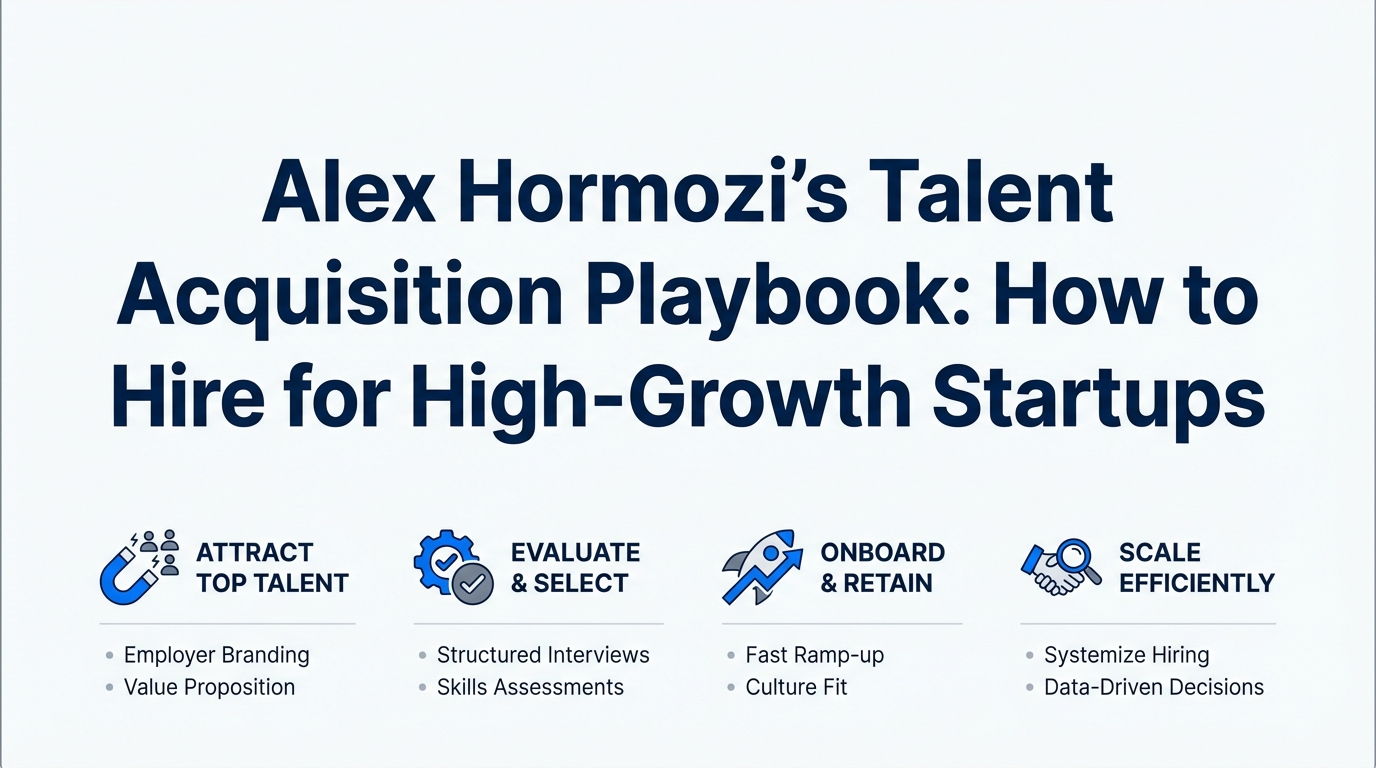
For most entrepreneurs, the early days of a business are characterized by brute force. You are the marketer, the salesperson, the product developer, and the customer support lead. But there is a ceiling to what one person—or even a small, scrappy team—can accomplish through sheer effort. According to Alex Hormozi, the highest return on capital an entrepreneur can ever achieve is not found in a new ad campaign or a product feature; it is found in talent. While a good marketing strategy might yield a 3x or 5x return, the right hire can deliver a 100x return on investment by unlocking entire departments and solving complex constraints you didn't even know existed.
The Highest Return on Capital: Why Talent Wins
In the world of hiring for startups, founders often view payroll as an expense to be minimized. Hormozi argues the opposite: talent is an asset class. If you invest $100,000 in a top-tier operator who then generates $2 million in enterprise value, that is a return profile that beats any stock market index or real estate flip. The challenge is shifting your mindset from "filling a role" to "acquiring an asset."
This shift requires moving away from desperate hiring. When you hire because you "really have to fill a role," you usually end up with the wrong person. The goal of a sophisticated talent acquisition strategy is to be so proactive that you find people you must have, even if you don't have a specific role for them yet. These are the A+ players who bring their own momentum to the company.
The $5M Revenue Milestone: Becoming a 'Collector of People'
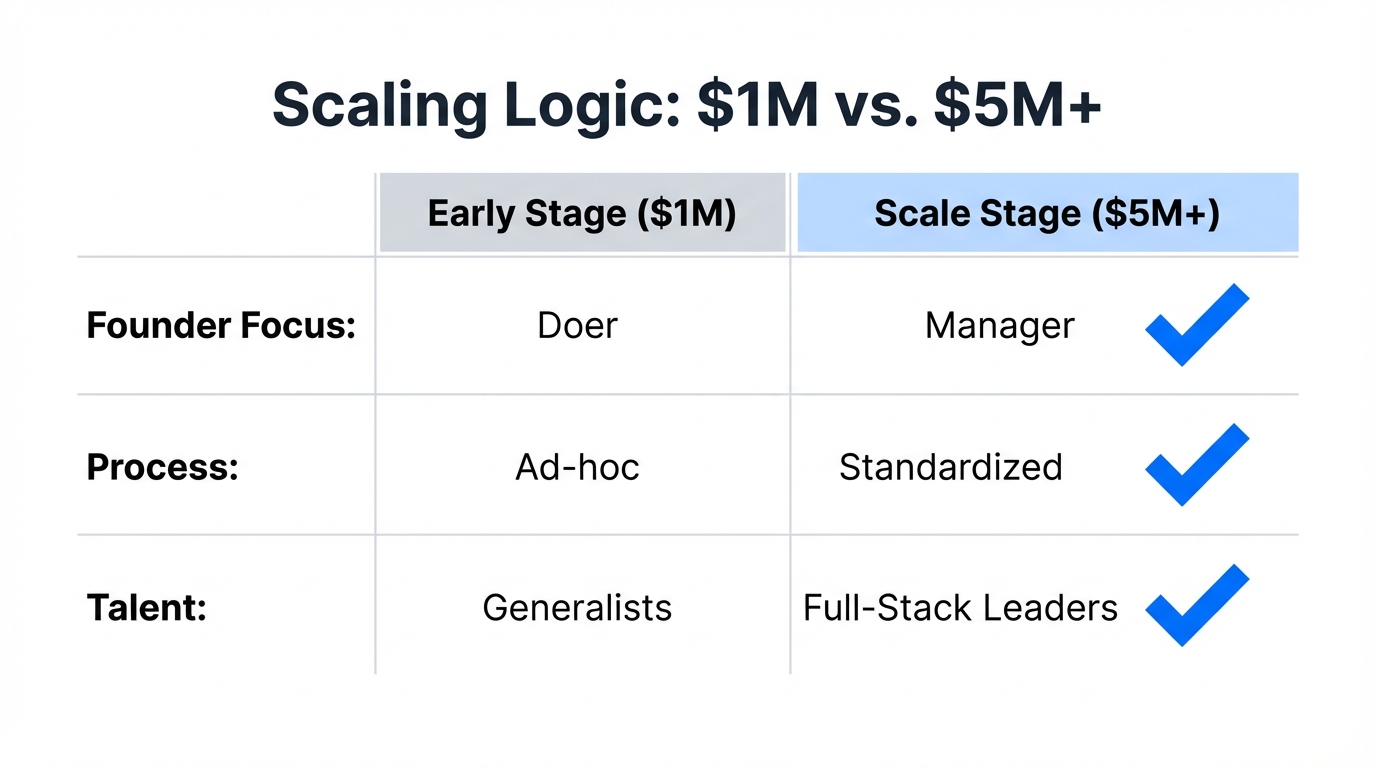
There is a specific inflection point—usually around the scaling business past 5 million revenue mark—where the founder's job description fundamentally changes. You are no longer a "fisherman" catching leads or closing deals; you must become a collector of people. At this stage, your primary output is the quality of the team you assemble.
Hormozi notes that many founders plateau at $1M to $3M because they are still the primary solvers of every problem. To break through to $10M and beyond, you must build a virtuous cycle. The faster you grow, the better talent you attract; the better talent you attract, the faster you grow. If your growth slows, you enter a vicious cycle where top talent leaves for more exciting opportunities, further slowing your progress. This is why aggressive growth is often a defensive necessity in the talent market.
"Once you get to 5 million in revenue, you have to become a collector of people. You are no longer just building a business; you are assembling a dream team."
Hiring for Rate of Learning Over Technical Skill
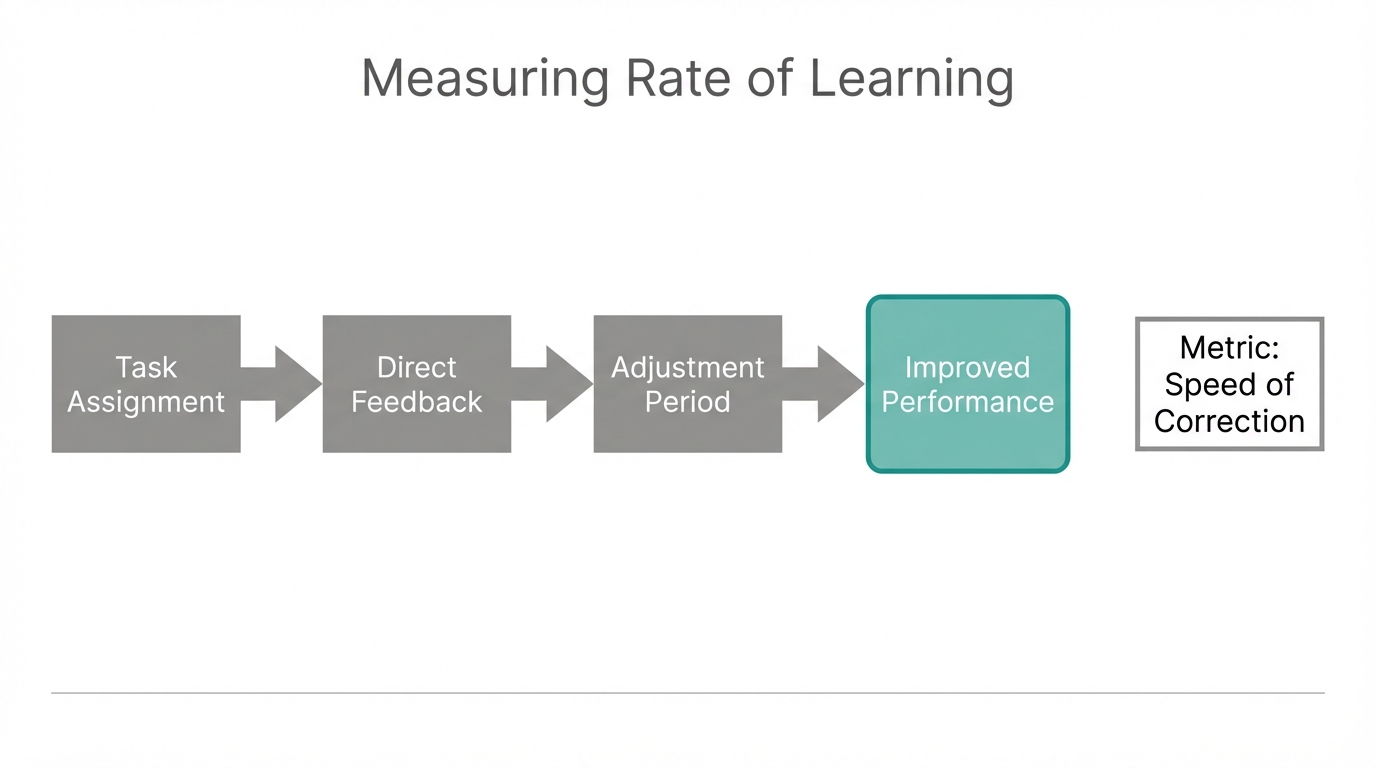
One of the most contrarian aspects of the Alex Hormozi hiring framework is the emphasis on general intelligence over specific experience. Hormozi defines intelligence as the rate of learning. In a fast-moving startup environment, the skills required today will be obsolete in six months. Therefore, you need people who can bridge skill gaps faster than the market changes.
| Role Type | What to Hire For | The Reasoning |
|---|---|---|
| Low-Skill Roles (e.g., Cashier, Support) | Attitude | Training technical tasks takes hours; training "not being a jerk" takes years. |
| High-Skill Roles (e.g., AI Researcher, VP) | Aptitude / Intelligence | You cannot train rate of learning. You need the horsepower to solve novel problems. |
| Leadership Roles | Full-Stack Ability | Must be able to go from "clouds to dirt"—strategy down to individual execution. |
When recruiting A+ players, Hormozi looks for the "small skill deficiency." Every skill is trainable, but is it worth the resources? High-intelligence candidates can be coached on the nuances of tools like Meta Ads Manager or complex project management in Notion in weeks, whereas a mediocre candidate with five years of experience might never reach the same level of creative problem-solving.
The Management Diamond: Solving Performance Issues
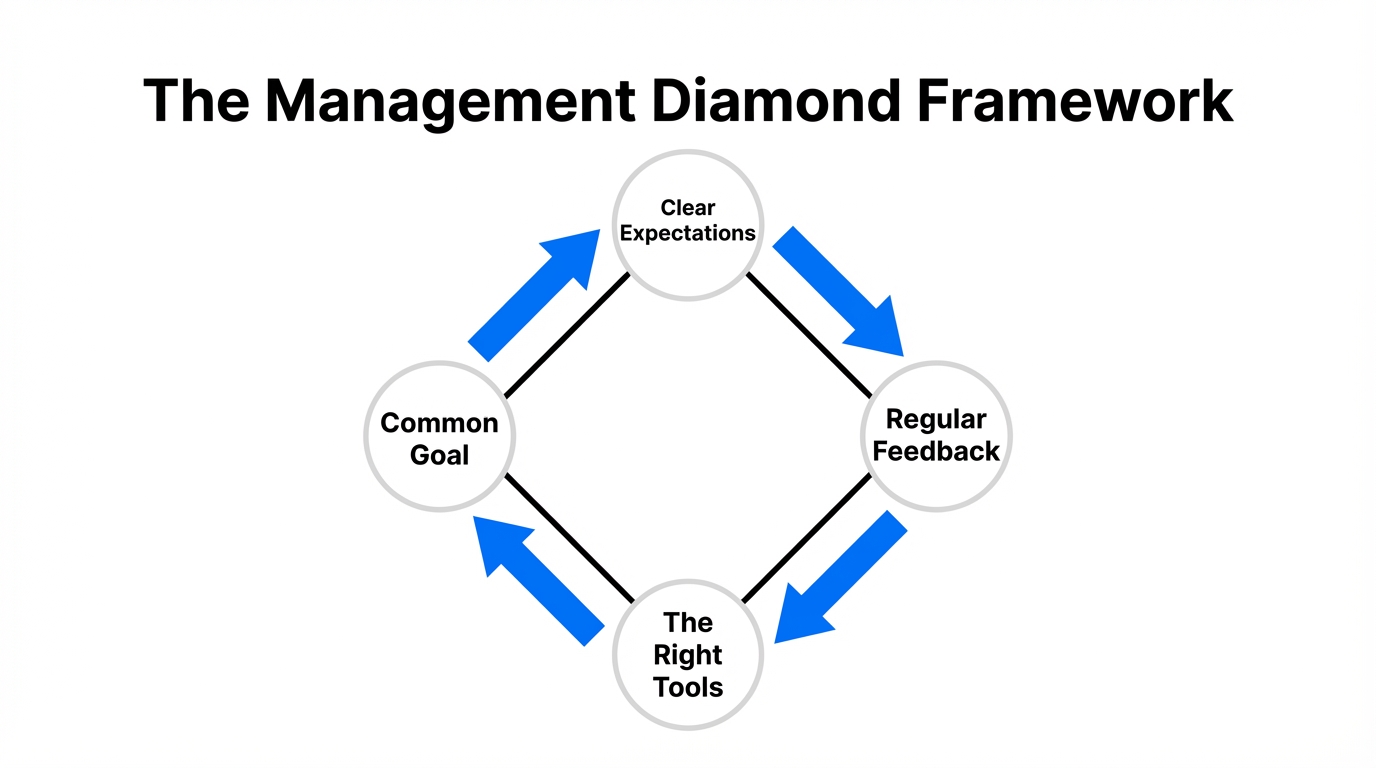
Before you fire someone for being "lazy" or "incompetent," Hormozi suggests using the Management Diamond framework to diagnose the real issue. This prevents you from attacking the person and instead focuses on the system. When an employee isn't performing, it's usually because of one of these four gaps:
- What: They don't know exactly what you want done (Lack of clarity).
- How: They don't know how to do it (Lack of training).
- When: They didn't know the deadline or priority (Lack of urgency).
- Blockers: Something is standing in their way (Lack of resources/support).
Only after these four are cleared do you look at Motivation. Most people want to do a good job to stay employed; if the first four are handled and they still fail, then you have a character or fit issue that requires a fast exit.
"Most performance issues are actually communication issues. If they know what, how, and when, and they have no blockers, then you can talk about motivation."
The Alex Hormozi Hiring Playbook: A Step-by-Step Process
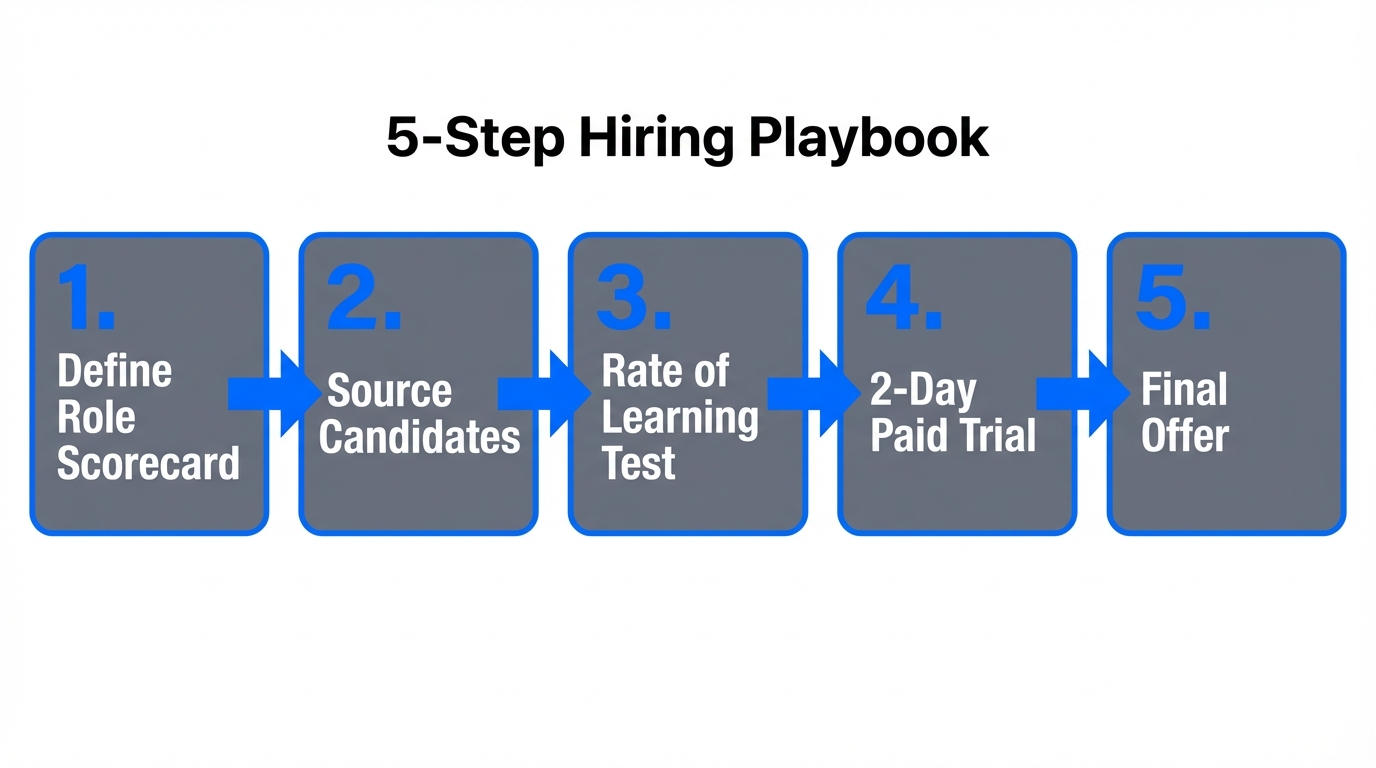
To implement this in your own startup, follow this structured process for every high-level hire.
Step 1: Vet for High-Quality Questions
During the interview, the quality of the questions the candidate asks is more important than their answers. A high-intelligence candidate will have researched your company deeply. If they ask generic questions that could be answered by a 5-minute search on Google, they lack the curiosity and resourcefulness required for a high-growth environment.
Step 2: Use Real-World Case Studies
Stop using hypothetical "ping-pong balls in a 747" questions. Instead, present them with a real problem your business is currently facing. For example, if you are struggling with creator outreach, ask them how they would use tools like Stormy AI to discover and vet influencers at scale. This gives you free consulting if they are smart and immediate proof of their problem-solving horsepower.
Step 3: Test for Coachability
During a roleplay (especially for sales or leadership), give the candidate a piece of direct, slightly harsh feedback. Watch how they react. Do they get defensive, or do they immediately try to implement the tweak? Coachability is a proxy for rate of learning.
Identifying 'Full Stack' Leaders with a 'Black Book'
When you are recruiting A+ players for C-suite or VP roles, you aren't just hiring an individual; you are hiring their network. Hormozi points out that it is "weird" if a senior executive has no one from their past who wants to follow them to a new venture. A great leader has a "black book" of former colleagues and subordinates who recognize their excellence.
Furthermore, these leaders must be "full stack." They should be able to operate in the "clouds" (high-level strategy) and the "dirt" (getting on a sales call or drafting a script). If a VP of Sales can't close a deal themselves, they cannot effectively manage a team of closers. This vertical integration of skills ensures that they can diagnose problems at every level of the funnel.
Retaining Talent: The Grand Slam Offer for Employees
To win the war for talent against tech giants and AI startups, you need a Grand Slam Offer for employees. While big companies offer stability and perks, high-growth startups offer growth and impact. Many A+ players are mission-driven; they want to see their work move the needle in real-time. Platforms like Stormy AI streamline creator sourcing and outreach, allowing your team to focus on high-level strategy rather than manual data entry, which is a major retention booster for top-tier talent who hate busywork.
Finally, remember that the best talent are partners, not just employees. If you don't seek their advice on complex problems, you aren't treating them like a value-add. If you do find a "Perfect Sam"—someone who can do 100% of what you do—be willing to pay them whatever it takes. Talent is the only investment where the upside is truly uncapped according to Hormozi's $100M Offers principles.
Conclusion: Building Your Talent Engine
Transitioning from a solo operator to a collector of people is the hardest leap an entrepreneur can take. It requires letting go of control and trusting the Alex Hormozi hiring framework: hire for intelligence, manage with clarity, and never settle for "good enough" when it comes to leadership. By focusing on talent acquisition strategy as your primary growth lever, you turn your business from a job into an enterprise. Ready to start finding those A+ players? Focus on building your virtuous cycle today, and the right people will eventually find their way to your door.