In the high-stakes business landscape of 2026, the difference between a struggling startup and a scaling empire often comes down to a single mathematical threshold. Alex Hormozi, the $100 million man and perhaps the most influential business educator of our time, has codified this into a framework he calls Money Models. At its core, this strategy isn't just about selling more; it's about engineering a sequence of offers where the profit from one customer immediately finances the acquisition of the next. If you want to scale without external investors, you need to master the physics of cash flow.
The Golden Equation: Gross Profit vs. CAC + COGS
 1:34
1:34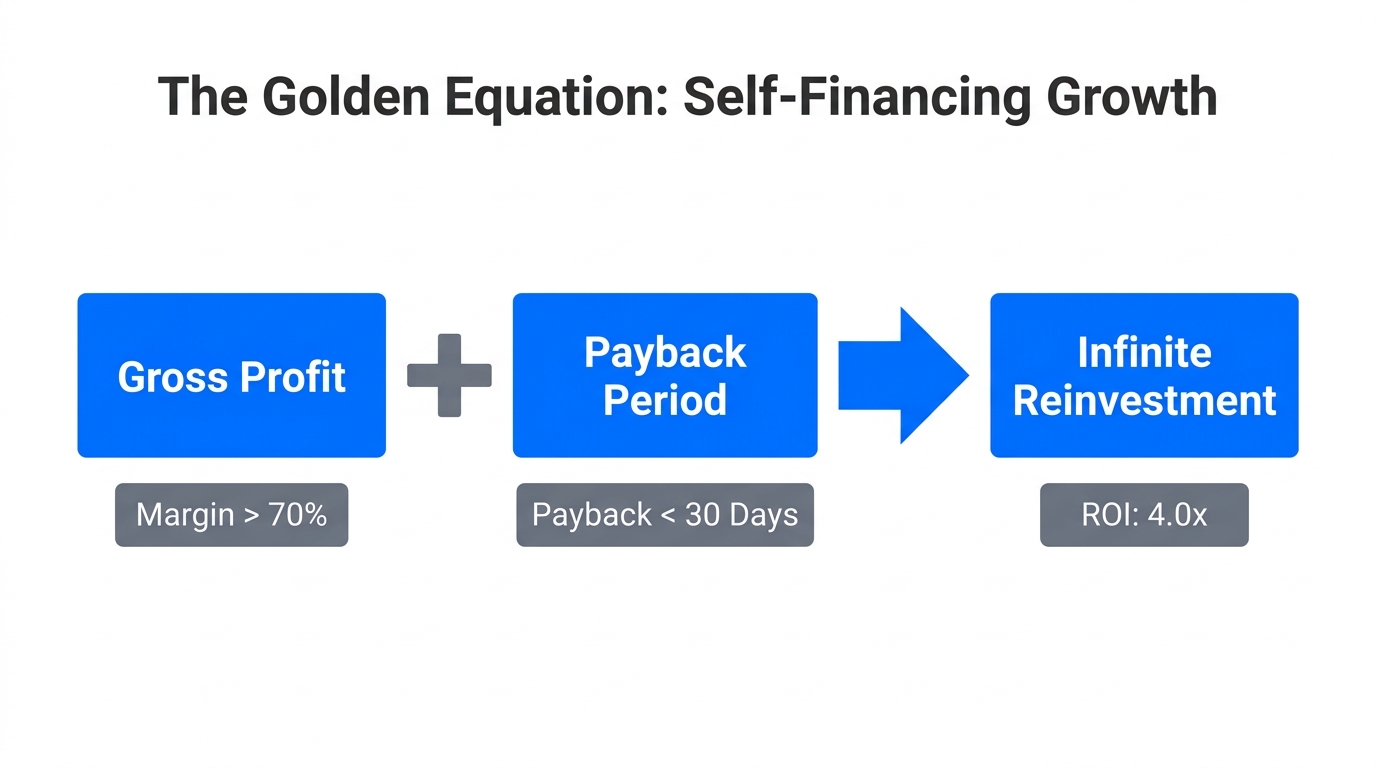
The fundamental pillar of the Hormozi money models is a simple yet brutal equation. To achieve what Hormozi calls "client-financed acquisition," your business must hit a specific financial benchmark within a 30-day window. In 2026, where attention costs on platforms like Meta Ads Manager and TikTok Ads Manager continue to rise, this math is your survival guide.
When your 30-day gross profit exceeds twice the sum of your acquisition and delivery costs, your business becomes a "printing press." Every customer you acquire doesn't just pay for themselves; they pay for two more customers. This creates a viral loop of capital rather than just users. By leveraging tools like Stripe for instant clearing and Stormy AI to discover high-ROI micro-influencers who lower your initial CAC, you can widen this gap significantly.
"One customer should come loaded with your next customer. If your math is right, they are holding the next guy by the throat, ready to fund your expansion."
The Old Way vs. The Money Model Way
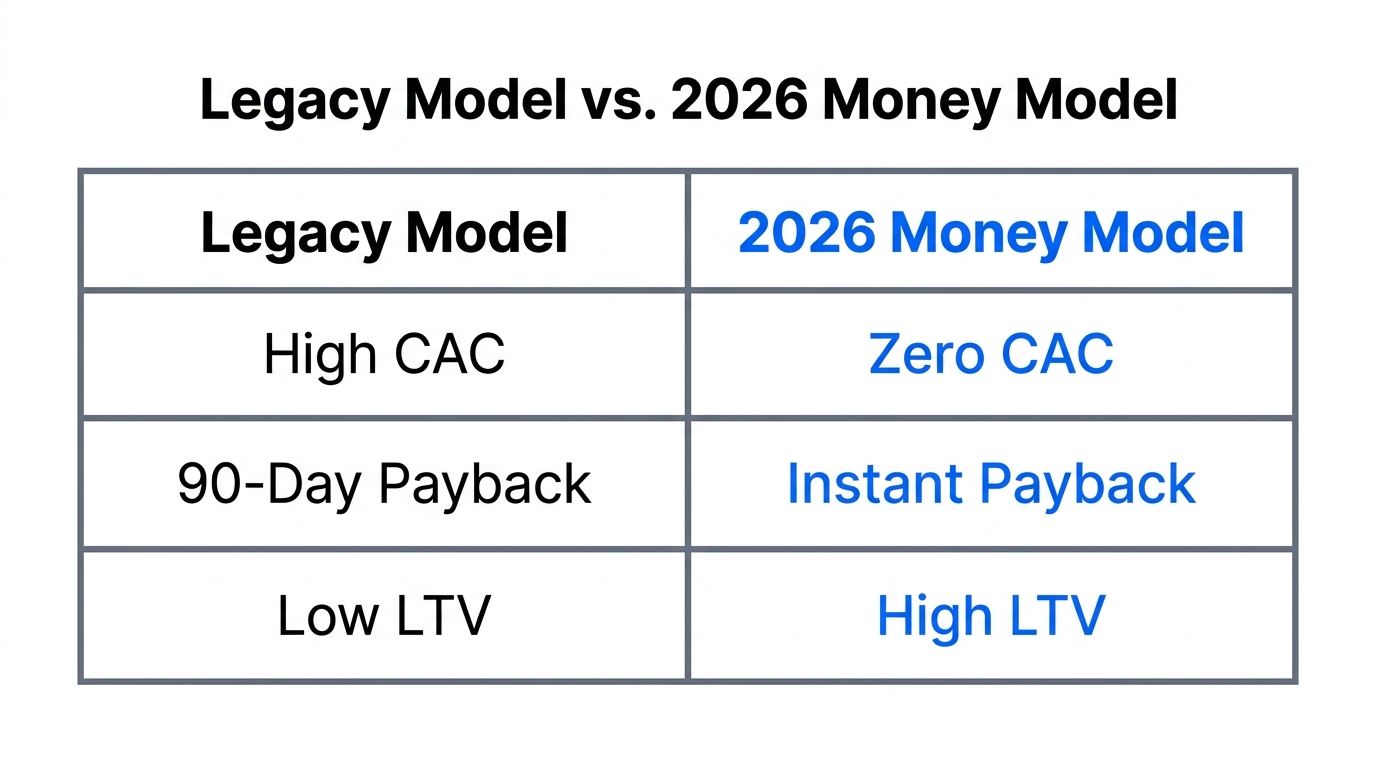
Most service businesses and SaaS platforms in 2026 still struggle with the "Old Way" of marketing. They offer low-ticket trials—$21 for 21 days or a free 14-day trial—hoping that volume will eventually lead to retention. The problem? You are upside down on your cash flow from day one.
| Metric | The Old Way (Trial Model) | The Money Model (Transformation) |
|---|---|---|
| Front-End Offer | $21 or Free Trial | $500+ Transformation Challenge |
| Time to Break Even | 60-90 Days | Day 0 (Instant Profit) |
| Cash Flow Position | Negative (Debt/Investment Needed) | Positive (Self-Financing) |
| Upsell Take Rate | Low (10-15%) | High (30-50% with 'X without Y') |
As Hormozi explains, the gym industry used to live on $99/month memberships that took 60 days to recoup a $50 CAC. In contrast, by selling a transformation promise (e.g., a 6-week weight loss challenge) for $500 upfront, you move from being a debt-collector to a cash-heavy operator. This upfront capital allows you to outspend competitors on Google Ads, effectively buying the market while they wait for monthly subscriptions to clear.
Anatomy of a 2026 Money Model: From Attraction to Continuity
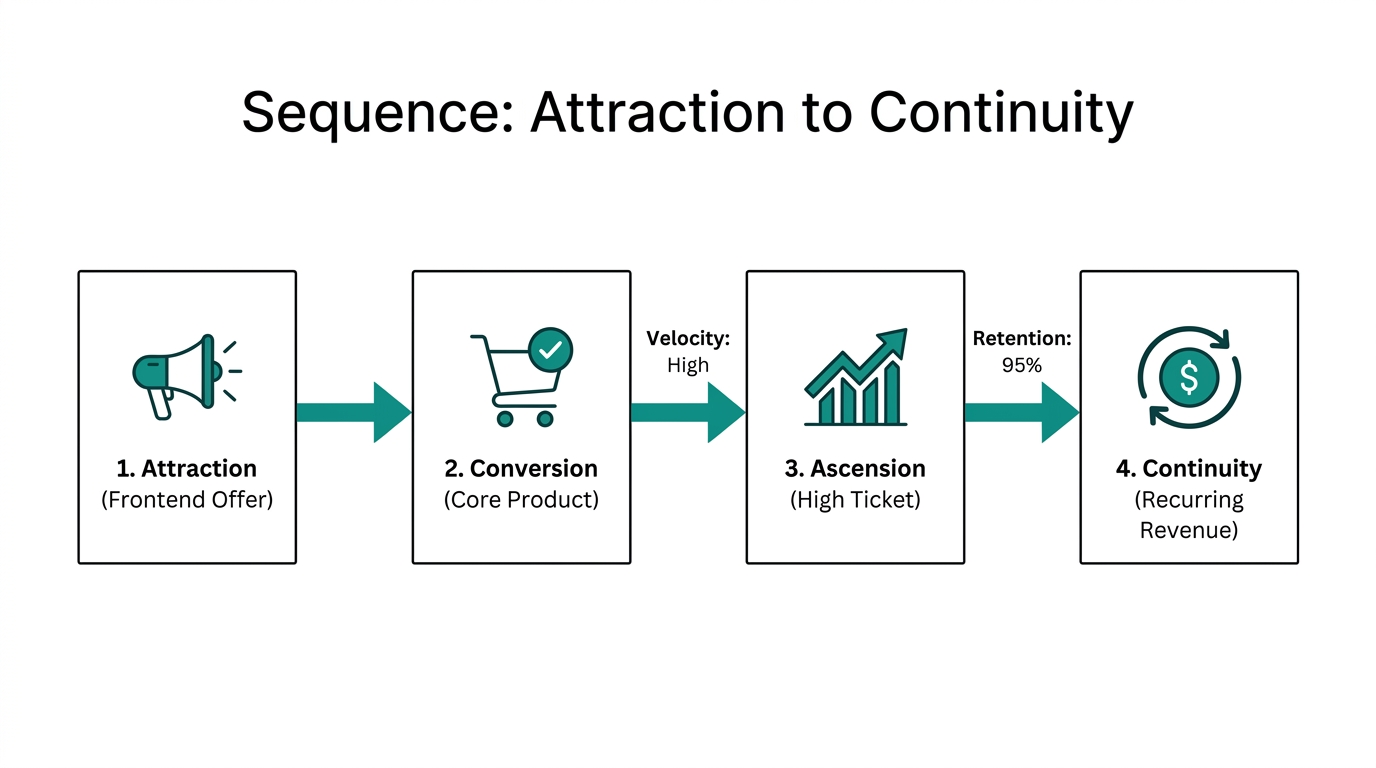
A Money Model is not just a single offer; it is a deliberate sequence designed to solve the customer's next problem before they even realize they have it. Hormozi breaks this down into four critical components:
1. Attraction Offers
This is your lead magnet on steroids. It’s not just an ebook; it's a "Win Your Money Back" challenge or a high-value giveaway. For example, if you run a talent agency like Somewhere.com, an attraction offer might be a raffle for a free top-tier developer for a year. This generates massive qualified demand. Brands are increasingly using Stormy AI to identify the exact creators whose audiences resonate with these high-value attraction offers, ensuring the front-end lead flow is both cheap and high-quality.
2. The Classic Upsell (X Without Y)
Hormozi’s favorite upsell logic is simple: You can't have X without Y. If you buy a burger, you need fries. If you buy a $500 fitness challenge, you need $200 in supplements to ensure results. If you hire a remote team, you need a payroll management solution to handle international compliance. By presenting the upsell as a way to make the first decision even more sound, you achieve 80-90% take rates.
"People have different 'wallets' for different pains. Their 'personal training' wallet might be empty, but their 'tax avoidance' or 'convenience' wallet is still full. Tap the right one at the right time."
3. Feature Downsells
When a prospect says no to your core offer, most marketers give up. The Money Model uses feature downsells. If they can’t afford the $5,000 package, remove the guarantee or the 1-on-1 coaching and offer a $2,000 version. Paradoxically, removing the guarantee often makes the customer realize how much they value it, leading them to re-upsell themselves back to the premium tier.
Timing the Pain: The Five Windows of Opportunity
11:27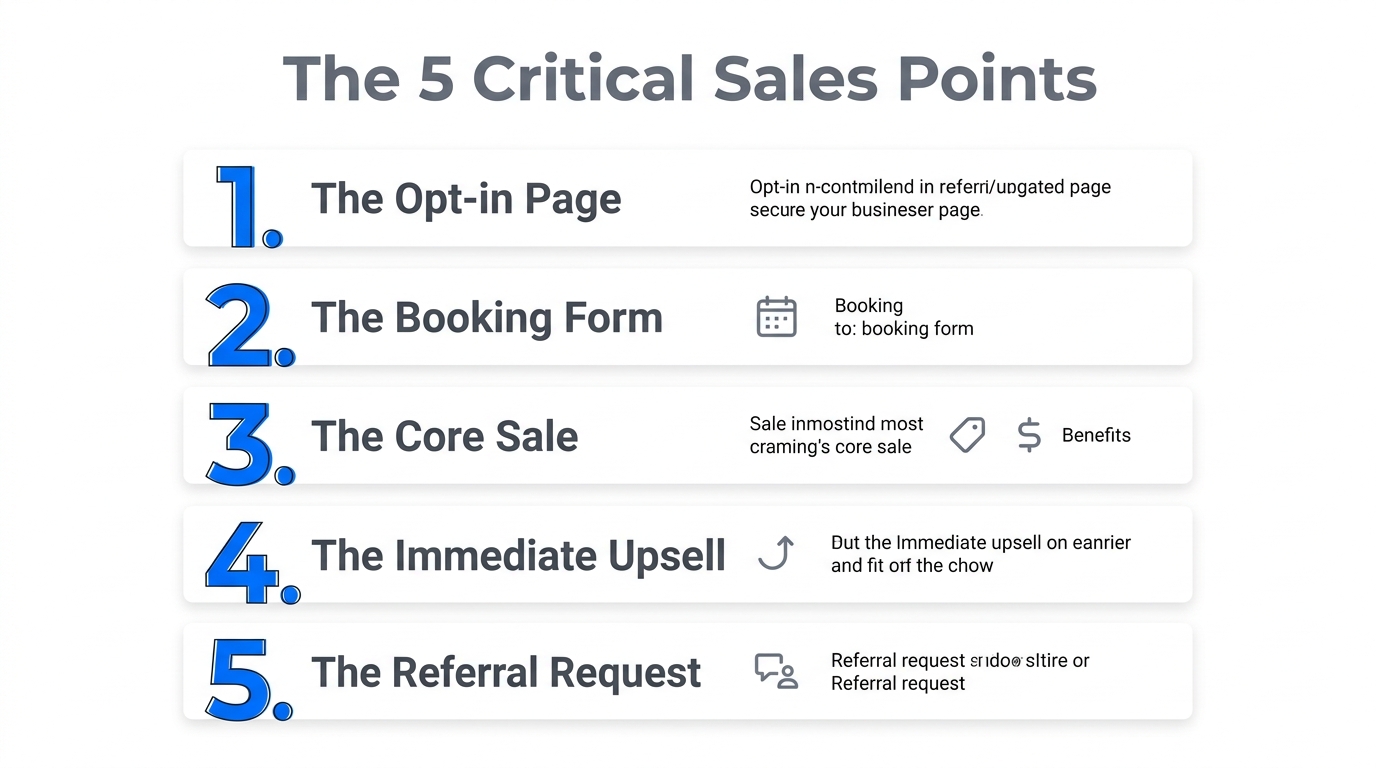
Success in 2026 requires selling at the point of greatest deprivation, not just greatest value. Hormozi identifies five key moments to trigger your Money Model sequences:
- Immediately: In the same conversation as the first 'Yes'.
- Activation: Right after they achieve their first small win.
- Halfway: Because "we are humans at halfway" and need a push.
- Milestone: When a specific achievement creates a new problem (e.g., getting too many leads creates a need for an AI CRM like Pipedrive).
- Last Chance: Just before the relationship or contract ends.
Case Study: Scaling Gym Launch from Zero to $2.2M/Month
4:09Alex Hormozi’s scaling of Gym Launch is the ultimate proof of concept for the self-financing business model. While competitors were stuck in the "Old Way," Hormozi used a 20:1 LTV-to-CAC ratio driven by upfront cash. Here is how the math worked:
- Initial CAC: $50 per customer using highly targeted social ads.
- Upfront Sale: $500 for a 6-week challenge.
- Immediate Upsell: $200 in supplements (80% margins = $160 profit).
- Pre-payment Continuity: 20% of members prepay for a full year ($2,000 upfront).
By stacking these, Hormozi averaged $1,000 in cash collected per customer in the first 30 days against a $50 acquisition cost. This meant he could spend $5,000 in ads and get $100,000 back before even opening a new gym location. This capital was used to paint walls, buy equipment, and hire staff, making the business cash flow positive on Day 1 without a cent of venture capital.
Optimizing the 2026 Growth Stack
To implement these money models today, you need a tech stack that supports rapid iteration and automated outreach. High-growth agencies and brands are pairing Hormozi’s logic with modern AI tools. For instance, using Canva to design high-ticket offer briefs and Stormy AI to automate the discovery and outreach to UGC creators allows you to test attraction offers at a fraction of the traditional cost.
Furthermore, managing these relationships requires a robust CRM for sales tracking, combined with Klaviyo for automated upsell email sequences. The goal in 2026 is to remove human friction from the "X without Y" logic, letting AI handle the follow-ups while you focus on the offer architecture.
"Technology democratizes consumption but consolidates production. If you have the best Money Model, you will eventually own the entire market because you can afford the attention that no one else can."
Conclusion: Your 2026 Profit Playbook
70:56The Alex Hormozi money models aren't about being "salesy"; they are about being financially literate. In a world where capital is expensive and attention is scarce, the only way to win is to ensure your first customer pays for the next two. Stop selling trials and start selling transformations. Map your "X without Y" upsells, implement "Wave Fees" for continuity, and use AI-powered discovery platforms to keep your CAC low.
By mastering these frameworks, you move from a student of the "thing" (the craft) to a student of business. That is where the $100 million net gains are made. Ready to find the creators who will fuel your attraction offers? Explore how to discover and vet influencers on Stormy AI to kickstart your self-financing journey today.