The highest return on capital an entrepreneur can achieve isn’t found in a stock index or a real estate play; it is found in talent. While traditional investments might net a 10% or 20% return, the right hire can deliver a 100x return reliably. As Alex Hormozi suggests, once a business crosses the $5 million revenue mark on platforms like Shopify, the founder’s job shifts from being a technician to becoming a collector of people. To manage this collection effectively, leaders need a robust performance management playbook that removes emotion and replaces it with objective diagnostics.
The 4 Pillars of the Management Diamond
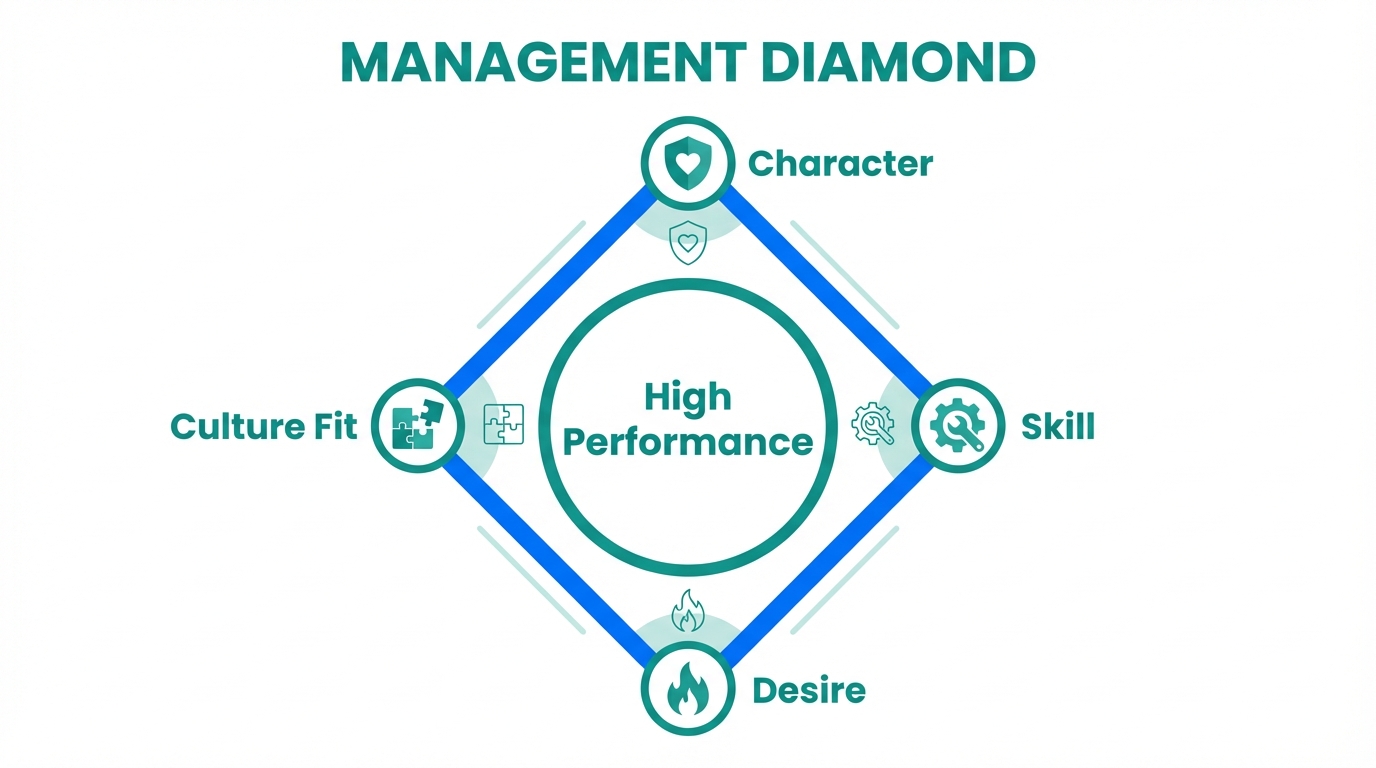
Most managers react to poor performance with frustration or personal attacks, labeling employees as "lazy" or "unmotivated." Hormozi’s Management Diamond is a leadership development framework designed to diagnose the root cause of why an employee isn't delivering, without attacking their character. It assumes that most people want to do a good job and keep their employment. If they aren't succeeding, it is usually a failure in one of four areas.
- Clarity of What: Did you communicate exactly what needs to be done? Often, a manager thinks they were clear, but the employee has a different mental model of the task.
- Clarity of How: Does the employee actually have the skill set to execute? If they know what to do but not how to do it, this is a training issue, not a character flaw.
- Clarity of When: Was there a specific deadline? Without a "when," a task is just a suggestion.
- Removing Blockers: Are there external factors—software issues, lack of budget, or dependencies on other departments—preventing them from finishing? Effective workflow automation can often eliminate these bottlenecks.
The Small Skill Deficiency Rule: Attitude vs. Aptitude
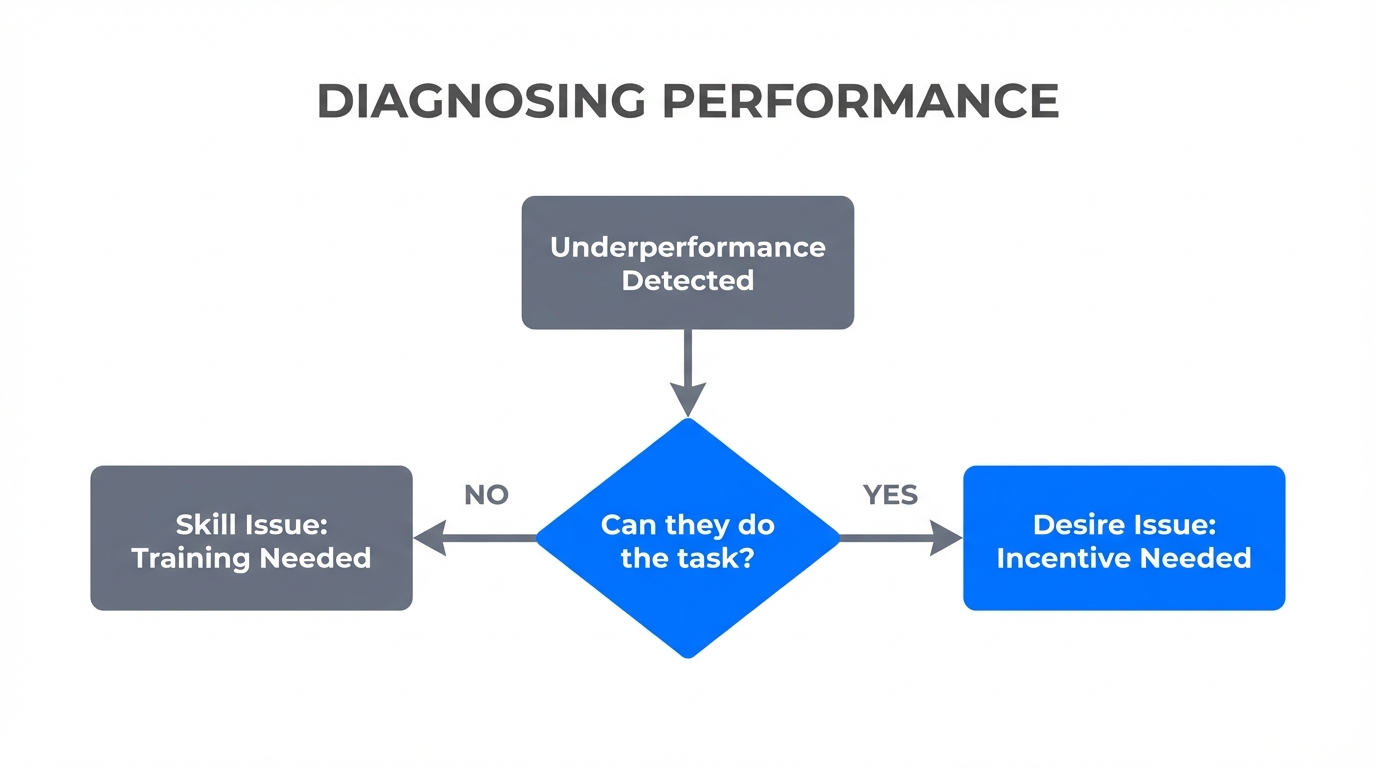
A common trap in team management strategies is applying the same hiring rubric to every role. Hormozi differentiates between "low-skill" labor and "high-leverage" roles. The secret is to hire for the small skill deficiency. This means identifying which traits are hardest to train and hiring for those first.
| Role Type | Primary Hiring Filter | Reasoning |
|---|---|---|
| Low-Skill (e.g., Hospitality) | Attitude | It takes 2 hours to teach someone a cash register, but 2 years to teach them to be friendly. |
| High-Leverage (e.g., AI Research) | Aptitude (IQ) | You can coach a brilliant researcher on communication, but you can't coach a friendly person into a world-class scientist. |
| Sales | Coachability | The ability to take immediate feedback and iterate is the highest predictor of success. |
In high-performance leadership, intelligence is defined as the rate of learning. If you hire someone with high "horsepower," they can bridge skill gaps faster than someone with experience but lower cognitive flexibility. This is why tools like Google Ads or complex data pipelines are managed best by those who can deconstruct problems from first principles rather than following a static manual.
"The faster you grow, the more talent you get, which grows you faster. It is a virtuous cycle that requires a relentless focus on the rate of learning."
Testing Horsepower: Using Case Interviews
How do you actually measure intelligence in an interview? Standard questions like "Where do you see yourself in five years?" are generic and easily gamed. Instead, high-performance teams use case interviews. This involves presenting the candidate with a real business problem the company is currently facing.
For executive roles, Acquisition.com often uses "frustration" as a tool. They provide candidates with a complex Google Doc of raw company data and ask them to build a strategy. This does two things: it provides free "consulting" perspective and, more importantly, it demonstrates how the candidate thinks. Do they ask high-quality questions? Do they deconstruct the problem using frameworks you haven't considered?
For more repetitive roles, like content creators or editors, the process is simpler but equally rigorous: give them a sample task. If you are hiring a creator to manage your social presence, don't just look at their portfolio—give them raw footage and see how they edit a 60-second clip using CapCut or Descript. This filters for those who can actually do the work versus those who are just good at interviewing.
Scaling Through Urgency: From Level 0 to Level 2 Managers
A major bottleneck in growth is the lack of urgency. Hormozi describes the transition of a manager through three levels of high performance leadership based on how they handle deadlines. If your business is using a Sales CRM to track deals, the speed at which your team moves determines your ultimate enterprise value.
- Level 0 Manager: Assigns a task but never asks for a deadline.
- Level 1 Manager: Asks for a deadline and accepts whatever the employee says (e.g., "I'll have it by Friday").
- Level 2 Manager: Questions the deadline. They ask, "What is blocking you from having this today?" and then re-prioritize the employee's workflow to pull the future forward.
By constantly asking "What would it take to do this in half the time?", leaders can accelerate the entire organization. This isn't about burning people out; it's about ruthless prioritization and removing the "buffer" people naturally build into their schedules.
Global Good vs. Local Good: The Ethics of Firing
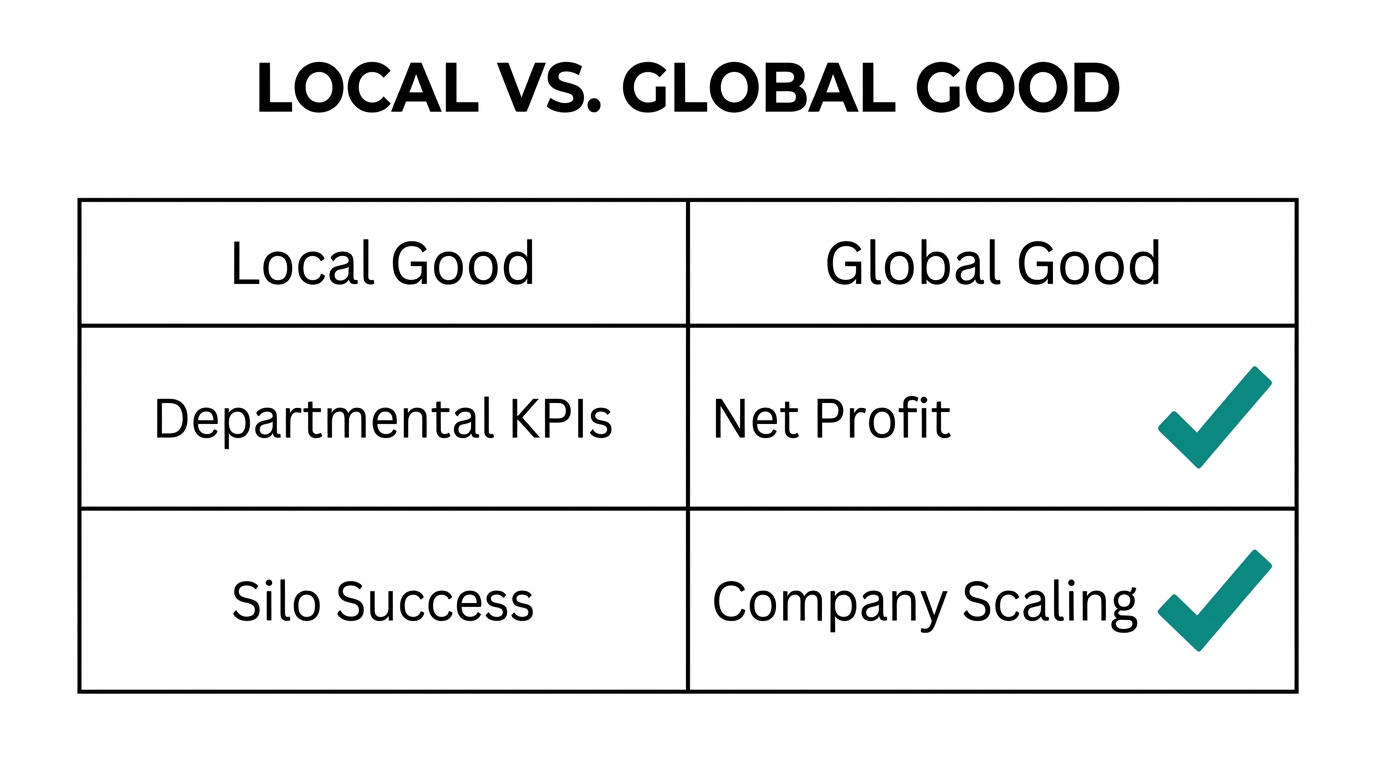
Firing is the hardest part of management, but it is often a necessity for performance management playbooks. Many leaders delay firing because they want to avoid the "local discomfort" of a hard conversation. However, Hormozi argues this is a form of selfishness. By keeping a low-performer, you are choosing your own short-term comfort over the global good of the company and the other high-performers whose careers depend on the company's success.
When evaluating whether to let someone go, categorize them into levels of competence:
- Yellow: They are competent but have reached their ceiling; they cannot take on more responsibility.
- Orange: They are struggling with their current role but aren't yet a critical bottleneck.
- Red: They are failing in a role that is the current constraint of the business.
Red-level employees must be handled immediately. If the person is the bottleneck for your growth, keeping them is an act of sabotage against the rest of the team. As mentioned in the Founders Podcast by David Senra, history’s greatest entrepreneurs often succeeded because they were willing to make these hard trades for the sake of the mission.
"You owe it to the people who have put their lives and careers in your hands to make the hard decisions that protect the organization's future."
Full-Stack Leadership: Clouds to Dirt
The best leaders are vertically integrated. They can handle "clouds" (high-level strategy, vision, entity structure) and "dirt" (getting on a sales call, editing a script, or setting up a TikTok Ads Manager account). A VP of Sales who can't close a cold lead is not a true A-player; they are a theorist.
This "full-stack" mentality allows a leader to vet talent effectively. If you know how to do the job, you can spot a "bullshitter" instantly. When scaling creator programs, for instance, platforms like Stormy AI provide the analytical "dirt"—engagement rates, audience quality, and fake follower detection—so that leaders can focus on the "cloud" strategy of brand positioning.
Conclusion: Building the Talent Snowball
Success in business is a snowball of talent. If you treat people well, pay exceptionally, and maintain high standards, your core team will follow you from venture to venture. The ultimate litmus test for a leader is their "black book." If an executive joins your team and can't bring a single "stud" they’ve worked with in the past, it's a major red flag.
By implementing the Alex Hormozi management diamond, you move away from emotional reactivity and toward a data-driven approach to human capital. Focus on the rate of learning, prioritize the global good, and never stop being a collector of people. Your business growth is nothing more than a reflection of the density of talent you've managed to assemble.