The narrative around artificial intelligence has shifted. We are moving past the era of mere curiosity and into the era of industrial application. For the savvy entrepreneur, this transition represents the single greatest arbitrage opportunity of our lifetime. While the world debates the philosophical implications of AGI, a new breed of service-based businesses is emerging: the AI Workflow Agency. These agencies aren't selling generic "AI advice"; they are selling the construction of digital factories that turn 40-hour work weeks into 40-minute tasks.
The value proposition is simple yet profound. Small and medium-sized enterprises (SMEs) are drowning in repetitive, manual tasks in departments like marketing, sales, and fulfillment. They know they need AI, but they are too overwhelmed by the pace of change to implement it. By mastering tools like ChatGPT Pro and Claude, you can step in as the expert architect, charging $50,000+ for high-velocity "efficiency sprints" that fundamentally transform their bottom line.
The Arbitrage Opportunity: Why Companies Pay $50k+ for Sprints
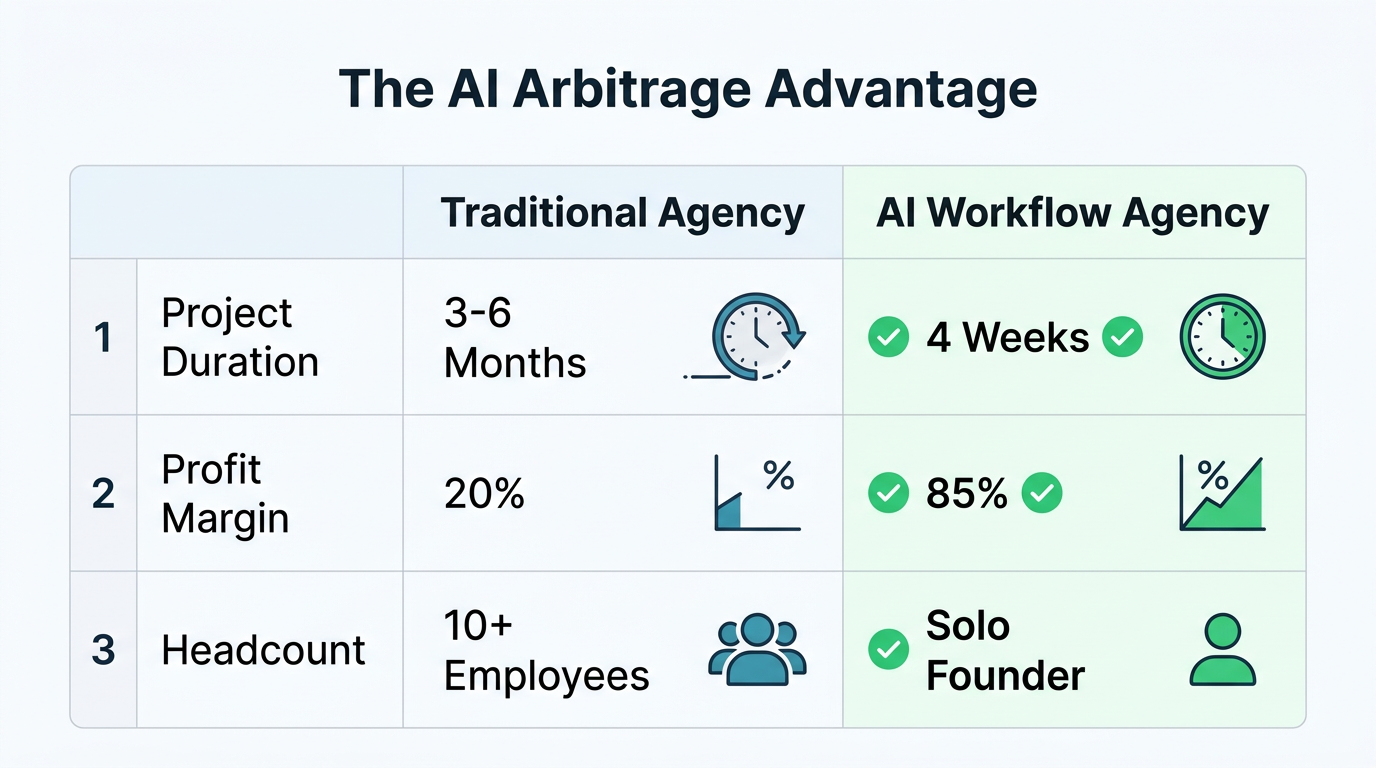
Why would a law firm or a logistics company pay five or six figures for a few weeks of consulting? Because the ROI is immediate and measurable. Consider this: many companies still spend tens of thousands of dollars on research papers or market studies that take months to produce. In the modern era, that same output can be generated—often with higher quality—in minutes using advanced models like GPT-4.5 or Claude 3.5 Sonnet.
According to recent industry insights, a study that previously cost $35,000 and took three months to complete can now be replicated through deep research in an AI model in under 10 minutes. This isn't science fiction; it is the current reality for those who know how to "set up the machine." For a business owner, paying $50,000 to eliminate $200,000 in annual contractor or labor costs is a logical, high-probability investment.
"Instead of hiring your first employee for $10,000 a month, you should hire ChatGPT Pro for $200. It gives you the productivity equivalent of hundreds of people if you know how to prompt the machine."
The current market is in a state of "subsidized intelligence." VCs are pouring billions into keeping tools like ChatGPT Pro and Claude affordable for individuals. This creates a temporary window where your agency's operating costs are nearly zero while your value delivery remains astronomical. Eventually, these tools may be priced closer to human labor costs, but right now, the arbitrage is yours for the taking.
Mapping the Factory: Diagnosing Repetitive Tasks
To build a successful AI automation consulting business, you must stop looking at businesses as teams of people and start looking at them as factories of repeatable tasks. Every department—marketing, sales, engineering, HR—has a "boring" layer of repetitive execution that is ripe for automation.
The Audit Process
When you enter a client's business, your first task is to "map the factory." You are looking for the 40-hour work week tasks that can be compressed into 40 minutes. YC (Y Combinator) has recently signaled that this compression of time is the primary metric for the next wave of billion-dollar startups. As an agency, you provide this compression as a service.
- Marketing: Are they manually researching Reddit threads for content ideas? Are they spending days on ad variations?
- Sales: Are SDRs manually writing every outreach email from scratch using basic templates?
- Fulfillment: Is there a team manually summarizing meeting notes or drafting white papers?
| Function | Traditional Workflow | AI-Powered Workflow |
|---|---|---|
| Content Ideation | 5 hours of manual research | 5 minutes (Reddit scraping + AI Analysis) |
| Ad Creation | Designers + Videographers (Weeks) | AI Image Gen + Faceless Video (Minutes) |
| Client Research | Junior researcher (2 days) | Perplexity/GPT-4 Deep Research (10 mins) |
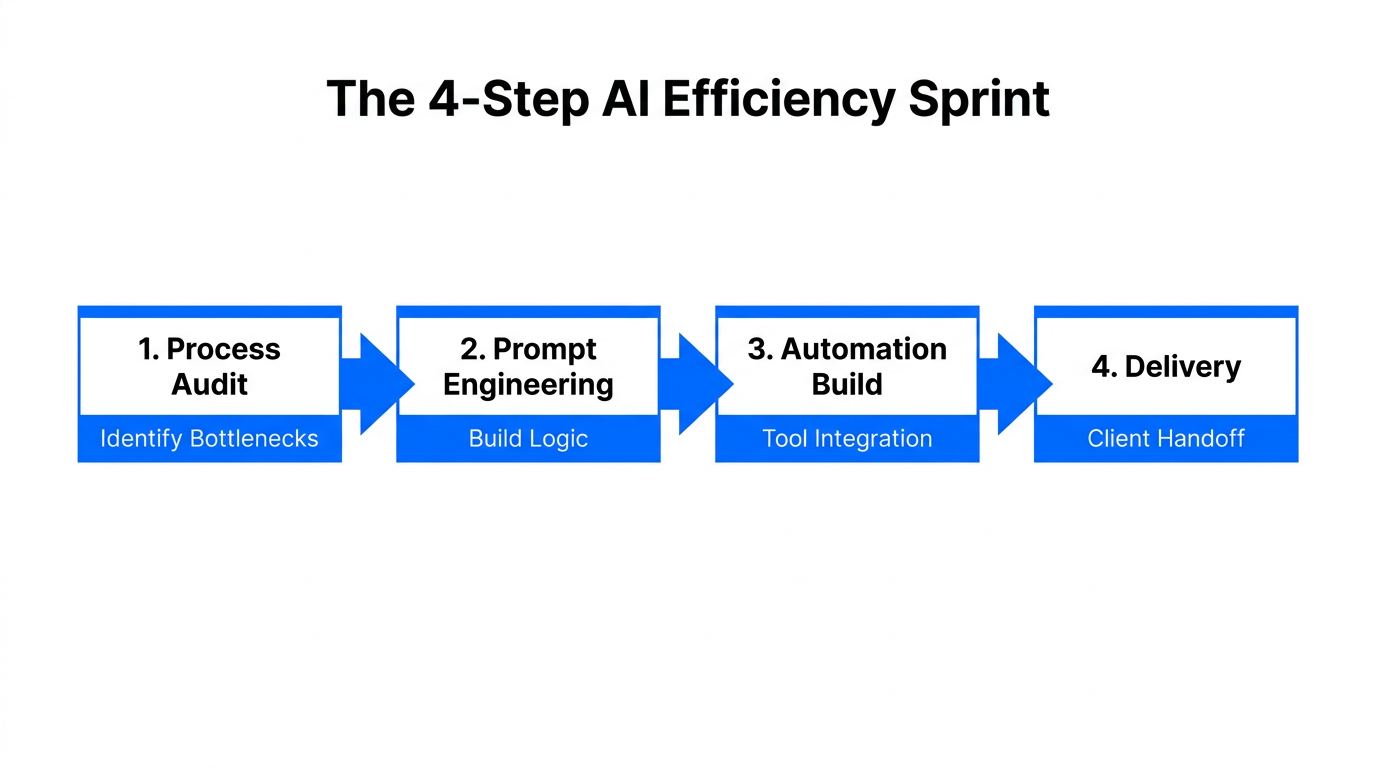
By identifying these bottlenecks, you can propose a 6-week sprint. You aren't just giving them a login to ChatGPT; you are building their custom memory, setting up their prompts, and integrating specialized tools into their daily operations via platforms like Zapier or Make.
The Claude and ChatGPT Pro Tech Stack
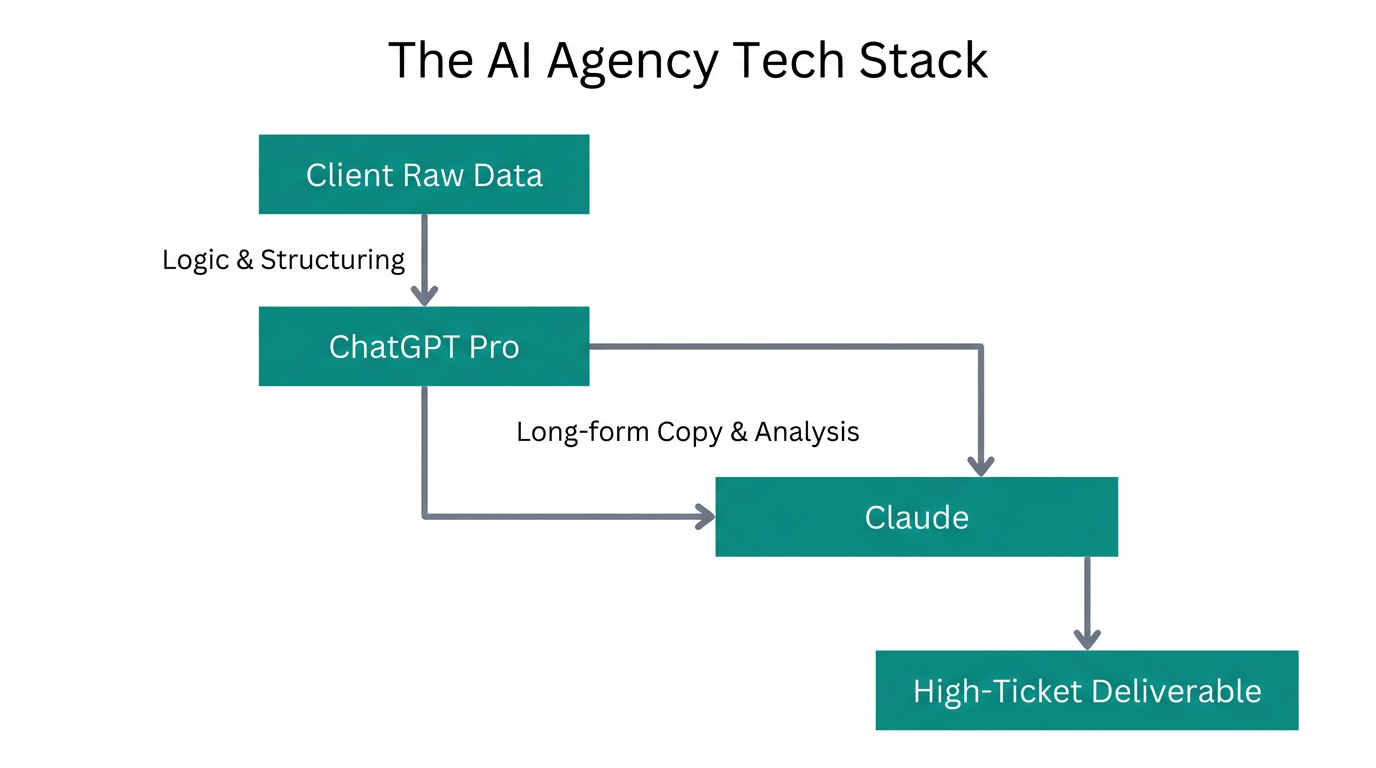
A high-ticket AI agency business model relies on more than just basic prompting. You need to build a specialized stack that solves specific problems. While Claude for business is exceptional for long-form writing and coding, ChatGPT Pro workflows are better for web searching and general task orchestration.
Advanced Image and Video Generation
One of the most profitable areas for AI implementation is creative production. Companies spending millions on Meta Ads Manager or Google Ads are desperate for more creative variations. Instead of a traditional production cycle, you can implement tools like Arcads for AI video actors or Canva Magic Design for high-converting image ads.
The secret is reverse engineering taste. As the human editor (think of yourself as Rick Rubin, the legendary producer), your value isn't in pushing the button—it's in having the taste and intuition to know which AI output is "banging." You can use AI to research what works on Reddit or TikTok Ads Manager and then prompt the machine to recreate that "vibe."
"If you know how to set up the machine, all you have to do is open the door at 9:00 a.m. and keep the lights on."
In cases where your clients need to scale their influencer presence or source User Generated Content (UGC), tools like Stormy AI can help source and manage creators at scale. By integrating an AI discovery and outreach engine, you help your clients move from manual search to an automated creator CRM, making their marketing department feel like it has 50 employees instead of five.
Niche Selection: Why 'Boring' is More Profitable
The most common mistake for new consultants is trying to be an "AI for everyone" agency. This leads to low margins and fragmented knowledge. The most profitable high-ticket service businesses focus on "boring" industries with high LTV (Lifetime Value) and repetitive administrative burdens.
Targeting High-Value, Boring Industries
- Law Firms: Document review, case research summaries, and automated client intake.
- Finance & Accounting: Data extraction from receipts using Stripe-compatible tools, report generation, and compliance checking.
- Logistics/Supply Chain: Route optimization summaries and vendor communication automation.
- B2B SaaS: Managing the creator marketing engine by using Stormy AI to automate outreach and discovery for app install campaigns.
These industries are less likely to be "AI-first," which means your impact is greater. A startup in San Francisco already knows about Notion AI; a mid-sized law firm in Ohio does not. That knowledge gap is where your $50,000 fee lives.
The 'Paid to Learn' Strategy: The Long Game
Running an AI automation consulting agency is the ultimate "bridge" business. While you are getting paid high fees to solve problems for clients, you are effectively being paid to master the tools of the future. This is the Paid to Learn strategy.
By seeing the internal friction points of 50 different companies, you will eventually identify a problem that occurs in every single one of them. That is your SaaS idea. Instead of guessing what to build, you are using your agency as a laboratory. You can then use your master-level knowledge of ChatGPT Pro workflows and Shopify integrations to build a software product that automates what you used to do manually.
Think of it like Gary Vaynerchuk and VaynerMedia. He used the agency to learn exactly how social media worked for big brands, then used that data to build his own personal brand and investment portfolio. Your agency is the tuition for your future billion-dollar oneperson startup.
Conclusion: Building the 100-Person Team for $320/Month
We are living through a unique window where a solo founder can have the output of a traditional 100-person firm. As Tiago Forte famously noted, for about $320 per month (ChatGPT Pro, Claude Max, and NotebookLM), you can access productivity levels that were previously reserved for Fortune 500 companies.
The difference between the person who builds a billion-dollar solo business and the person who gets left behind isn't the tools—it's the mastery and integration of those tools into a repeatable workflow.