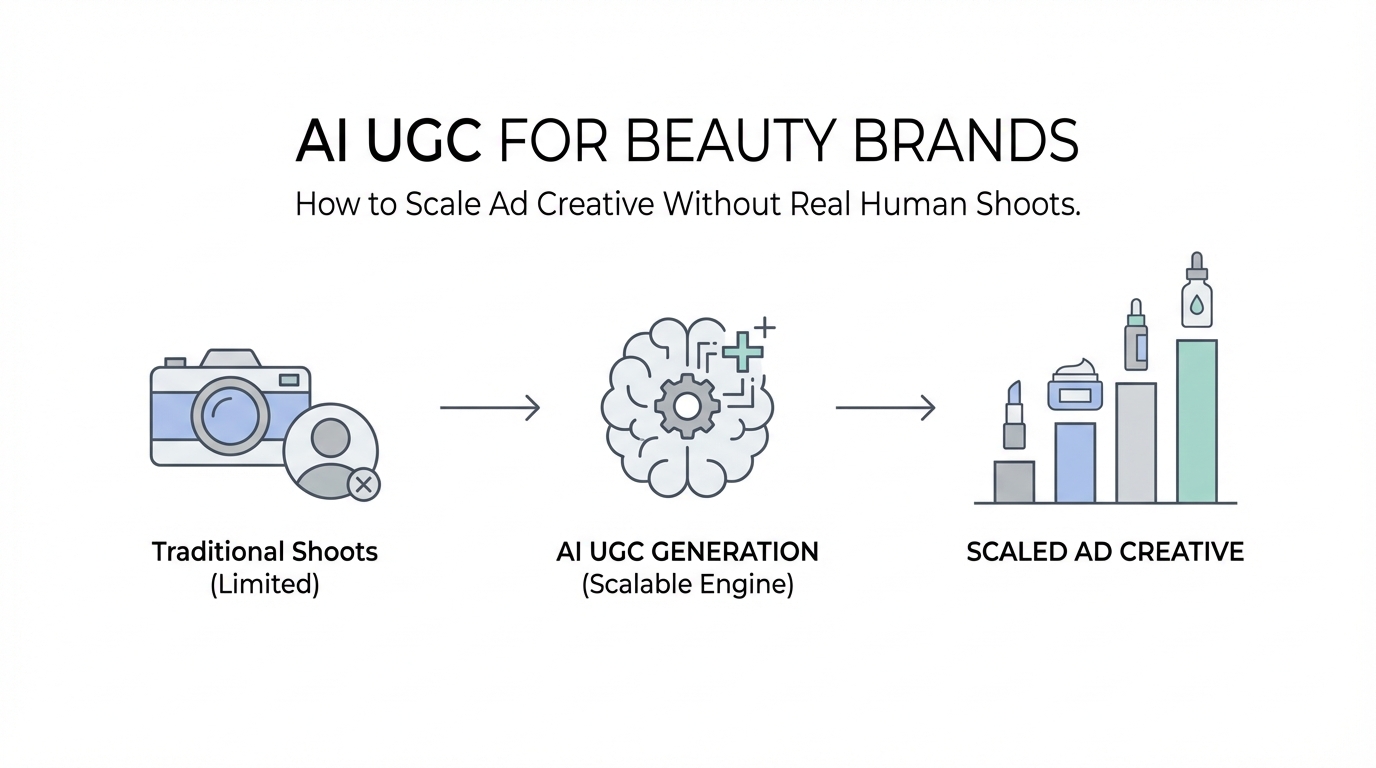
In the high-stakes world of beauty brand marketing, content is no longer just a luxury—it is the lifeblood of survival. The industry has reached a tipping point where traditional production cycles cannot keep pace with the voracious appetite of the Facebook and TikTok algorithms. Many founders find themselves trapped in a 'creative bottleneck,' where the inability to produce fresh, high-performing video content leads to ad fatigue, soaring customer acquisition costs, and stagnant growth. However, a new paradigm is emerging: AI-powered User-Generated Content (UGC). By leveraging tools like makeugc.ai and advanced AI research agents, brands are now scaling their creative output by 10x while maintaining—and even exceeding—a 5x ROAS, all without stepping foot in a production studio.
The E-commerce Bottleneck: Why Creative Fatigue Kills Growth

The core problem for any ecommerce growth agency or beauty brand founder is the 'biology' of ad creative. Even the most viral ad has an expiration date. As Cody Schneider noted in a recent deep dive on IdeaBrowser, beauty brands often run massive amounts of spend through their accounts, causing audiences to see the same creative too many times. This saturation leads to 'creative fatigue,' where the once-high engagement rates plummet and the Return on Ad Spend (ROAS) begins to bleed.
Historically, the only solution was to hire more creators, ship more products, and wait weeks for raw footage to be edited. Traditional UGC agencies often charge upwards of $6,000 for just five videos, a price point that makes rapid testing nearly impossible for many scaling brands. According to recent industry reports, to maintain a 5x ROAS, you need to be testing dozens of creative variations every month, not just a handful. This is where ugc for ecommerce is shifting from human-dependent to AI-augmented, allowing for a higher volume of creative variations that the Meta and TikTok algorithms can use to find your winning audience.
The New Tech Stack: AI Actors 'Holding' Physical Products
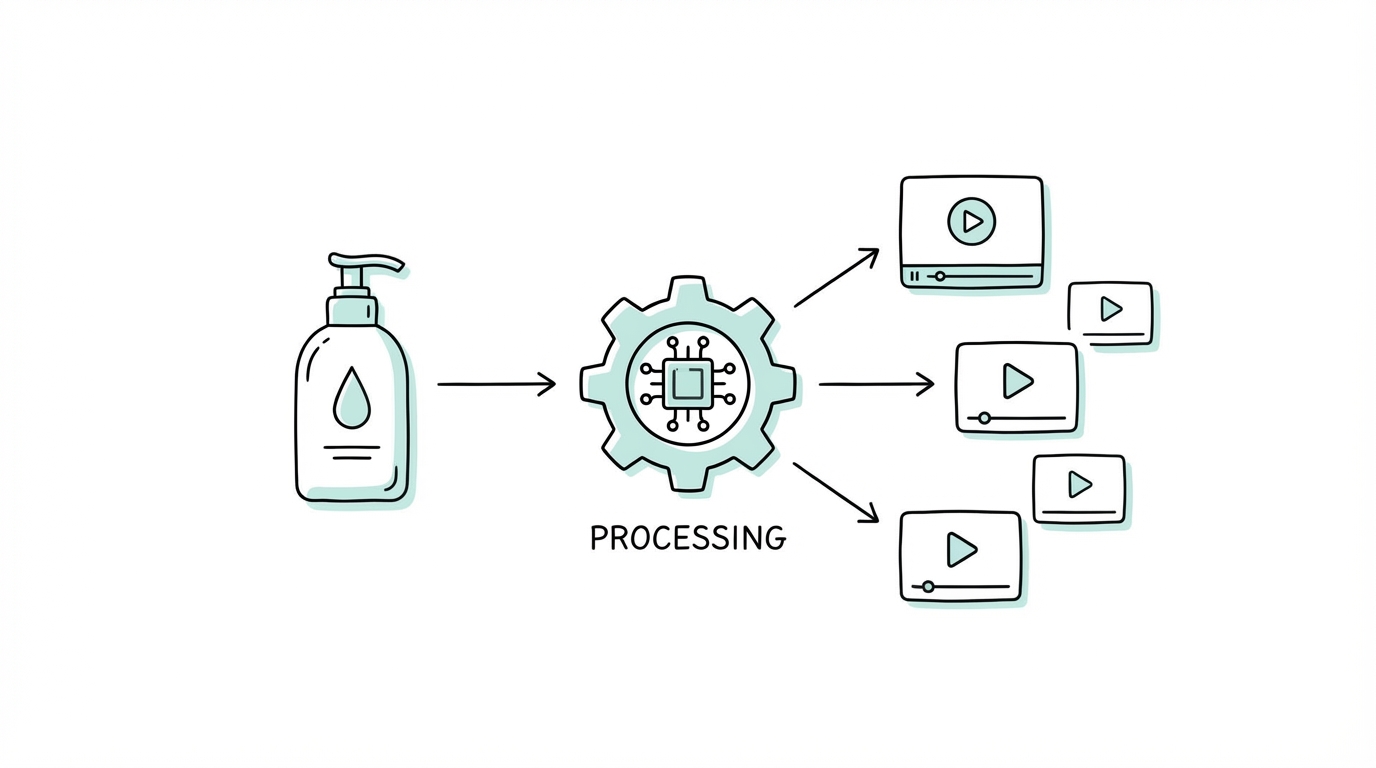

For a long time, the limitation of an ai video generator for ads was the lack of physical interaction. Beauty brands need to show the texture of a serum, the application of a lipstick, or the before-and-after of a skincare routine. Faceless videos or generic avatars didn't cut it. However, tools like makeugc.ai have changed the game by training AI models to 'hold' and interact with specific physical products, a technique similar to the generative AI advancements seen in major retail sectors.
This allows brands to create hyper-realistic social media ad creative where an AI-generated person talks through their 'experience' with the product while physically showing it to the camera. This eliminates the need for shipping physical samples to dozens of creators and waiting for their lighting and audio quality to match brand standards. By using these tools, you can generate 20 to 30 unique ad pieces per month for the cost of a single human-led shoot. For brands looking to scale, this isn't just a cost-saving measure; it's a competitive advantage that allows for constant 'pattern disruption' in the feed.
Pattern Disruption vs. Creative Mimicry: The Research Edge
Most marketers make the mistake of only looking at their direct competitors. They scrape the Meta Ad Library, see what their rival is doing, and copy it. This results in 'creative mimicry,' where every ad in the skincare or supplement niche starts to look identical. To truly disrupt the scroll, you need better source material.
Advanced agencies are now using AI agents built on platforms like Perplexity and Claude to scrape Reddit forums and social media comments. By analyzing thousands of customer reviews and 'unfiltered' conversations about skincare concerns—like eczema or adult acne—you can extract unique 'hooks' that your competitors are missing. For example, if you find a specific, funny way a customer describes their struggle with dry skin on Reddit, that becomes your hook. Using Stormy AI can further refine this process by helping you discover existing creators who are already resonating with these specific niches, allowing you to model your AI content after proven audience preferences.
Step 1: Automated Pain-Point Research
Use an AI agent to aggregate reviews from Amazon, Sephora, and Reddit. Look for the 'Problem-Benefit-Solution' framework. What is the emotional core of the customer's complaint, and how does your product uniquely solve it? These insights are fed into the ad script generator.
Step 2: Scripting with Claude
Take those raw insights and use Claude to write 10 different versions of an ad script. Each script should focus on a different hook: some educational, some testimonial-style, and some focused on 'unboxing' or texture.
Step 3: High-Volume Production
Run these scripts through an ai video generator for ads. By producing 20+ variations, you are giving the Google Ads or Meta algorithms enough data to figure out which creative-hook combination actually converts.
Verticalizing Your Agency: Why the 'Eczema Expert' Wins
If you are running a beauty brand marketing agency, the era of the 'generalist' is over. Being a 'general e-commerce agency' is a race to the bottom on price. Instead, the real revenue—and the highest retention—comes from verticalization. Schneider suggests that being the 'skincare ad expert for eczema brands' is far more valuable than being a generalist.
When you verticalize, you build a repository of what works for that specific sub-niche. You know which hooks convert for sensitive skin, which visual styles perform best on TikTok vs. Instagram, and which AI avatars resonate with that demographic. This expertise allows you to charge premium prices—anywhere from $3,000 to $5,000 per month—because you aren't just selling 'videos'; you are selling a proven path to ROAS. Managing these specialized client relationships and tracking the specific creators you might model your AI after is significantly easier with a creator CRM like Stormy AI that keeps all your data in one place.
The 'Comment-to-Access' Strategy for Agency Growth
Generating inbound leads for an AI-driven agency requires showing your 'sauce' in public. One of the most effective strategies currently working on LinkedIn is the 'Comment-to-Access' flywheel.
Instead of running traditional cold outreach, create a high-value asset—for example, 'I scraped 100 top-performing beauty ads and categorized their hooks.' Post a breakdown of your findings and tell people to 'Comment ADS below to get the full library.' This creates an engagement flywheel that pushes your content to more potential clients. When they comment, you send them the link (which can be a simple Google Drive or a lead magnet) and start a discovery conversation. This builds trust by providing education before you ever ask for a sale.
Reporting and Retention: Tracking What Actually Works
To keep clients paying $5k a month, you must prove the value of your AI UGC. You need a way to show that your creative is outperforming their old, human-shot videos. Tools like Grafth allow agencies to build 'chat-with-data' dashboards. Instead of sending a confusing PDF at the end of the month, you give the client a dashboard where they can ask, 'Which ad had the best ROAS last week?' and get an instant answer.
You should also be looking at 'secondary' platforms for organic growth. While Meta and TikTok are the giants, Pinterest is becoming a goldmine for beauty brands. Using AI to generate aesthetic food and lifestyle images that link back to recipe blogs or beauty routines is a massive SEO and traffic opportunity that most agencies ignore.
Conclusion: The Future of Beauty Marketing is AI-First
The transition to AI UGC is not about replacing humans; it's about removing the friction of production so that brands can focus on strategy and storytelling. By utilizing an ai video generator for ads, scraping deep customer insights, and verticalizing your expertise, you can solve the creative fatigue problem once and for all. The brands that win in the next 24 months will be those that can iterate the fastest. If you are still waiting three weeks for a creator to send back a video, you've already lost. Start building your AI creative engine today, stay close to the revenue, and watch your ROAS climb.