AI Profit Margin Analysis for Shopify: A Guide to Luca AI and Shopify Sidekick in 2026
Master AI profit margin analysis for Shopify in 2026. Learn how to use Luca AI and Shopify Sidekick to shift from ROAS to POAS and hit 10% net margins.
In 2026, the e-commerce landscape has officially transitioned from the "growth at all costs" era to the "age of sustainable margin protection." For Shopify merchants, the vanity of high revenue figures no longer guarantees survival. With rising acquisition costs and a complex web of global logistics, the difference between a thriving brand and a failing one lies in AI profit margin analysis. As Shopify President Harley Finkelstein famously noted earlier this year, 2026 is the "year of the builders," where AI agents handle operational complexity so merchants can focus on brand strategy.
This guide explores the strategic shift toward True Contribution Margin, leveraging tools like Luca AI and Shopify Sidekick to ensure your store doesn't just grow, but remains highly profitable in a competitive market.
The New 2026 Profitability Benchmarks
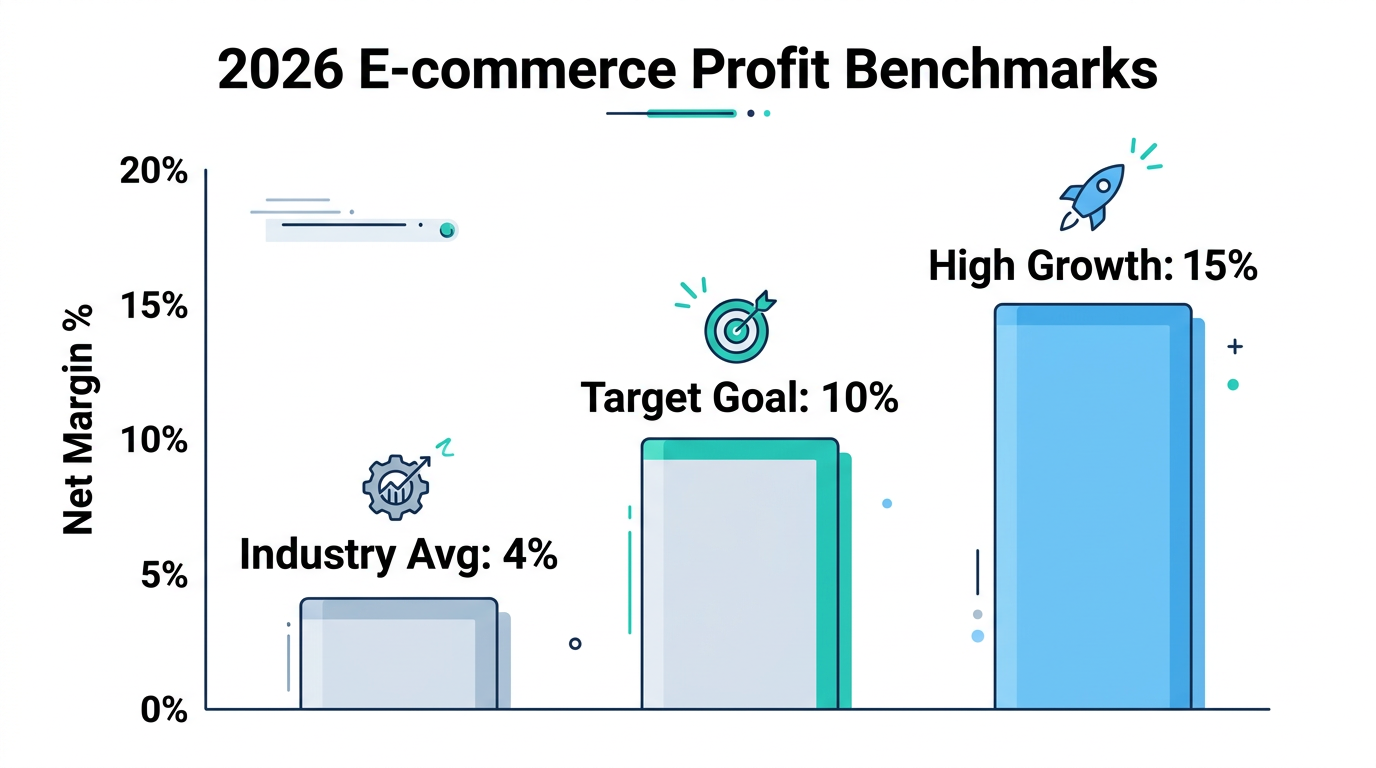
The standard for a "healthy" Shopify store has tightened significantly. In 2026, industry data suggests that top-performing brands are achieving 20%+ Net Margins by utilizing AI to slash operational overhead. However, for most growing stores, the following Shopify net margin benchmarks are the baseline for sustainability:
- Healthy Range: 40%+ Gross Margin; 10%+ Net Margin.
- The Danger Zone: Any net margin below 5% is considered high-risk due to rising ad costs (15–30% of revenue) and shipping (8–15%).
- The AI Advantage: Stores using Luca AI profit analytics report up to a 15% reduction in wasted spend by identifying unprofitable SKUs in real-time.
The AI-powered e-commerce market is projected to reach $22.6 billion by 2032 according to Precedence Research, up from $8.65 billion just last year. This rapid growth means that merchants who fail to integrate automated financial intelligence will likely be out-competed by those using connected intelligence models.
"Connected intelligence—where people, data, and digital workers operate together—is the only viable operating model for 2026." — Aruna Ravichandran, CMO of Cisco
The Shift from ROAS to POAS (Profit on Ad Spend)
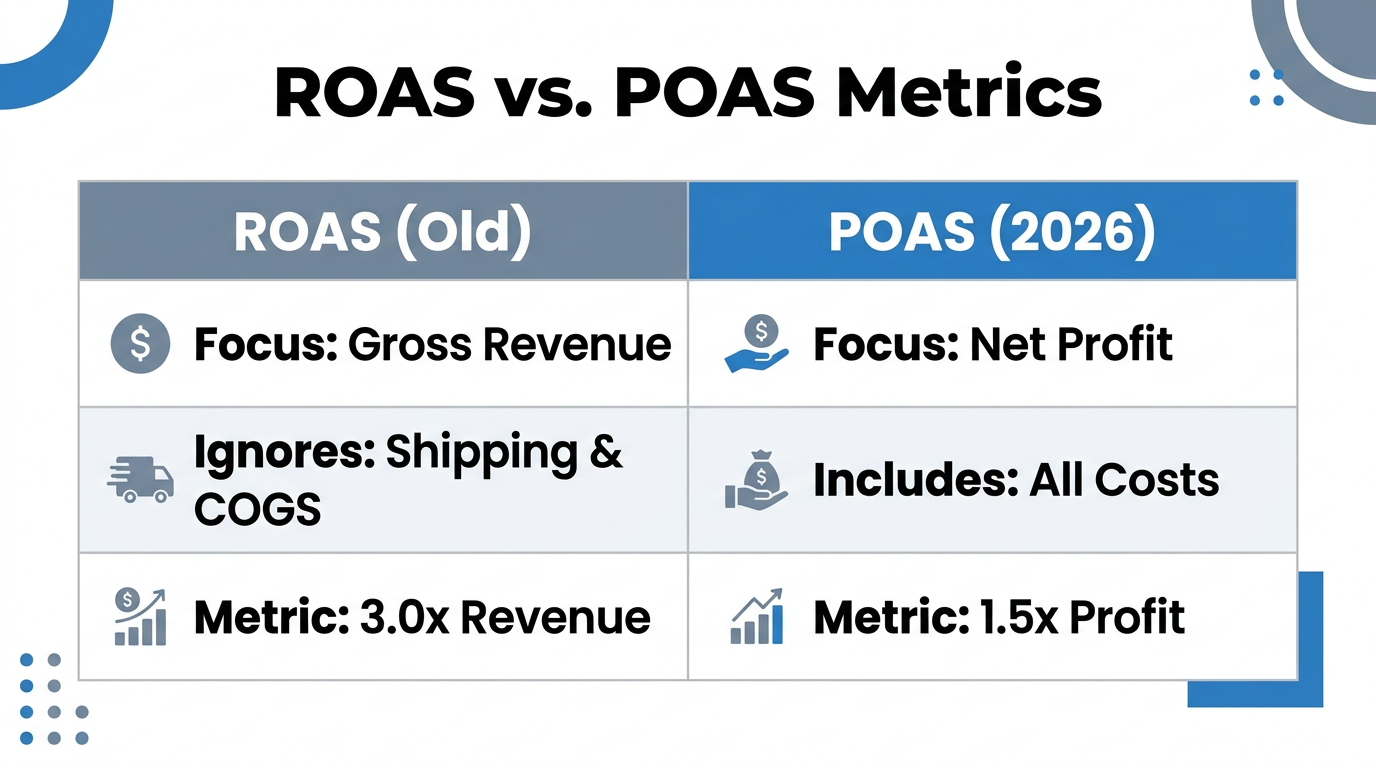
For years, Return on Ad Spend (ROAS) was the gold standard for digital marketing. But in 2026, ROAS is increasingly viewed as a vanity metric. Why? Because a 4.0x ROAS on a product with a high return rate and heavy 3PL fees can actually result in a net loss. This is where POAS (Profit on Ad Spend) comes in.
POAS measures the actual profit generated from every dollar spent on advertising, factoring in the Cost of Goods Sold (COGS), shipping, and payment processing fees. By shifting the focus to POAS, brands can scale their Meta Ads or Google Ads based on bottom-line reality rather than top-line illusions.
| Metric | Focus Area | What it Ignores | 2026 Recommendation |
|---|---|---|---|
| ROAS | Top-line Revenue | COGS, Shipping, Returns, Fees | Use for channel-level direction only |
| POAS | Bottom-line Profit | Nothing (if data is unified) | Primary Marketing KPI |
| MER | Blended Efficiency | Individual Product Margins | Secondary health check |
Platforms like Triple Whale and its "Moby" AI agents have helped brands like Ekster reduce reporting time by 65% while improving their Marketing Efficiency Ratio (MER) by 20%. When combined with Stormy AI for discovering high-converting, low-cost creators, the path to a 20% net margin becomes much clearer.
Using Luca AI for Unified Profit Analytics
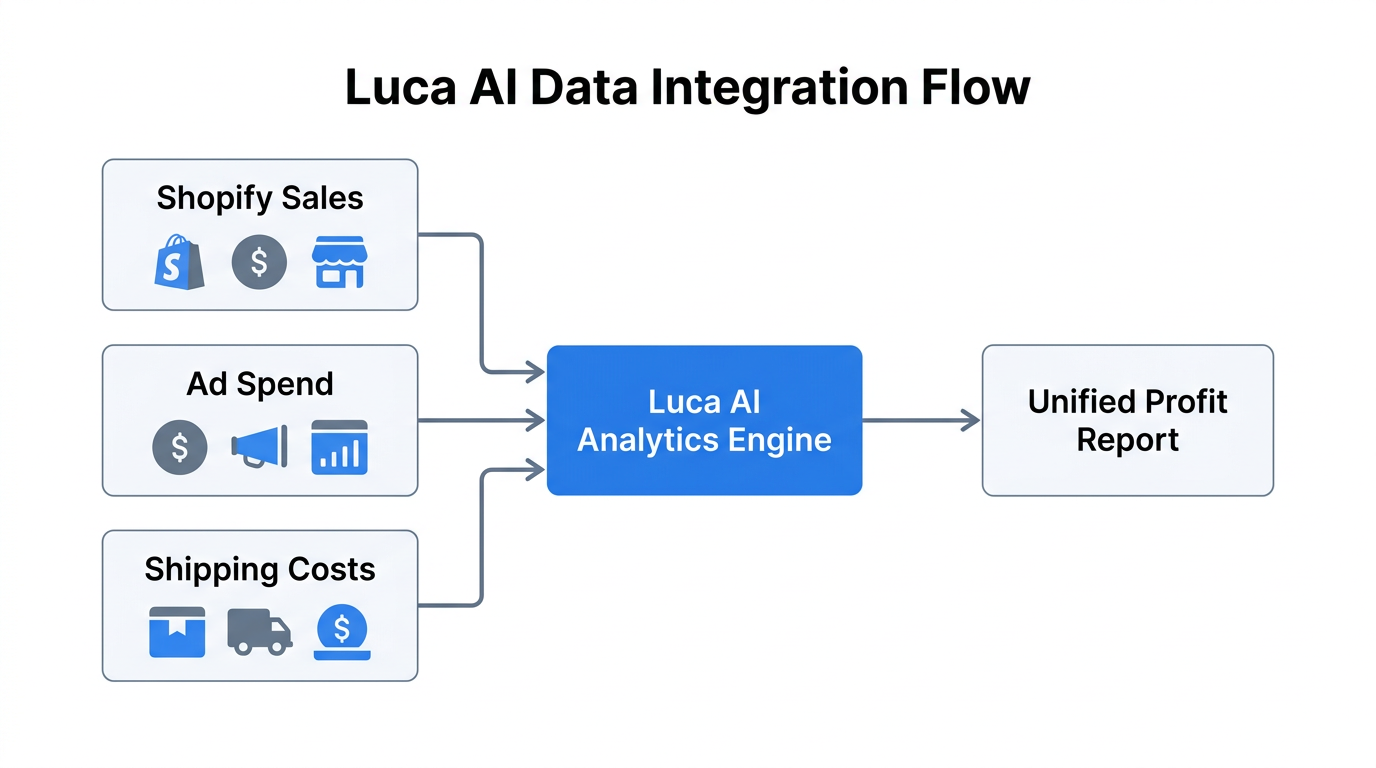
The biggest hurdle to AI profit margin analysis is the "Dashboard Trap"—having your financial data in Xero, your ad data in TikTok Ads Manager, and your sales data in Shopify. Luca AI solves this by creating a single source of truth.
Luca AI connects directly to your tech stack to calculate True Contribution Margin. It automatically pulls in:
- Variable Costs: Stripe or Shopify Payment fees.
- Logistics: Real-time shipping costs and 3PL expenses.
- Ad Spend: Integrated data from Meta, Google, and TikTok.
- COGS: Dynamic updates based on inventory levels and vendor pricing.
By leveraging Luca AI, merchants move away from expert opinions and toward repeatable AI-driven rules that protect margins at scale. As Logan Brown of Triple Whale suggests, the value in 2026 is not in gut feelings but in the data-backed logic that AI can apply 24/7.
"The danger is not in the AI making a mistake, but in the merchant ignoring the hidden costs that the AI has already identified."
Shopify Sidekick Tutorials 2026: Automating Operational Analysis
Shopify Sidekick has evolved into a full-fledged AI business partner. Beyond just answering questions, it can now perform deep-dive operational analysis to find margin-draining SKUs. If you're looking for Shopify Sidekick tutorials 2026, start with these three high-impact prompts to audit your store's health:
Prompt 1: The Margin-Drainer Audit
"Sidekick, analyze my sales over the last 90 days. List the top 5 SKUs that have the highest revenue but the lowest net profit margin after accounting for returns and shipping."
Prompt 2: Inventory Velocity Sync
"Compare my current inventory levels for [Category] with predicted demand for Q3. Identify which items are likely to become dead stock and suggest a discount strategy that maintains a 5% net margin."
Prompt 3: Customer Acquisition Cost (CAC) vs. LTV
"Analyze my Klaviyo segments. Which customer segment has the highest Lifetime Value (LTV) relative to their initial acquisition cost via Meta Ads?"
The 2026 Playbook: Calculating True Contribution Margin
To achieve a 10% net margin, you must go beyond simple gross profit. Follow this step-by-step playbook to calculate your True Contribution Margin using 2026 best practices.
- Step 1: Aggregate All Variable Costs. Use an AI-powered tool like ProfitHelm to pull in shipping labels, packaging, and payment gateway fees. These often account for 10-15% of the total order value.
- Step 2: Factor in Returns and Refractions. Returns are a margin killer. AI models now predict which customers are "serial returners." Factor the average cost of returns back into your per-unit profit calculation.
- Step 3: Calculate POAS by Channel. Instead of scaling the campaign with the highest ROAS, scale the one with the highest POAS. You might find that a lower-ROAS YouTube campaign actually generates more retained profit than a high-ROAS TikTok campaign due to higher LTV.
- Step 4: Implement Dynamic Pricing. Use a tool like Prisync to adjust prices based on competitor stock levels. When a competitor goes out of stock, your AI should automatically raise prices to capture higher margins.
- Step 5: Automate Influencer Sourcing. Lower your CAC by using Stormy AI to find creators who align perfectly with your niche, reducing the need for expensive, broad-targeted paid ads.
"An ML-driven approach to inventory forecasting can result in 40% better planning accuracy and an 18% decrease in cart abandonment."
Common AI Analytics Mistakes to Avoid
While AI is powerful, it is not infallible. Merchants often fall into these traps when setting up their AI profit margin analysis:
- The "GIGO" Principle (Garbage In, Garbage Out): Feeding AI messy, uncleaned spreadsheet data leads to distorted profit forecasts. Ensure your Shopify COGS are updated monthly.
- Vanity Metric Obsession: Scaling ads based on ROAS while ignoring 3PL fees. Remember: revenue is vanity, profit is sanity.
- AI Tool Sprawl: Paying for 10+ disconnected tools ($2,000–$5,000/mo) that don't talk to each other. Experts recommend a "Unified Intelligence" platform like Luca over fragmented tools.
- Ignoring Privacy: Ensure your AI tools are GDPR/CCPA compliant. Fines in 2026 can reach 4% of annual turnover for non-compliance.
Conclusion: The Future of Profit is Automated
As we navigate 2026, the brands that survive are those that treat profit as a repeatable science rather than a lucky outcome. By moving from ROAS to POAS and utilizing unified intelligence tools like Luca AI, you can protect your margins against the volatility of the modern market. Combine these financial insights with native tools like Shopify Sidekick and creator-sourcing platforms like Stormy AI to build a growth engine that is as profitable as it is efficient.
Start your journey toward a 10% net margin today by auditing your current COGS and setting up your first automated profit dashboard. The era of guessing is over—the era of the profitable builder has begun.