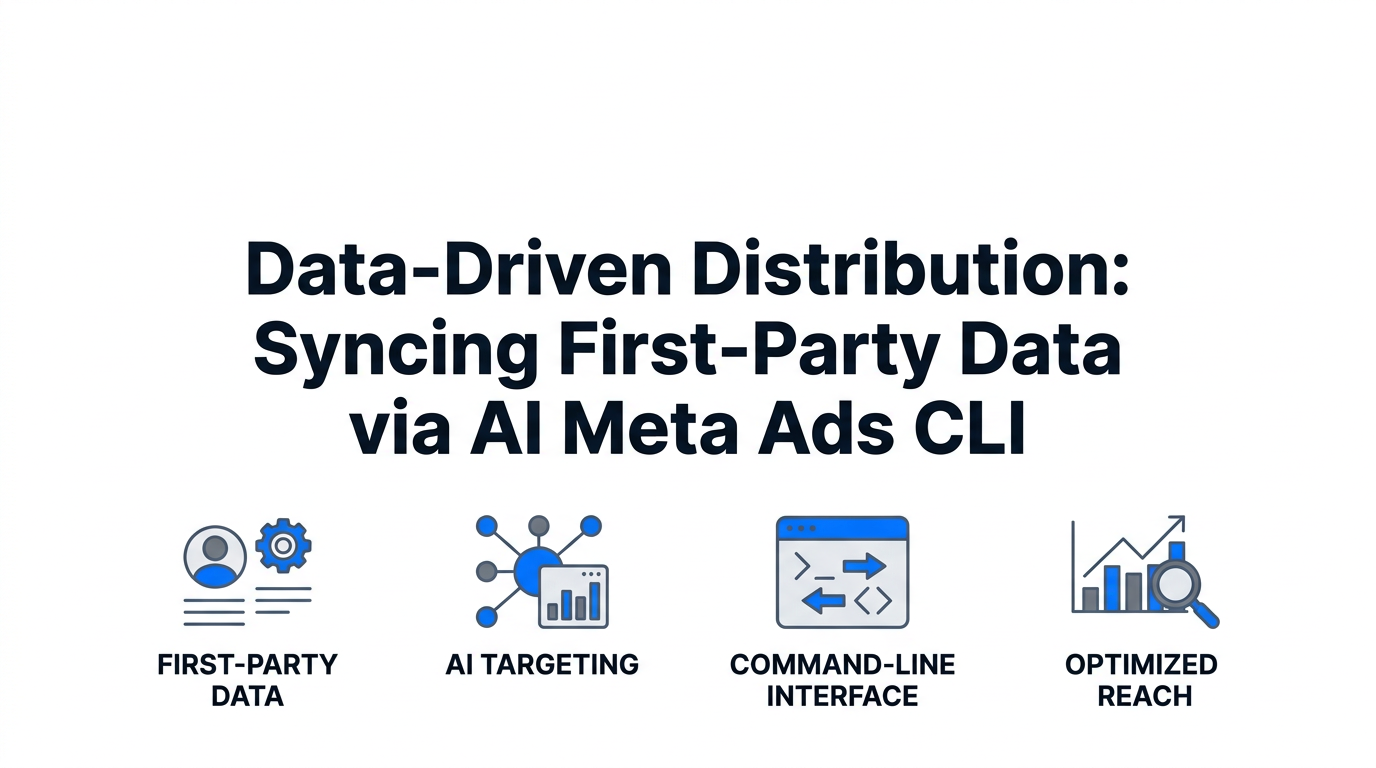
The era of the third-party cookie is coming to an end, forced by Google’s Privacy Sandbox initiative and Apple’s stringent App Tracking Transparency (ATT) framework. For performance marketers, this shift means that the old "set and forget" pixel-based tracking is no longer sufficient. To maintain high-performance targeting, brands must pivot toward a first-party data strategy, specifically by leveraging the Meta Conversions API (CAPI).
The challenge, however, isn't just collecting data; it’s the distribution. Manually uploading CSV files or relying on fragmented browser-side events leads to data gaps and attribution errors. This is where a Data-Driven Distribution model—powered by a custom AI-driven Meta Ads CLI (Command Line Interface)—becomes a competitive advantage. By using Python-based scripts, marketers can automate the flow of customer signals directly from their CRM or database to Meta’s servers.
Why Syncing First-Party Data is Non-Negotiable
First-party data—the information customers share directly with your brand via Shopify purchases, newsletter sign-ups, or app interactions—is the most reliable signal available. When you sync this data via CAPI, you bypass browser limitations. This ensures that your Meta Ads Manager has a complete picture of the customer journey, leading to lower Cost Per Acquisition (CPA) and improved Return on Ad Spend (ROAS).
While traditional automation tools like Zapier or Make are great for simple triggers, they can become expensive and rigid at scale. A custom CLI allows for sophisticated data cleaning and normalization using Large Language Models (LLMs) before the data ever reaches Meta’s API.
Building the AI Meta Ads CLI
A modern distribution script typically involves three layers:
- The Data Layer: Pulling raw event data from sources like PostHog or a BigQuery warehouse.
- The AI Layer: Using AI to categorize customer segments or "score" lead quality before syncing.
- The Execution Layer: Pushing these events through the Meta Marketing API.
This technical infrastructure ensures that your ads are shown to people who actually convert. However, even the best data sync won't save a campaign with poor creative. To fuel these high-performance ads with authentic content, many growth teams are moving away from stock assets. Platforms like Stormy AI streamline creator sourcing and outreach, allowing you to find the right influencers to generate high-converting UGC that you can then distribute using your first-party data segments.
Scaling with Automation
Once your CLI is established, you can schedule it to run daily or even hourly. This creates a "feedback loop" where your ad account is constantly learning from real-time sales data. For brands managing heavy creator-led campaigns, using Stormy AI to vet influencers and manage the outreach process ensures a steady stream of fresh creative to test against these data-driven audiences.
By combining technical distribution via CLI with AI-powered creator management, you move from "guessing" to "knowing." In a privacy-first world, the brand that owns its data—and knows how to sync it efficiently—wins.