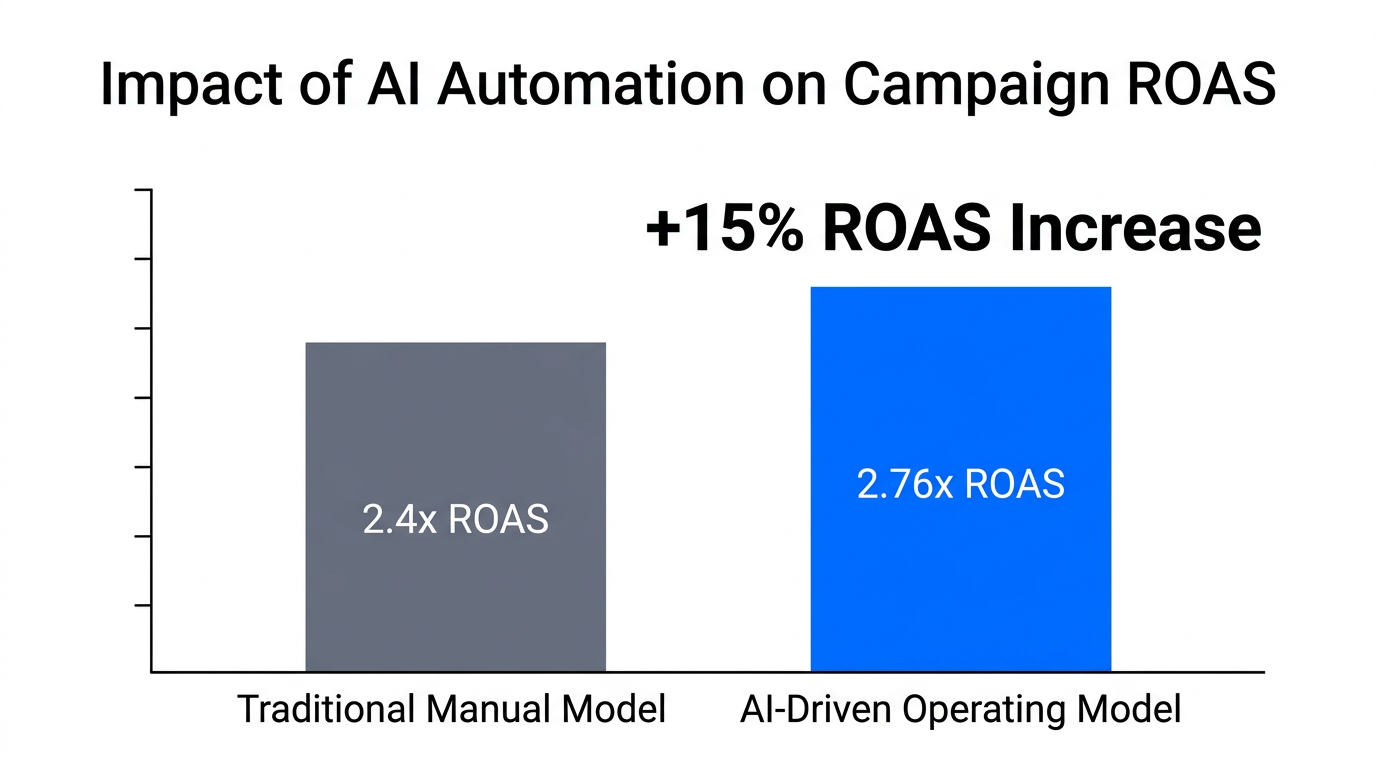
The era of the manual media buyer—the professional whose primary value lay in the rapid-fire clicking of toggle switches and the obsessive monitoring of CPM fluctuations—is effectively over. As we move into 2025, Meta has shifted its entire architecture toward a "full-funnel automation" model. Data from Meta Advantage+ research shows that brands embracing these AI-driven systems are already seeing a 12% lower cost per action (CPA) and a 15% higher Return on Ad Spend (ROAS). For growth marketers, the challenge is no longer about learning the interface; it is about building a software stack that allows an autonomous AI media buyer to manage campaigns 24/7 while the human team focuses on high-level strategy.
The New Operating Model: Creative-Led Targeting
Meta is rebuilding its core recommendation engine around a new architecture often referred to as Andromeda (or the Lattice engine). This system unifies signals from website data, app usage, and ad engagement into a single prediction layer. In this new world, manual interest targeting is being phased out in favor of "creative-led targeting." The AI now analyzes the visual and text elements of your ad to determine who sees it. According to industry analysis, the strategy is to provide the algorithm with a broad canvas and let the content itself find the audience.
Setting Stop-Loss and Scaling Rules with Revealbot
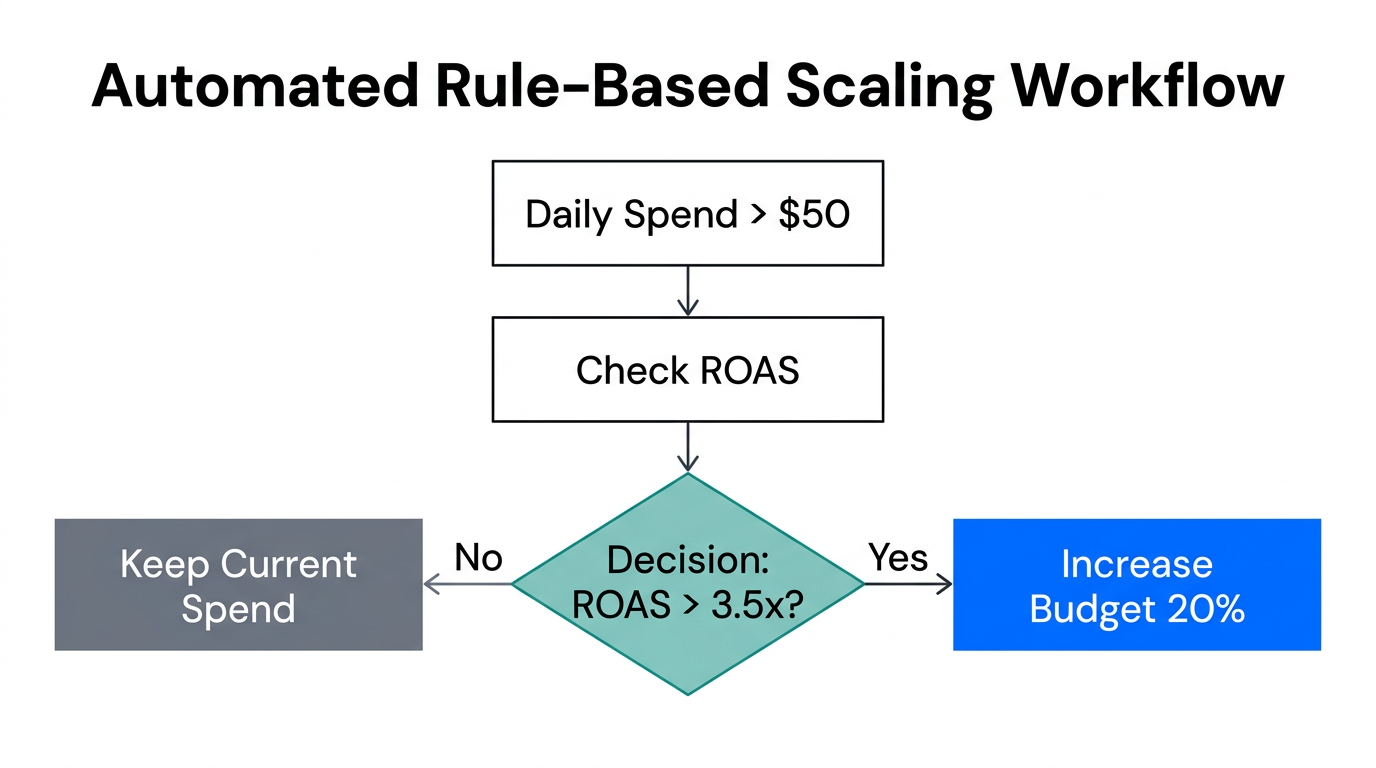
One of the most critical components of an automated ad management stack is a rule-based engine like Revealbot. In a traditional setup, a human must wake up at 2:00 AM to check if a campaign is bleeding budget. With automated rules, you can set a "stop-loss": if an ad set spends more than 1.5x your target CPA without a conversion, the system pauses it instantly.
Conversely, automated scaling Meta ads allows you to increase budgets by 10-20% every time specific performance benchmarks are met. Experts recommend gradual scaling to avoid resetting the Meta learning phase. By using tools like Revealbot, you can ensure that budget increases only happen during high-conversion windows, protecting your bottom line from volatility. This logic can be extended across your entire tech stack, including Google Ads and even TikTok Ads Manager.
"The role of the Media Buyer is shifting from button-pushing to High-Level Strategy. AI handles 90% of the volume, but the human must provide the vision."
Real-Time Budget Reallocation with Trapica and Smartly.io
While Meta’s native tools are powerful, they are often siloed. To run a truly autonomous operation, you need cross-platform intelligence. Trapica and Smartly.io use predictive analytics to forecast campaign performance before you spend a single dollar. If Meta Ads Manager is underperforming relative to your YouTube campaigns, these tools can automatically reallocate budget to the highest-yielding channel in real-time.
| Tool Category | Primary Platform | Core Strength |
|---|---|---|
| Rule-Based Management | Revealbot | Custom if/then scaling and stop-loss rules. |
| Predictive Analytics | Smartly.io | Forecasting ROAS and creative performance. |
| Autonomous Agent | AdAmigo.ai | Hands-off campaign launching and monitoring. |
| Budget Optimization | Trapica | Real-time cross-platform budget shifting. |
This level of AI for Meta ads goes beyond simple automation; it acts as a digital CFO for your marketing spend. When integrated with an e-commerce backend like Shopify and a payment processor like Stripe, the entire funnel—from ad spend to revenue realization—becomes a closed-loop system of efficiency.
The Rise of Autonomous Agents: AdAmigo.ai
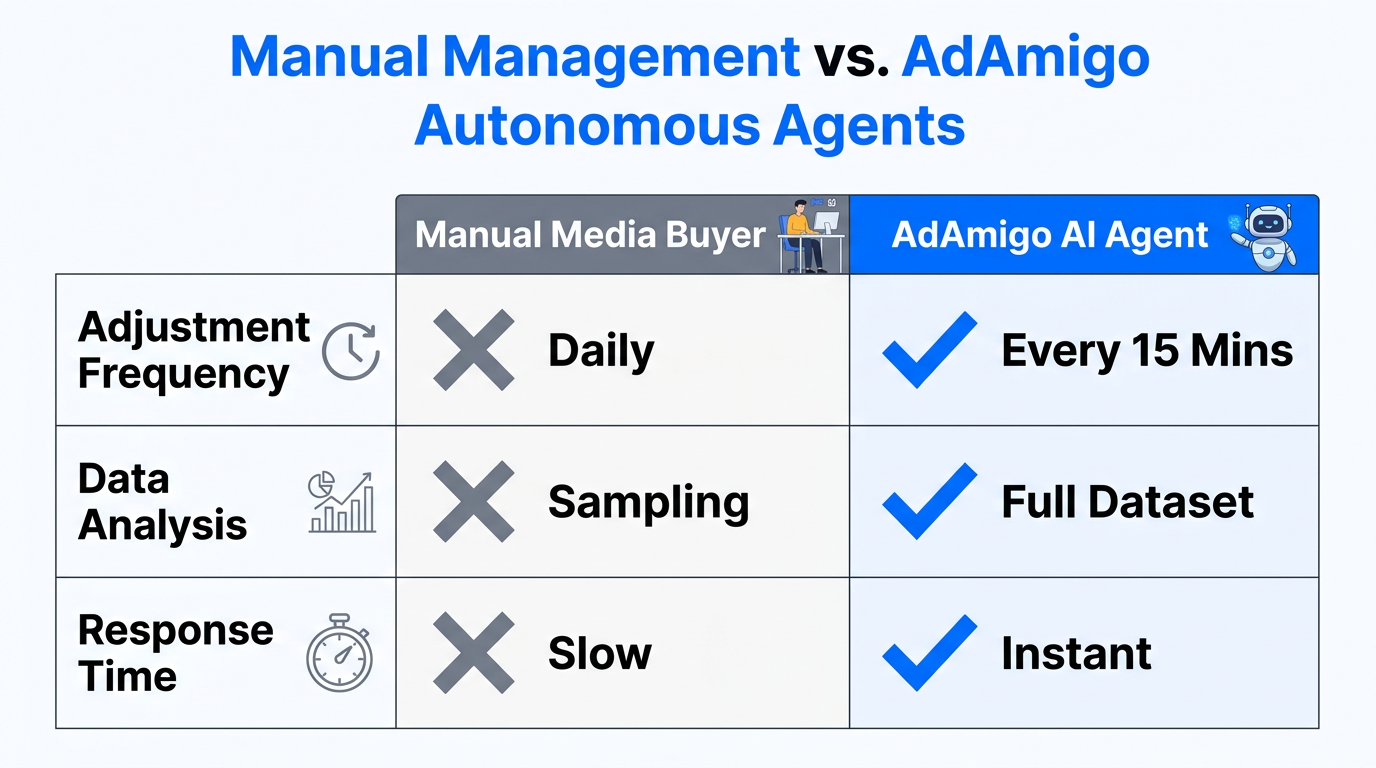
We are currently seeing the emergence of autonomous agents like AdAmigo.ai. Unlike rule-based tools that require you to define every parameter, these agents are designed for hands-off campaign launching. They analyze your landing page, generate copy, select audiences, and monitor performance autonomously. By delegating tactical execution to these agents, they function like a junior intern who never sleeps, allowing agencies to scale their client count without a linear increase in headcount.
Combatting 'Creative Fatigue' with Automated Alerts
The greatest weakness of any automated ad management system is its inability to fix a bad creative. Even the most sophisticated AI cannot save a campaign if the video content is boring or outdated. Creative Fatigue occurs when your audience has seen your ad too many times, leading to a sharp drop in Click-Through Rate (CTR) and an increase in CPM. By setting automated alerts in your management software, you can receive a notification the moment CTR drops below a specific threshold (e.g., 1%).
To keep the machine fed, brands are increasingly turning to User-Generated Content (UGC). Platforms like Stormy AI streamline the process of sourcing and managing UGC creators at scale. By using Stormy AI's discovery engine, brands can find influencers on TikTok and Instagram who match their niche, vet them for audience quality, and secure the high-volume content needed to launch 20–50 creative variants per campaign. This continuous stream of fresh creative is the fuel that prevents the AI from stalling.
"AI doesn't replace the creative director; it makes the creative director 10x more important by demanding a constant supply of high-quality assets."
The AI Media Buyer Playbook: A Step-by-Step Implementation
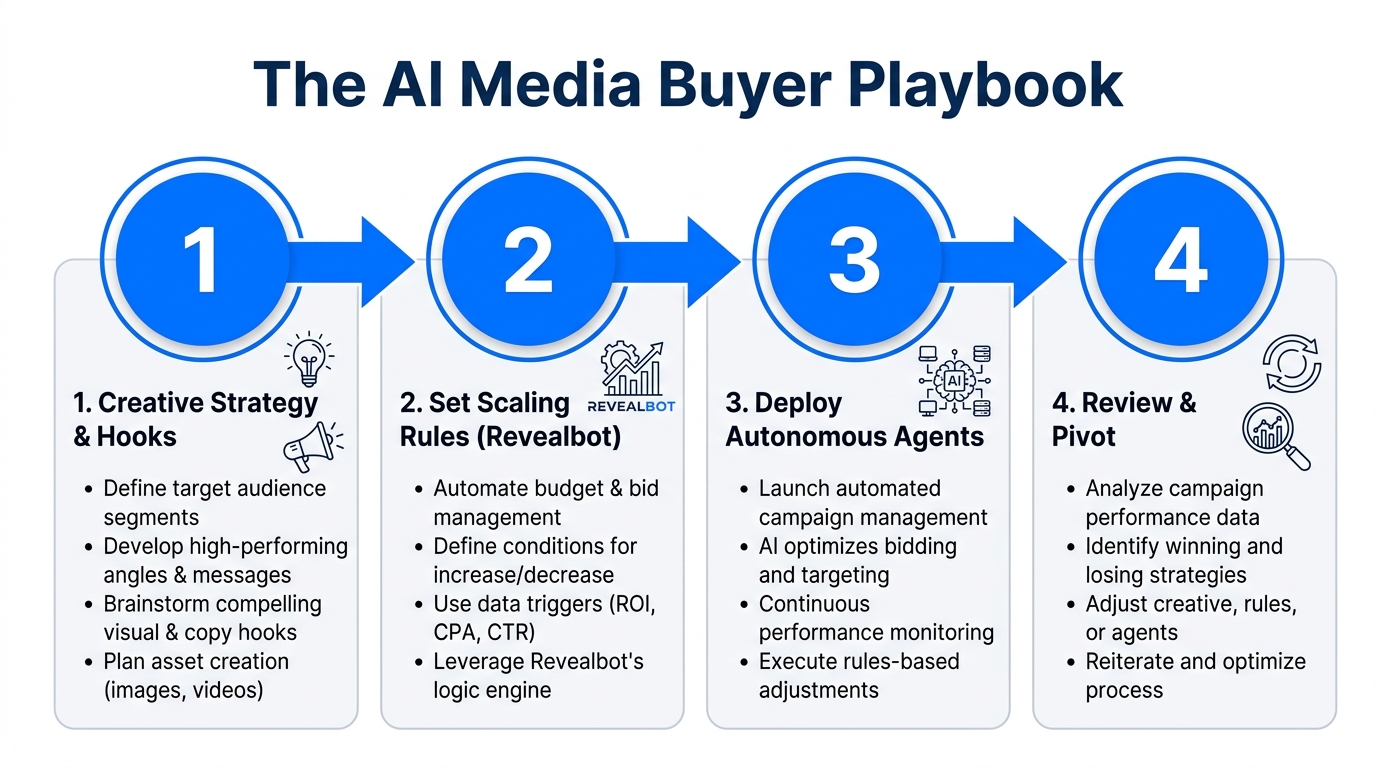
Transitioning from manual management to an automated stack requires a systematic approach. Follow these steps to build your autonomous ad operation:
- Step 1: Clean Your Data. Automation is only as good as the data it receives. Set up the Meta Conversions API (CAPI) to ensure server-side tracking is accurate as cookie-based tracking declines.
- Step 2: Implement Advantage+ Shopping. Start by testing Meta's native Advantage+ campaigns against your traditional manual setups. Monitor the 5% median decrease in cost per result reported by high-performing advertisers.
- Step 3: Layer on Revealbot. Define your Guardrail Rules. Set a rule to pause any ad with 0 sales and $50 spend, and a rule to increase budget by 15% if ROAS is above 3.5.
- Step 4: Scale Creative Volume. Use AI-powered tools like Creatify.ai to turn product images into Reels. Use Stormy AI to discover and outreach to UGC creators who can provide the raw video footage.
- Step 5: Audit with a Human Eye. Review your AI's performance weekly. Look for "hallucinated" copy or brand-unsafe placements that the algorithm might have missed.
Evolution of Team Roles: From Tactical to Strategic
As Meta ads management software takes over the day-to-day execution, the structure of your marketing team must evolve. Media buyers should transition into "Growth Strategists" who oversee the Go-To-Market (GTM) strategy and distribution. Instead of adjusting bids, they should be analyzing data in Google Analytics or Mixpanel to understand long-term customer LTV.
Your creative team also becomes more central. Rather than making one "perfect" ad, they must become comfortable with multi-variate testing. Tools like Marpipe allow for systematic testing of every visual element—background colors, headlines, and calls-to-action—to find the winning combination. This shift ensures that the human element of marketing—emotional resonance and brand voice—remains intact while the AI handles the heavy lifting of distribution.
Conclusion: Building a Resilient Future
The transition to an AI Media Buyer model is not about replacing humans; it is about eliminating the low-value tasks that prevent marketers from doing their best work. By combining native tools like Advantage+ with rule-based engines like Revealbot and creative discovery platforms like Stormy AI, brands can build a resilient, 24/7 advertising operation that scales with efficiency and precision. As privacy-first automation becomes the standard, those who master the software stack today will be the ones who dominate the marketplace of 2026 and beyond.
Start small, set your guardrails, and let the AI find your next million customers while you focus on the big picture.