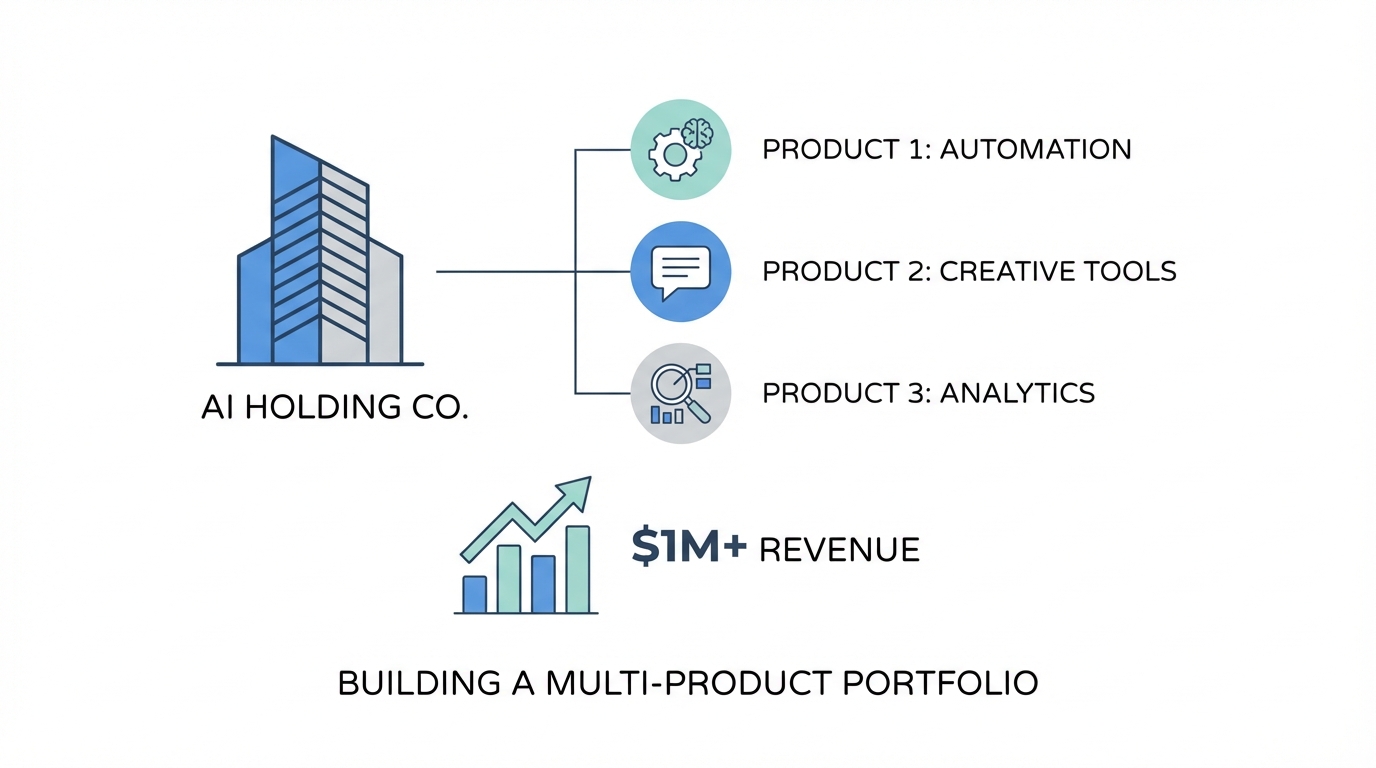
For years, the gold standard of entrepreneurship was the "one-hit wonder." You poured every ounce of capital and sanity into a single SaaS product, prayed for a 10x return, and hoped you didn't run out of cash before the next venture round. But in the age of generative AI, that model is becoming obsolete. The modern serial entrepreneur isn't building a single product; they are building an AI holding company (HoldCo)—a resilient, multi-product portfolio where shared resources, distribution flywheels, and AI business automation create compound growth.
The goal is no longer to build a strip mall of disconnected apps, but a skyscraper where every floor supports the one above it. This strategy allows you to diversify risk, lower customer acquisition costs (CAC), and build long-term enterprise value without ever speaking to a venture capitalist. If you are looking to transition from a single-product grind to a $1M+ portfolio, this is the complete playbook for the AI era.
The Walt Disney Flywheel: Thinking in Ecosystems
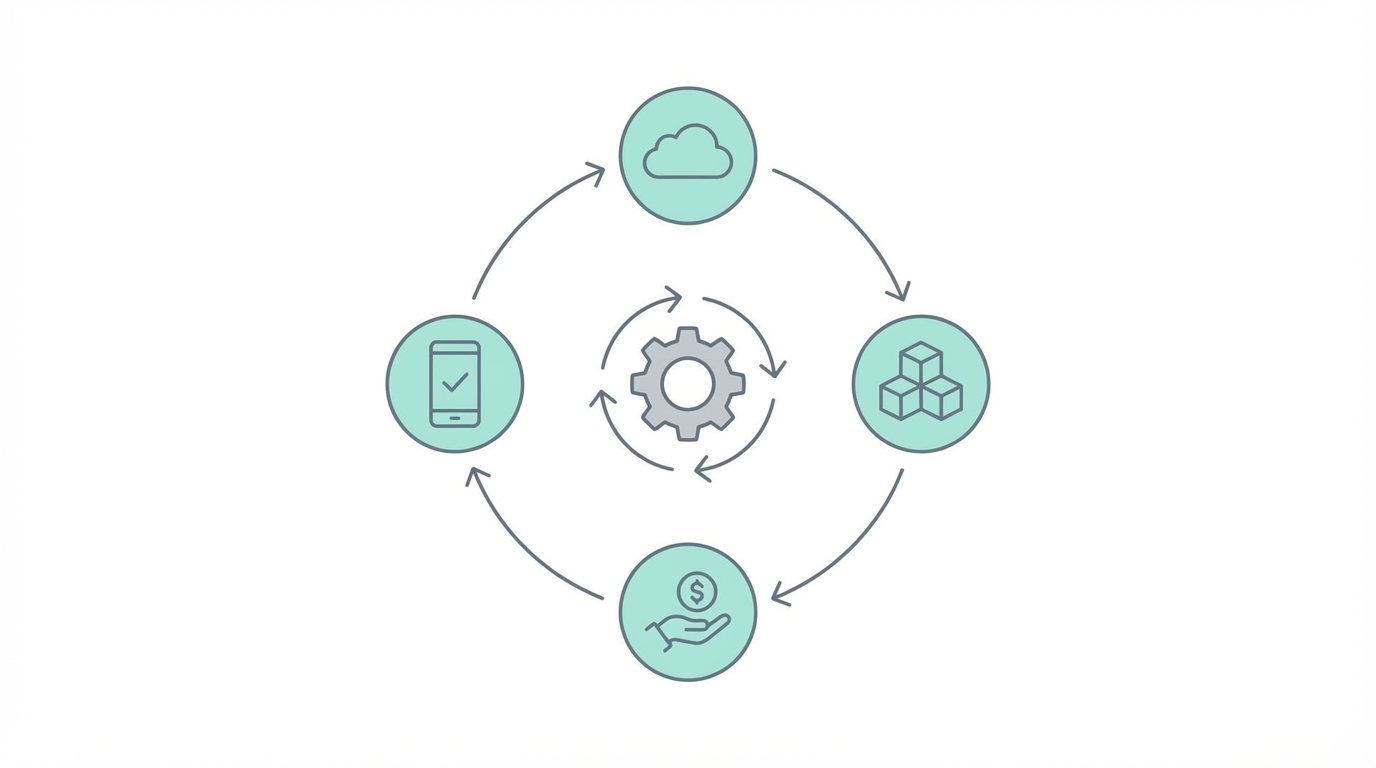
To understand the HoldCo model, you have to look back to 1967. Walt Disney famously drew an ecosystem map that showed how his films, theme parks, merchandise, and music publications were not separate businesses, but a self-sustaining flywheel. The films drove interest in the parks; the parks sold the merchandise; the merchandise kept the characters alive until the next film. In the digital age, your multi-product business model should function the same way.
Instead of launching random ideas, every product in your portfolio should be a "star" in a single constellation. For example, if you build a video editing tool, your next product shouldn't be a fitness app. It should be a lead generation tool for video agencies or a marketplace for video templates. By staying within a niche, you can reuse your audience, your data, and your marketing infrastructure. This is the difference between building a collection of features and building a startup portfolio strategy that compounds.
Phase 1: Discovery and Niche Selection
The first step in building an AI HoldCo is finding an underserved niche. In the AI era, "underserved" doesn't mean the niche is small; it means the competition is lagging on technology. You want to build on the back of a trend because the market's natural growth will act as a tailwind for your efforts. Tools like Google Trends are essential here to validate that interest is rising before you commit code.
Once you've identified a trend, you need to understand the "content exhaust" of that niche. What memes do they share? What formats do they consume—vlogs, stories, or long-form threads? This qualitative data is what helps you build an unfair advantage. If you are struggling for inspiration, platforms like Idea Browser provide data-backed startup ideas daily, allowing you to "steal" concepts that already have proven market demand.
The "Heads Down" Rule
Even for experienced entrepreneurs, the biggest trap is trying to do everything at once. You must go "heads down" on one product until it reaches a baseline of stability. Set a strict schedule—even if it's just one hour of deep work from 9 PM to 10 PM—to ensure that your first portfolio piece becomes the foundation for the HoldCo, rather than a half-finished experiment. Statistics show that the startup failure rate is often linked to a lack of focus in the early stages.
Phase 2: Building V1 with AI Efficiency
In the past, building a V1 required a $50k development budget. Today, you can use a stack of AI tools to build, design, and launch a prototype in a weekend. The modern serial entrepreneur playbook uses AI as a co-founder to keep the team small and the margins high.
- Product Requirements: Use ChatGPT to generate your PRD (Product Requirement Document) and perform competitive analysis.
- UI/UX Design: Use v0.dev for your first interface designs.
- Prototyping: Tools like Bolt or Lovable can generate functional prototypes in hours.
- Development: Use Cursor or Windsurf to scale that prototype into a production-ready V1.
Your V1 should focus on a single killer feature plus the absolute table-stakes requirements (like user profiles or payments). If you are building a marketplace, your V1 might actually be a service business where you handle the matching manually. This allows you to get paid to learn the pain points before you automate the workflow in V2.
Phase 3: The Distribution Flywheel

The biggest asset of an AI holding company isn't the code; it's the distribution. You need to own the loop: Audience > Community > Product. Instead of buying ads, build an audience on a single platform (like X or LinkedIn) until you hit 25,000 to 50,000 followers. A simple hack to get your first 1,000 followers is to set tweet notifications for major players in your niche and provide thoughtful, value-add replies to their content every single day.

Using Lead Magnets and Free Tools
One of the most effective ways to drive top-of-funnel traffic is by building public-facing free tools. Companies like Veed.io have mastered this by creating hundreds of tiny, specific tools (like "SVG to PNG converter") that lead users into their main ecosystem. This not only builds trust but also boosts your "AI SEO," making it more likely that LLMs will recommend your products when users ask for solutions.
As you scale, you can also partner with creators in exchange for equity (1-20%) or generous revenue shares (20-50%). Since you are building a portfolio, tools like Stormy AI can help you search and discovery creators in your specific niche across TikTok, YouTube, and Instagram. Having an automated way to vet these influencers for fake followers and engagement quality ensures your distribution stays high-quality and cost-effective.
Phase 4: Sharing Resources and Infrastructure
This is where the "Holding Company" magic happens. Once you have 2-3 products, you stop hiring for individual apps and start hiring for the HoldCo. You can share hires, tools, and infrastructure across the entire portfolio. For example, a single head of SEO or a short-form video editor can service three different products, effectively cutting your overhead by 66% per product.
You also gain access to "data exhaust." If Product A is a video software, you naturally generate leads for people who might need a video agency (Product B). By monetizing this backend data—either through cross-promotion or licensing—you create revenue streams that single-product companies can't touch. This multi-product business model increases your total enterprise value because the business is no longer reliant on a single market's fluctuations.
Phase 5: Automating with AI Agents
Before you hire an operations role, you must backfill the position with AI agents. Your goal should be to automate 90% of the manual tasks in your business. Start small: identify a 5-minute task you do 10 times a day and automate it using Zapier or Lindy. Over time, these automations become the "glue" that holds your portfolio together, allowing you to manage multiple products without a massive headcount.
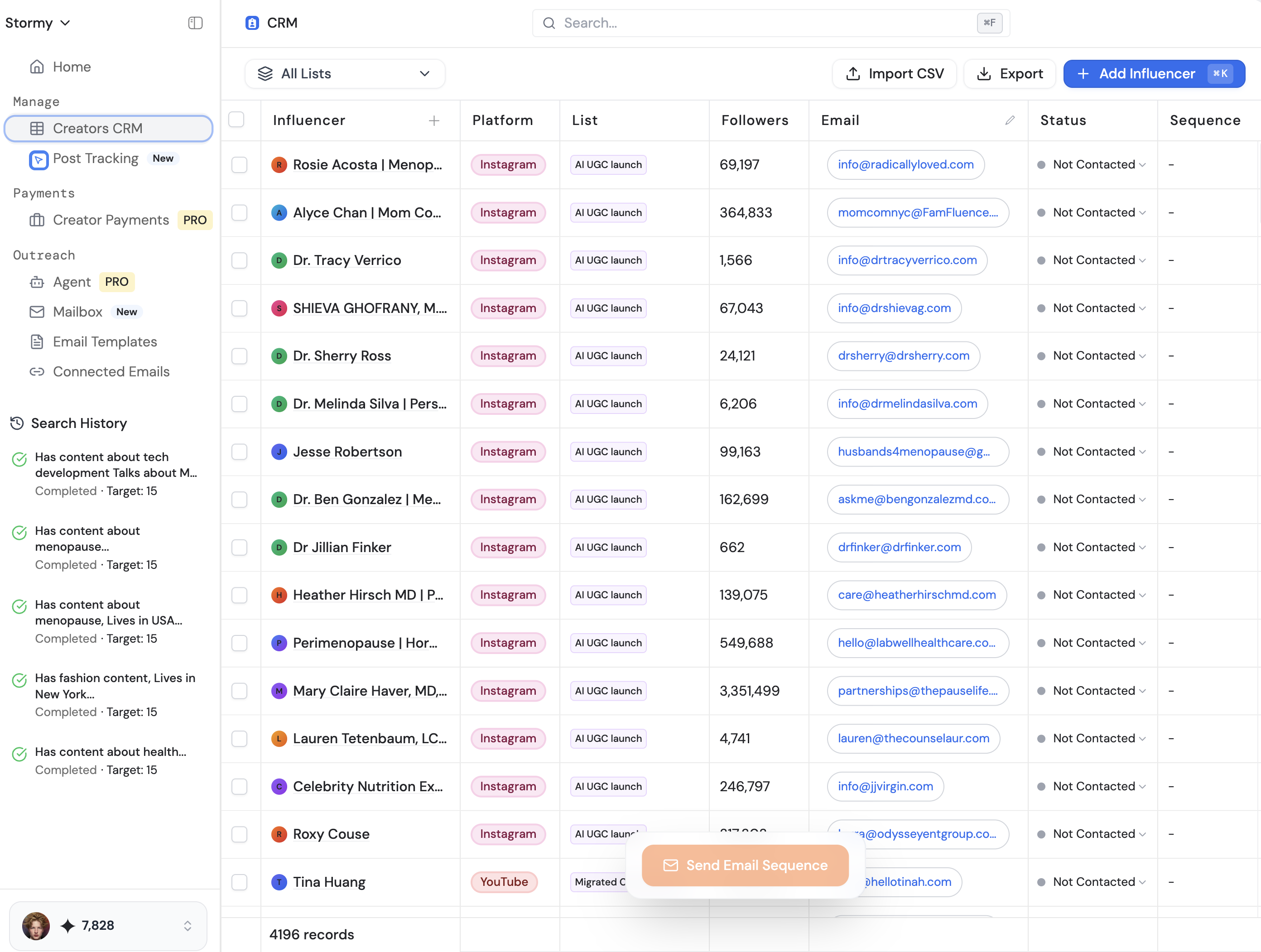
For example, if you are managing relationships with dozens of creators across your portfolio, using a creator CRM like Stormy AI is essential. You can set up AI agents to handle the discovery, outreach, and follow-ups on a daily schedule, ensuring your distribution flywheel never stops spinning while you sleep.
Acquiring Underperforming Assets
Not every product in your HoldCo needs to be built from scratch. Once you have established a distribution channel (an audience or a large email list), you can acquire underperforming products that have great tech but zero marketing. This is known as a "leveraged buyout with leads." You can often structure these deals as seller-financed or profit-share arrangements, meaning you don't need millions of dollars in upfront capital to expand your portfolio.
Recruiting Niche Operators
As the founder of an AI HoldCo, your role eventually shifts from "Builder" to "Headhunter." To reach the $10M+ mark, you need to recruit niche operators—General Managers (GMs) who run individual products for a mix of salary and profit share. Look for these operators on platforms like X or LinkedIn. Start by building a friendship, collaborate on a small project, and then transition them into a leadership role once the product has clear traction. Your job is to provide the infrastructure, the capital, and the AI tools, while they provide the focus.
Conclusion: Build Once, Compound Forever
The transition to an AI holding company is about moving from a mindset of linear growth to one of compound interest. By building an ecosystem where code, audience, and trust all stack, you create a business that is virtually impossible to displace. You don't need outside investors; you need a culture of shipping, a commitment to automation, and a Disney-style map that guides your expansion.
Start by finding that first underserved niche, build a killer V1 with AI, and never stop reinvesting your profits into the flywheel. In the AI age, the most successful entrepreneurs won't be the ones with the best single idea, but the ones with the best system for launching and managing many of them. Happy building.