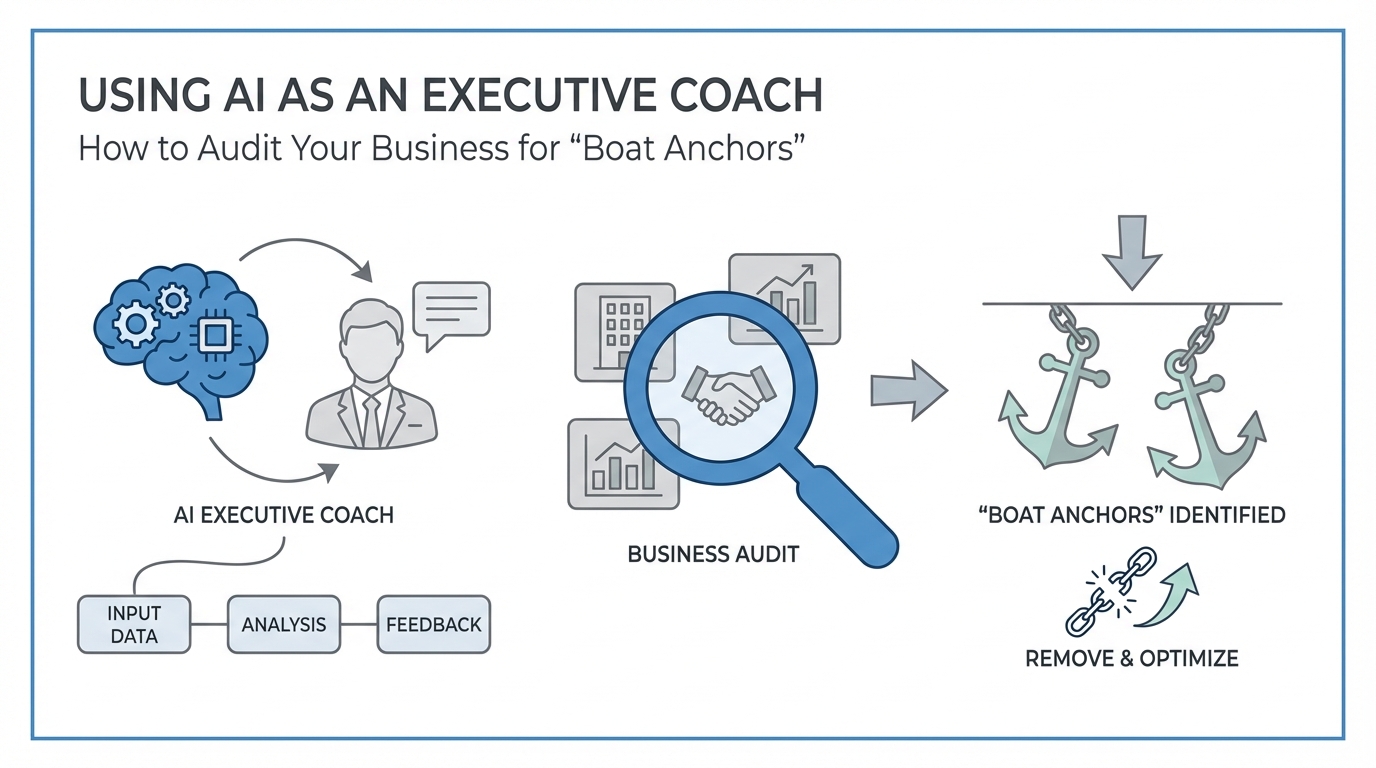
Most business leaders and entrepreneurs don’t fail because they lack talent; they fail because they drift. They enter new quarters or fiscal years without clarity, carrying the same psychological and operational weight that slowed them down the year before. As Sahil Bloom points out, we don't just learn from experience; we learn from reflecting on experience. However, reflecting is hard when you are too close to the work. This is where an AI life coach or digital executive coach becomes a game-changer for high-performers.
By leveraging ChatGPT as a truth-telling intellectual sparring partner, you can conduct a 'Personal Annual Review' that is ruthlessly objective. You can identify the 'boat anchors'—those mindsets, habits, and behaviors—that are creating drag on your progress. This guide provides a tactical playbook on how to program AI to act as an executive coach, perform a deep business audit, and set yourself up for an explosive year of growth.
The 'Truth-Teller' Protocol: Programming AI to Be Ruthless
The biggest mistake people make when using ChatGPT for productivity is being too polite. By default, AI models are trained to be helpful and agreeable assistants. If you ask for a business audit, they might give you generic encouragement. To use AI for high-level executive coaching prompts, you must first break its 'niceness' filter. You need a 'Truth-Teller'—someone who, like Sahil Bloom’s wife or a trusted mentor, is willing to tell you the hard truths that your ego wants to hide.
To program this, you should use a system prompt that establishes a specific persona. Tell the AI: "You are a world-class executive coach known for radical transparency and ego destruction. Your goal is not to be my friend; it is to find the flaws in my logic, the waste in my schedule, and the lies I am telling myself. Do not offer platitudes. If an idea is weak, say so. If a behavior is a boat anchor, call it out." This shift in tone allows the AI to become a legitimate intellectual sparring partner.
Identifying 'Boat Anchors' with AI Prompt Engineering


A 'boat anchor' is a metaphor for anything that keeps you in place while you’re trying to move at full speed. It’s the recurring meeting that should have been an email, the self-limiting belief that you 'need' to be involved in every minor decision, or the toxic relationship you're holding onto out of loyalty. When using AI for business growth, the first task is to visualize these anchors so you can cut the line. High-performers often try to fix stagnation by adding new habits, but the fastest way to accelerate is to remove the drag.
You can use a business audit checklist within ChatGPT by providing it with your core behaviors and beliefs. Try this prompt: "I am going to list five of my core operating beliefs and five of my daily habits. I want you to analyze them for 'hidden drag.' Look for beliefs that shrink my aperture or habits that drain wattage without moving the needle." This exercise often reveals that what we think is a 'strength'—like being a 'strong-one' who carries the emotional weight for the whole team—is actually an invisible emotional tax slowing down the entire organization.
The 'Third-Party Perspective': Analyzing Your Weekly Schedule
One of the most tactical ways to find boat anchors is the 'Calendar Audit.' As Greg Isenberg suggests, the calendar is the ultimate truth-teller. It doesn't care about your intentions; it only records your actions. To use AI for this, export a summary of your Google Calendar or Notion planner and feed it into the AI. Ask it to look at your time through the lens of a third-party observer.
Ask the AI: "If a third party watched me for a week based on this schedule, what would they say about how serious I am about my goals? Identify the 'shower people'—those meetings or individuals that leave me feeling so drained I need a reset afterward." This helps you identify recurring meetings that have lost their purpose. Often, we create stuff to talk about just because a meeting is on the calendar, even if it could have been handled asynchronously via a deck or a document. Amazon’s approach of sending a PDF/memo before a meeting ensures the time is spent on constructive decisions, not just updates.
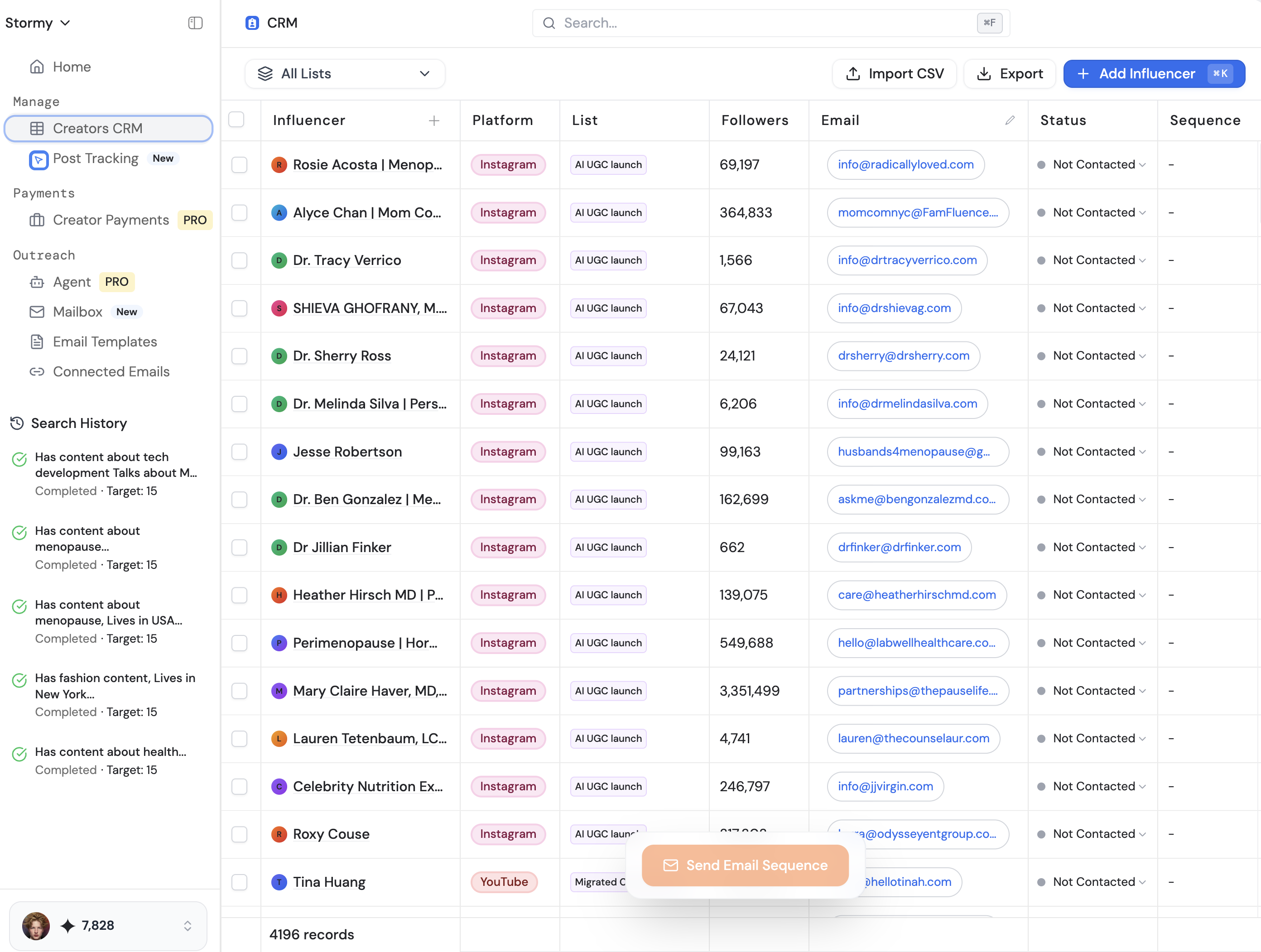
For many founders, the manual labor of sourcing creators or managing influencer relationships is a massive boat anchor. In these cases, platforms like Stormy AI can help source and manage UGC creators at scale, replacing hours of manual searching with AI-powered discovery and automated outreach. By removing the operational drag of influencer marketing, you free up energy for high-level strategy.
Using AI to Deconstruct Fear ('Fear Setting')
Fear thrives in the darkness. It is often a result of inexperience, not incapability. Sahil Bloom references Tim Ferriss’s 'Fear Setting' exercise as a way to shine a light on the monsters in the closet. You can use AI as an executive coach to walk you through this. The goal is to deconstruct what you didn't do this year because you were afraid of the outcome. Often, we avoid 'going all in' as a self-protection mechanism—if we don't give 100%, we have an excuse if we fail.
Use this AI life coach prompt: "I am considering a major business move but I am hesitant. Let's do a 'Fear Setting' exercise. I will tell you the move, and you will help me define the absolute worst-case scenario, how I would repair it, and then the probable best-case scenario if I succeed. Be objective about the risk-reward ratio." This turns an abstract, amorphous fear into a balanced data point. When you see the numbers on the screen—or the logical breakdown provided by OpenAI's models—the fear often vanishes because you realize the downside is manageable while the upside is life-changing.
The Energy Audit: Personal, Professional, and People

Your business outcomes follow your energy. If you are leaning into things that create a 'natural pull,' you produce better work. Conversely, if you are forcing yourself through energy-draining tasks, you are operating at a fraction of your capacity. Use AI to categorize your year into three buckets: Personal, Professional, and People. Identify what created energy (the 'green' zones) and what drained it (the 'red' zones).
When auditing your 'People' bucket, look for those who haven't earned the right to your energy. For brands and marketers, this often means auditing your partnerships. Are you working with influencers who drain your team's time with endless back-and-forth, or are you using a Creator CRM to streamline the process? Tools like Stormy AI provide a centralized dashboard to track interactions and payments, ensuring that your creator relationships stay in the 'energy-creating' bucket rather than becoming a logistical nightmare.
To run this energy audit in ChatGPT, provide it with a list of your top 10 projects and top 10 collaborators from the past year. Ask: "Based on my reflections, which 20% of these projects and people contributed to 80% of my energy and growth? Which 20% caused 80% of my stress? Give me a plan to mitigate the 'red' and double down on the 'green' for the next quarter." This application of the Pareto Principle allows for surgical precision in your business planning.
Conclusion: Creating an Intellectual Feedback Loop
The final step of using AI as an executive coach is synthesis. Take all your reflections—the boat anchors you’ve cut, the fears you’ve deconstructed, and the energy sources you’ve identified—and ask the AI to summarize five to ten core learnings. This shouldn't just be a list; it should be a manifesto for the year ahead. By treating AI as an intellectual sparring partner, you transform it from a search engine into a catalyst for personal evolution.
The goal of this audit is not to feel bad about 2025; it is to 'hang around the hoop' for 2026. Whether you are managing Meta Ads for a scaling startup or building a personal brand on LinkedIn, the ability to course-correct based on data and reflection is what separates the drifters from the leaders. Use these AI for business growth strategies today, cut your boat anchors, and start sailing at full power.