In the digital landscape of 2026, the boundary between a high-growth brand and a stagnant retailer is no longer just product quality—it is the precision of the customer experience. As we move deeper into this year, the standard for 'personalization' has shifted from a competitive advantage to a fundamental infrastructure requirement. Brands that excel at delivering tailored experiences are now generating 40% more revenue than those failing to adapt. With the global AI-enabled eCommerce market projected to reach $22.6 billion by 2032, according to Precedence Research, the question for mid-market and enterprise brands is no longer whether to implement an AI personalization engine, but how to do so with the surgical precision of industry leaders like Sephora and Zara.
The Sephora Model: 20% Sales Growth via Virtual Intelligence
Sephora has long been a pioneer in retail digital transformation, but their 2026 strategy has reached new heights by blending diagnostic AI with seamless purchase paths. By implementing an AI Beauty Assistant and virtual try-on tools, Sephora solved the ultimate friction point in beauty: the 'shade-match' hesitation. Their engine doesn't just suggest popular products; it uses 1:1 skin-tone matching and facial analysis to recommend products that are scientifically likely to satisfy the user.
This success is rooted in the platform's ability to synthesize first-party data. By encouraging users to take quizzes and use diagnostic tools, Sephora collects Zero-Party Data that fuels their recommendation engine across every touchpoint. This ensures that a customer who uses a diagnostic tool for dry skin on their mobile app sees hydrating primers on the homepage of their desktop site five minutes later. This level of omnichannel personalization strategy creates a unified profile that follows the user, rather than treating each device as a separate silo.
"The core of AI personalization is the 'relevancy score.' Success is no longer about showing more products, but showing the most relevant ones by synthesizing clickstream data in real-time." — Vinod Sivagnanam, Adobe
Zara’s Style Journey Mapping: Increasing Conversions by 30%
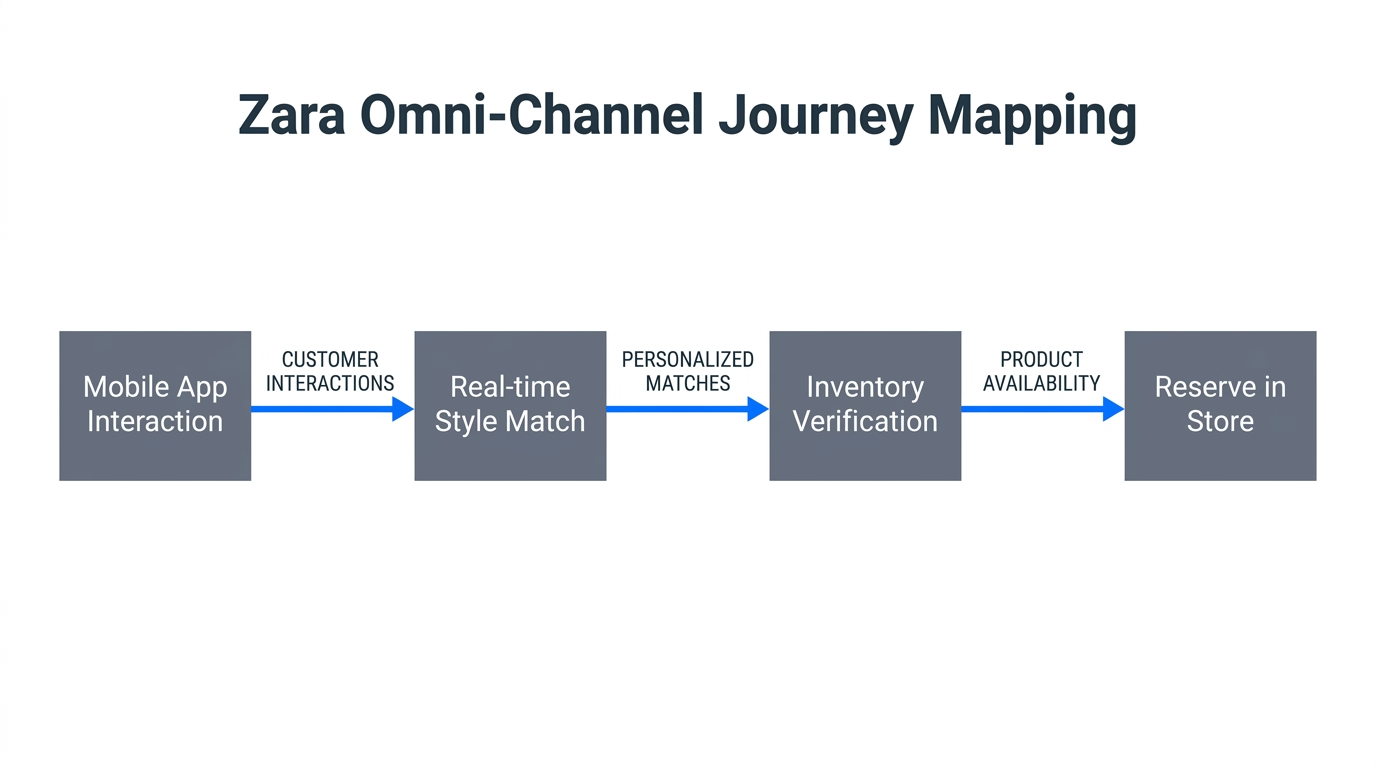
While Sephora focuses on diagnostic utility, Zara has mastered behavioral intent. Zara’s AI engine maps the 'style journey' of every visitor, analyzing micro-behaviors such as hover time, scroll depth, and color palette preferences. Instead of a linear funnel, Zara treats the shopping experience as a dynamic web of style preferences. This approach has led to a 30% increase in completed purchases by surfacing items that match the user’s aesthetic intent before they even search for them.
Zara’s engine, powered by Inditex's advanced logistics and tech stack, prioritizes real-time signals over historical data. In 2026, relying solely on what a customer bought six months ago is a recipe for irrelevance. If a user is currently browsing for summer linens despite a history of buying winter wool, the engine shifts its 'relevancy score' instantly. This prevents the 'echo chamber' effect where customers are chased by ads for things they no longer need.
The ROI of Real-Time Signals vs. Historical Data in 2026
In the current shopping landscape, the value of data has a very short half-life. Historical data tells you who a customer was; real-time signals tell you who they are right now. AI-powered personalization can boost conversion rates by 15% to 23% specifically through real-time behavioral analysis. This is because modern engines use 'predictive shopping agents' to anticipate the user's next move, a concept explored in depth by Gartner.
For example, 71% of consumers feel frustrated when their shopping experience is impersonal, according to Sailthru. By using real-time signals, brands can trigger 'replenishment nudges' or 'intent-based popups' using tools like OptiMonk. This ensures that the interaction feels helpful rather than intrusive. The goal is to replicate the 'Amazon Benchmark,' where personalized recommendations account for 35% of total revenue.
| Strategy | Focus | Primary Benefit |
|---|---|---|
| Historical Profiling | Past Purchases | Loyalty & Replenishment |
| Real-Time Behavioral | Current Session Intent | High Instant Conversion |
| Predictive Modeling | Future Probabilities | Improved CLV |
The 5-Step Playbook for Scaling Revenue with AI
For mid-market brands looking to replicate the results of Sephora and Zara, the following playbook provides a roadmap for implementation:
Step 1: Break Down Data Silos
Your personalization engine is only as good as the data it can access. Ensure your website, email platform (like Klaviyo), and customer service portal are all feeding into the same data lake. If your engine doesn't know a customer already bought an item in-store, your recommendations will feel outdated and annoying.
Step 2: Deploy Dynamic Product Recommendations (ML)
Move beyond static 'related products' bars. Use machine learning algorithms on Product Detail Pages (PDPs) and Cart pages. Tools like Clerk.io or Nosto allow you to rank products based on individual likelihood to buy, not just overall popularity.
"Any step in the customer journey that isn't personalized is a risk of losing that customer to a more intuitive competitor." — Industry Consensus, 2026
Step 3: Implement Behavioral Triggers
Automate messaging based on 'Browse Abandonment'—where a user views a category but doesn't add to cart—rather than just 'Cart Abandonment.' Using an SMS specialist like CartBoss allows you to send high-intent, personalized nudges directly to the user's phone, which often sees higher engagement than email.
Step 4: Leverage Visual & Multimodal Search
In 2026, consumers often search with screenshots. Integrating AI-powered visual search via ViSenze allows users to upload a photo of a style they like and find matching items in your inventory instantly. This significantly boosts customer lifetime value growth by making discovery effortless.
Step 5: Synthesize UGC with Personalization
The most effective personalization doesn't stop at product names; it includes the content shown. Top-tier brands now use Stormy AI to discover UGC creators who match specific customer demographics. By showing a fitness creator's video to a fitness enthusiast, you personalize the social proof itself, not just the product listing.
Choosing the Right Growth-Focused Engine
Not all engines are created equal. Your choice should depend on your current tech stack and specific growth goals. For brands on Shopify Plus, the ecosystem of apps is vast, but enterprise-level needs often require more robust solutions.
| Engine | Best For | Key Feature |
|---|---|---|
| Nosto | Mid-Market Retailers | Commerce Experience Platform |
| Bloomreach | Large Enterprise | Loomi AI (Search-focused) |
| Klaviyo AI | Omnichannel SMS/Email | Predictive Analytics |
| Insider | Mobile-First Brands | Cross-Channel Messaging |
Common Implementation Mistakes to Avoid
Even the most advanced AI engine will fail if implemented poorly. Avoid these common pitfalls to protect your ROI:
- Over-Automation: While AI can handle 90% of queries, customers still want human intervention for complex issues. Ensure your AI shopping assistants have a clear 'handoff' to human agents using platforms like Intercom or Zendesk.
- Generic Models: Using a 'one-size-fits-all' AI that doesn't understand your niche (e.g., suggesting a sugary snack to a Keto buyer) will destroy brand trust.
- Poor UX Placement: If your personalized recommendations are buried at the bottom of the page, they won't convert. Place AI nudges 'above the fold' and within the natural shopping path.
- Ignoring Privacy: With the end of third-party cookies, ensure your engine relies on first-party data. Use tools that are compliant with global privacy standards like GDPR to avoid massive fines.
Conclusion: The Race to Zero Friction
The lessons from Sephora and Zara are clear: omnichannel personalization strategy is not about showing the user more; it's about showing them less—specifically, only the things that matter. In 2026, the retail winners are those who use AI to eliminate every possible micro-friction in the buying journey. Whether it's through virtual skin-tone matching or predictive style journeys, the goal is a seamless, one-to-one relationship at the scale of millions.
By shifting to real-time signals, breaking down data silos, and leveraging Agentic AI assistants found in platforms like Stormy AI, brands can see the same 30% conversion lifts enjoyed by global leaders. The tools are available, the data is abundant, and the ROI is proven. The only remaining variable is the speed of your execution.