How to Build an AI-Driven Marketing Agency with OpenClaw in 2026
Learn how to build a scalable AI-driven marketing agency in 2026 using OpenClaw. Discover the math of replacing $5,000 fees with autonomous marketing agents.
In the fast-paced marketing landscape of 2026, the traditional social media agency model is undergoing a radical transformation. We have officially entered the era of the ‘workforce AI,’ where agencies no longer compete on headcount, but on the sophistication of their autonomous agent fleets. The catalyst for this shift is OpenClaw, a viral agentic framework that has fundamentally redefined AI agency workflow 2026. Originally a niche tool for developers, OpenClaw has exploded to over 270,000 GitHub stars, surpassing legacy infrastructure like React and the Linux kernel. For agency owners, this isn't just a new tool—it is a total operational reboot.
As we navigate the current year, the data is clear: agencies adopting autonomous marketing agents are reporting a 55% increase in operational efficiency and a 35% reduction in overhead costs, according to the latest research from Deloitte. The choice for agency owners in 2026 is simple: evolve into an AI agent conductor or be outpaced by the sheer volume and speed of automated competition.
The Economics of the AI-Driven Agency: $5,000 vs. $80
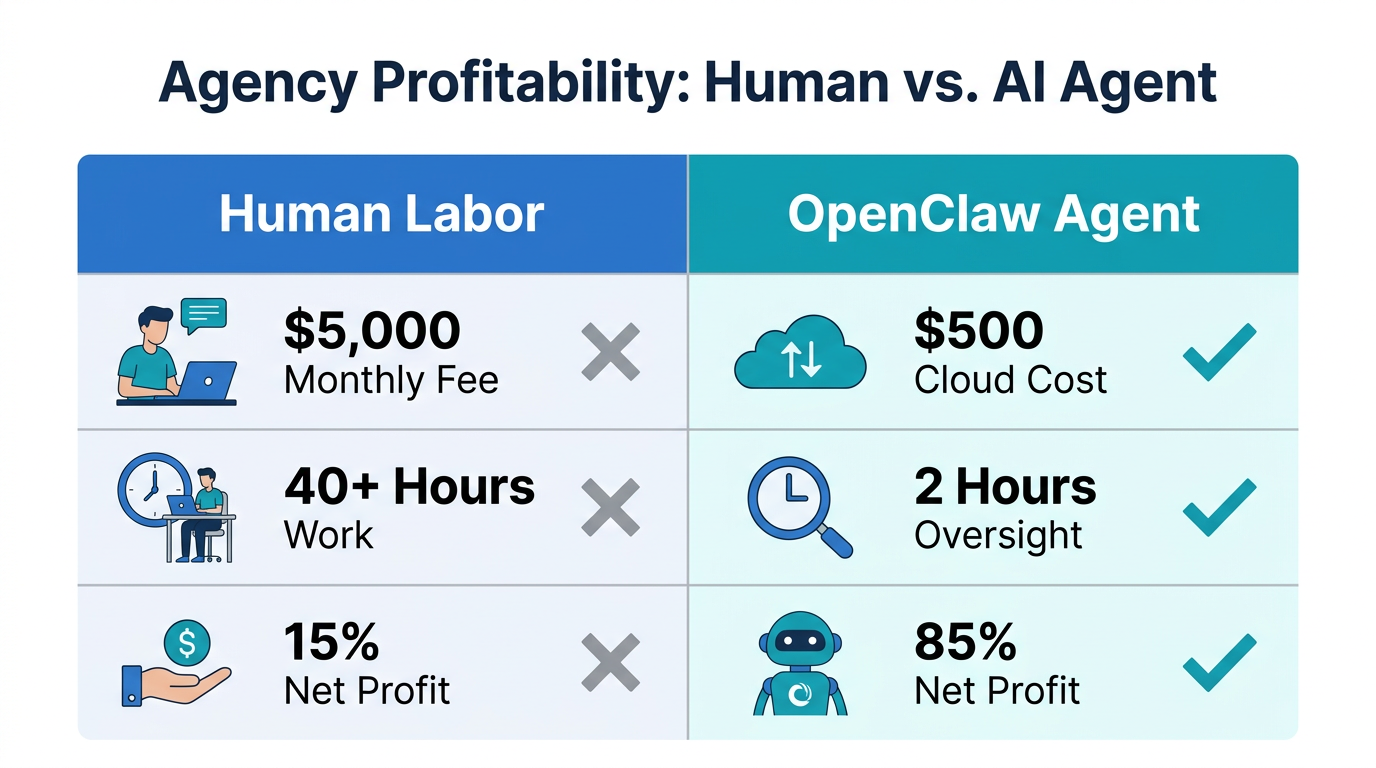
The most disruptive aspect of building an AI-driven agency this year is the dramatic shift in cost structures. Traditionally, a social media management retainer of $5,000 per month was required to cover the salaries of content creators, community managers, and analysts. In 2026, savvy operators are achieving the same (or superior) output using a custom OpenClaw setup that costs between $40 and $80 per month in API fees. This isn't just a slight discount; it's a 98% reduction in the cost of production.
| Metric | Traditional Agency (2024) | AI-Driven Agency (2026) |
|---|---|---|
| Monthly Overhead | $15,000+ (3 Staff) | $200 - $500 (API + VPS) |
| Content Throughput | 15 posts/week | Unlimited (Scaled by Agents) |
| Response Time | 2-4 Hours | < 60 Seconds |
| Scalability | Linear (Hire more people) | Exponential (Deploy more agents) |
This economic shift is driving the global creator economy toward a projected valuation of $202.56 billion, with agencies acting as the technical infrastructure providers. By leveraging AI marketing automation, agencies can now handle 10x the client volume without increasing their internal headcount.
"OpenClaw is the single most important release of software probably ever. It transforms AI from a chatbot you talk to into a workforce that executes for you." — Jensen Huang, Morgan Stanley TMT Conference
Transitioning from Social Media Manager to 'AI Agent Conductor'
In 2026, the job description of a marketing executive has pivoted. You are no longer writing captions or manually scheduling posts in Buffer. Instead, you have become a Conductor. Your role is to design the logic, set the guardrails, and manage a fleet of specialized agents that handle different segments of the marketing funnel. Experts at Stormy AI note that roles are shifting from "creators" to "orchestrators" who oversee the Business-to-Agent (B2A) ecosystem.
Being a conductor means understanding how to string together different "skills" within the OpenClaw framework. For example, you might deploy a "Trend Analyst" agent to monitor viral signals on X and Reddit, which then triggers a "Content Engine" agent to draft scripts, followed by a "Distribution" agent that pushes content to TikTok Ads Manager. This workflow ensures that your social media agency scaling is limited only by your strategic imagination, not your manual labor hours.
Setting Up Autonomous 'Trend Analyst' Agents
One of the biggest competitive advantages in 2026 is speed. To beat competitors to viral topics, you must deploy autonomous Trend Analyst agents. These agents scan over 40+ sources including competitor newsletters, social feeds, and niche forums. By using recursive browsing capabilities, these agents can identify a rising trend before it hits the mainstream.
As documented by creators on YouTube, a fleet of 14 specialized agents can be built in under 72 hours for less than $200. These agents don't just report the news; they perform a Weekly Gap Analysis. Every Monday morning, your agent can deliver a report detailing exactly where your client's competitors are gaining traction and where there is an untapped content vacuum you can fill.
"The key to winning in 2026 isn't having the best AI; it's having the best agents that actually do things while you sleep."
The Content Repurposing Engine: A Playbook
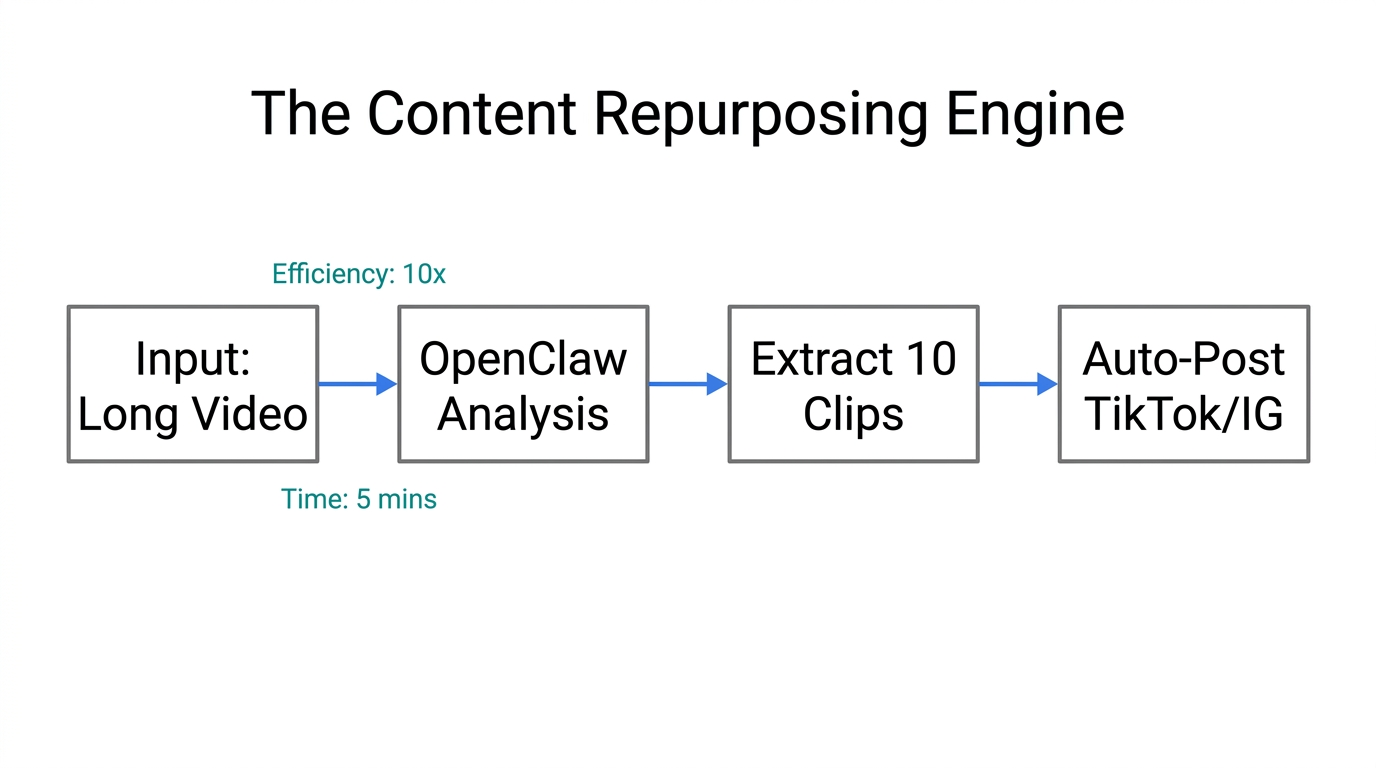
The most immediate way to implement AI agency workflow 2026 is through an autonomous content engine. Using OpenClaw’s "nested sub-agents," you can take a single piece of long-form content and turn it into a multi-platform campaign automatically.
Step 1: Input the Source Material
Upload a long-form video or podcast to a cloud directory. Your OpenClaw agent, running on a DigitalOcean VPS for security and uptime, detects the new file and begins transcription.
Step 2: Sub-Agent Delegation
The master agent delegates tasks to specialized sub-agents:
- Script Agent: Drafts 3-5 high-hook TikTok and Reel scripts.
- Thread Agent: Crafts a 10-post thread for X (Twitter) using the latest viral formatting styles.
- B2B Agent: Writes a professional summary for LinkedIn and an executive digest for a Beehiiv newsletter.
- Visual Agent: Uses Canva or Figma APIs to generate basic social assets.
Step 3: Human-in-the-Loop Review
To maintain brand voice and avoid legal errors, the agents push these drafts to a Notion database or Slack channel for a final human sign-off. This step is critical; letting agents publish autonomously without review can lead to "hallucinated" brand facts or tone-deaf messaging.
Step 4: Autonomous Distribution
Once approved, the agent uses tools like Zapier or PostEverywhere.ai to schedule and publish the content across all platforms simultaneously.
Autonomous Influencer Outreach with Stormy AI
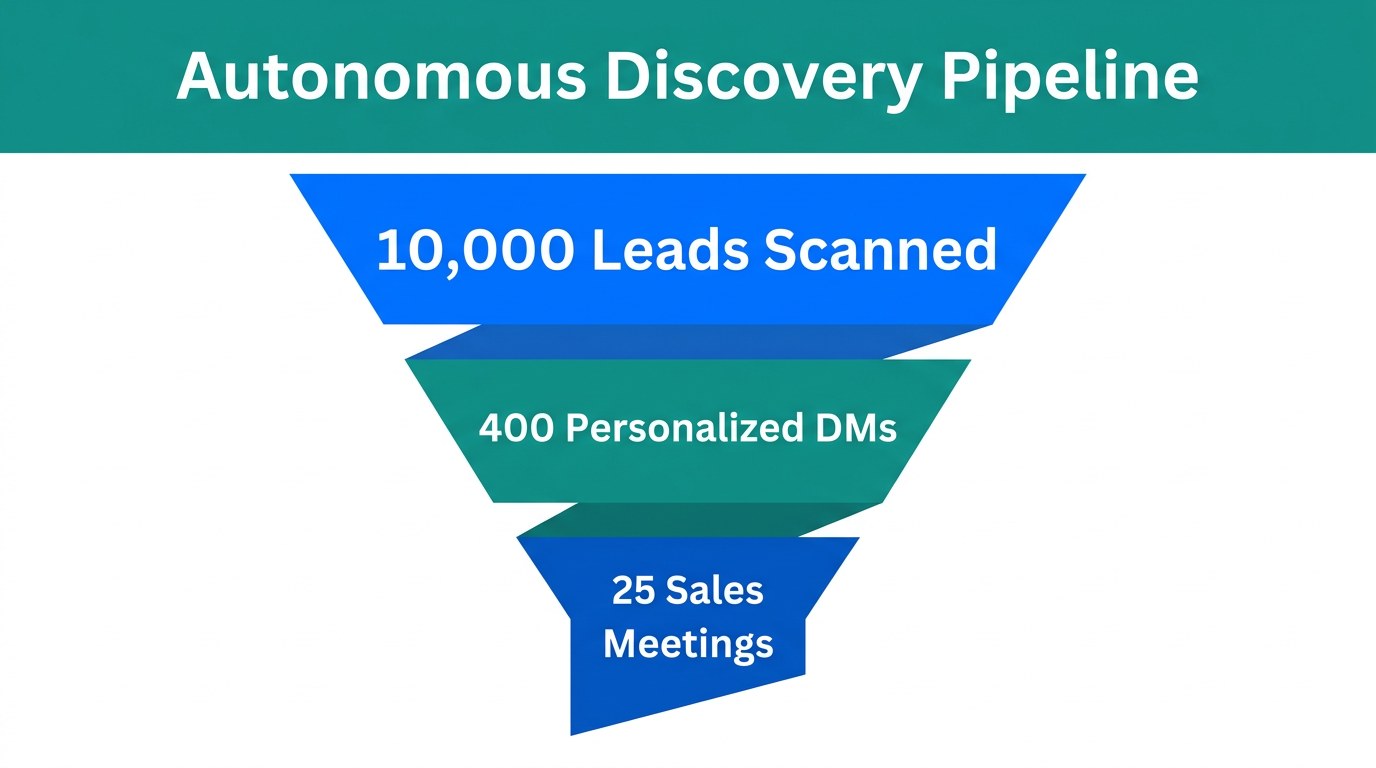
Finding the right creators to represent a brand used to take weeks of manual searching. In 2026, agencies are pairing OpenClaw with specialized discovery engines. For instance, you can use Stormy AI to identify, vet, and analyze thousands of micro-influencers in seconds.
By connecting OpenClaw to Stormy AI, you can build an outreach agent that:
- Searches for creators in a specific niche (e.g., "SaaS founders on LinkedIn").
- Analyzes their audience quality and engagement rates using Stormy's AI-powered quality reports.
- Drafts hyper-personalized emails based on their recent posts.
- Initiates contact and manages follow-ups until a reply is received.
Avoiding Common Pitfalls in the Agent Era
While the potential for social media agency scaling is massive, there are significant risks to manage. Security is the foremost concern. Because OpenClaw requires system-level access to browse and execute commands, it is vulnerable to malicious "skills" found in unvetted marketplaces. Always review the code of any third-party skill before deployment, as researchers on Medium have identified scripts designed for data exfiltration.
Another common error is API cost bloat. Using high-reasoning models for simple tasks like scheduling a post can lead to bills exceeding $500 per month. Use model-routing tools to ensure simple tasks are handled by cheaper, faster models, reserving the "expensive" brains for strategic analysis and creative writing.
"AI is no longer a replacement for creativity; it is the infrastructure that frees us for the high-leverage work of building real human communities." — Amber Kai, Founder of Sequincial
Conclusion: The Future is Agentic
Building an AI-driven marketing agency with OpenClaw in 2026 isn't just about saving money—it's about increasing the velocity of experimentation. When the cost of failure is reduced to a few cents of API usage, you can afford to test 50 different creative angles simultaneously. This level of scale was previously only available to Fortune 500 brands with multi-million dollar budgets. Today, it belongs to the "conductor" who knows how to wire the agents together.
To start your journey, focus on one manual workflow today—perhaps influencer discovery or content repurposing—and automate it using Stormy AI and OpenClaw. The transition from manager to conductor won't happen overnight, but in the competitive landscape of 2026, it is the only path to sustainable growth.