In 2026, the era of staring at static dashboards and trying to guess why your Return on Ad Spend (ROAS) dipped on a Tuesday is officially over. We have entered the age of Agentic Commerce, where reporting systems no longer just describe the past—they dictate the future. High-growth brands are moving away from descriptive reporting (telling you what happened) and toward agentic systems that identify a problem and immediately trigger a back-office solution. With the global AI in e-commerce market projected to reach $10.5 billion by late 2026, according to Triple Whale, the competitive gap is no longer about who has the best products, but who has the most efficient AI employees running their operations.
Defining Agentic Commerce: From Descriptive to Predictive Action
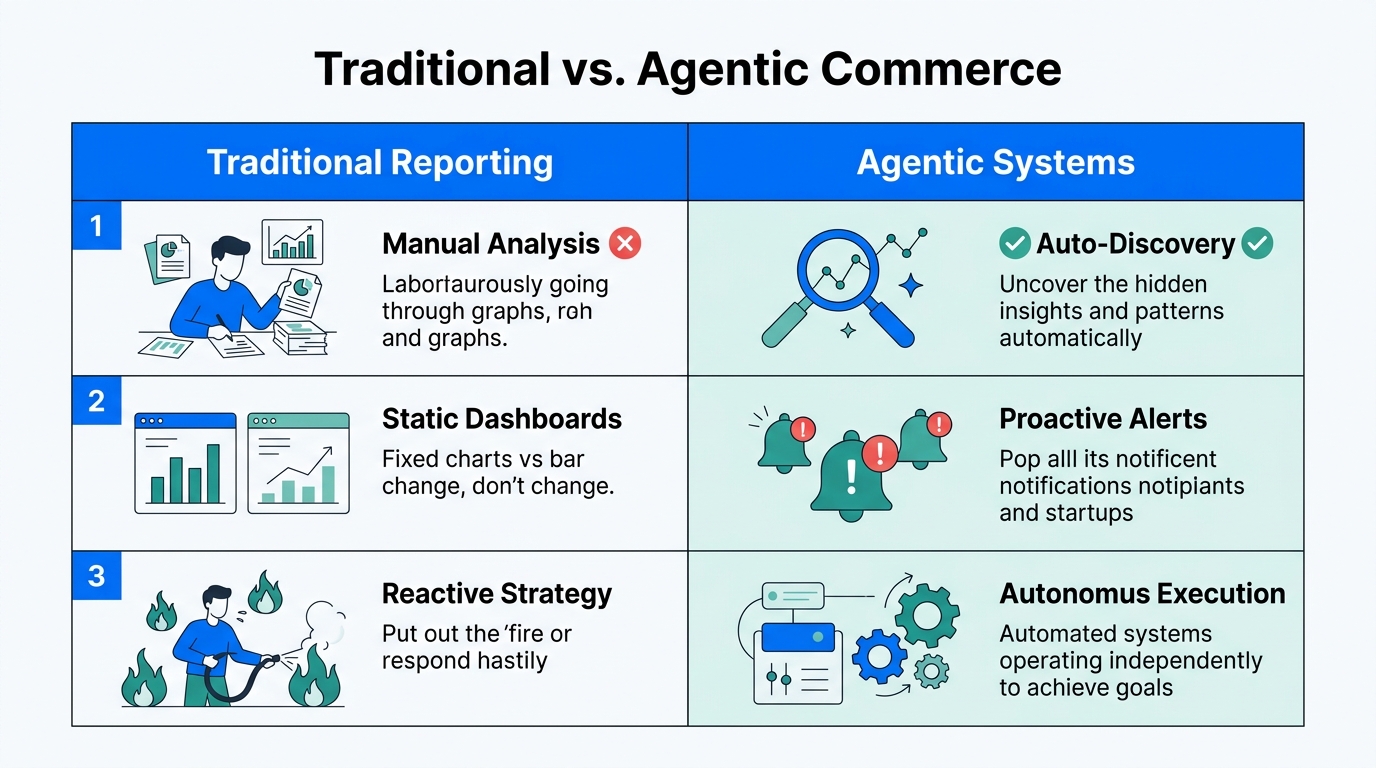
For years, Shopify merchants relied on "Last-Click" attribution and manual CSV exports. In 2026, that workflow is considered a legacy liability. Agentic commerce reporting is the practice of using autonomous AI agents to monitor store performance, correlate data across silos, and execute operational tasks without waiting for a human to click "approve."
As Dani Nadel, President of Feedvisor, recently noted in Forbes, shopping has turned "predictive, contextual, and operationally disciplined." This means your reporting shouldn't just be a PDF in your inbox; it should be a live feed that knows your Contribution Margin, Customer Lifetime Value (LTV), and New Customer Acquisition Cost (nCAC) in real-time. Tools like Polar Analytics now offer no-code BI that allows merchants to "chat" with their data, asking complex questions like, "Why did my AOV drop on Wednesday?" and receiving an answer that factors in everything from shipping surcharges to ad creative fatigue.
"2026 is the year of the builders, and we’re powering them from first sale to full scale with AI." — Harley Finkelstein, President of Shopify
Predictive Inventory: Simulating the Future with Simgym
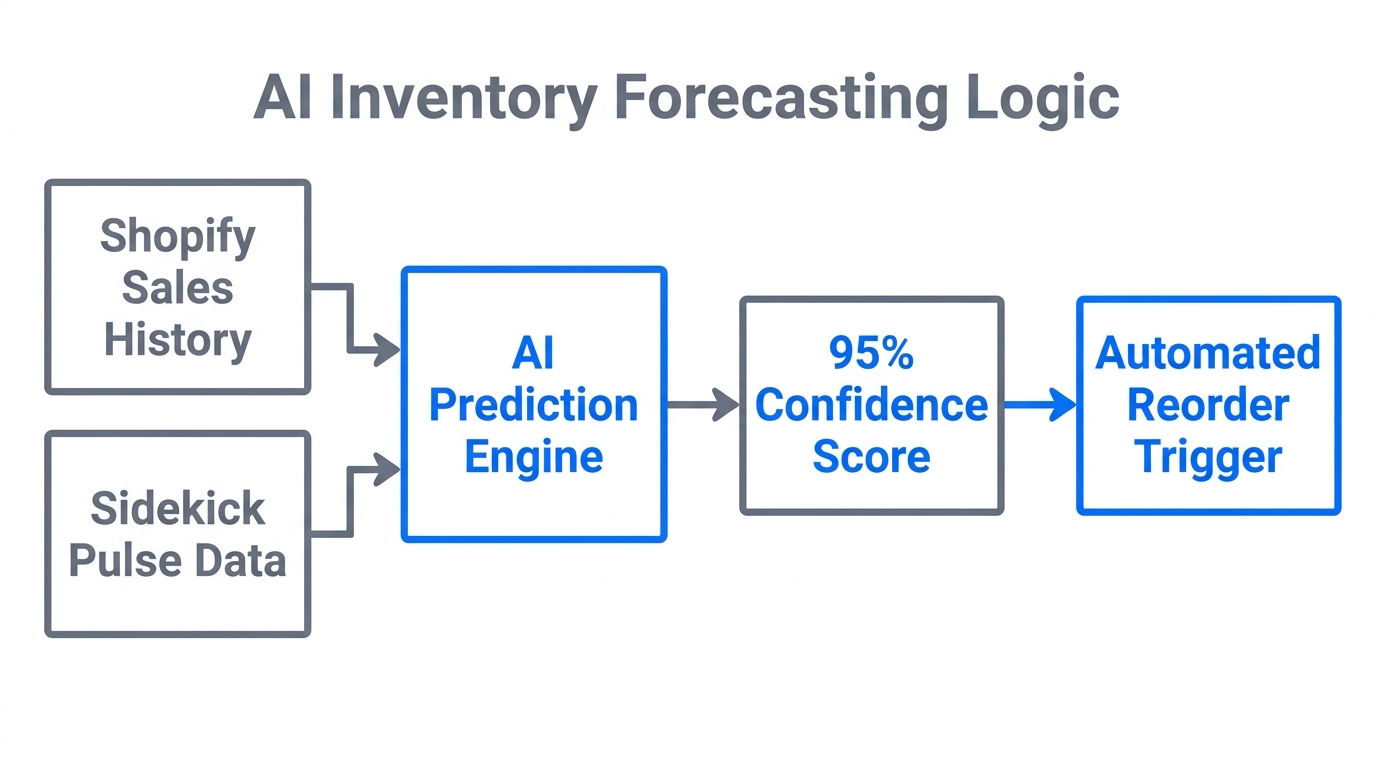
One of the most significant breakthroughs in 2026 is the ability to "test" your store's future before it happens. Shopify’s new Simgym environment allows you to run simulations on pricing strategies or inventory levels. Instead of guessing if a 20% discount will cannibalize your profit, you can ask the AI to simulate the next seven days based on historical traffic and current conversion trends.
This is where predictive inventory forecasting AI becomes a superpower. By integrating a tool like Prediko, you can forecast upcoming week’s revenue with 90%+ accuracy. When the forecast identifies a potential stockout, an AI ecommerce employee like Stormy AI doesn't just send you a notification—it checks your supplier's lead times, drafts a restock Purchase Order in your shared workbook, and waits for your final nod to send the email.
This shift is vital because orders generated through AI-driven search and recommendations grew 15x YoY in 2025, as reported by the Ottawa Business Journal. If your inventory reporting isn't agentic, you simply won't be able to keep up with AI-driven demand spikes.
Orchestrating Ad Spend: How Stormy AI Closes the Loop
Data silos are the #1 enemy of profit. Meta Ads Manager might claim a 4.0 ROAS, while Google Ads claims a 3.5, yet your Shopify bank balance tells a different story. This is the "Attribution Gap," which often leads to 15% to 30% reporting errors.
In a modern AI ecommerce automation 2026 setup, you use an AI employee to reconcile these differences. Stormy AI can be configured to pull performance data from Meta, Google, and TikTok Ads every hour. It compares this spend against real-time sales in Shopify and flags underperforming campaigns immediately. For example, if a specific SKU's conversion rate drops below 1.5% on TikTok Shop, Stormy AI can suggest shifting that budget to a higher-performing Google Search campaign, providing the mathematical reasoning in a shared spreadsheet for your team to review.
"AI is a mandatory multiplier of human talent. Teams must prove an AI can't do a job before requesting new headcount." — Tobias Lütke, CEO of Shopify
| Feature | Manual Reporting | Agentic Reporting (Stormy AI) |
|---|---|---|
| Time Investment | 10–15 hours / week | < 30 mins / week |
| Data Sync | Static / CSV Exports | Real-time / API-first |
| Actionability | Descriptive ("What happened") | Agentic ("Fix it now") |
| Attribution | Last-click only | Multi-touch / 1st Party |
Playbook: Setting Up Your 2026 AI Store Context
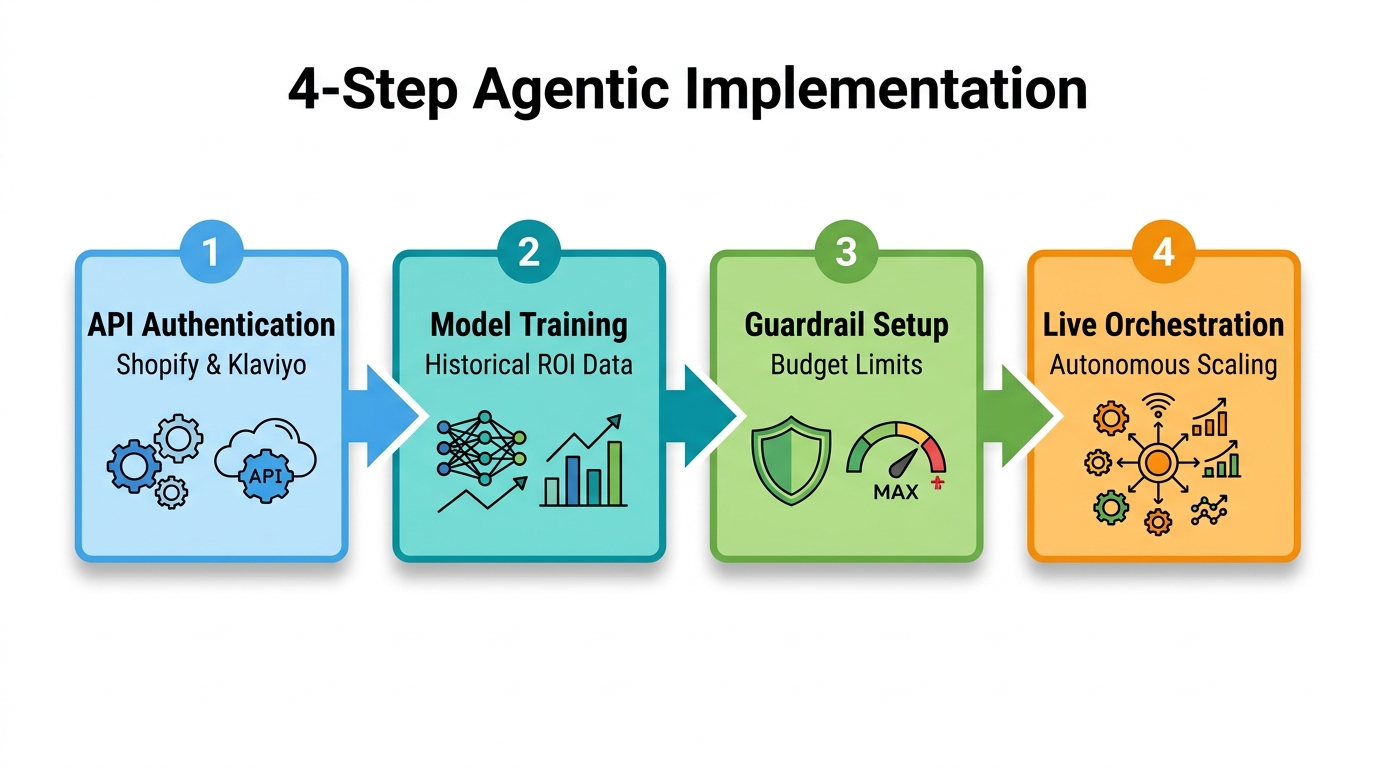
To move from basic charts to an agentic system, you need to provide your AI with "Context." AI models require high-quality data hooks to avoid hallucinations. Follow this step-by-step guide to configure your Shopify Sidekick Pulse setup and integrate it with your broader operations.
Step 1: The GraphQL API Migration
Ensure your reporting tools are using the 2026-01 GraphQL API. This version is 3x faster at retrieving Metafields and Metaobjects, which are crucial for training your AI agents on specific product attributes. According to technical documentation at Shopify Dev and insights from Design Musketeer, this API migration is the foundation for any store looking to scale with autonomous agents.
Step 2: Map Your 2026 Marketing Calendar
One of the biggest causes of "AI Hallucination" is when an agent sees a sales spike and assumes it's organic when it was actually a planned influencer drop. Use the "Store Context" feature in Sidekick Pulse to upload your entire 2026 marketing calendar. This allows Stormy AI to understand that a sudden 20% traffic surge from TikTok is expected behavior, not a bot attack or a reporting error.
Step 3: Set Agentic Thresholds and Reminders
In your shared spreadsheet, set row-level triggers for your KPIs. For example, instruct Stormy AI: "If AOV drops >10% below the 4-week rolling average, check for broken discount codes and alert the team on Slack." This proactive monitoring, often called a "Pulse check," allows you to catch errors in hours rather than waiting for the end-of-week review.
The Safety Net: Human-in-the-Loop (HITL) Checkpoints
Despite the massive efficiency gains, AI reporting is not infallible. A 2026 study cited by Neil Patel found that AI tools still have a 34.2% error rate when performing complex multi-step financial reasoning, such as calculating net profit after manual discounts and shipping surcharges.
This is why Human-in-the-Loop (HITL) checkpoints are mandatory. You should never let an AI agent authorize high-value refunds or multi-thousand-dollar ad budget shifts without a final human "thumbs up." We've seen "Phantom Refund" issues where agents mistakenly approved returns for non-existent orders, leading to direct financial loss. Use Stormy AI to do the heavy lifting—gathering the data, identifying the trend, and drafting the response—but keep the final execution button in human hands.
"The key to 2026 isn't replacing humans with AI; it's using AI agents to eliminate the 15 hours of manual reconciliation every merchant hates."
Choosing Your Stack: Triple Whale vs. Polar vs. Luca AI
The 2026 landscape offers specialized tools depending on your brand's scale and needs. If you are a creative-heavy DTC brand, Triple Whale remains the gold standard for ad attribution. However, for data-driven power users doing over $5M GMV, Polar Analytics offers an open Snowflake data warehouse that is perfect for custom AI agent training.
For brands looking for a mix of business intelligence and capital, Luca AI has emerged as a strategic advisor that can even assist with embedded capital access. Regardless of the tool you choose, ensure it integrates with your operational teammates like Stormy AI. While your BI tool shows you the data, Stormy AI is the one that wakes up at 3 AM to check if your inventory is running low and emails the supplier for you.
The Bottom Line for 2026
Building an agentic reporting system isn't just about better charts; it's about building a store that can think for itself. By combining the predictive power of Shopify Simgym, the proactive alerts of Sidekick Pulse, and the operational execution of an AI ecommerce employee like Stormy AI, you can run a lean, eight-figure operation with a fraction of the traditional headcount.
Stop spending 15 hours a week stitching together CSVs. Transition to agentic commerce today and let your AI teammate handle the messy back office while you focus on the big-picture strategy. The data is clear: the brands that "ask and act" with AI are the ones that will dominate the remainder of this decade.