The era of manually adjusting bids and micro-managing campaign spreadsheets is coming to a definitive end. As digital landscapes fragment across social, search, and retail media, the role of the media buyer is undergoing a fundamental transformation. We are shifting from "automated" advertising—where tools follow rigid rules—to autonomous advertising, powered by reasoning engines that negotiate and optimize in real-time. By leveraging an AI agent for media buying, brands can finally break through the walled gardens of Meta, Google, and TikTok to achieve a truly unified multi-channel distribution strategy.
The New Logic of Agentic Advertising
Traditional programmatic advertising relied on the Demand Side Platform (DSP) as a central hub, often resulting in high fees and slow negotiation cycles. The rise of agentic advertising changes this dynamic by introducing autonomous agents that represent both the buyer and the seller. Instead of a middle-man holding the keys, these agents use Large Language Models (LLMs) to communicate directly. According to Warmly.ai, the global AI agent market is projected to grow from $5.4 billion in 2024 to $7.6 billion in 2025, representing a staggering 45.8% CAGR.
The efficiency gains are not just theoretical. Data from DoubleVerify/Scibids shows that companies implementing autonomous media buying report 20%–40% improvements in campaign efficiency. This shift allows human marketers to move away from the "execution" phase and focus on higher-level governance and strategic creative direction.
Understanding Ad Context Protocol (AdCP)
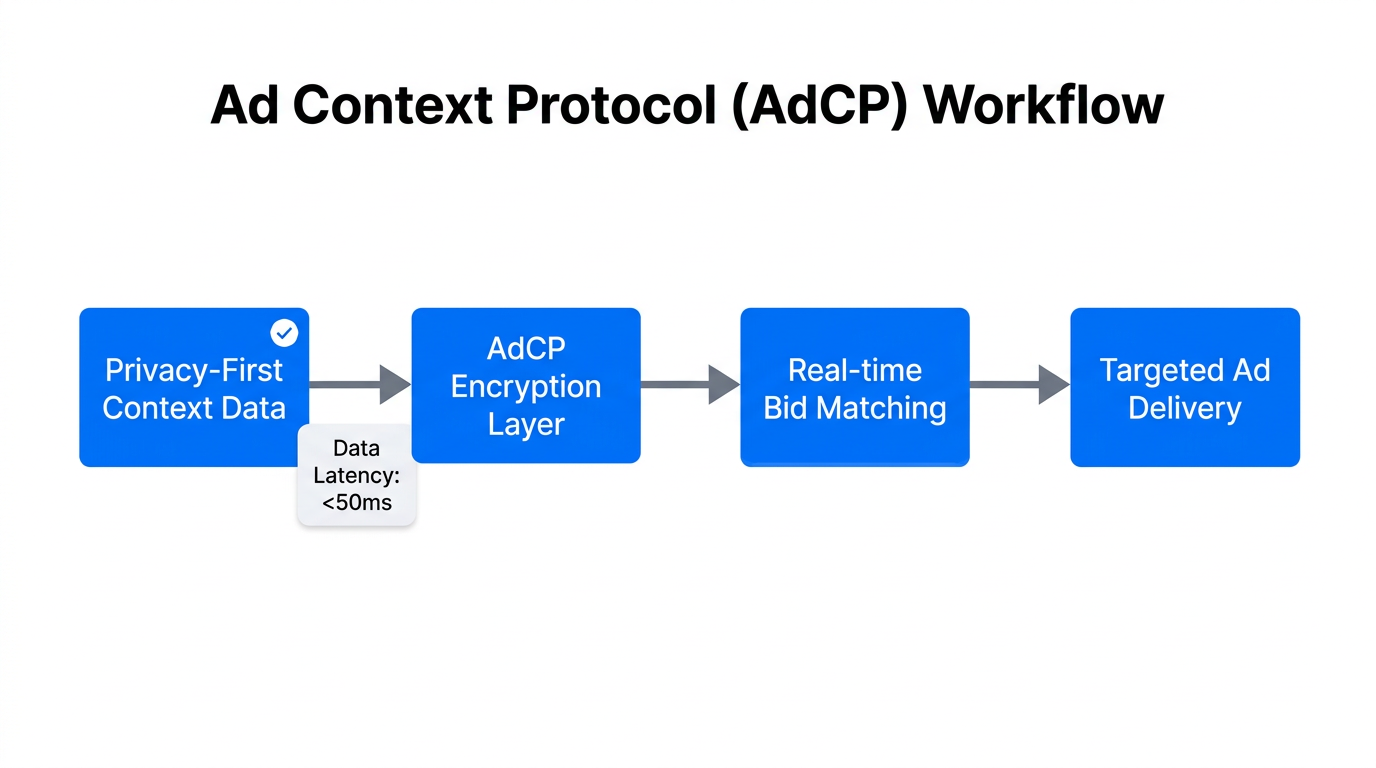
At the heart of this revolution is the Ad Context Protocol (AdCP). This open standard is designed to allow buyer and seller agents to "talk" to each other seamlessly. Historically, data silos between platforms like Meta Ads Manager and Google Ads made it nearly impossible to optimize for a single user journey across the web. AdCP breaks this operational bottleneck by moving programmatic from millisecond transactions to strategic, long-term portfolio management.
As Ben Skinazi, CMO of Equativ, notes, AdCP is the key to unlocking interoperability across fragmented channels. When buyer agents can negotiate directly with seller agents based on a standardized protocol, the reliance on high-fee DSPs decreases, and the speed-to-market increases significantly. This is especially critical for brands trying to navigate the privacy-first advertising landscape.
"The Ad Context Protocol will break the operational bottleneck, moving programmatic from millisecond transactions to strategic, long-term portfolio management."
Deploying 'Agent Swarms' for Distribution
Instead of relying on a single monolithic tool, leading brands are now deploying "agent swarms." In this model, multiple specialized agents work in tandem to solve complex marketing problems. For example, one agent may be tasked solely with audience discovery across TikTok Ads Manager, while a second agent simultaneously optimizes creative variations for Apple Search Ads. Expert Deepak Gupta highlights that this swarm approach allows for a level of granularity and speed that human teams simply cannot match.
This ecosystem-based approach is what Martech leader Scott Brinker describes as a "rainforest" rather than a "Ferrari"—an environment of independent but interconnected AI agents. These swarms don't just bid; they learn. If an agent discovers that a specific video hook is performing well on TikTok, it can instantly communicate that insight to a companion agent managing YouTube Shorts, ensuring that high-performing creative is scaled instantly across the entire stack.
Privacy-First Optimization: Context over Cookies
With the death of the third-party cookie, the industry is pivoting toward contextual targeting AI. Agents no longer need to follow an individual's browsing history to predict conversion. Instead, they analyze billions of contextual and attention-based signals in real-time. Tools like Scope3 are leading the way by helping agents predict performance based on the quality and sustainability of the media environment.
By moving to a privacy-first advertising model, agents use deep learning to understand the intent behind a user's presence on a specific page or platform. This ensures compliance with global privacy regulations while maintaining—or even improving—targeting accuracy. Reports from Matic Digital indicate that AI-powered contextual campaigns see a 25%–30% reduction in Cost-Per-Acquisition (CPA) and a 30% increase in ROAS compared to manual bidding.
The Future of Interoperability: Breaking Walled Gardens
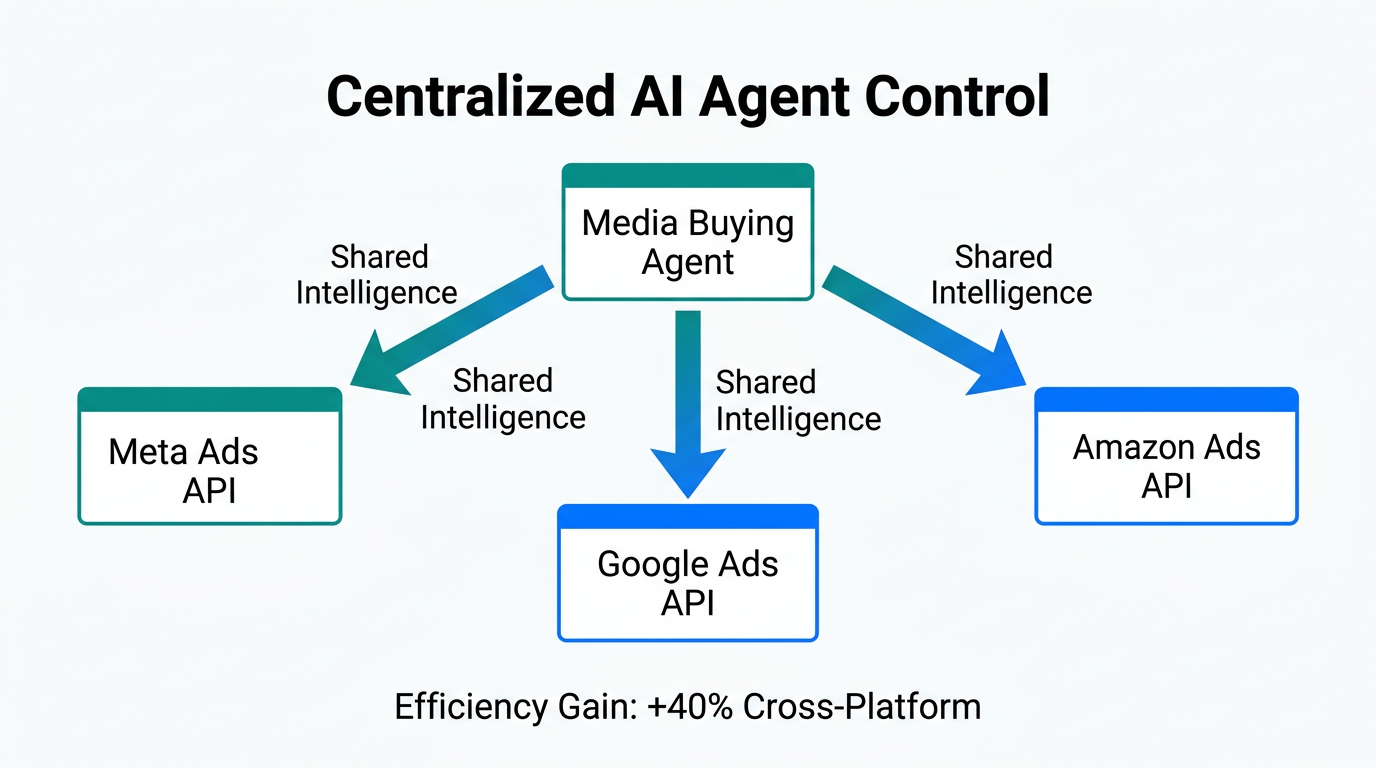
One of the biggest pain points for modern growth teams is the lack of communication between Amazon, Meta, and Google. Each platform wants to claim 100% of the credit for a sale. New autonomous control centers are beginning to solve this by managing the entire budget from a single autonomous hub. Platforms like Fluency.inc allow agents to distribute spend dynamically between Perpetua for Amazon and Revealbot for social automation.
For brands scaling UGC (User-Generated Content), this cross-platform intelligence is vital. While agents handle the programmatic distribution, sourcing the actual content remains a human-centric or specialized task. This is where tools like Stormy AI come into play, allowing brands to discover high-quality creators on TikTok and Instagram to feed the creative pipeline that these AI media buying agents require to function effectively.
| Agent Category | Recommended Platform | Primary Value Prop |
|---|---|---|
| Fully Autonomous | Albert AI | End-to-end execution across search and social. |
| Programmatic & RTB | DoubleVerify (Scibids) | Real-time logic layer for high-volume bids. |
| Enterprise Operations | Fluency.inc | Robotic Process Automation for large-scale media. |
| PPC Optimization | Optmyzr | Advanced script-based management for Google/Bing. |
The AI Media Buying Playbook: How to Implement
Transitioning to an agentic model shouldn't happen overnight. To avoid the "set and forget" trap, follow this structured approach to implementing autonomous media buying.
Step 1: Build a Data Foundation
Agents are only as effective as the data they consume. Before connecting an agent, centralize your first-party data from your CRM systems and clean it. According to Hashmeta, data silos lead to bid duplication and wasted spend, as the agent on Meta won't know what the agent on Google is doing.
Step 2: "Chunk the Elephant"
Don't try to automate your entire funnel at once. Start with high-frequency, low-risk tasks such as pacing monitoring and creative A/B testing. MINT.ai suggests that starting with small, discrete tasks allows you to build trust in the agent's reasoning before handing over the entire budget.
Step 3: Implement Human-in-the-Loop (HITL)
Set strict budget and brand safety guardrails. Use agents to provide "recommendations" that require human approval for the first 30–60 days. This ensures the agent understands your brand voice and doesn't optimize for short-term clicks at the expense of long-term brand equity.
"The modern martech stack is becoming more like a rainforest than a Ferrari—an ecosystem of independent but interconnected AI agents."
Real-World Success: From Crabtree & Evelyn to Coca-Cola
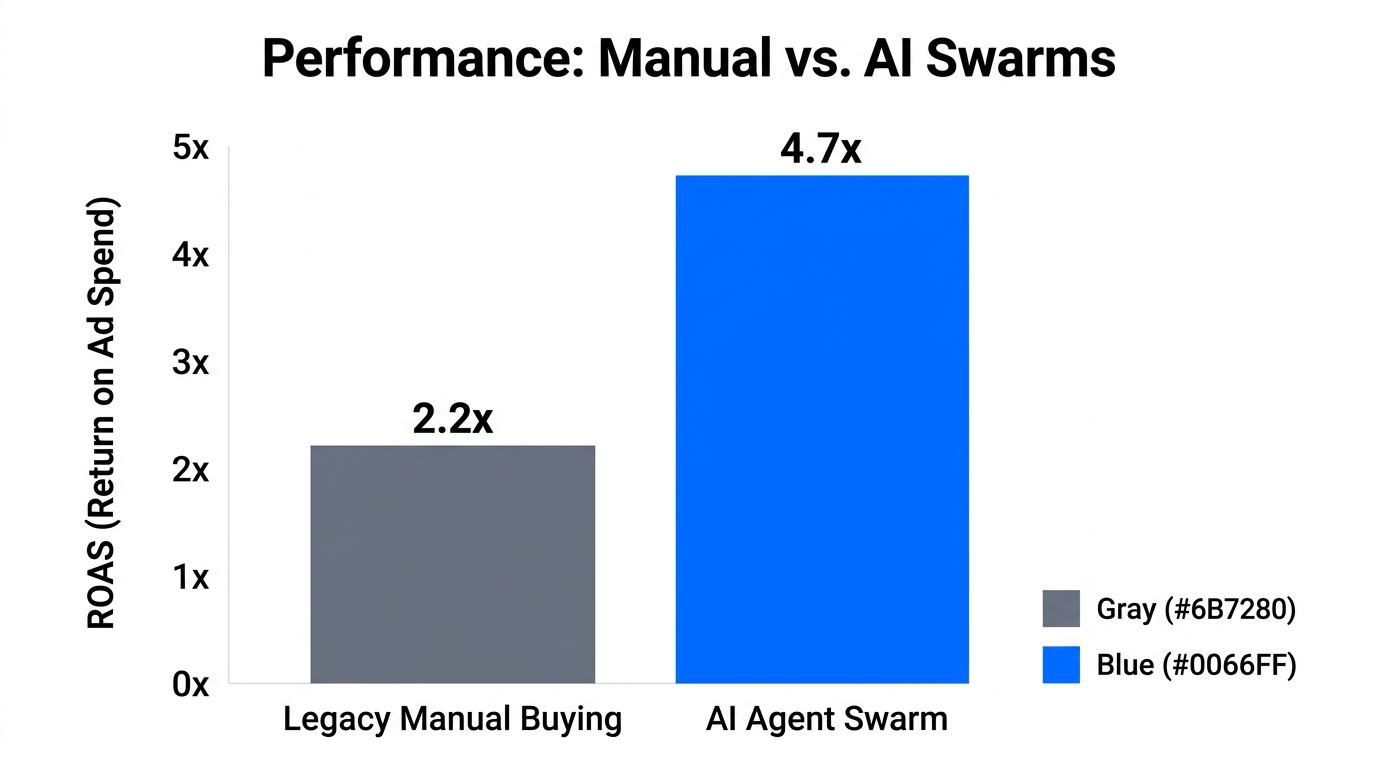
The impact of agentic advertising is already visible in enterprise-scale results. Crabtree & Evelyn used Albert AI to manage their social programs, achieving a 30% increase in ROAS without increasing their media spend. By allowing the agent to find audience pockets they hadn't considered, they were able to scale efficiently across regions.
Similarly, Dole Food Company leveraged autonomous agents to identify niche celebratory moments in the Philippines. By identifying these hyper-local opportunities in real-time, they successfully expanded market share for smaller product lines that usually get ignored in large-scale manual campaigns. Even giants like Coca-Cola are getting in on the action, using agents to integrate creative generation with media placement via their "Create Real Magic" platform.
Common Pitfalls to Avoid
While the allure of "set and forget" is strong, AI lacks strategic foresight. One of the most common mistakes is treating AI as a total replacement for human strategy. Over-reliance can lead to "short-termism," where agents optimize for the cheapest click rather than the highest lifetime value (LTV).
Furthermore, generic AI prompts lead to generic ads. If you don't train your agents on specific brand guidelines and emotional tones, your creative will quickly suffer from fatigue. Always pair your distribution agents with a robust creative engine—whether that's an in-house team using Canva and Figma or a platform like Stormy AI to source authentic UGC creators who can keep the agent's "testing pool" fresh with high-quality content.
The Future: Interoperable Autonomy
The future of media buying is not one single tool, but an interconnected web of agents. By adopting the Ad Context Protocol and exploring agent swarms, marketers can finally move from the role of "pilot" to "air traffic controller." The ability to break walled gardens and manage Meta, Google, and Amazon as a single, fluid ecosystem is no longer a pipe dream—it is a competitive necessity.
To stay ahead, brands must begin building their agentic infrastructure today. Start by centralizing your data, testing autonomous bidding on a single channel, and slowly expanding to a multi-agent workflow. The brands that master this transition will be the ones that achieve unprecedented scale while maintaining a privacy-first approach to the modern consumer.