For the last decade, growth marketers have lived in the era of 'If-Then' logic. If the Cost Per Acquisition (CPA) exceeds $50, then pause the campaign. If the click-through rate is below 1%, then swap the creative. While this level of Google Ads automation helped us scale, it has reached its ceiling. We are currently witnessing a seismic shift from passive automation to active autonomy. According to Marc Benioff, CEO of Salesforce, we are entering an 'Agent Revolution' that is as significant as the cloud or mobile revolutions, moving software from something we use to something that works for us.
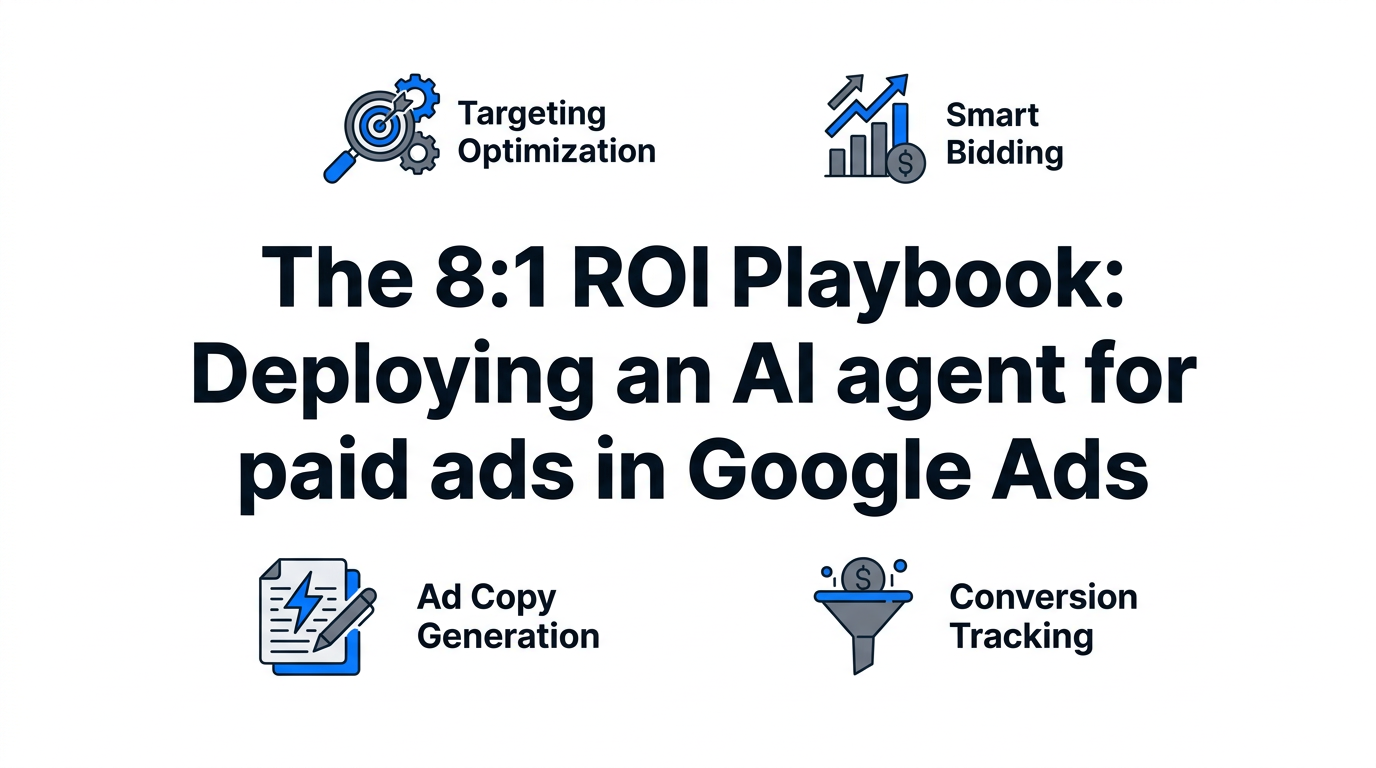
This article provides a strategic playbook for deploying an AI agent for paid ads. By moving beyond simple scripts and into the realm of autonomous AI marketing agents, brands are no longer just saving time—they are fundamentally rewriting their marketing ROI. While traditional automation typically yields a 2:1 return, autonomous bidding strategy implementations are now delivering an average 8:1 ROI benchmark.
The Shift from Automation to Autonomy: The Perceive-Think-Act Loop
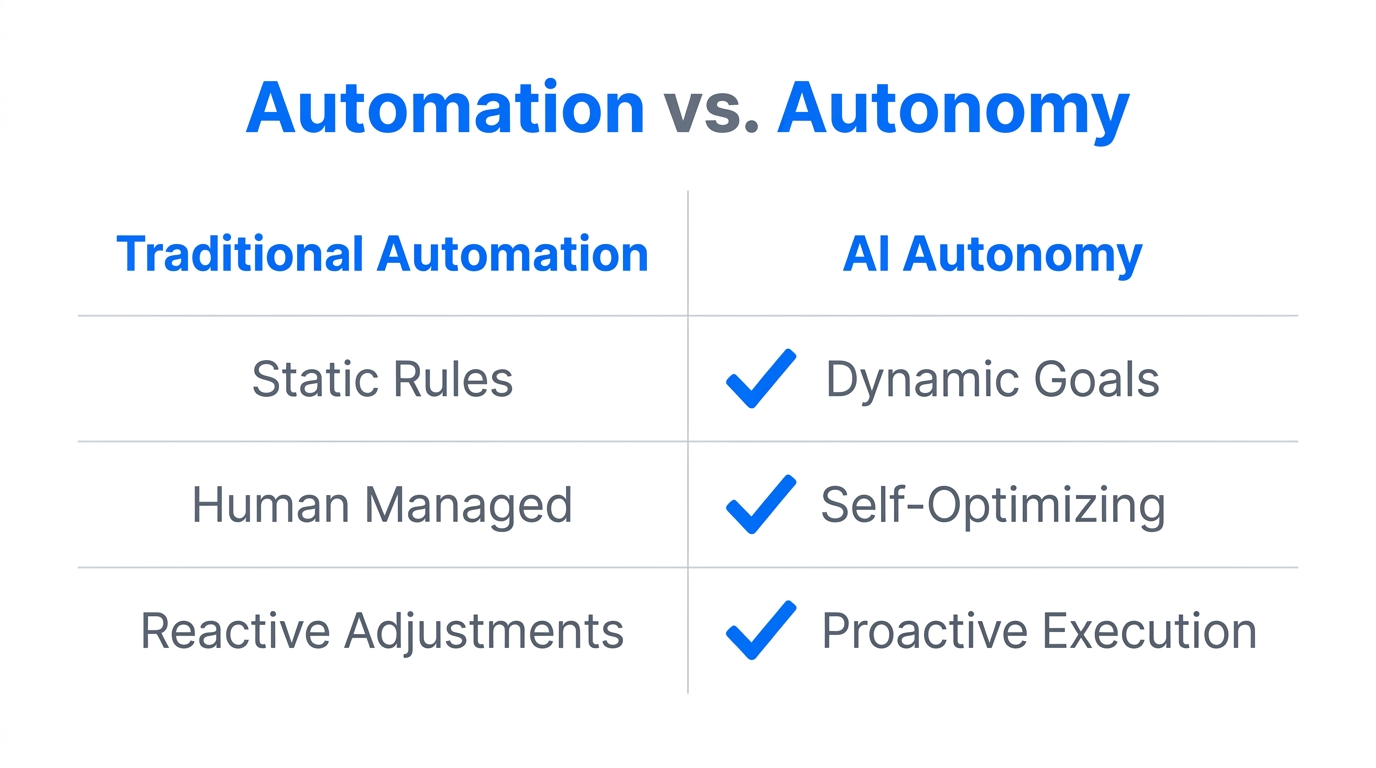
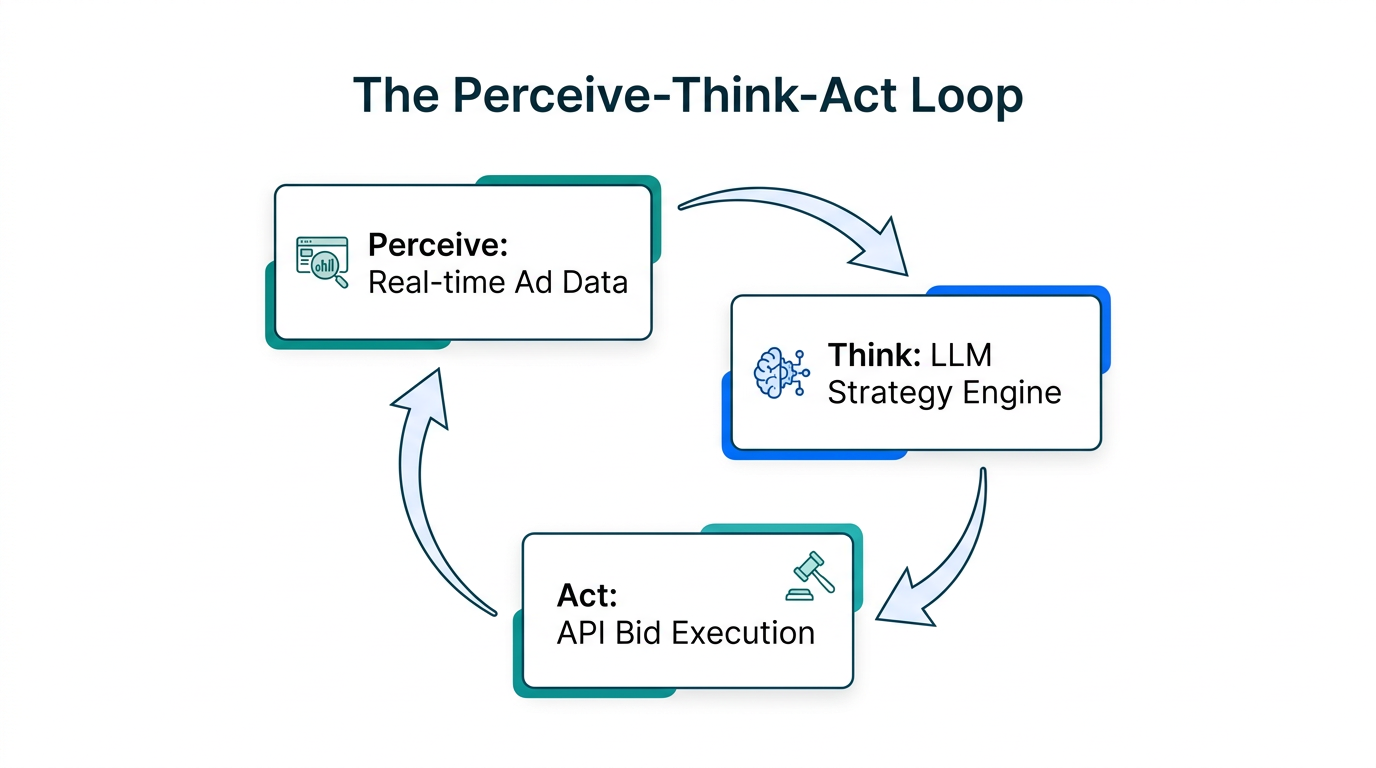
To understand why an AI agent for paid ads outperforms traditional Google Ads automation, we must look at the underlying architecture. Traditional tools are reactive; they wait for a specific trigger to execute a pre-defined command. In contrast, autonomous agents operate on a continuous Perceive-Think-Act autonomous loop.
- Perceive: The agent connects to live data streams via the Google Ads API. It doesn't just look at clicks; it monitors real-time market trends, competitor moves, and even external factors like weather or social sentiment.
- Think: Using advanced Large Language Models (LLMs) like GPT-4o or Claude 3.5, the agent analyzes the data against your high-level business goals. It asks: "Is this high CPA caused by poor creative, or is there a temporary spike in auction density?"
- Act: The agent executes a multi-step solution. It might simultaneously increase the budget on a top-performing keyword, generate a new ad headline using Copy.ai, and reallocate spend from a lagging campaign—all without human intervention.
- Learn: Every action is logged, and the outcome is used to refine the agent's future decision-making matrix.
"In 2025, AI moved from the side of the tech stack to the center, taking over entire workflows like campaign routing and performance leveling." — Saul Marquez, CEO of Outcomes Rocket.
Achieving the 8:1 ROI Benchmark
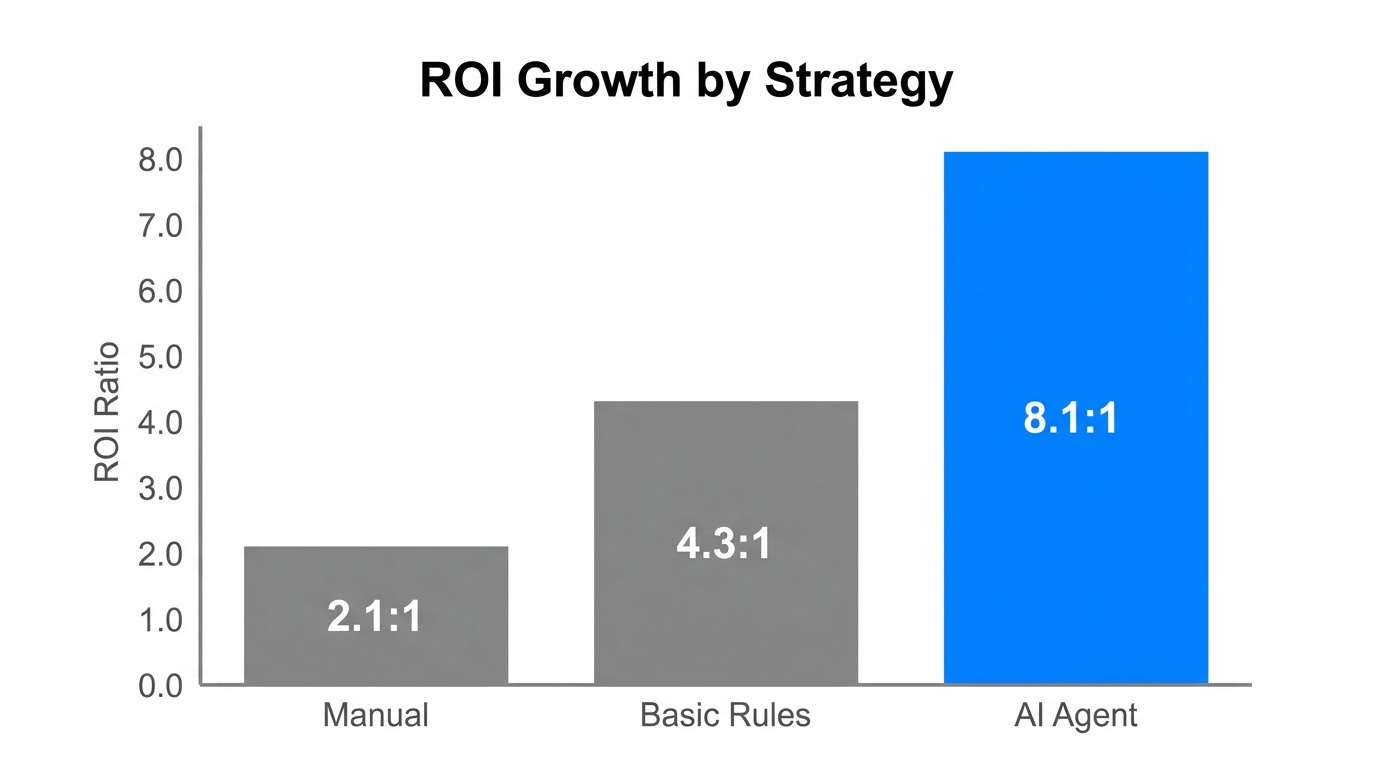
Why is the performance gap between automation and agents so vast? According to data from Latenode, platforms powered by autonomous agents deliver an 8:1 ROI, quadrupling the results of legacy systems. This is driven by three core efficiencies:
- Zero Latency: While a human manager might check an account twice a day, an agent checks it every 60 seconds using tools like Make.com to monitor triggers. This prevents 'budget bleed' during underperforming hours.
- Hyper-Granularity: Agents can manage thousands of micro-bids across hundreds of ad groups simultaneously—a task physically impossible for a human team.
- Predictive Reallocation: Instead of looking backward at yesterday's performance, agents use predictive modeling to shift budgets into campaigns that are *about* to trend.
| Feature | Traditional Automation | Autonomous AI Agents |
|---|---|---|
| Logic Basis | If-Then Rules | Perceive-Think-Act Loop |
| Decision Speed | Scheduled (Hourly/Daily) | Real-Time (Millisecond) |
| Creative Input | Static/Manual | Dynamic/Generative |
| Average ROI | 2:1 | 8:1 |
The Step-by-Step Setup for AI-Driven Bidding
Transitioning to an autonomous bidding strategy requires a shift in how you structure your ad account. Follow this playbook to deploy your first agent-led campaign.
Step 1: Data Ingestion and API Integration
An agent is only as good as the data it perceives. You must break down data silos. Ensure your agent has access to your Google Ads account, your CRM (like Salesforce), and your web analytics via Google Analytics. This ensures the agent optimizes for revenue, not just clicks.
Step 2: Define the Logic Engine
You aren't writing rules; you are providing context. In tools like Relevance AI, you feed the agent a 'System Prompt' that includes your brand voice, target CPA, and mandatory exclusion lists. For example: "You are a growth marketer for a SaaS brand. Your goal is to keep CAC under $45 while maximizing sign-ups. If a keyword shows 0 conversions after 500 clicks, pause it immediately."
Step 3: Real-Time Budget Reallocation
Configure the agent to monitor budget utilization across different platforms. If your Google Ads search campaign is hitting its daily cap by 2 PM while your TikTok Ads are under-spending, the agent should autonomously shift the remaining funds to the platform with the higher current ROAS.
"The key to scaling in 2025 is not working harder; it's building a 'team' of agents that monitor, analyze, and execute while you sleep."
Implementing 'Constrained Autonomy' and Safety Guardrails
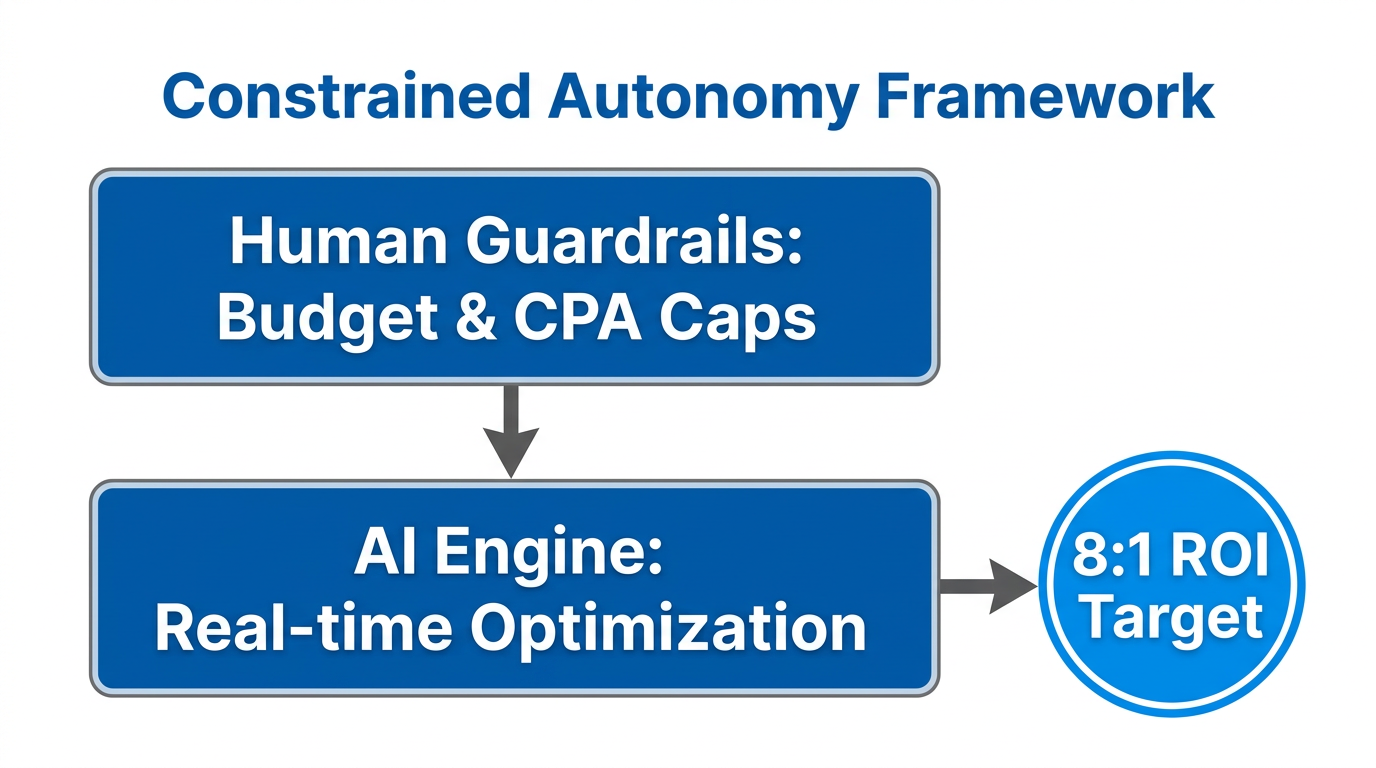
One of the biggest fears in Google Ads automation is the 'runaway agent'—an AI that spends your entire monthly budget in three hours due to a technical glitch. To prevent this, elite marketers use constrained autonomy. This involves setting 'safety pre-hooks' that act as a digital fence.
- Hard Budget Kill Switches: Set a daily spend limit at the account level that the AI agent cannot override, regardless of its logic.
- Human-in-the-Loop (HITL): Require human approval for any budget changes that exceed a specific percentage (e.g., 20%).
- Drift Monitoring: Agents can sometimes experience 'logic drift,' where they optimize for the wrong metric. Schedule weekly audits to ensure the agent's actions still align with long-term brand goals.
Case Study: How Coca-Cola Achieved a 20% Conversion Boost
Coca-Cola is a prime example of a global brand moving toward AI marketing agents. By implementing a dynamic bidding agent that adjusted spend based on real-time event triggers (such as live sports scores or weather changes), as noted in their digital transformation reports, they were able to deliver ads when consumers were most likely to crave a beverage. The result? A 20% increase in conversion rates. This wasn't just simple automation; it was an agent perceiving the real world and acting on it instantly.
Similarly, when scaling these high-performance campaigns, sourcing fresh content is critical. Platforms like Stormy AI allow marketers to discover and vet the UGC creators needed to feed the AI agent's creative engine, ensuring the 'Think' phase of the loop always has high-quality assets to deploy.
Common Mistakes to Avoid in the Agent Era
Deploying an AI agent for paid ads is not a 'set-it-and-forget-it' strategy. To maintain your marketing ROI, avoid these three common pitfalls:
- Data Silos: If your agent only sees Google Ads data but not your backend sales in Shopify, it will optimize for the cheapest click, which often leads to the lowest quality lead.
- The 'Creep Factor': Agents are powerful at hyper-personalization, but 71% of consumers get frustrated with impersonal experiences. Balance is key.
- Ignoring Brand Voice: Generic LLM prompts produce 'hallmark-style' ad copy. Always feed your agent a comprehensive Brand Style Guide as part of its base memory.
Conclusion: The Future of Performance Marketing
The transition from manual Google Ads automation to autonomous AI marketing agents is no longer optional for brands that want to remain competitive. By adopting the AI-driven bidding strategy and the Perceive-Think-Act loop, you can move toward the 8:1 ROI benchmark that defines top-tier performance in 2025.
Start small: deploy an agent to manage budget reallocation between two campaigns. Once you establish 'constrained autonomy' and trust the logic, scale your agentic workforce to handle creative testing and real-time bidding. The brands that win will be those that stop managing ads and start managing the agents that manage the ads. For those looking to fuel these agents with high-performing UGC, leveraging a creator discovery tool like Stormy AI is the logical next step in your autonomous growth stack.