2026 Strategy Guide: Boosting ROI with AI Abandoned Cart Email Recovery
Discover how AI abandoned cart email recovery is tripling ecommerce ROI in 2026. Master predictive intent scoring and automated recovery for higher revenue.
In 2026, the digital checkout line is leakier than ever. As consumer attention spans fragment across dozen of platforms, the global average cart abandonment rate has stabilized at a staggering 70.19% to 76.8%, according to latest data from the Baymard Institute and Sendtric. For the average ecommerce founder, this isn't just a metric; it is a massive hole in the bucket that costs billions in unrealized gains.
However, 2026 marks a turning point in how we address this crisis. The era of the static, three-email sequence is officially over. Today, brands are transitioning to AI abandoned cart email recovery systems that don't just 'remind' the user—they predict behavior, resolve friction in real-time, and triple industry-average success rates. If your current recovery strategy is still built on rigid time-delays, you are leaving 40% of your potential revenue on the table.
The 2026 Ecommerce Landscape: Why Static Systems Are Failing
The fundamental problem with traditional recovery sequences is their lack of context. In the past, a user would receive a 'forgot something?' email 24 hours after leaving. In 2026, 24 hours is an eternity. Modern shoppers, particularly on mobile where abandonment reaches 78–80.2% (Envive), have likely already purchased from a competitor on Shopify or forgotten why they wanted the item in the first place.
Traditional recovery flows typically hover around a 15% success rate. In contrast, AI-driven systems are now achieving recovery rates of 45–56%. This performance gap exists because AI systems analyze real-time intent signals rather than just checking if a 'checkout-completed' event fired.
"In 2026, if you're still sending a 'Did you forget something?' email 24 hours later, you've already lost the sale to an AI agent that answered the customer's question in seconds."
| Feature | Traditional Sequences | AI-Powered Systems |
|---|---|---|
| Recovery Rate | 15% average | 45–56% |
| Timing | Fixed (e.g., 1hr, 24hr) | Predictive (Behavior-based) |
| Personalization | Name & Product Image | 1:1 Browsing History & Logic |
| Discounting | Flat coupon for everyone | Dynamic (Margin-optimized) |
The Financial Impact: Understanding Revenue Per Recipient (RPR)
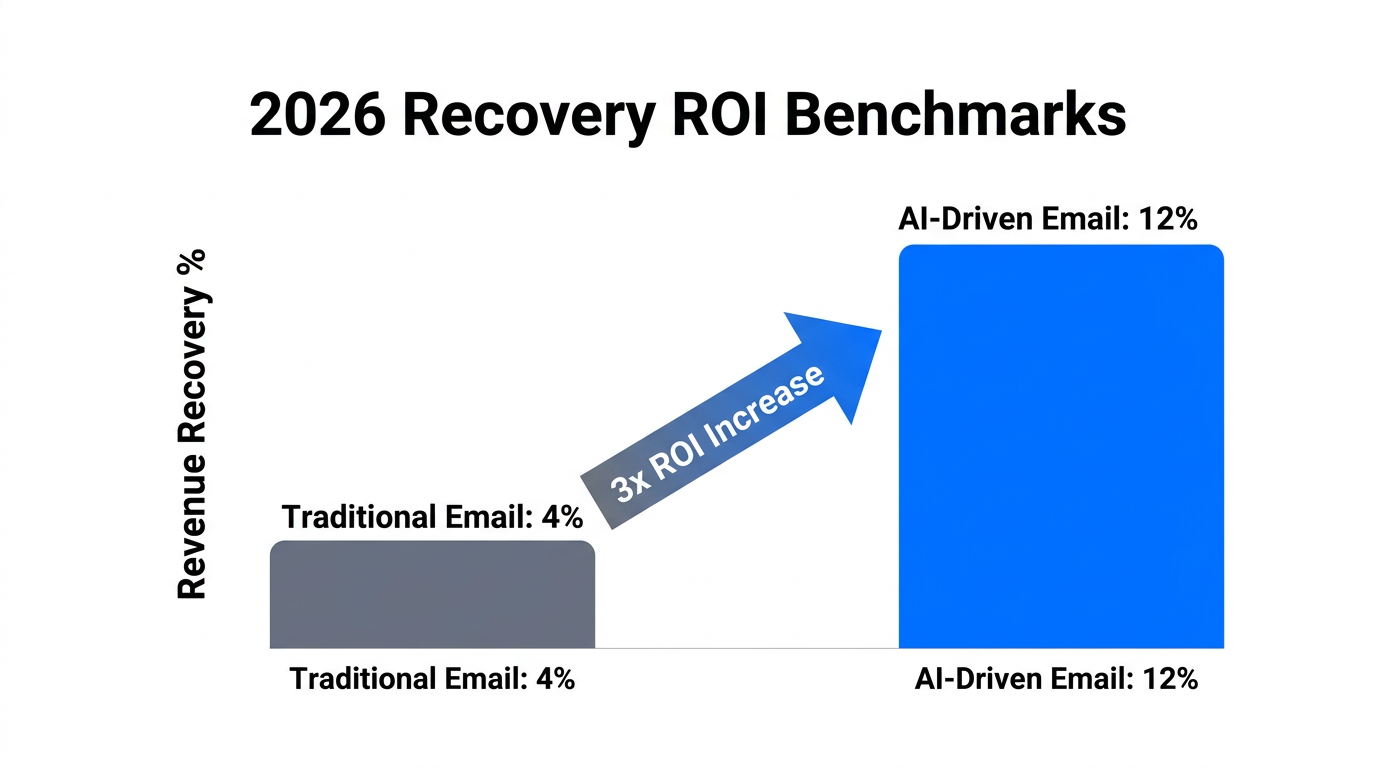
To understand why ecommerce revenue optimization now centers on AI, we have to look at the Revenue Per Recipient (RPR). According to research from Klaviyo, AI-driven cart recovery campaigns generate an average of $3.65 RPR. However, this is just the baseline. In high-value niches like home improvement or luxury goods, this can skyrocket to $75.66 RPR.
Why is the RPR so much higher? Because AI-powered emails generate 22x more orders than standard promotional blasts (Omnisend). By utilizing 1:1 content generation, tools like Remarkable AI can dynamically alter the email copy based on the specific support interactions or browsing depth of that individual user.
Predictive Intent Scoring: Intervening Before the Exit
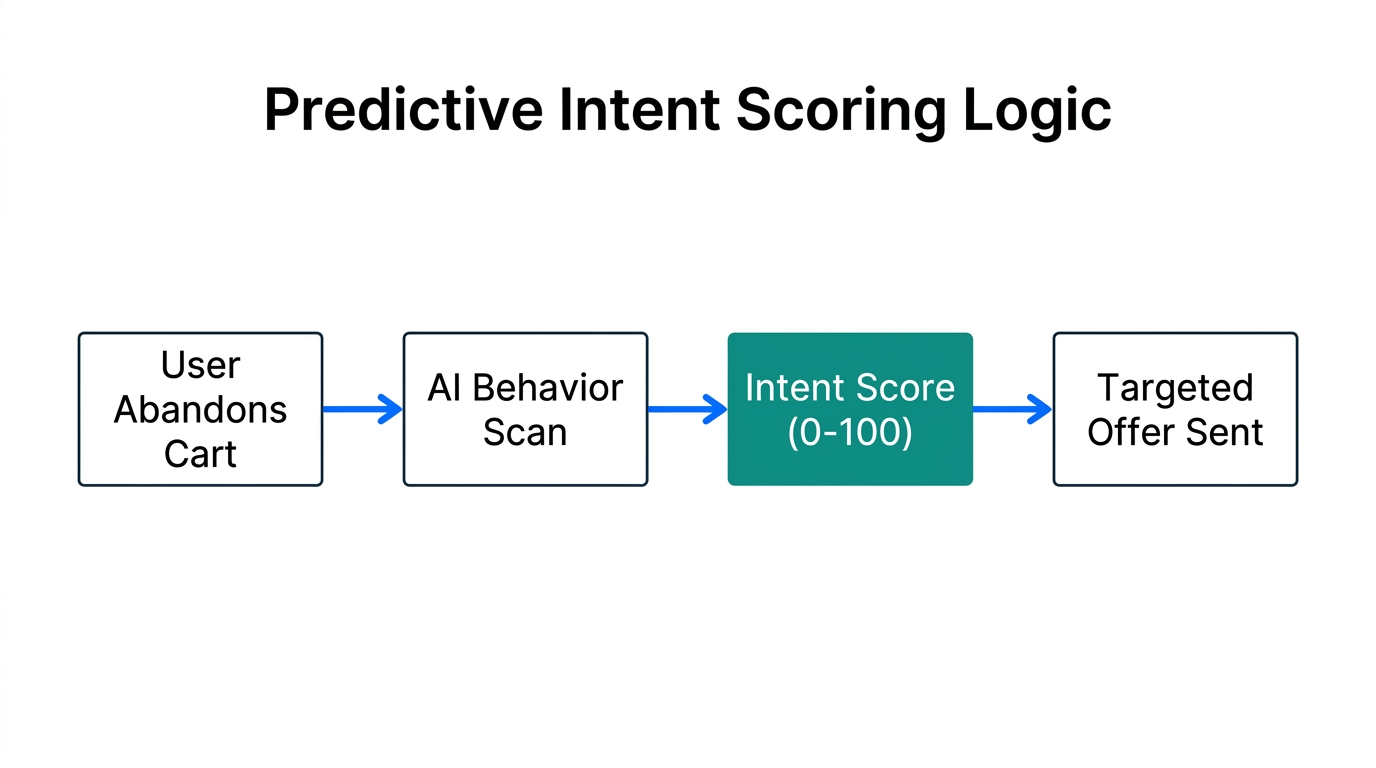
The most sophisticated automated email marketing 2026 strategies don't wait for the abandonment to happen. They use predictive intent scoring. Machine learning models from platforms like Alhena AI analyze micro-behaviors—mouse velocity, scroll depth, and even tab-switching frequency—to detect hesitation.
If a user shows high intent but stalls on the shipping policy page, an AI agent can intervene 2–4 seconds before they close the tab. This might trigger a real-time AI chatbot from byVoice or AgentiveAIQ to answer a specific question about returns. As Nick Trafimov of byVoice notes, "voice automation allows a two-way discussion while purchase intent is fresh," rather than a one-way nudge days later.
"The goal is no longer to 'recover' a cart, but to eliminate the friction that caused the abandonment in the first place through predictive intervention."
A 4-Step Framework for Implementing AI Recovery Tools
Transitioning your store to an AI-first recovery model doesn't happen overnight. Use this playbook to restructure your ecommerce growth strategy for maximum efficiency.
Step 1: Deploy Identity Resolution
Most brands only track logged-in users. To capture the full $260 billion in recoverable revenue identified by the Baymard Institute, you must use AI identity resolution. Tools like Blueknow allow you to track and recover carts for anonymous guest users who haven't reached the email-entry stage yet.
Step 2: Master the 'Golden Hour' Rule
Timing is everything. Sending your first AI-triggered email within 30–60 minutes can boost open rates by 18–25% (Easy Subscriptions). If you wait 24 hours, your conversion rate drops to 12.2%, compared to 20.3% within the first hour (Unific).
Step 3: Implement Dynamic Discount Logic
Stop training your customers to abandon carts just to get a 10% coupon. Use AI to determine if a discount is necessary. If a user is a loyal repeat buyer, they might just need a 'service message' (e.g., "We saved your items for you"). Reserve margin-cutting coupons for first-time shoppers who exhibit high price sensitivity, a strategy supported by Shopware.
Step 4: Layer in Social Proof and UGC
In the second stage of your sequence (usually 24 hours post-abandonment), AI should select reviews specifically for the item in the cart. This is where high-quality content becomes critical. Many brands use platforms like Stormy AI to discover and vet UGC creators who can produce the authentic video testimonials that AI recovery systems then distribute to hesitant shoppers. Pairing Stormy AI for creator sourcing with an automated flow in Klaviyo ensures your 'Social Proof' email is actually persuasive.
1. Reminder (1 hour): Soft nudge via email/SMS.
2. Social Proof (24 hours): AI-selected reviews/UGC.
3. Final Incentive (3-5 days): Limited-time offer or last-chance notice.
Common Mistakes to Avoid in AI Recovery
Even with the best tools, execution errors can tank your cart abandonment statistics. Avoid these common pitfalls:
- Over-Discounting: As mentioned, AI should score intent. Don't give away 15% of your margin to someone who was going to buy anyway.
- Lack of Frequency Capping: Ensure your system has a 'stop' trigger. Nothing damages a brand faster than receiving a 'Where did you go?' email two hours after you already bought the product.
- Ignoring Conversational Channels: In 2026, email is only one part of the puzzle. WhatsApp Business AI agents have shown recovery rates 3x higher than email alone (Blueknow).
- Poor Subject Lines: Use tools like Jasper AI to generate high-click subject lines that change based on the user's specific reason for leaving.
"AI-driven cart recovery is not a set-it-and-forget-it tool; it's an evolving conversation between your brand and your customer's intent."
Conclusion: The ROI of Intelligence
The shift from static to AI-driven abandoned cart recovery is no longer optional for ecommerce brands aiming to scale in 2026. By moving from a 15% recovery rate to a 50% recovery rate, you aren't just saving orders—you are multiplying the efficiency of every dollar spent on marketing.
Start by auditing your current flow. Are you using predictive intent? Is your timing optimized for the 'Golden Hour'? Are you leveraging identity resolution for guest shoppers? By integrating advanced tools like AgentiveAIQ for real-time chat and Stormy AI to find the creators who fuel your social proof, you can turn your checkout leaks into a streamlined engine for growth. The revenue is there—you just need the AI to go and get it.