Agentic Commerce 101: How OpenClaw is Redefining Social Media Sales in 2026
Discover how agentic commerce and OpenClaw are shifting marketing from DTC to B2A in 2026. Learn to optimize for AI agents and capture social commerce growth.
In 2026, the landscape of digital retail has undergone a seismic shift. We are no longer just marketing to humans who scroll; we are marketing to autonomous agents that search, filter, and execute transactions on behalf of their users. This is the era of agentic commerce, where the traditional Direct-to-Consumer (DTC) model is being rapidly superseded by Business-to-Agent (B2A) marketing. At the heart of this revolution is OpenClaw, an open-source AI agent framework that has turned social media platforms from discovery engines into fully automated sales pipelines.
The Dawn of B2A: Why Your Best Customer is Now an AI
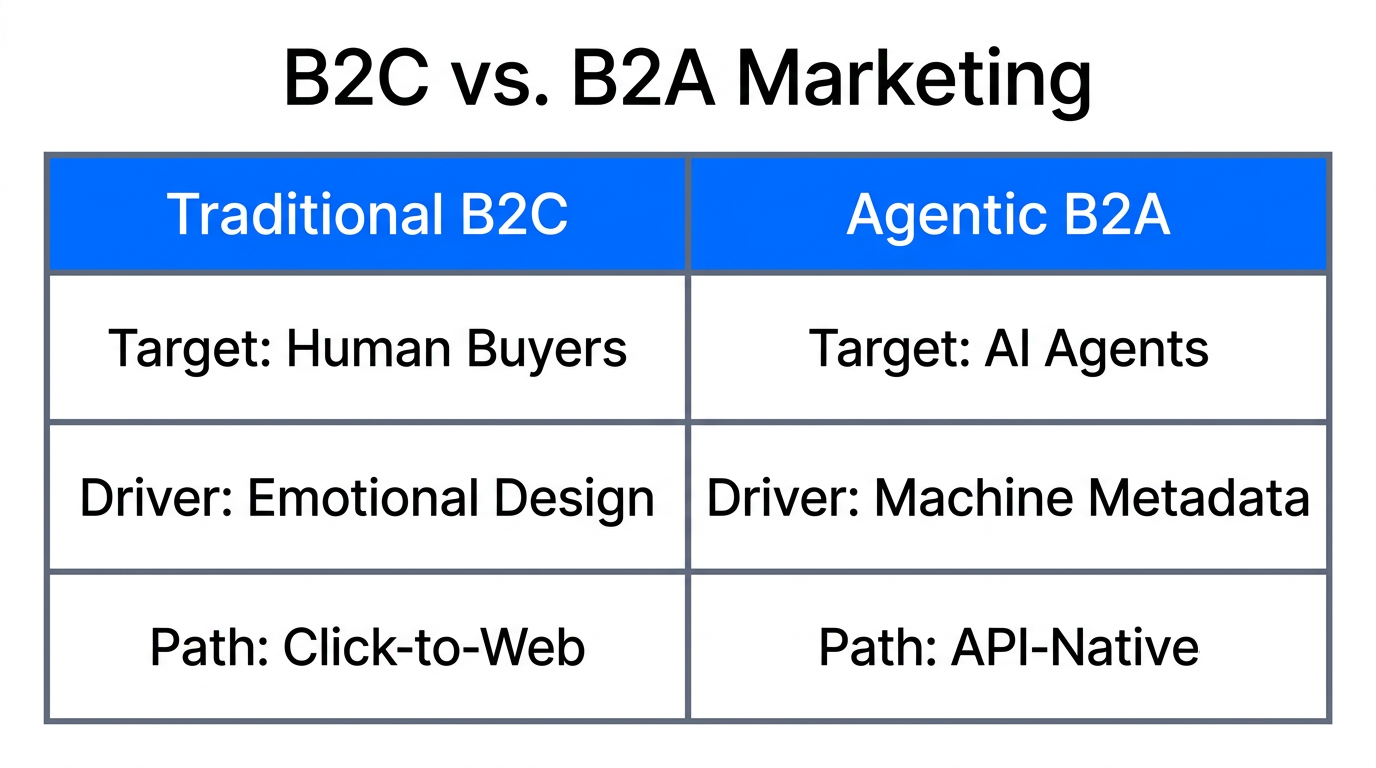
For years, marketers focused on human psychology—color palettes, emotional hooks, and FOMO. While those still matter, the 2026 marketing strategy revolves around machine-readability. As Jacky Chan, CTO of Votee AI, famously noted, we have entered an age where brands must optimize content so autonomous agents can discover and parse their products before a human ever sees them. In this Business-to-Agent (B2A) world, your target audience is an AI assistant like OpenClaw that has been instructed to "find the best eco-friendly sneakers under $150 with 4-star reviews and buy them."
"Marketers are entering the era of B2A. They must optimize content so autonomous agents can discover and parse their brands."
This shift is driven by the sheer efficiency of autonomous assistants. Unlike passive chatbots, OpenClaw is an agent with "hands and feet." It doesn't just suggest a product; it can browse the web via the Fast.io Skill, manage files, and even interact with social messaging apps like WhatsApp and Discord to finalize a deal. For brands, this means the path to purchase is becoming shorter and more automated than ever before.
OpenClaw Mechanics: Autonomy in Action
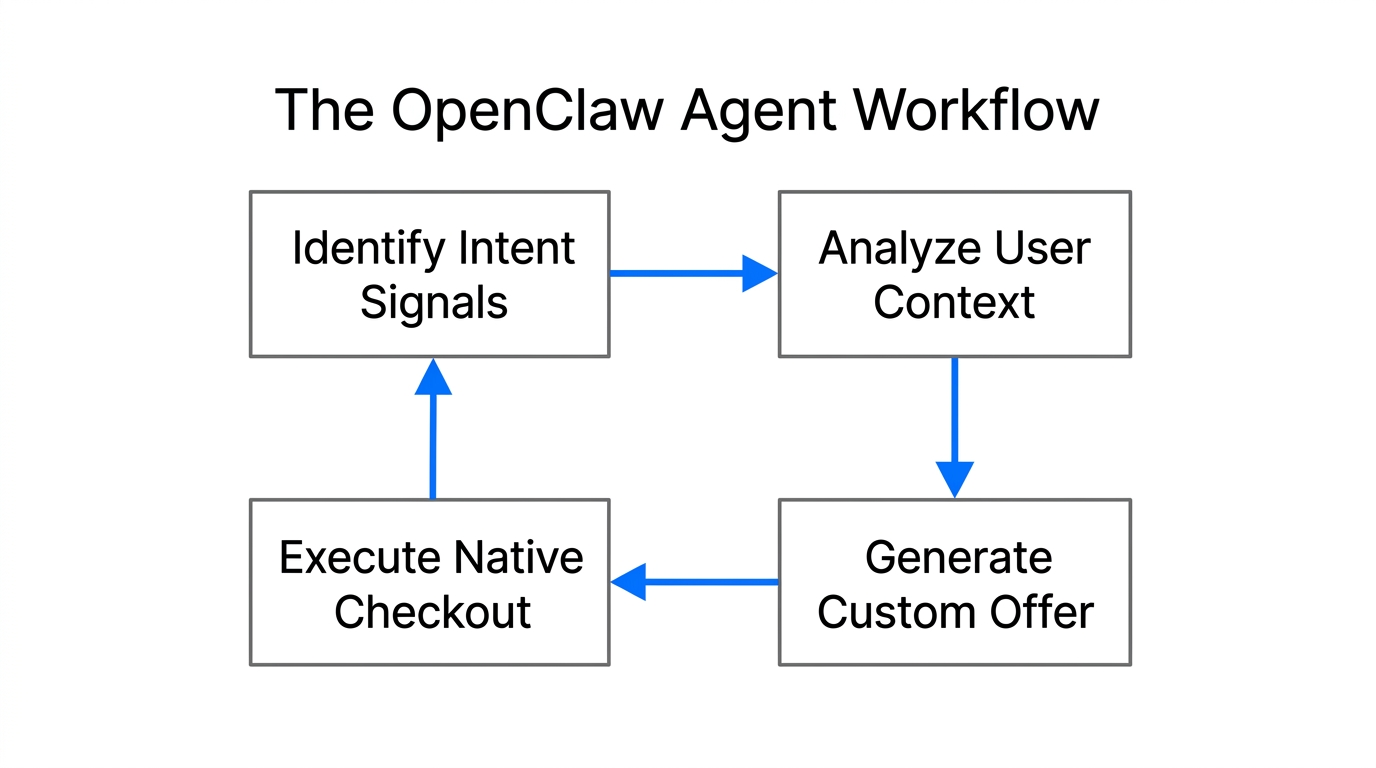
To understand agentic commerce, one must understand the tool leading the charge. OpenClaw (formerly known as Moltbot) is a viral, open-source framework that allows users to deploy agents that act on their behalf. These agents can execute shell commands, monitor inventory, and scrape competitor pricing in real-time. This level of autonomy is what separates 2026 commerce from the static e-commerce of 2024.
| Feature | Traditional E-commerce | Agentic Commerce (2026) |
|---|---|---|
| Discovery | Human-led scrolling/search | Autonomous agent crawling |
| Purchase Path | Multi-click web funnel | Zero-click background execution |
| Price Comparison | Manual/Comparison sites | Real-time API/Scraping triage |
| Engagement | Reactive customer support | Proactive agent-led negotiation |
Brands are now using the DigitalOcean 1-Click OpenClaw deployment to set up their own internal agents. These brand-side agents monitor Shopify stock levels and automatically broadcast "Back in Stock" alerts to community hubs like ClawHub or private Telegram groups, ensuring that the supply chain communicates directly with the consumer's agent.
The $8.5 Trillion Social Commerce Opportunity
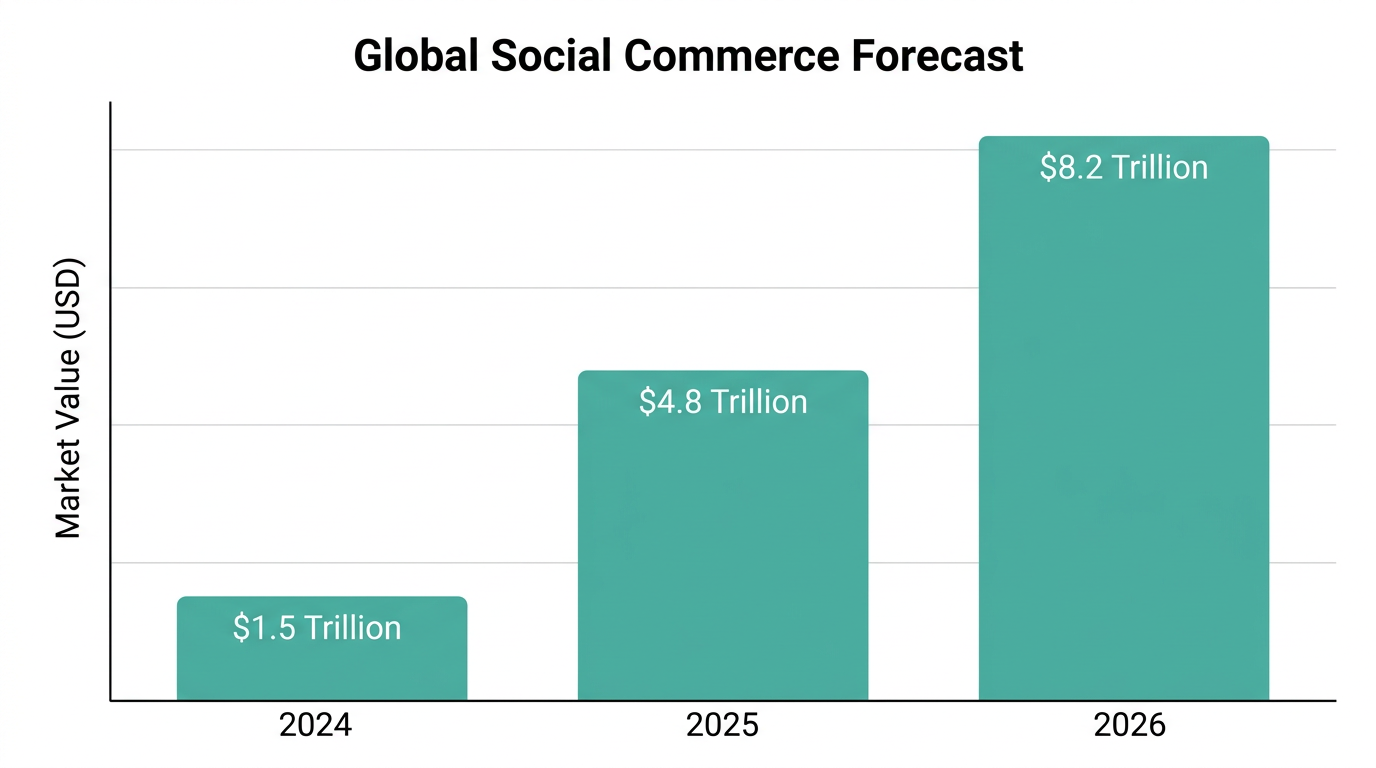
The numbers behind this shift are staggering. Social media commerce reached nearly $1 trillion in 2024, but with the integration of agentic AI, the market is projected to reach $8.5 trillion by 2030, according to data from Capital One Shopping. Social commerce is currently growing 3x faster than traditional e-commerce, as reported by Apex Pro Media, making it the primary battleground for brand dominance this year.
In 2026, 82% of users rely on social platforms for product discovery. However, the discovery process has changed. Users no longer just follow influencers; they deploy agents to follow the data generated by those influencers. This means that if an influencer showcases a product, an agent like OpenClaw can instantly parse the video, find the product SKU, and check for the best price across TikTok Shop and Sephora in seconds.
Reducing "Social Bounce" with Native Storefronts
One of the biggest hurdles in social media sales has been "social bounce"—the drop-off that occurs when a user is forced to leave a social app to complete a purchase on an external website. Research from SimplicityDX indicates that inconsistent tagging and external redirects are the leading causes of lost sales. To combat this, successful 2026 brands are leaning heavily into native storefronts.
Platforms like TikTok Shop have proven that keeping the transaction in-app drastically increases conversion rates. Take the example of Medicube, which achieved 1,000% YoY growth by building what Impact.com calls a "structural social commerce engine." By integrating their inventory directly into the social API, they allow both human users and AI agents to execute purchases without friction. Native checkout is no longer a luxury; it is a requirement for agentic discovery.
"Social is not there primarily to sell directly. It is there to reduce friction. It supports decisions that are already forming." — Perry Pearcey, Qoob Digital
Optimizing for Discovery: Metadata and UGC
To capture the attention of an OpenClaw agent, brands must rethink their content strategy. It's not enough to have a pretty video; that video must be backed by robust metadata. Agents crawl for specific identifiers—price, material, shipping speed, and availability. If your TikTok Ads or organic posts lack these markers, they are invisible to the agentic economy.
Furthermore, User-Generated Content (UGC) has become the "trust currency" of 2026. According to Social Media Today, customers are 6x more likely to buy if a page includes social proof in the form of UGC. Agents are programmed to weigh social proof heavily in their decision-making algorithms. A product with thousands of UGC mentions and high engagement rates will always outrank a brand-only post in an agent's recommendation engine. To scale this, many brands now use platforms like Stormy AI to discover and collaborate with thousands of niche creators who generate the high-quality metadata and social proof needed to feed these AI agents.
The B2A Playbook: 3 Steps to Implementation
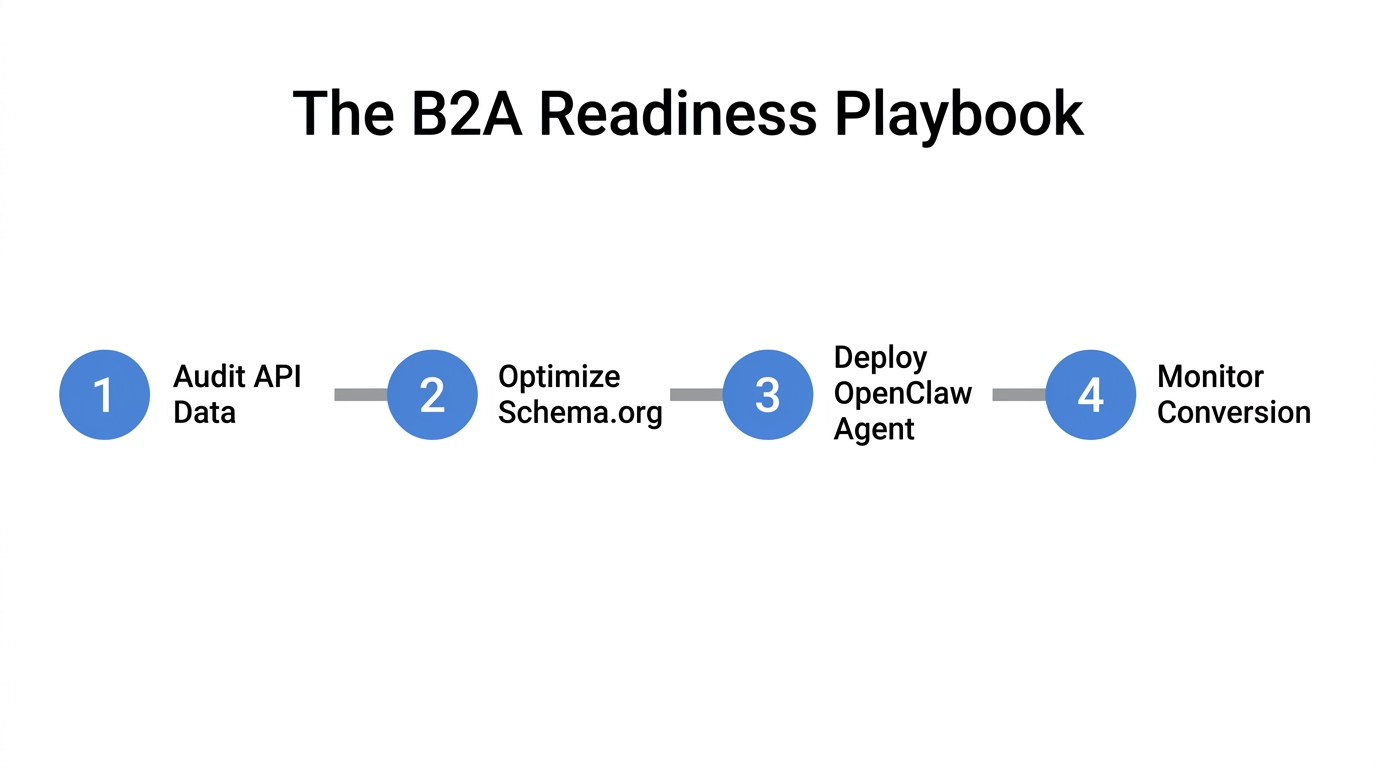
If you are ready to transition your brand to agentic commerce, follow this playbook to ensure your products are agent-ready by the end of 2026.
Step 1: Automate Your Social Operations
Stop managing your social shops manually. Use OpenClaw in tandem with automation hubs like N8N to sync your inventory across platforms. If a product sells out on Shopify, your agent should instantly update your TikTok Shop and Instagram tags to prevent the dreaded "out-of-stock" social bounce.
Step 2: Deploy Competitor Monitoring Agents
In the agentic era, pricing is dynamic. Deploy agents to scrape competitor pricing daily and adjust your discounts in real-time. This ensures that when a consumer's agent does a price comparison, your brand is consistently the most competitive choice without sacrificing margins.
Step 3: Build an AI-Personalized Outreach Engine
The best way to generate the UGC that agents love is through massive, personalized creator outreach. Instead of manual emailing, use an AI-powered platform. For instance, Stormy AI allows you to set up autonomous agents that discover and contact creators on a daily schedule, ensuring a constant stream of social proof that keeps your brand relevant in agentic search results.
Governance and Security: The Risks of Autonomy
While the allure of total automation is strong, it comes with significant reputational and security risks. Experts at RetailGentic warn that out-of-the-box AI agents can be "inherently insecure" if given full access to credit cards or sensitive CRM data without strict guardrails.
Furthermore, as Trowers & Hamlins Law points out, the deployment of agentic AI requires rigorous governance to avoid legal pitfalls. Brands must ensure their agents do not engage in deceptive pricing or spam-like behavior that could lead to platform bans or legal action. Balancing automation with brand trust is the most critical challenge for CMOs this year.
Conclusion: Future-Proofing Your Brand for 2026 and Beyond
Agentic commerce is not a distant trend—it is the current reality of social media sales. By shifting your focus from DTC to B2A, you are positioning your brand to capture a massive share of the projected $8.5 trillion market. Whether it's through optimizing your metadata for OpenClaw crawlers, reducing social bounce with native storefronts, or scaling UGC with influencer platforms, the goal is clear: make your brand the easiest choice for both humans and their AI agents.
The brands that win in 2026 will be those that embrace the "hands and feet" of AI, turning passive social media followers into an automated, high-velocity sales engine.