In 2026, the traditional e-commerce funnel has been completely rewritten. We no longer live in a world where consumers primarily 'google' for products or manually refresh tracking pages. Instead, we have entered the era of Agentic Commerce, where AI agents—think ChatGPT, Perplexity, and specialized shopping assistants—do the heavy lifting for the consumer. For Shopify founders, this shift means that 'visibility' is no longer just about SEO keywords; it is about making your logistics data machine-readable. If an AI agent cannot track your product, your brand effectively does not exist in the 2026 search landscape.
The stakes are higher than ever. Recent data shows that 78% of organizations have integrated AI into their core operations, a massive leap from just a few years ago. This guide explores how AI shipment tracking for Shopify is the key to unlocking the 'Agentic Commerce' loop, turning reactive logistics into a growth engine that drives 11x more AI-originated traffic.
The Rise of Agentic Commerce: Why 2026 is Different
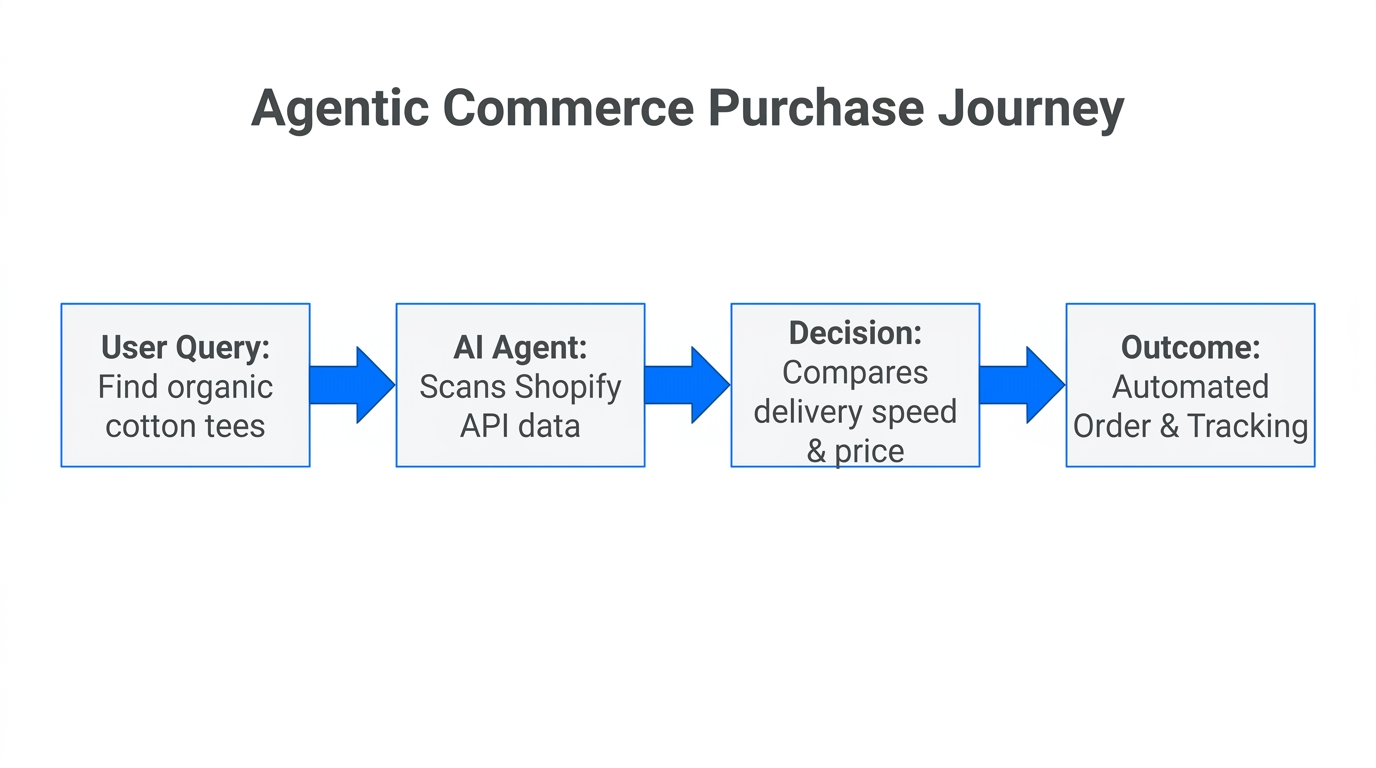
In 2026, the consumer journey is automated. A shopper doesn't ask 'What is the best moisturizer?'; they tell their personal AI agent, 'Find me a cruelty-free moisturizer with fast shipping and track it until it arrives at my door.' This shift toward autonomous agents has led to a 7x rise in AI-originated traffic for Shopify merchants, as noted in recent tech industry analysis. If your store's logistics data isn't optimized for these agents, you are missing out on the most lucrative segment of the market.
"2026 is the year of AI Enablement, where the focus shifts from simple chatbots to AI models that orchestrate entire delivery networks autonomously."Traditional search is dying because it requires too much manual effort. Today's customers prioritize predictability over speed. They want to know exactly when a package will arrive, and they want their AI agent to handle the 'Where Is My Order?' (WISMO) anxiety. By implementing robust AI-driven ecommerce strategies, brands are seeing their logistics become their best marketing tool.
Standardizing Delivery Data for 'AI Visibility'
For an AI agent to accurately track a package, it needs structured, clean data. Many Shopify stores suffer from 'fragmented tech stacks,' where the shipping carrier, the helpdesk, and the store itself don't talk to each other effectively. This leads to 'AI hallucinations,' where a customer's assistant might provide the wrong delivery date because the underlying data is messy. Treating delivery data as a strategic asset is the first step toward winning in 2026.
Retailers must ensure that their logistics data is formatted so that platforms like Microsoft Copilot or Gemini can ingest it. This means using platforms that offer Predictive Delivery Dates (AI EDD). These systems analyze real-time weather, carrier backlogs, and historical lane performance to give a precise window. When your data is this granular, AI agents prioritize your brand because you provide the highest level of certainty to the end user.
The Top AI Shipment Tracking Tools for Shopify in 2026
Choosing the right partner for your logistics stack is critical. You need tools that don't just 'track' but 'predict.' In the competitive Shopify landscape, these platforms have emerged as the leaders in the agentic commerce space.
| Tool | Primary AI Feature | Impact on Store |
|---|---|---|
| AfterShip | AI-powered EDD & recommendations | Increases checkout conversion by 15% |
| Gorgias | Autonomous WISMO resolution | Reduces support tickets by 60-80% |
| 17TRACK | Multi-carrier AI tracking | Essential for global agentic reach |
| Track123 | AI-driven product upsells | Generates 300% more revenue from repeat buyers |
Using these tools allows you to feed the 'Agentic Commerce' loop. For example, Gorgias uses an AI Agent to resolve shipping inquiries end-to-end, meaning a customer never has to wait for a human to find their tracking number. This efficiency isn't just a cost-saver; it is a competitive advantage in an era where speed of information is everything.
"WISMO inquiries typically account for 30–50% of all customer support volume. AI tracking can automate 80% of these tickets, freeing humans for high-value tasks."While managing these technical logistics, savvy brands also use Stormy AI to find creators who can showcase the 'unboxing' experience. When a creator tags a product that is tracked by an AI agent, it creates a seamless loop from discovery to delivery confirmation.
The Impact: 11x Increases and 32% Cost Savings
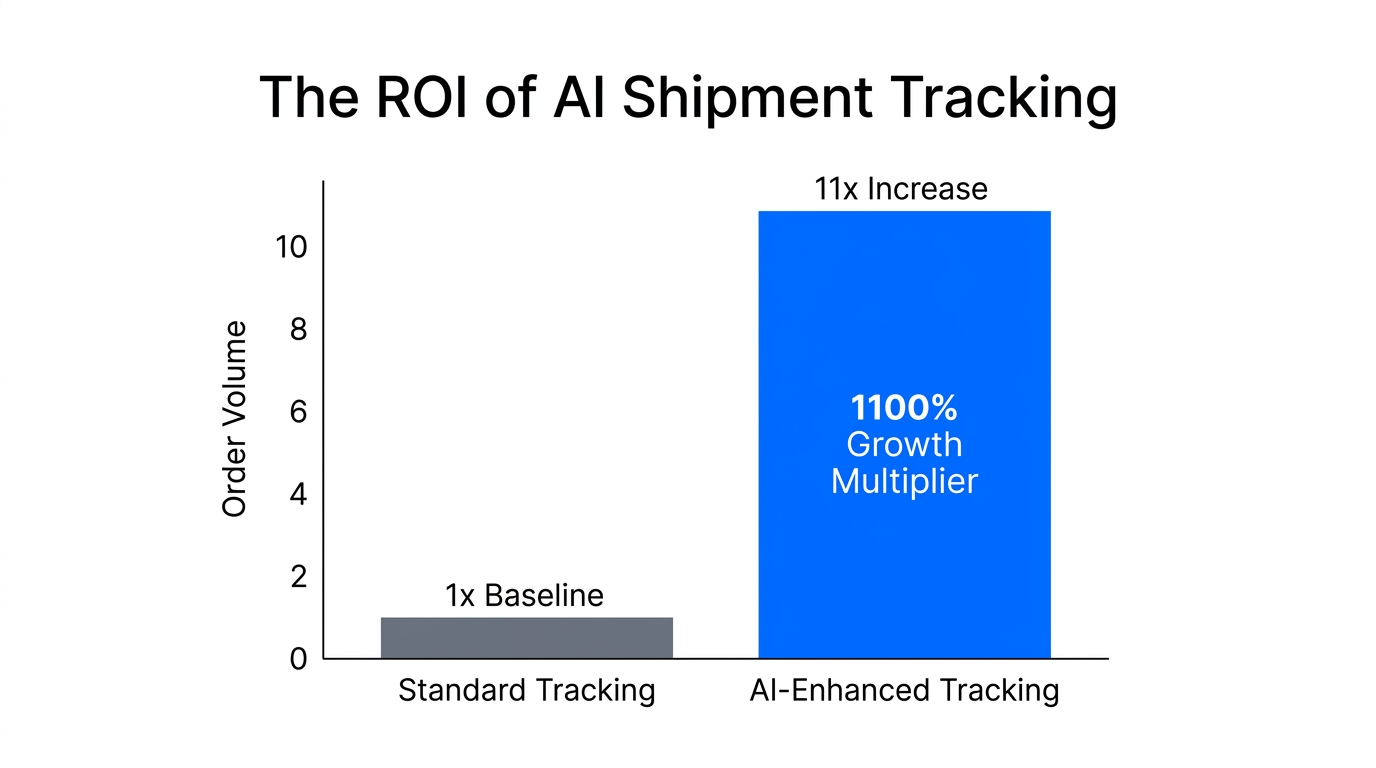
The transition to AI shipment tracking for Shopify isn't just about keeping up with trends; it is about the bottom line. Consider Balance ONE, a merchant that implemented a machine-learning-based inventory system. They saw a 32% decrease in cost-per-order year-over-year by optimizing how they distributed their products to match AI-predicted demand. This is the power of a modern logistics distribution strategy.
Furthermore, brands like Princess Polly have seen a 40% increase in support team efficiency by using deep AI integrations to manage order changes. By removing the friction of manual tracking, you allow your customers to focus on the product, not the process. This creates a retention engine where customers return because the experience is invisible and effortless.
When you provide a branded tracking page with AI-driven product recommendations, you turn a mundane logistics step into a revenue opportunity. Repeat shoppers, who are often handled by their AI agents, generate significantly more revenue than first-time buyers. By keeping the tracking experience within your ecosystem, you ensure that the AI agent brings the customer back to your store, not a generic carrier site.
Future-Proofing: Moving to Autonomous Orchestration
The final step in mastering agentic commerce is moving from reactive to proactive. In late 2026, we are seeing the rise of the 'Operational Brain.' This isn't just a bot that answers questions; it is an AI that algorithmically re-routes parcels in transit to avoid delays caused by weather or labor shortages before the customer even knows there is a problem.
To future-proof your Shopify store, follow this Agentic Logistics Playbook:
- Audit Your Data Hygiene: Ensure your Shopify metadata is clean so AI agents don't 'hallucinate' shipping statuses.
- Implement Multi-Carrier AI: Use a tool like 17TRACK to ensure you have global visibility across all shipping lanes.
- Personalize the Outreach: Combine your logistics excellence with influencer marketing. Use Stormy AI to discover creators in your niche who can build trust with the audiences your AI agents are serving.
- Adopt Predictive Fulfillment: Use tools like ShipStation to predict which warehouses should hold stock based on AI-driven demand forecasts.
"The key to 2026 isn't just faster shipping; it is smarter shipping that talks to the customer's personal AI agent."Conclusion: Winning the 2026 Landscape
The era of agentic commerce is here, and it has fundamentally changed what it means to be a successful Shopify merchant. By investing in AI shipment tracking for Shopify, you aren't just solving a logistics problem—you are optimizing for the way people find and buy products in 2026. You are making your brand visible to the AI agents that now control the majority of consumer traffic.
The path forward is clear: standardize your data, adopt predictive tools, and move toward autonomous orchestration. Those who treat their logistics as a silent, efficient, and AI-visible part of their marketing stack will be the ones who thrive. Start by auditing your current tracking experience and ensuring that when an AI agent asks, 'Where is the order?', your store has the best, most accurate answer on the web.