In 2026, the marketing landscape has undergone a tectonic shift. We have officially moved past the era of "Generative AI"—where we simply used models to churn out blog posts—and entered the era of Agentic AI marketing. Today, 96% of marketers are utilizing automation platforms, according to the latest data from DemandSage. But the leaders aren't just automating emails; they are deploying autonomous marketing agents that manage entire customer journeys from first touch to final conversion without human intervention.
As the global marketing automation market hits $8.14 billion this year, as reported by Fortune Business Insights, the focus has shifted from efficiency to autonomous outcome management. Organizations that have embraced this shift are seeing a staggering $5.44 return for every $1.00 spent. This playbook provides a step-by-step guide for growth leads and CMOs to transition from old-school "if-then" rules to a fully autonomous growth engine.
Defining Agentic AI: From Content Generation to Outcome Management
For years, marketing automation was a series of rigid workflows. If a user clicked a link, then the system sent a follow-up email. In 2026, agentic AI marketing has replaced these static rules with dynamic agents that understand intent. Unlike standard generative tools, these agents possess agency—the ability to make decisions, reallocate budgets, and choose the best channel for a specific user in real-time.
According to Janine Kanters, Director of Research at Gartner, "CMOs are under pressure to boost acquisition while budgets are flat. By 2026, 81% of tech leaders have already implemented AI agents to bridge this gap." These agents don't just write the copy; they monitor the conversion rate and autonomously rewrite it if the performance dips below a certain threshold.
"The brands that win in 2026 treat AI as a growth engine, not a cost-saving layer. If your brand lacks clarity and trust, you will simply disappear from AI-mediated discovery." — Gunnar Kihl, COO at GDR.
The Economic Impact: Reducing CAC by 37%
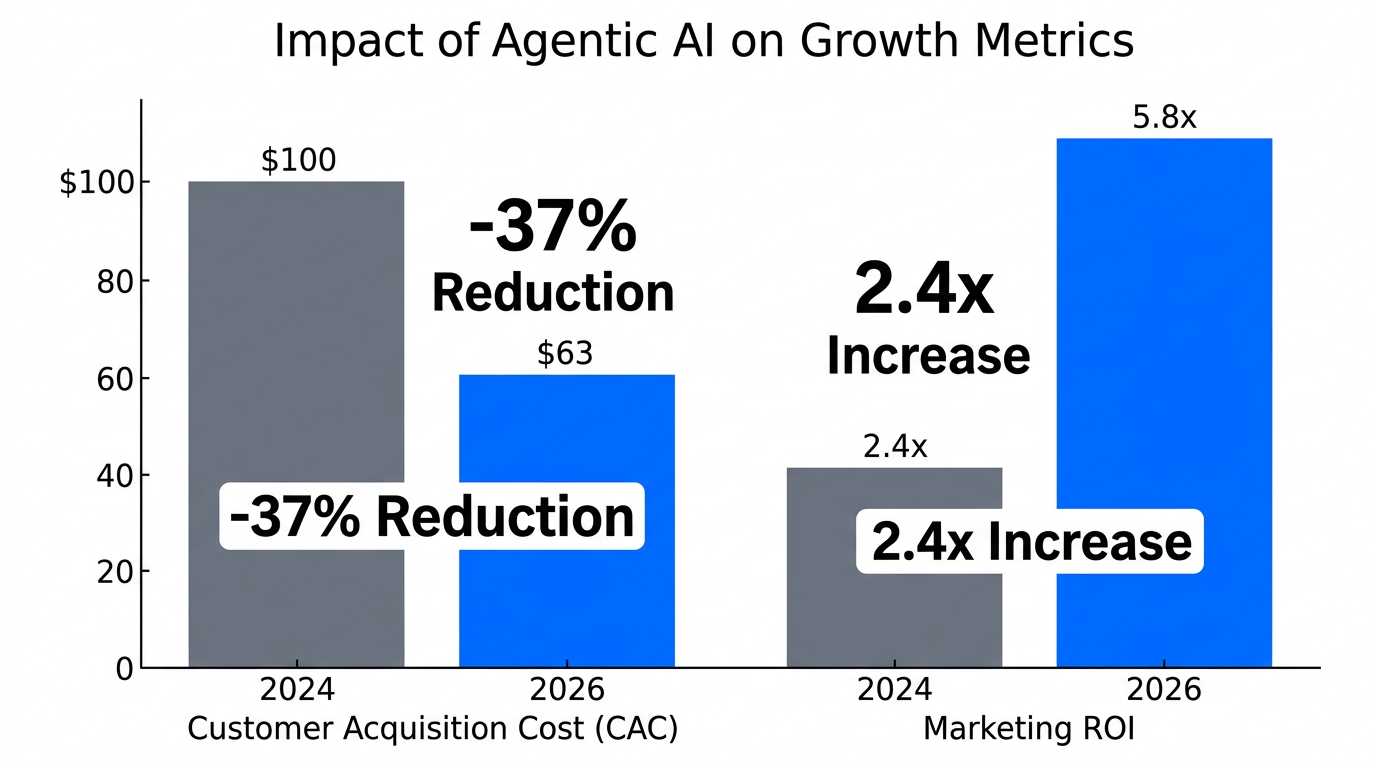
The financial justification for moving to autonomous marketing agents is no longer theoretical. Recent performance benchmarks from Zigment.ai show that organizations using agentic systems reported a 41% average revenue increase. More importantly, AI-powered targeting and autonomous budget reallocation have led to a 37% reduction in Customer Acquisition Cost (CAC).
By removing the lag time between data ingestion and manual campaign adjustment, brands are achieving a 77% higher conversion rate compared to legacy rule-based processes. For example, e-commerce giants like Amazon have seen a 15-25% increase in sales simply by letting AI agents handle retention flows autonomously, as highlighted by Level8 research.
| Metric | Legacy Automation | Agentic AI (2026) |
|---|---|---|
| Avg. ROI | 280% | 544% |
| CAC Reduction | 5-10% | 37% |
| Campaign Launch Speed | Weeks | Minutes/Hours |
| Conversion Rate Lift | 12% | 77% |
While the productivity gains are massive—with campaigns launching 75% faster—there is a hidden cost. Marketing teams now spend an average of 4.3 hours per week on verification to prevent "AI slop," ensuring the brand voice remains intact while the machine runs at full speed.
The 2026 Playbook: 5 Steps to Growth Engine Automation
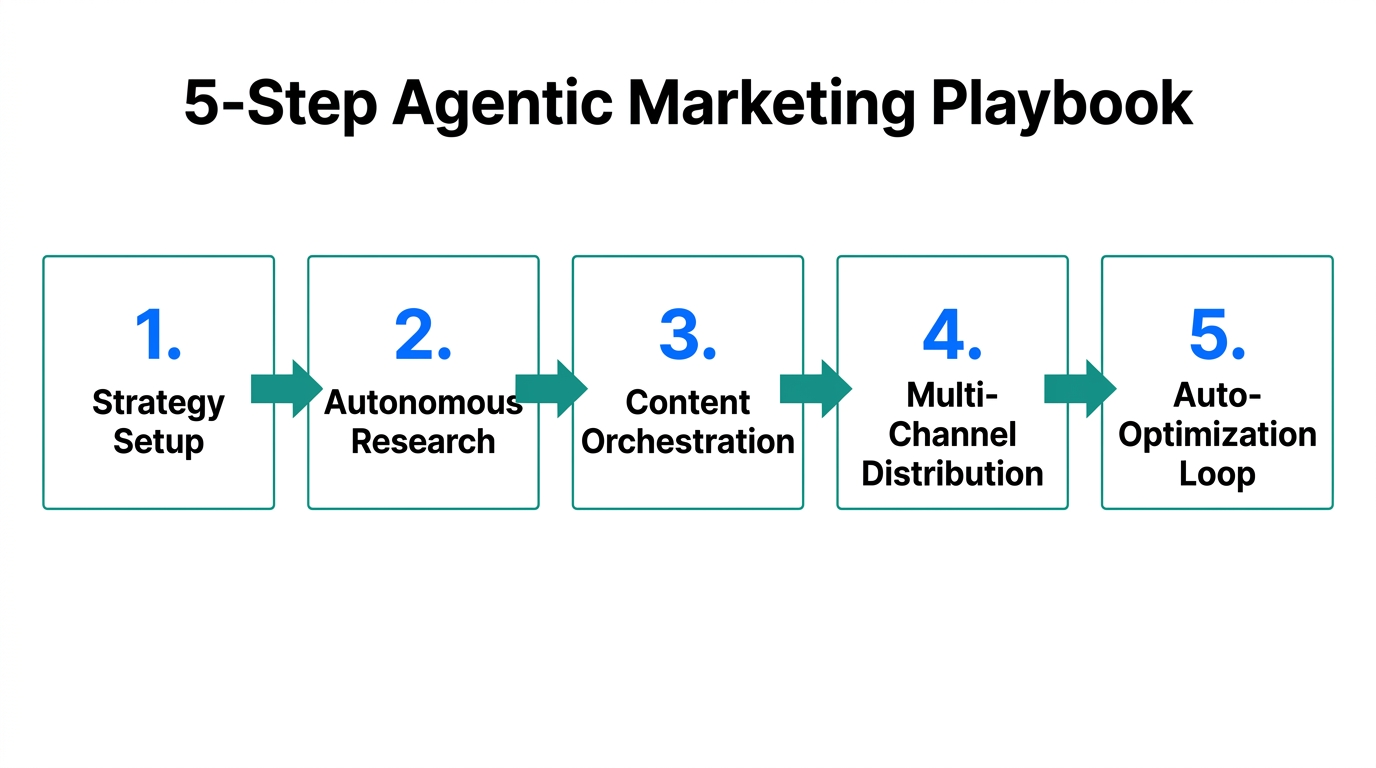
Building a growth engine automation stack requires a shift from a "tools-first" mindset to a "data-first" hierarchy. Follow this sequential playbook to build your autonomous system.
Step 1: Unified Ingestion
Your AI agents are only as smart as the data they consume. You must connect your Composable CDP, such as Hightouch, to every first-party touchpoint—from web clicks to support tickets in HubSpot. In 2026, fragmented data is the #1 cause of AI failure, cited by 74% of marketers in recent pain point analyses.
Step 2: Predictive Segmenting
Stop creating manual lists. Use agents to perform Predictive Lead Scoring. Instead of "users who visited the pricing page," your agents should target "users with a 85% propensity to churn within 30 days." Platforms like ActiveCampaign now offer native AI models that automatically group users based on behavioral intent rather than static demographics.
Step 3: Trigger-Nudge Logic
In the AI customer journey orchestration model, every "trigger" (like an abandoned cart or a stalled SaaS trial) is met with an "agent action." If a user stalls, the agent doesn't just send a generic discount. It analyzes the user's past behavior and generates a hyper-personalized nudge—perhaps a one-to-one video or a specific case study that addresses their exact friction point.
"2026 is the year AI finally handles the heavy lifting, allowing marketers to focus on community and strategy." — David Visser, CEO at Zyber.
Step 4: Meta-Agent Orchestration
Use "orchestrator" tools like Zapier Central or Relay.app to build meta-agents. These are agents that manage other apps. For instance, a meta-agent can monitor your TikTok Ads Manager, detect a high-performing creative, and autonomously instruct Canva to generate five variations for A/B testing.
Step 5: The Feedback Loop
Autonomous systems must learn from their own failures. Ensure your automated reporting feeds "winning" paths back into the agent's core model. This creates a self-optimizing loop where the machine-readable content is constantly refined for better performance in the "Answer Engine" era.
Building Meta-Agents: Multi-App Orchestration
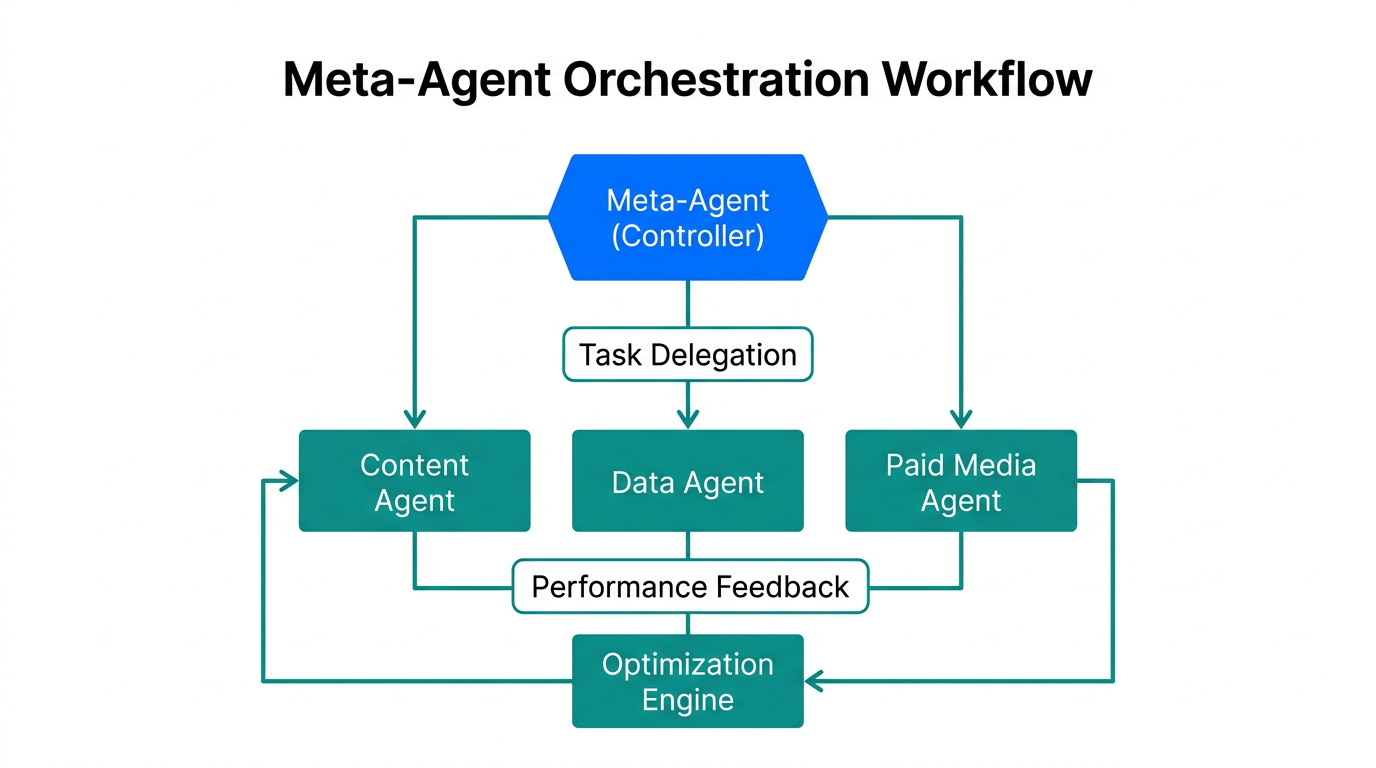
The real power of marketing automation strategies in 2026 lies in cross-app fluidity. We have moved away from the "monolith" CRM and toward a specialized stack. Marketers on Reddit's r/MarketingAutomation consensus suggest pairing the stability of HubSpot with the agility of agentic pioneers.
For example, a modern growth stack might look like this:
- Sourcing: Using Stormy AI to discover and outreach to creators autonomously.
- Email & Retention: Klaviyo for AI-driven SMS and email orchestration.
- Data Activation: Hightouch to sync warehouse data back into marketing tools.
- Orchestration: Zapier Central acting as the "brain" connecting these disparate limbs.
By using an autonomous agent, such as the one found in Stormy AI, brands can discover, vet, and outreach to influencers on a 24/7 schedule, effectively decoupling headcount from revenue growth.
Managing the 'Trust Gap' and Preventing 'AI Slop'
Despite the technical 2026 milestones, a "sobering reality" has set in. Between 42% and 54% of AI initiatives were scrapped last year due to poor data quality and "integration debt," according to Flowlyn. Furthermore, 72% of consumers report distrust in AI-mediated brand interactions when the content feels like "AI slop"—low-quality, repetitive, or hallucinated material.
To succeed, you must implement human-in-the-loop (HITL) verification. While the agents run the execution, humans must provide the strategic grounding and brand-voice guardrails. Gartner predicts that by 2027, 20% of brands will actually differentiate themselves by being "AI-Free" to regain consumer trust. The goal for 2026 is not to be 100% autonomous, but 100% authentic while using autonomy to scale.
"The performance gap is no longer between those who use AI and those who don't. It is between those who use AI to generate noise and those who use it to generate value."
The New SEO: Generative Engine Optimization (GEO)
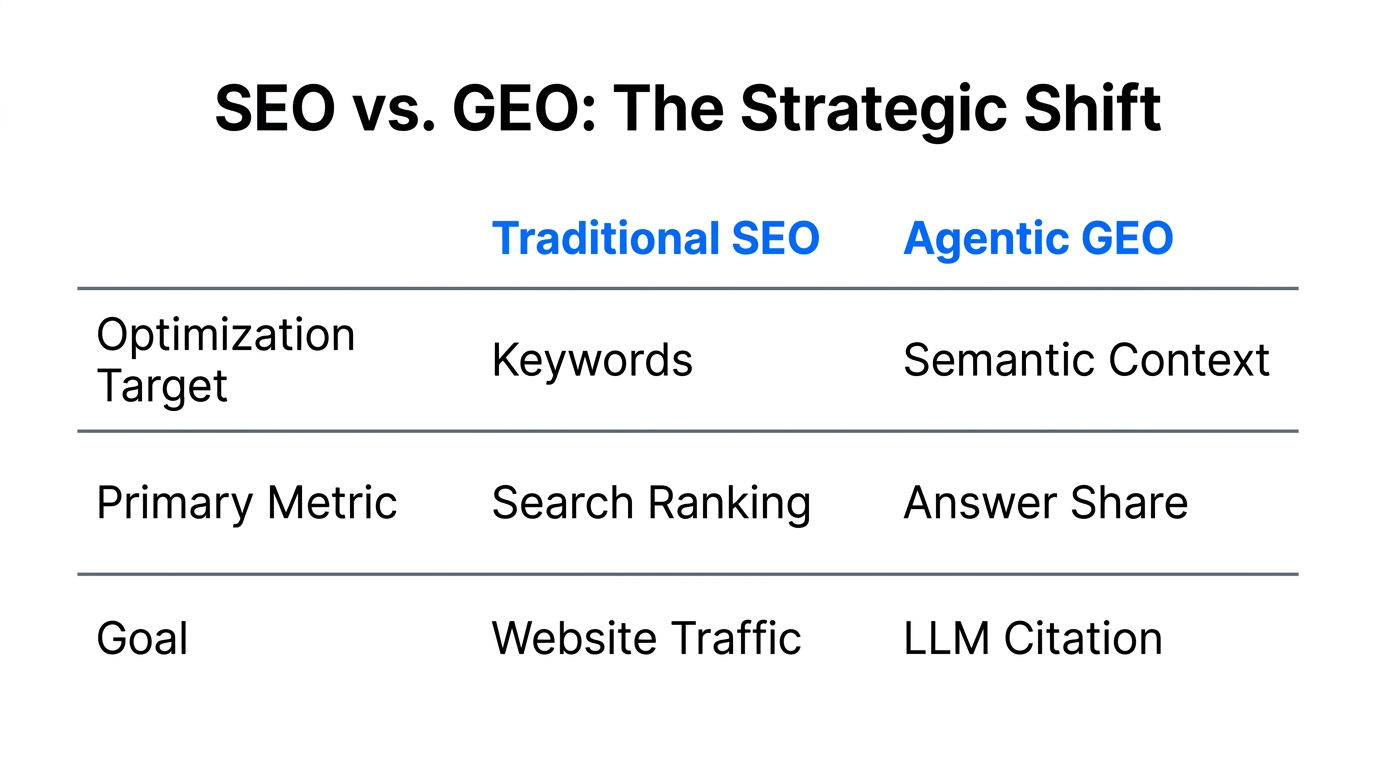
Traditional SEO is dying. In 2026, users don't scroll through pages of blue links; they ask Gemini, ChatGPT, or Perplexity for answers. As a result, autonomous marketing agents are now being optimized for GEO (Generative Engine Optimization).
Marketers must focus on Machine-Readable Content and robust Schema Markup. Platforms like Profound have emerged as leaders in "Answer Engine Optimization," helping brands ensure they are the primary source cited by AI models. If your content isn't structured for AI consumption, your growth engine will stall, regardless of how much you spend on ads.
Conclusion: The Path to Autonomy
Transitioning to an agentic AI marketing model isn't just about buying new software; it's about re-engineering your entire growth philosophy. By following the 2026 playbook—unifying your data, deploying predictive segments, and using meta-agents for orchestration—you can build a system that achieves a 544% ROI while reducing CAC by a third.
Start by identifying a single high-friction journey, such as creator outreach or lead qualification, and automate it end-to-end using specialized tools like Stormy AI. Once you bridge the trust gap with quality data, your growth engine will finally be able to run itself while you focus on the only thing AI can't replicate: strategy and community.