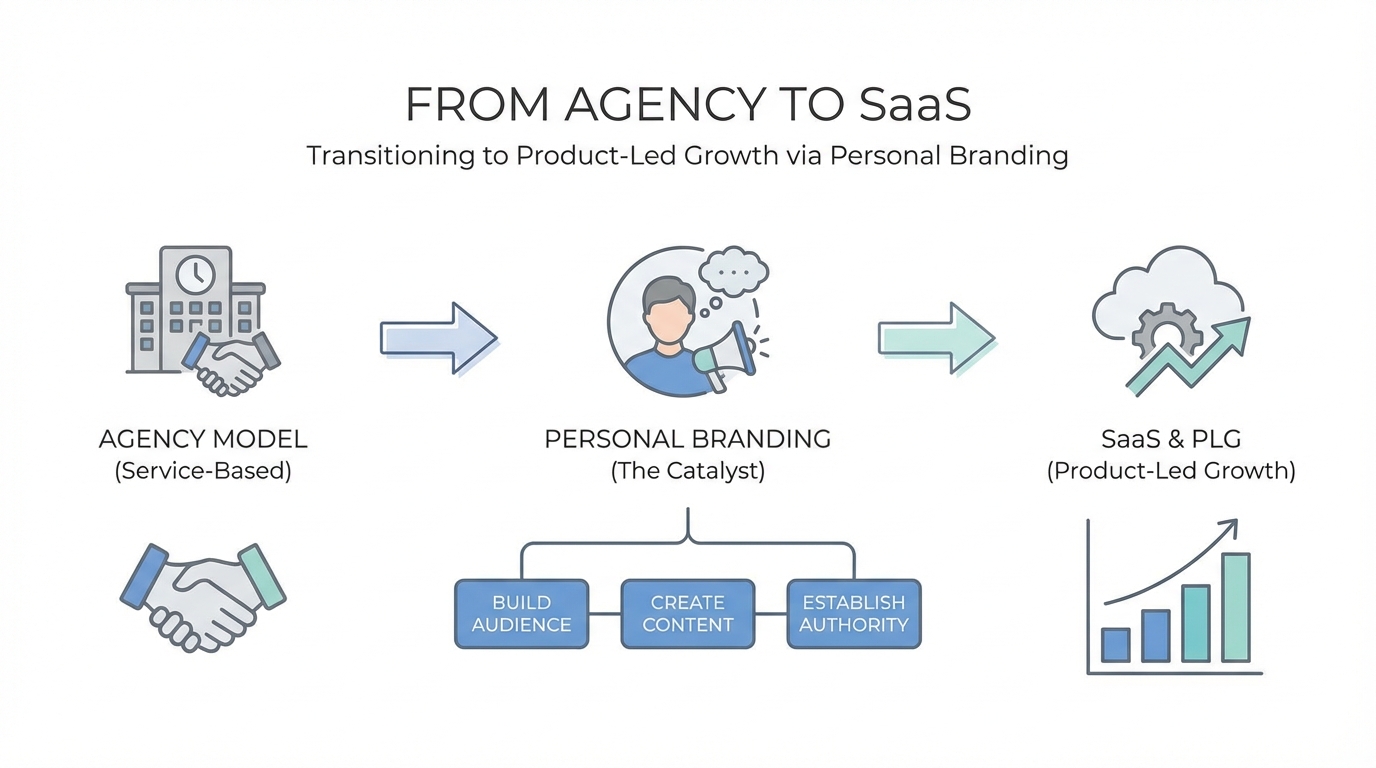
The agency model is a double-edged sword. On one hand, you gain deep expertise by solving complex problems for diverse clients; on the other, you are often trapped in a cycle of trading time for money, chasing the next lead, and managing high-touch service delivery. Many agency owners dream of transitioning from agency to saas to build a scalable, high-margin asset, but the bridge between services and software is often paved with failed launches. The secret to crossing that bridge isn't just better code—it is founder led growth and the strategic use of a personal brand to build distribution before the product even goes live.
The Agency Trap and the Painkiller Pivot
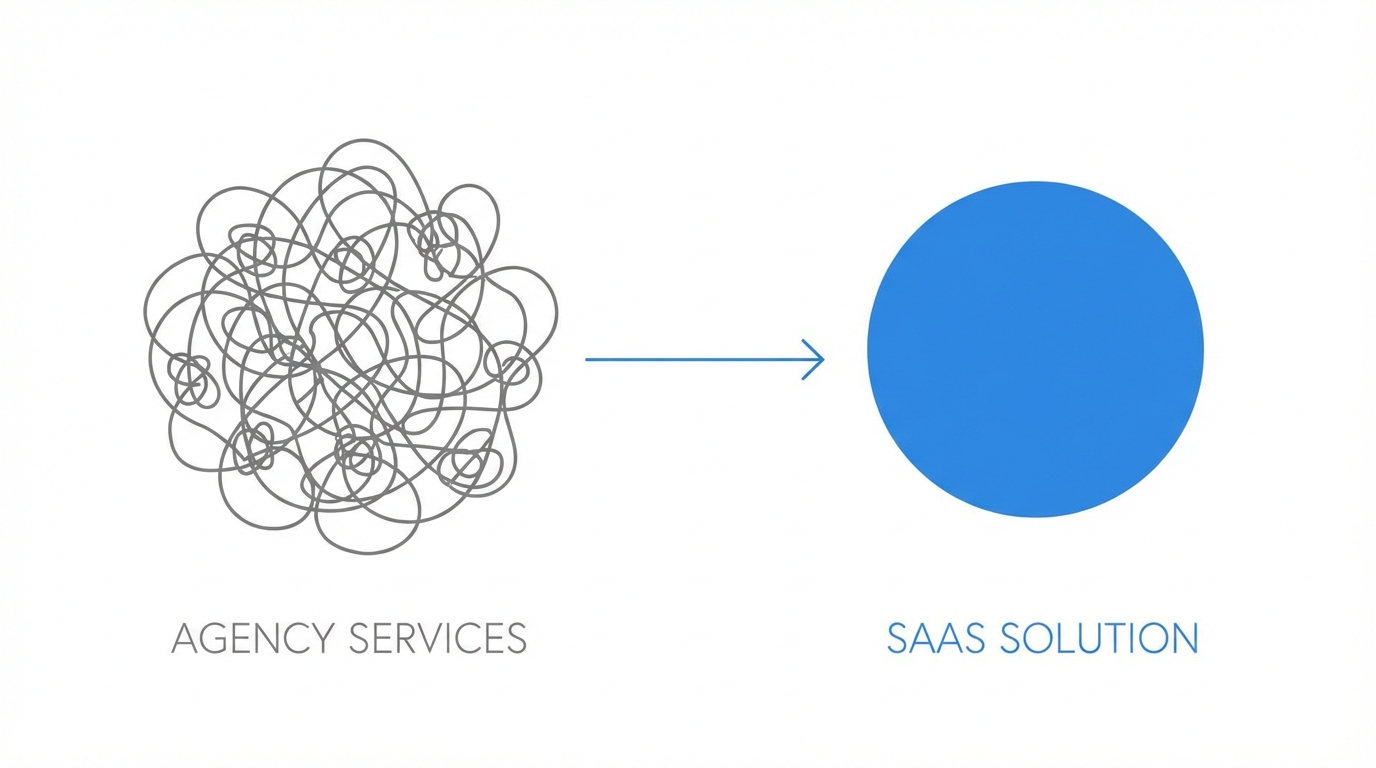
Most agency owners try to build software by creating a "vitamin"—something that is nice to have but not essential. After years of building custom solutions for others, the tendency is to build a complex tool that handles every edge case. However, according to successful founders like Rob Hallum, the first step in a successful product led growth strategy is identifying a "painkiller." A painkiller solves a recurring, acute problem for a specific niche, often a problem you discovered while running your agency.
Rob’s story is a prime example of this transition. After being laid off from a corporate job and spending years failing to monetize five different products, he realized that distribution matters more than the product itself in the early stages. By sharing his struggles transparently on platforms like X, he didn't just find a product idea; he find a community of people facing the same hurdles. This realization is the bedrock of personal brand for entrepreneurs: your journey is your marketing.
The Viral Lead Method: How Vulnerability Becomes Runway


When you are transitioning from agency to saas, cash flow is your biggest enemy. Building software takes time and money. Rob Hallum discovered the "Viral Lead" method by accident. After facing repeated failures, he posted an honest, vulnerable account of his journey on X. That single post received 150,000 views and led to a comment suggesting he start a development agency to fund his SaaS dreams. That one viral post secured his first $3,000 client, providing the financial runway needed to continue developing his software, SuperX.
For agency owners, this means your "failure" or "process" posts are actually your most valuable assets. By being uncomfortably vulnerable, you build a level of trust that automated marketing can never replicate. This trust acts as an inbound magnet for high-ticket agency clients who eventually become the beta testers and first subscribers for your SaaS. This is how you master how to get saas customers on social media without spending a dime on Meta Ads in the early days.
Monetization from Day One: The Antidote to Zero-Dollar Failures
A common mistake in the product led growth strategy is waiting for the "perfect" launch to ask for money. If you are building in public, you should be selling from the moment you have a functional prototype. Platforms like Stripe and Lemon Squeezy make it trivial to set up subscriptions early. When Rob launched SuperX, he didn't just post a feature list; he posted a selfie and a story. That post drove more signups than the professional launch video, adding $1,000 in MRR in just 24 hours.
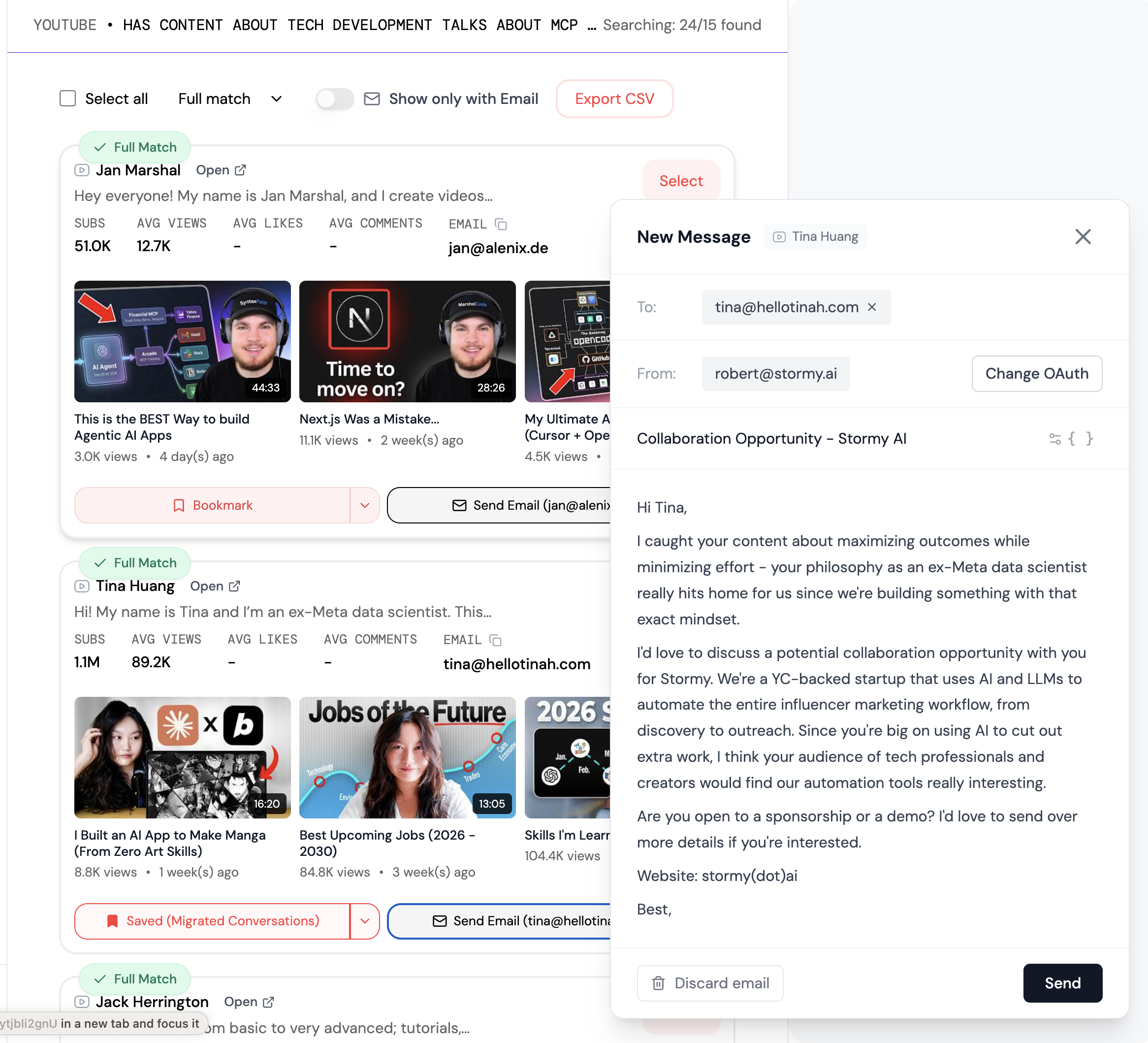
In the world of mobile app marketing and UGC (user-generated content), this transparency is equally powerful. Brands are increasingly looking for AI-powered creator discovery tools to find authentic voices. Stormy AI is an AI-powered search engine that allows users to find matching influencers across TikTok and YouTube using simple natural-language prompts, much like how a founder analyzes their own engagement metrics to drive SaaS growth. By using founder led growth, you are essentially becoming the primary UGC creator for your own brand.
The Playbook: Building an Audience from Scratch
If you were to start today with zero followers, how would you go about transitioning from agency to saas? Here is the systematic approach to founder led growth used to scale SuperX to $13,000 MRR with a 30% trial conversion rate.
Step 1: Set Your Foundation
Your social media profile is your landing page. Use a clear, friendly headshot and a bio that explains exactly what you are doing. Most importantly, use your pinned post to share your "Elevator Pitch" or "Mission." For example: "Left my agency job to build a SaaS to $10k MRR in public." This gives every new visitor a reason to follow your journey.
Step 2: Pick a Goal and Document Daily
Consistency is the only way to avoid being forgotten in the digital noise. Pick a specific goal—like reaching a certain revenue milestone or shipping a specific feature—and document the process. This creates a storyline that people can root for. Authentic moments, like being hospitalized or facing API changes, build more trust than polished corporate updates.
Step 3: Implement the Content Loop
Your content should follow a specific cycle to maximize how to get saas customers on social media:
- Entertaining: Viral-style posts, memes, or relatable struggles to capture attention.
- Educational: Teach something valuable related to your niche (e.g., "How to optimize your Apple Search Ads strategy").
- Convincing: Directly selling your product by showing how it solves a problem.
- Inspirational: Sharing the wins and what they mean to you personally.
Building a Trust Moat in the Era of AI Slop
We are entering an era where AI can generate infinite amounts of generic content. In this landscape, the only way to compete is by building a trust moat through personal storytelling. People don't want to follow a logo; they want to follow a person. This is why personal brand for entrepreneurs is no longer optional—it is a defensive asset.
When you share your actual face and your actual failures, you create a connection that an AI bot cannot replicate. This is especially true when finding creators on Stormy AI; the platform provides deep audience demographics and quality scoring to help you vet profiles for fake followers and fraud before you collaborate. The most successful creators are those who have built a genuine rapport with their audience. As a SaaS founder, you are the lead creator. Your goal is to turn followers into genuine friends by engaging intentionally rather than using automated reply bots.
Systemizing Virality with Data
While storytelling is the soul of your growth, data is the engine. You should not guess what to post. Successful founders use tools to analyze what is already working in their niche. For example, if you notice that "algorithm simulators" are trending in the marketing space, you might build a similar feature into your SaaS or create a content series around that concept.
By using analytics tools like PostHog and monitoring your social metrics, you can identify patterns. Much like how you can use Stormy AI to track individual videos and monitor campaign performance across all platforms, you must ruthlessly analyze your own founder-led content. Rob Hallum found that video content received 10x the reach of text posts on X. He doubled down on video demos created with Screen Studio, which helped him maintain 100,000 impressions per day. Always double down on what works and ruthlessly kill features or content styles that don't resonate.
The Tech Stack of a Solo SaaS Founder
Transitioning from agency to SaaS requires a lean, efficient tech stack. The goal is to spend less time on "tech debt" and more time on distribution. A proven stack for a solo developer includes:
- Frontend/Backend: Next.js, Node.js, and Tailwind CSS.
- Database: SQLite for simplicity or Zilliz for vectorized search.
- AI Integration: OpenAI or Claude for intelligent features.
- Infrastructure: AWS for hosting and Framer for rapid landing page deployment.
For marketing and creator management, leveraging Stormy AI can streamline the process of finding influencers and automating your personalized outreach with its built-in AI agent, allowing you to focus on the product core while your distribution scales in the background.
Conclusion: From Billable Hours to Monthly Recurring Revenue
Transitioning from an agency to a SaaS model is not just a change in business structure; it is a change in mindset. You must move from being a service provider to a storyteller. By identifying a genuine painkiller, documenting your journey with uncomfortable honesty, and systemizing your content through a founder led growth framework, you can build a software business that scales far beyond your own capacity.
The roadmap is clear: set your foundation, commit to a public goal, use the content loop to build trust, and leverage data to scale what works. In a world of automated noise, your personality is your greatest competitive advantage. Start building your trust moat today, and the revenue will follow.