When the automotive giant Carvana successfully launched over 1.3 million personalized video ads, it signaled a seismic shift in how performance marketing works. No longer is advertising a game of broad demographics and wide-net creative; it is now an engineering challenge. To reach this level of scale, elite growth teams are moving away from cumbersome dashboards and toward Google Ads automation via the terminal. By utilizing hyper-personalized advertising strategies powered by tools like Adscriptly CLI, brands can now execute thousands of micro-campaigns with the same effort it once took to launch a single ad group.
The global AI marketing market reached $20.4 billion in 2024 and is projected to skyrocket to $107.5 billion by 2028, according to Primal. As 69.1% of marketers already incorporate AI into their daily operations (up from 61% just a year ago, per GPTZero), the competitive advantage has shifted from those who use AI to those who automate it at the highest velocity.
The Velocity Advantage: Why CLI Beats GUI
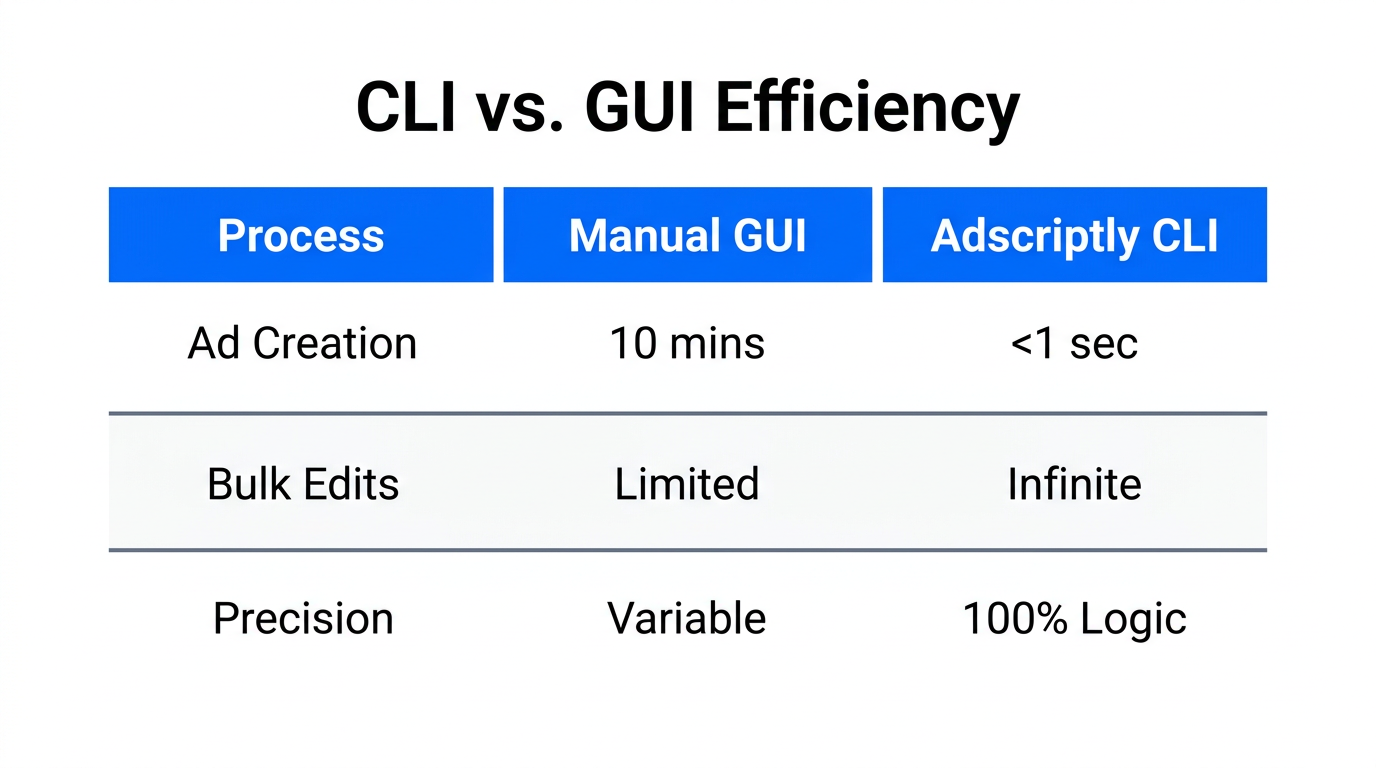
For the average marketer, the Google Ads interface is a labyrinth of menus, tabs, and loading spinners. Auditing a high-spend account can take hours of manual clicking. However, for a technical marketer using a Command Line Interface (CLI), that same audit is performed in 30 seconds with a single command like adscriptly audit. This is the "Velocity Advantage."
When you operate via a CLI, you aren't just managing ads; you are writing the logic for how those ads behave. This allows for AI ad copy generation that isn't just generic filler, but content that responds to real-time data inputs. Programmatic advertising, often driven by CLI tools at the enterprise level, has been shown by Marketing LTB to reduce Cost Per Acquisition (CPA) by up to 30%. By removing the friction of the web interface, growth teams can iterate on copy and bidding logic ten times faster than their competitors.
"The future of advertising isn't found in a dashboard; it's written in the terminal where logic and scale meet without friction."
Implementing Micro-Campaign Strategies
The traditional approach to Google Ads involves creating a few large campaigns targeting broad interests or keywords. Micro-campaign management flips this on its head. Instead of one campaign for "SUV buyers," you launch 500 micro-campaigns, each targeting a specific user behavior, local weather condition, or inventory level.
| Feature | Traditional Campaigns | Micro-Campaigns (CLI-Driven) |
|---|---|---|
| Targeting | Broad Demographics | Hyper-Specific Behaviors |
| Creative | 1-5 Variants | 1,000+ Dynamic Variants |
| Management | Manual Dashboard Tweaks | Automated CLI Scripts |
| Agility | Slow to Pivot | Instant Global Updates |
| Performance | Average ROAS | High Precision / Lower CPA |
According to Digital Robots, micro-campaigns allow AI to find the most profitable pockets of traffic that broad campaigns often ignore. For example, Trendyol, a leading retailer, implemented predictive bidding and automation to achieve a 180% improvement in ROAS and a 27% reduction in CAC. This scale is only possible when you treat your ad account as a database that you can query and update programmatically.
The 3-Step Playbook: Plan, Execute, and Yolo
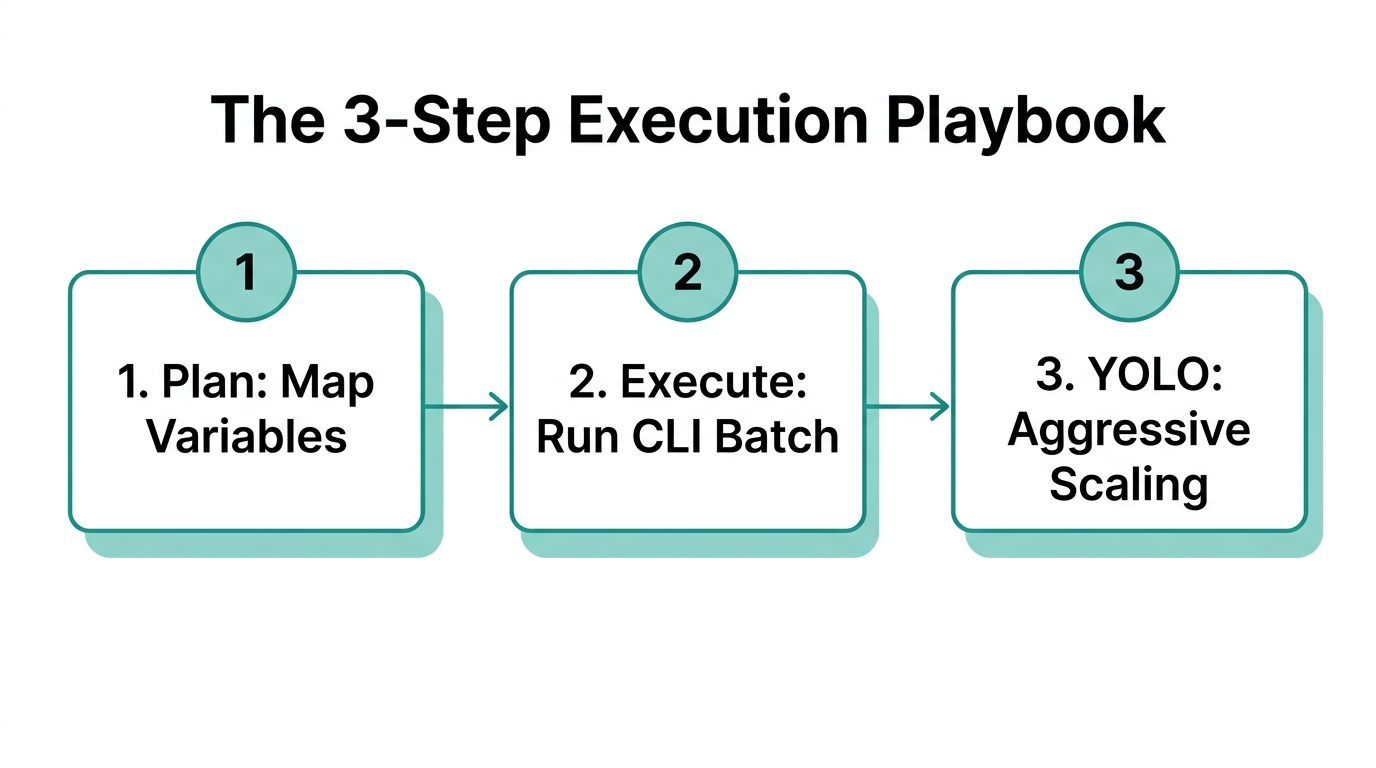
Adscriptly CLI introduces a structured framework for managing hyper-personalized advertising safely. This workflow prevents the common "set and forget" mistakes that lead to budget bleeding, as noted by experts at ExtraDigital.
Step 1: Plan Mode (The Audit)
In Plan Mode, the CLI acts as a read-only analyst. You can ask natural language questions like, "Which ad groups have a CPA 20% higher than the account average?" The CLI queries the Google Ads API and returns a detailed report without making any changes. This is where you identify impression share loss and find wasted spend.
Step 2: Execute Mode (The Human-in-the-Loop)
Once you've identified the necessary changes, Execute Mode allows you to stage those updates. The CLI will present a summary of the actions it's about to take—pausing low-performers, adjusting bids, or deploying new AI ad copy generation. Nothing goes live until a human gives the confirmation. This satisfies the 86% of successful marketers who believe manual review is essential for AI-generated content, according to Hashmeta.
Step 3: Yolo Mode (Fully Autonomous)
For mature accounts with strict guardrails, Yolo Mode enables fully autonomous execution. This is where the AI agent manages the account 24/7, reacting to market shifts in real-time. By connecting tools via the Model Context Protocol (MCP), your CLI can monitor everything from stock levels to competitor pricing and adjust your Google Ads strategy instantly.
"Yolo mode isn't about recklessness; it's about building a system so robust that it can out-execute a human team while they sleep."
Reducing Impression Share Loss with Automation
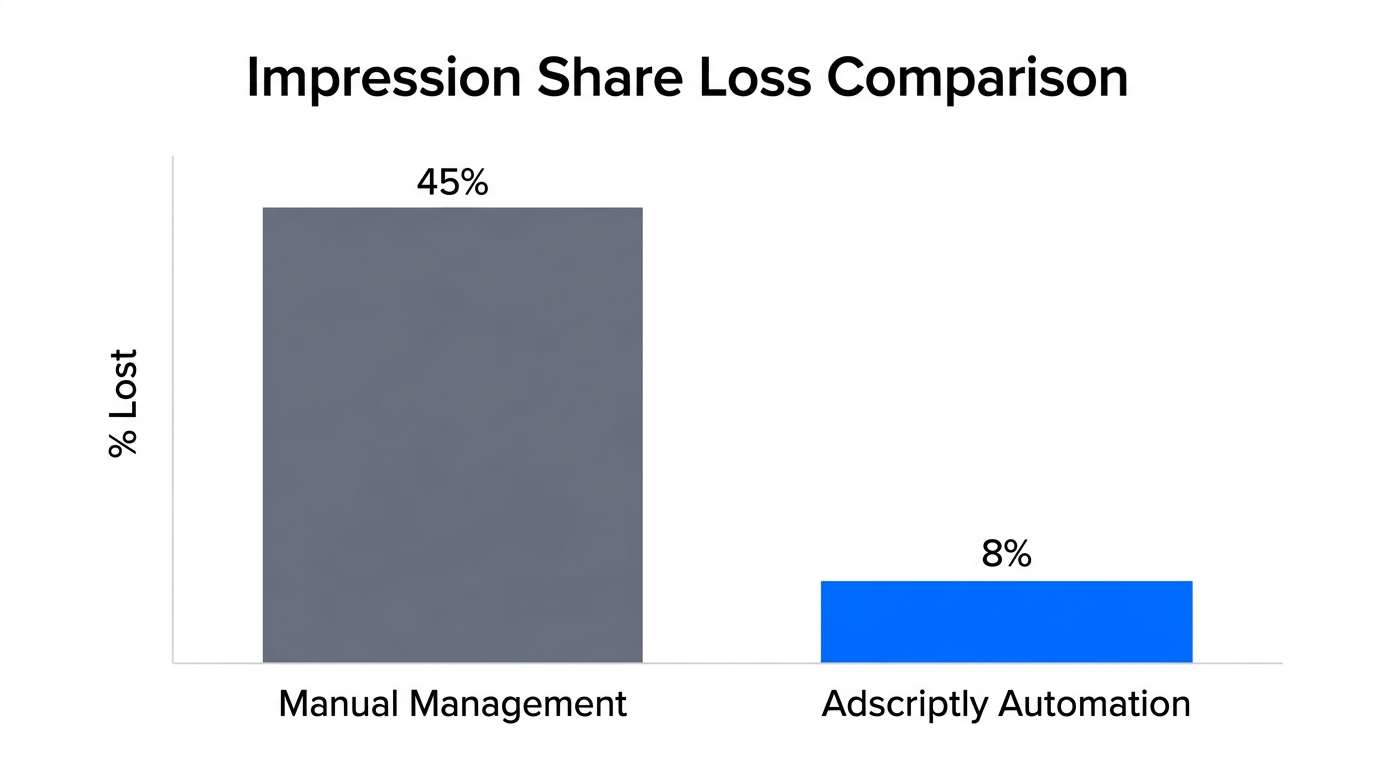
One of the silent killers of ROI is Impression Share (IS) loss due to rank or budget. Google Ads automation via the terminal allows you to monitor these metrics hourly rather than weekly. If the CLI detects a spike in IS loss due to rank, it can automatically analyze your quality score and suggest improvements to your ad copy.
Furthermore, CLI-driven negative keyword automation is a game-changer. Instead of manually reviewing search term reports, you can script a process that automatically adds terms with high spend and zero conversions to a shared negative list across all 1.3 million ads. This level of maintenance ensures that your budget is always flowing toward high-intent users, a strategy that helped H&R Block see a 144% increase in conversion rates, as reported by Prodia.
Scaling Creative with the Modern Stack
Launching 1.3 million ads requires a massive volume of creative assets. While AI ad copy generation handles the text, brands need high-quality visual content to maintain engagement. This is where a diversified tech stack becomes essential. For instance, teams can source authentic User-Generated Content (UGC) using platforms like Stormy AI, which allows you to discover and vet creators who fit your brand's niche perfectly.
Once you have your core assets, you can use the CLI to deploy them into thousands of micro-campaign variations. Pair Stormy AI for creator sourcing with Adscriptly for deployment, and you have a full-funnel autonomous marketing engine. This hybrid approach ensures that while the execution is automated, the content remains human-centric and trustworthy.
Closing the Loop: Offline Conversion Tracking
The final piece of the micro-campaign management puzzle is data feedback. Ad platforms are only as good as the data they receive. If you are only tracking website clicks, the AI will optimize for clickers, not buyers. By using a CLI, you can "close the loop" by feeding offline conversion data—such as signed contracts from HubSpot or processed payments from Stripe—directly back into the Google Ads API.
| Stack Component | Tool Example | Role in the Playbook |
|---|---|---|
| Creator Discovery | Stormy AI | Source authentic UGC assets for ad creative. |
| Ad Management | Adscriptly CLI | Deploy and optimize micro-campaigns via terminal. |
| Data Connectivity | n8n | Bridge the gap between CRM and Ad APIs. |
| CRM | HubSpot | Track the true bottom-line value of every lead. |
By automating the upload of offline conversions, you train the Google Ads algorithm to look for users who actually generate revenue. This is exactly how top-tier performers improve their targeting accuracy, a benefit cited by 82% of marketers using AI tools in a study by SuperAGI. Feeding clean data back into the CLI is the single most important step for long-term autonomous success.
Conclusion: The Future of the Technical Marketer
The era of manual ad management is ending. As the success of Carvana and Trendyol demonstrates, the future belongs to those who can manage hyper-personalized advertising at a scale that is impossible for human hands alone. By mastering the Adscriptly CLI and adopting a micro-campaign mindset, you can transform your ad account from a static expense into a dynamic, autonomous revenue engine.
The playbook is clear: Plan with data, Execute with precision, and eventually, let the system Yolo its way to maximum ROI. Start by auditing your current account for impression share loss, then begin the journey of automating your creative and conversion loops. In the high-speed world of 2025 advertising, the only way to keep up is to stop clicking and start scripting.