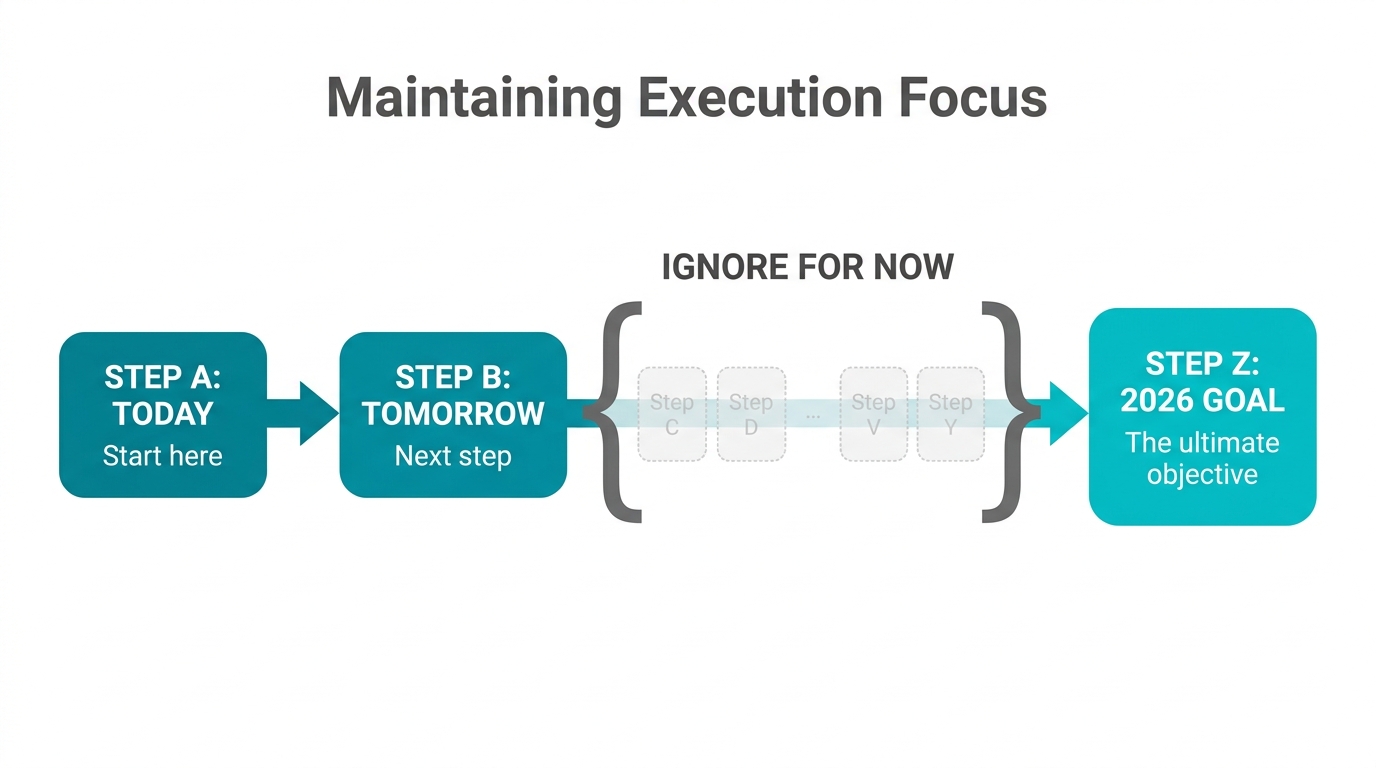
In 2026, the startup landscape has moved beyond the era of 'growth at all costs' and entered a period of precision execution. Founders are no longer just building for the sake of building; they are architecting their lives around specific freedom numbers. However, the biggest hurdle to achieving a 2026 exit isn't a lack of ambition—it's planning paralysis. Most entrepreneurs get bogged down in the 'how' of steps C through Y, losing sight of the immediate momentum needed to move the needle. This is where the ABZ Growth Framework becomes the ultimate cheat code for scaling a newsletter business or a SaaS platform.
The ABZ framework, popularized by growth experts like Sam Parr, is a psychological and strategic model that simplifies the complexity of a startup GTM strategy. It requires you to have a crystal-clear vision of your 'Z' (the end goal) while ruthlessly focusing your daily energy only on 'B' (the immediate next step). By ignoring the messy middle, you create a reverse engineering business goals workflow that eliminates anxiety and prioritizes exponential growth.
Breaking Down the ABZ Framework: Difference Between Long-Term Vision and Daily Execution
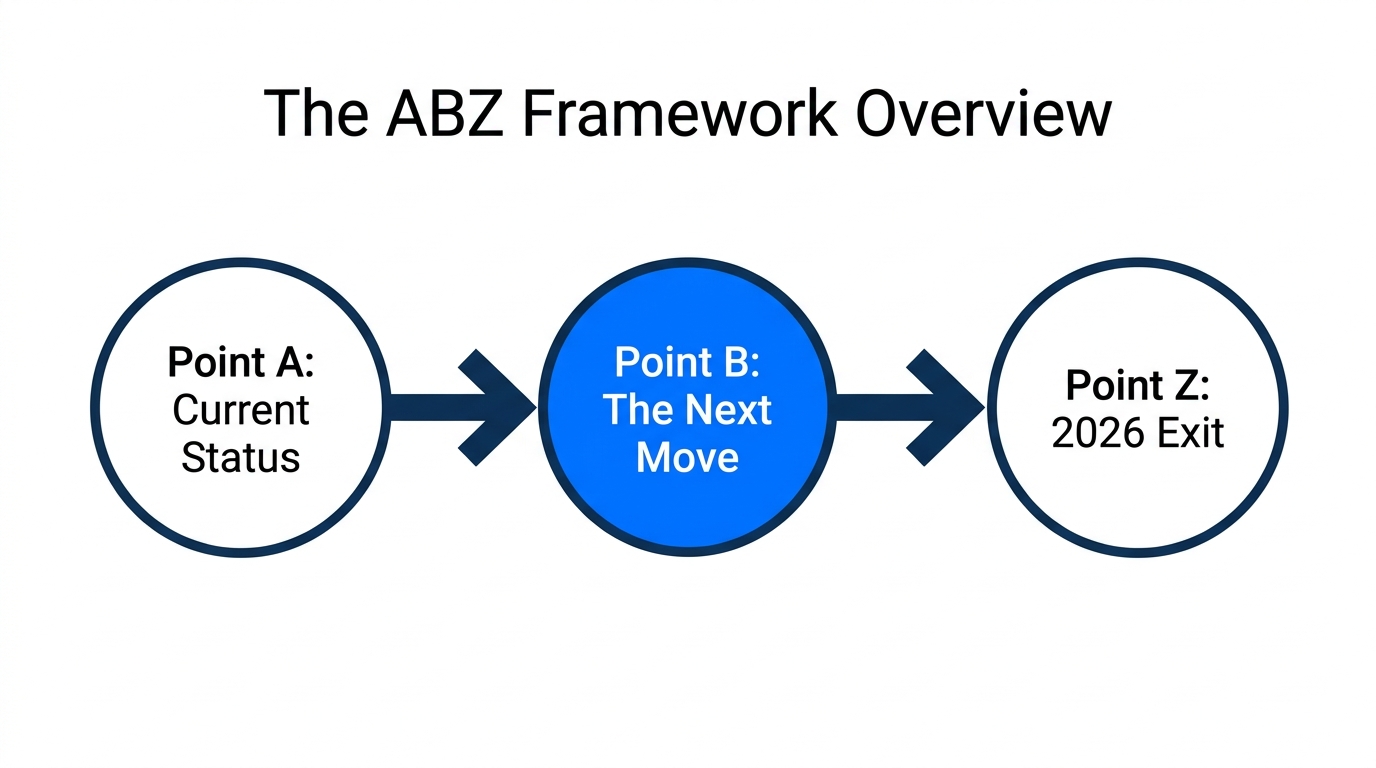
Most business growth frameworks 2026 fail because they treat the journey as a linear 26-step process. In reality, the middle steps are constantly shifting. If you try to plan step 'M' while you are still at step 'A', you are wasting cognitive load on variables you cannot yet control. The ABZ framework simplifies this into three distinct pillars:
- A: Where you are right now. Your current revenue, subscriber count, and resources.
- Z: Your ultimate exit or vision. This is the $20 million liquid number or the dream of living off a 3% perpetual motion machine. It is the fuel, but it is not the daily map.
- B: The immediate next milestone. If you have 1,000 subscribers, step B isn't a million; it's 10,000. It is the only thing that deserves your focus today.
As mentalist and performance expert Oz Pearlman notes, achieving mastery in any field requires a level of relentless drive and the ability to overcome failure consistently. Just as a mentalist reverse engineers a trick from the 'reveal' back to the 'setup', a founder must work backward from the exit price to the daily task. When you focus only on step B, you enter what is known as execution mode.
"Z is for inspiration; B is for action. If you worry about C through Y before you hit B, you're just creating noise that leads to failure."
Reverse Engineering Revenue Targets: From Your 2026 Exit Price Back to Monthly Goals
 30:00
30:00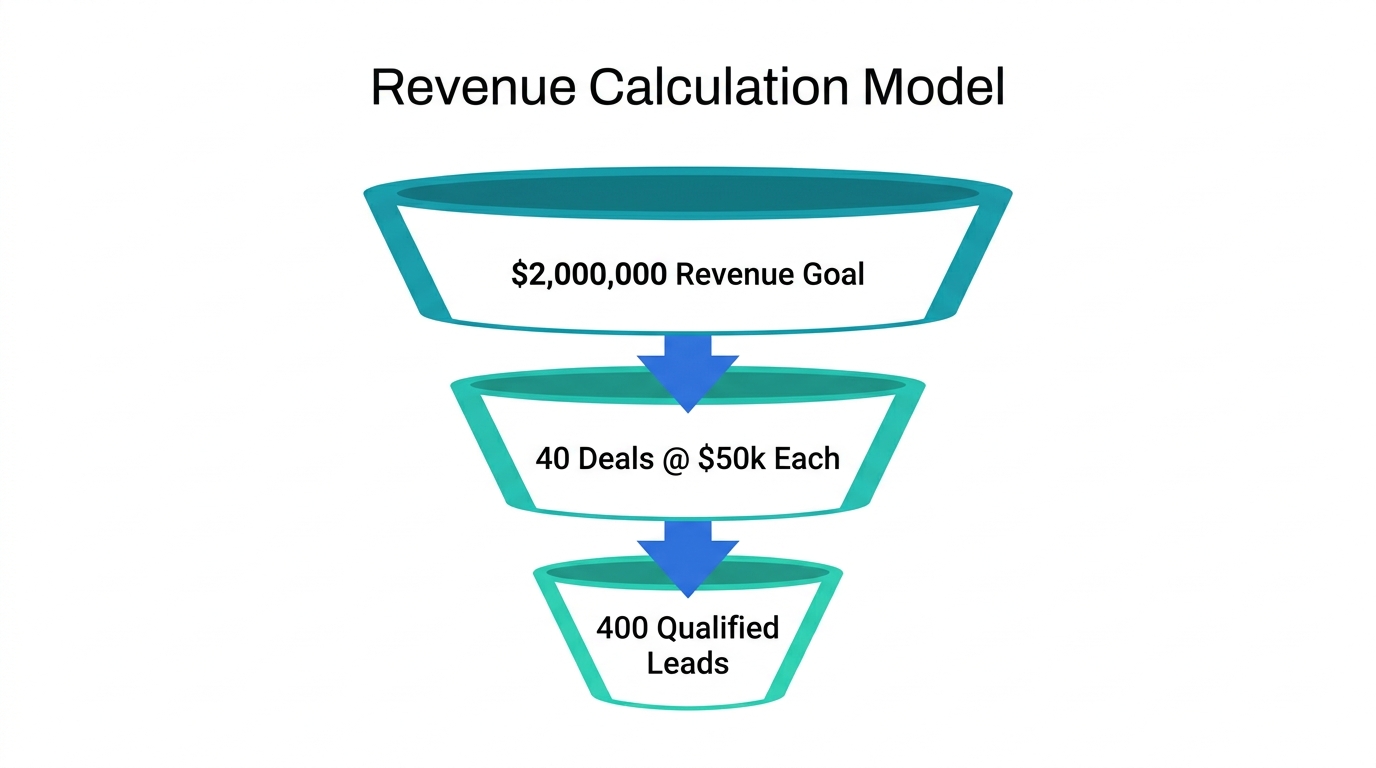
To successfully scale, you must move beyond vague dreams and into hard math. In 2026, a startup GTM strategy should begin with the end price. Let’s look at the math for a media or newsletter business aiming for a significant liquidity event. If your 'Z' is a $30 million to $40 million exit, you need to understand what that looks like in terms of annual recurring revenue (ARR) and EBITDA.
For a media company to sell for $40 million, it typically needs to generate roughly $18 million in revenue with healthy margins. Using the ABZ framework, you don't just wake up and 'try' to hit $18 million. You break it down into monthly subscriber and advertising targets. If your goal is to hit that number by year four, you must map out your exit velocity year by year.
| Year | Phase | Revenue Target (Estimated) | Key Milestone (Step B) |
|---|---|---|---|
| Year 1 | Foundational | $500k | 10,000 Subscribers |
| Year 2 | Scaling | $3M | Primary Sponsor Retention |
| Year 3 | Optimization | $8M | Product Ecosystem Launch |
| Year 4 | Exit Ready | $18M+ | Strategic Acquisition Fit |
When you use tools like Beehiiv for newsletter growth or Stripe to manage your recurring billing, you can track these metrics in real-time. The goal of reverse engineering business goals is to make your daily success binary: Did I hit the growth target for Step B this month? If yes, move to C. If no, stay at B.
The 'Safety Withdrawal Rate' for Founders: Calculating Your Personal 'Freedom Number'
29:00Why are you building this business? For many founders in 2026, the answer is the Safety Withdrawal Rate (SWR). This is a financial principle that dictates how much you can withdraw from a liquid pot of money annually without ever depleting the principal. It is the ultimate 'perpetual motion machine' for personal wealth.
If your lifestyle costs $50,000 per month to maintain ($600,000 per year), and you follow a 3% safety withdrawal rate, you need a liquid pot of $20 million. This $20 million is your 'Z'. Knowing this Safety Withdrawal Rate (SWR) number changes how you make business decisions. It stops being about 'more zeros' and starts being about 'exit velocity'.
When you realize that your 'freedom number' is $20 million, you stop chasing low-leverage side hustles and start focusing on a startup GTM strategy that can actually deliver a 30x multiple. You might use TikTok Ads Manager to drive traffic or Lemlist for B2B outreach to hit those enterprise-level contracts that move you closer to the Z faster.
"Wealth isn't about the zeros in the bank; it's about the safety withdrawal rate that allows you to never have to work another day in your life."
Execution Mode: Why Ignoring Steps C Through Y is the Key to Achieving Exponential Growth
One of the most profound lessons from ultra-marathoners—who run races like the 153-mile Spartathlon—is the 'next mile' mentality. When you are at mile 54 and you realize you have 99 miles to go, your spirit can crumble. The weight of the remaining distance is too heavy for the human brain to process effectively. This is why how to scale a newsletter business or a tech startup requires cognitive dissociation.
You must become 'The Machine'. This is an alter ego that ignores the pain of the current mile and the distance of the finish line, focusing only on the next 20 minutes—or in business, the next Step B. If your Step B is hitting 10,000 subscribers, you should not be worrying about your Series B pitch deck. You should be worrying about your influencer marketing distribution and your conversion rates.
In this phase, leveraging platforms like Stormy AI can be a game-changer. Instead of manually sourcing creators to grow your brand—which is a Step C or D distraction—you can use AI-powered search to find the perfect UGC creators in seconds. This allows you to stay in execution mode on your core product while the AI handles the distribution logistics.
The Psychology of Rejection and the 'Agent' Persona
9:05Scaling a business in 2026 requires an ABZ framework for founders that includes psychological shielding. To hit Step B, you will face constant rejection—from investors, potential partners, and customers. High-performers like Oz Pearlman use 'cognitive dissociation' to handle this. He views himself as his own agent.
When a project fails or a deal falls through, it isn't a rejection of the individual; it's a rejection of the 'product' or the 'act'. By separating your ego from the business execution, you can maintain the relentless drive needed to iterate Step B until it works. This is the difference between those who 'want' to be rich and those who achieve exponential growth.
- Mastery: Treat your business as a craft, like magic or mentalism. Iterate on the delivery until the 'wow' is universal.
- B2B Over B2C: As your business matures, shifting toward enterprise clients (B2B) often provides a higher ROI and less 'consumer drama'. It is easier to get one $1M check than a million $1 checks.
- Multiple Outs: Always have different ways for a 'trick' or a business deal to end successfully. If one distribution channel fails, have the next one ready to go.
Applying the Ultra-Marathoner 'Next Mile' Mentality to Scaling
30:30Whether you are running 153 miles in Greece or scaling a SaaS to an eight-figure exit, the principle is the same: Don't extend beyond the next mile. If you can survive the next 20 minutes, you can survive the next hour. If you can hit your targets for this month, you are one step closer to your Z.
For founders in 2026, the ABZ framework is the ultimate tool for reverse engineering business goals. It provides the clarity of the long-term vision with the fierce urgency of the immediate next step. By using AI tools to automate the 'Step B' tasks—like using Stormy AI for creator discovery and outreach—you free up your mental bandwidth to maintain 'Machine' mode.
Conclusion: Your 2026 Playbook for Exit Velocity
Reverse engineering your business exit isn't just about math; it's about discipline. The ABZ framework forces you to acknowledge your Safety Withdrawal Rate and the reality of your current 'A' state. To reach your Z in 2026, you must embrace the startup GTM strategy of the ultra-marathoner: ignore the 100 miles ahead and focus on the next mile. Use AI-powered discovery to fuel your distribution, stay in your 'Machine' persona to avoid burnout, and never stop iterating on Step B. Your first million—and your twenty-millionth—is a result of the steps you take today, not the plans you make for next year.